You bought a house with a nutone 350 central vacuum system already mounted on the basement wall, and now you have no idea whether it’s a reliable built-in workhorse or a relic waiting to fail at the worst moment.
The dealer page swears it covers 3,000 square feet and brags about 396 air watts. Neither number means what you think it does. By the end of this guide, you’ll know exactly what’s inside this unit, whether it’s worth saving, and what to do the day the motor finally quits.
NuTone 350 Central Vacuum System
The NuTone 350 was a solid built-in vacuum for its era, honest about its entry-level rating and dependable in smaller homes. The company that made it exited the central vacuum business in 2023. Your real decision now is about parts availability, motor lifespan, and a clean exit plan.What the NuTone 350 Actually Is
Where the 350 Sits in the Old NuTone Lineup
The CV350 was the mid-size unit in a lineup that once ran from budget to premium, sitting below the CV450 and CV750 in both price and output. It shares bags, filters, and some parts with the CV352, CV353, and CV653. Knowing that matters the moment you search for a replacement part. Cross-compatibility expands your options and saves you a wasted return.
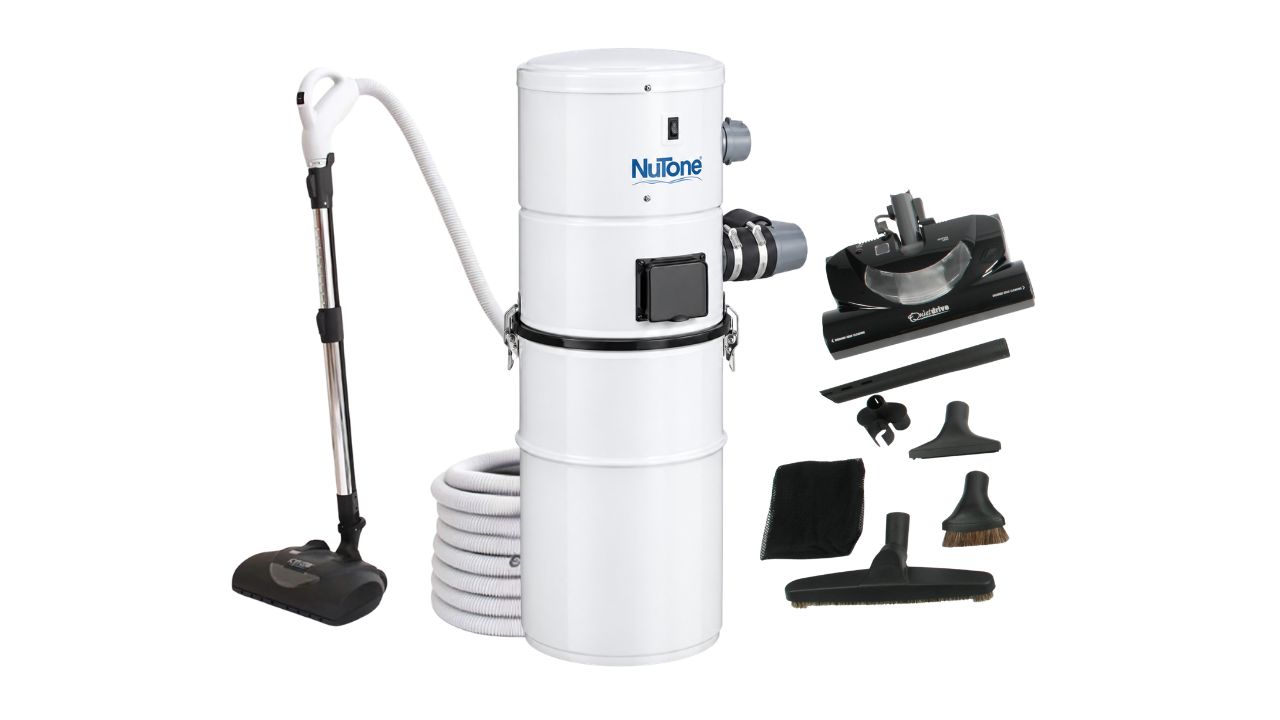
Find the model number near the electrical connection: CV350, CV-350, or just 350. The 12-inch diameter by 30-inch white steel canister is a reliable visual ID whether the label is present or long gone.
The Single Motor Doing All the Work
Inside the CV350 sits one two-stage tangential bypass motor, and that distinction matters more than the horsepower rating on the box. Two stages means two fan impellers stacked in series. Bypass means the motor breathes cooling air around the housing, not through the dirt stream, so fine dust never degrades the windings the way it does in a thru-flow design.
NuTone sourced this motor from Ametek Lamb, the OEM supplier behind most major North American central vacuum brands. Forum rebuilders and vacuum technicians report these motors running well past 30 to 40 years with regular maintenance. That lifespan is the single best argument for repairing a CV350 rather than scrapping it.
Bagged, UL Listed, and Built for Dry Pickup Only
The CV350 uses a 6-gallon removable paper bag for primary filtration, backed by a secondary safety filter before the motor. Two adults on hardwood floors empty it every five or six months; a family with pets and carpet runs through it faster. The manual is blunt about wet pickup: don’t try it. The UL listing confirms the basic electrical and fire-safety standards are met.
The Spec Sheet, Read Honestly
What 396 Air Watts Really Tells You
Air watts are calculated from both airflow and suction combined, per the ASTM F558 air-watt measurement standard, and they’re the single most honest cleaning performance figure on a spec sheet. The CV350 is rated at 396 air watts on 107 CFM of airflow. Entry-level central vacuum units run from 350 to 500 air watts; premium whole-home systems start near 600. The CV350 sits at the lower end. Not a disqualifier for a smaller home, but worth naming plainly.
Why Water Lift and Air Watts Are Not the Same Fight
Think of water lift as grip strength and CFM as lung capacity. At maximum grip the motor has zero airflow; at maximum airflow there’s no grip left. They’re opposite ends of the same curve.
The CV350 is rated at 113 inches of water lift and 107 CFM. Parts sellers list both side by side as though they compound. They don’t. Real-world performance lands somewhere in the middle, at whatever airflow your pipe run and attachments allow.
The Square Footage Claim That Argues With Itself
One major retailer lists the CV350 as covering both 2,000 and 3,000 square feet on the same product page. Two numbers, zero explanation. Coverage estimates depend entirely on inlet placement, pipe run length, elbow count, and floor count. Cut any dealer coverage figure roughly in half before counting on it, and test the farthest inlet in your home before trusting the spec.
Why Some Owners Call It Anemic
The Performance Reputation, Straight From Enthusiasts
Vacuum hobbyists on VacuumLand describe the NuTone 350 consistently as decent but anemic. One user compared a CV350 to an older Beam unit, owned by Electrolux Group since its acquisition of the brand’s global central vacuum assets, with a similar motor spec and reported the Beam moved noticeably more air. Consistent sentiment across independent sources is worth naming, even without a lab result to back it.
The 350 was an honest entry-level unit. It was never competing with the high-output systems on the shelf beside it.
How Suction Fades the Farther You Get From the Unit
Every foot of PVC pipe reduces suction; every 90-degree elbow reduces it further. An inlet 40 feet from the power unit with three elbows in between won’t pull like one six feet away. Basic pipe-flow physics that no dealer mentions before you buy.
A first-floor room 20 feet from the utility room? The CV350 handles it well. A third-floor bedroom at the end of a 60-foot pipe run with two sweep elbows? Expect noticeably less. Know your layout before you blame the unit.
The Brand On Your Wall Is Gone
NuTone Quietly Left the Central Vacuum Business
NuTone, now operating as Broan-NuTone LLC after Nortek’s consolidation of the brand’s residential ventilation and vacuum lines, discontinued its entire central vacuum product line as of August 31, 2023. The company routes every central vacuum question to DrainVac and no longer makes, services, or warrants new central vacuum systems. That’s stated plainly on the Broan-NuTone website.
Who DrainVac Is and Why It Took Over
DrainVac International, a Quebec-based manufacturer building central vacuum systems since 1982, acquired the NuTone line in 2023. Enthusiasts read it as DrainVac adding a budget tier beneath its premium units. New stock ships under the Broan-NuTone by DrainVac label, with installer coverage strong across eastern Canada and the northeastern US.
What the Handoff Means for Your Parts Supply
DrainVac is now the official source for NuTone central vacuum parts, service, and warranty claims on eligible units. Independent retailers continue stocking bags, filters, and motors for the CV350. Cross-compatibility with the CV352 and CV653 expands the supply pool, and Ametek Lamb motors are stocked by multiple non-brand suppliers. Discontinued does not mean unsupported, at least for the next several years.
Repair or Replace Your Aging 350
The $250 Motor Question Every Owner Hits
One owner posted on a central vacuum forum about a NuTone 350 motor that finally gave out after roughly 50 years of service. The motor had run through multiple sets of carbon brushes, and each brush replacement bought another five to eight years. A genuine Ametek Lamb replacement motor for the CV350 runs over $250 retail; labor at an independent vacuum shop typically adds $80 to $150.
Retailers often push a full unit at this moment: the margin on a $500 system beats an hour of labor. Keep that in mind when the advice arrives without your asking.
Is the NuTone 350 Central Vacuum System Worth Keeping?
Repair wins when the canister is intact and the failure is the motor or brushes only. A $250 motor plus $100 in labor on solid pipe infrastructure buys many more years from a network already in your walls.
Replace when the motor failure arrives alongside a cracked canister, corroded pipe fittings, or a secondary filter housing warped from heat. Those are signs the motor ran hard in its final months.
New units in the 550 air watt range, which upgrading to the NuTone 550 covers in detail, start around $400 to $500 retail with a fresh warranty. That gap closes quickly once you add motor cost plus labor to the repair side.
The Two-Motor Trap That Ruins Repairs
The CV350 shipped with two different Ametek Lamb motors across its production run. Part numbers 115334 and 117465 are not interchangeable. They look nearly identical, and installing the wrong one causes immediate problems and voids any parts warranty.
Before ordering, pull the motor, photograph the data plate, and match the part number exactly. A knowledgeable vacuum retailer cross-references this in 30 seconds.
Can a New Unit Reuse My Old Pipe?
Your In-Wall PVC Almost Always Survives
Yes. The 2-inch Schedule 20 PVC in your walls is brand-neutral. A replacement power unit from DrainVac, CycloVac, OVO, or almost any North American central vacuum brand connects directly to the existing pipe. A 1975 installation in a 2,800-square-foot colonial feeds a brand-new power unit today with zero pipe modification. The inlets, fittings, and trunk lines all stayed. Only the canister was swapped.
Checking That the Old Low-Voltage Wiring Still Fires
Two thin low-voltage wires run from your inlet valves back to the power unit and close a circuit when you open an inlet. A continuity test with a multimeter confirms the loop in minutes. In most 20-plus-year-old installations this wiring is still fine. It carries almost no load and doesn’t corrode like line-voltage wiring.
Why a Shop Vac Is a Tempting but Bad Swap
A $60 shop vac on your in-wall pipe loses auto-start convenience and sealed exhaust routing in one move. You’re walking to the utility room to flip a switch every time you clean, and the dust it recirculates is precisely the problem built-in systems solve. The savings rarely survive daily reality.
Filtration and the Allergy Question
What the Paper Bag Does and Does Not Catch
The CV350’s paper bag handles primary filtration. The secondary motor filter protects the motor, not the air in your home. Together they keep debris out of the motor and larger particles out of the exhaust. Route exhaust outside through a wall vent and fine particles leave the living space entirely. That’s the real filtration advantage of any central vacuum over a portable.
Why HEPA-Style Is Not the Same as True HEPA
True HEPA, as defined by the US Department of Energy standard, captures 99.97% of particles at 0.3 microns. The CV350’s bag-plus-secondary-filter system was never certified against that standard, and no NuTone documentation claims otherwise. Some dealer listings use HEPA-adjacent language around it. Treat that skeptically.
Choose a unit with a certified true HEPA canister filter for any household with asthma or pet dander allergies. Routing exhaust outdoors is the minimum step worth taking if you keep the CV350.
What To Buy If You Replace It
The Direct Manufacturer Replacement Path
The NuTone PP5501, a 550 air watt unit now sold under the Broan-NuTone by DrainVac label, is the named successor to the CV350. It connects to your existing 2-inch PVC pipe, uses the same 391-series bags, and runs on the same 20-amp circuit. Minimum friction, maximum familiarity.
Where Better Value Lives Today
| Unit | Air Watts | Filtration | Warranty |
|---|---|---|---|
| NuTone CV350 (original) | 396 AW | Bag + secondary filter | Discontinued |
| NuTone PP5501 | 550 AW | Bag + secondary filter | 3-year limited |
| CycloVac E515 | 515 AW | Cyclonic, no bag | 5-year motor |
The gap between 396 and 550 air watts is real in a home with long pipe runs. Bagless cyclonic units like the CycloVac E515, from CycloVac, one of Quebec’s premium central vacuum manufacturers, eliminate bag costs and maintain consistent suction as the canister fills. Compare air watts per dollar, not horsepower marketing.
Matching Power to Your Actual Floor Plan
Size the replacement unit to your actual pipe-run demands, not the square footage headline on the box. A 2,400-square-foot two-story home with eight inlets and a 55-foot pipe run to the farthest bedroom needs more capacity than the coverage spec implies. Add 10 to 15% to whatever the manufacturer claims and land there. More elbows and longer runs demand more air watts at the far end. The farthest inlet in your home is the real test.
Conclusion
You came in wondering whether the NuTone 350 on your wall was worth keeping. It’s an honest entry-level unit from a brand that’s since left the business, and the pipe network it feeds is worth more than the canister.
Tonight, pull the unit, photograph the motor data plate, and match the part number before you need it. When you’re ready to think bigger, choosing the right whole-home vacuum maps the full market, and authorized local installation partners can put new hardware on your existing pipe faster than you’d expect. That pipe is the part worth keeping.
Frequently Asked Questions
Is the NuTone CV350 central vacuum still made?
No. NuTone discontinued its entire central vacuum line on August 31, 2023. DrainVac International acquired the line and now handles parts, service, and new products under the Broan-NuTone by DrainVac label.
What are the specs of the NuTone 350 central vacuum system?
The CV350 is rated at 396 air watts, 107 CFM, and 113 inches of water lift on a dedicated 20-amp circuit, with a 6-gallon canister and a UL listing. NuTone rated it to 3,000 square feet. Treat that figure skeptically until you’ve tested the farthest inlet in your own home.
What kind of motor is in the NuTone CV350?
A two-stage tangential bypass motor from Ametek Lamb. The bypass design keeps cooling air separate from the dirt path, which is why forum rebuilders report these motors running 30 to 50 years in well-maintained homes.
What bags does the NuTone CV350 use?
391-series paper bags. These also fit the CV352, CV353, and CV653, so supply is solid through independent vacuum retailers even after NuTone’s exit from the category.
Why is my NuTone CV350 losing suction?
Start with the bag: a full bag cuts suction fast. Check the secondary motor filter next, then inspect inlet gaskets for cracks. Worn carbon brushes are the final likely cause, and they’re cheap to replace before you consider a full motor swap.
How much does it cost to replace the motor in a NuTone CV350?
Expect to pay over $250 for a genuine Ametek Lamb replacement motor, plus $80 to $150 in labor at an independent vacuum shop. Confirm your exact motor part number, 115334 or 117465, before ordering. They look similar and they’re not interchangeable.
Should I repair my NuTone 350 or replace the whole power unit?
Repair it when the canister is intact and the issue is the motor or brushes alone. Replace the whole unit when the housing is cracked or multiple components are failing together. Your existing pipe connects to virtually any new central vacuum on the market. Replacement is less disruptive than most owners expect.