You’re done dragging an 18-pound upright up two flights of stairs. Central vacuum systems canada shoppers all hit the same wall: a dealer swears a bigger motor wattage number means stronger cleaning at the floor. It doesn’t.
That single number sends buyers home with the wrong unit. By the end, you’ll size a system by air watts and inlet placement, not sales talk, and you’ll know all the central vac brand names worth your money.
Keynote: Central Vacuum Systems Canada
A central vacuum system is a stationary power unit, piped through your walls, that pulls dust to a canister in the garage and vents the exhaust outside. The cleaning number isn’t motor wattage. It’s air watts, measured at the hose. Match it to your square footage and longest pipe run.
Why your portable vacuum keeps losing this fight
Your portable loses a fight it can’t win: a small motor you carry, a bag that chokes airflow as it fills, and stairs. A central system parks the motor once and never makes you lift it again.
Take a family in a 2,800-square-foot Calgary two-storey with two golden retrievers. Mom hauls the upright up to the bedrooms, down to the rec room, back up for the stairs. Three trips, one sore shoulder. The vacuum works. The routine doesn’t.
That dragging-it-upstairs dread you know too well
The dread is mechanical, not in your head. A corded portable ties you to one outlet and one staircase at a time. A central system ends that: you leave the motor in the basement and carry only a lightweight hose.
You know the cord-and-stairs tango: the plug pops out at the doorway, you reset it, climb again, and the cord snags the banister every trip. Now carry 18 pounds to the third floor. Your shoulder remembers.
Why central vacuum systems canada searches spike every winter
Demand climbs every winter because sealed Canadian homes trap pet dander and dust for months, so people vacuum more to fight it. Roughly two-thirds of Canadian households own a pet, which piles on the dander load.
Close the windows in November and your house turns into a sealed box until April. A portable blows fine particles right back into the room through its own exhaust. A central unit vents that exhaust outside or to a far utility room, so the dust you pick up actually leaves. Exhaust routing, not raw suction, drives those winter searches.
So why do some buyers spend big and still feel weak suction?
The suction-loss story portable owners never see coming
A new central system sometimes feels weaker than an old upright, and that scares buyers off. The cause is almost always a bad install, not the unit: too many sharp elbows, undersized pipe, or a clogged filter starving airflow.
“My builder’s central vac felt weaker than the $200 upright it replaced.”
You’ll find that complaint everywhere, and the cause is usually the same. The builder spec’d the cheapest unit, ran the pipe with nine tight 90-degree elbows instead of long sweep turns, and nobody changed the filter for six years.
Each sharp elbow and every extra 10 feet of pipe shaves airflow. The motor was fine. The plumbing strangled it. Pick the right air watts and routing, and that story never happens to you.
The one spec dealers skip: air watts
Air watts measure the actual cleaning power at the end of your hose, blending airflow and suction into one number. Dealers quote motor wattage instead because the figure looks bigger and means almost nothing at the floor.
How air watts actually get calculated
Air watts combine airflow (CFM) and suction (water lift) into a single figure. The formula is simple: CFM times water lift, divided by 8.5. ASTM recognizes air watts as the standard measure of vacuum cleaning power.
Suction alone is how hard the vacuum pulls. Airflow is how much air it moves. Air watts are a measure of sealed cleaning power that blends both, calculated at the hose end under load. High suction with no airflow barely lifts dirt off a bare floor. High airflow with weak suction barely lifts embedded dander from carpet.
Why 600 air watts beats your Dyson’s 230
A 600-air-watt central unit roughly triples the cleaning power of a premium cordless that peaks near 230 air watts. You need that headroom, because a central system pushes air through 40 to 90 feet of pipe before it reaches the floor.
“My 600-air-watt inlet still out-pulls the cordless I keep for quick jobs.”
A cordless dumps all its power right at the head, inches from the battery. A central unit gives up some along the run. Start at 600 and you spend 100 air watts on distance and still beat the cordless at the farthest inlet. Start at 230 and there’s nothing to spare.
Central vacuum vs cordless Dyson? The cordless wins grab-and-go. The central wins everything that touches carpet.
Marketing wattage versus the number that cleans
Input wattage measures the electricity the motor draws from the wall, not the suction it delivers. Two 1,400-watt units produce wildly different air watts depending on motor design. Demand the air watt rating every time.
| Spec | What it measures | What it tells you at the floor |
|---|---|---|
| Input watts (1,400 W) | Electricity drawn from the outlet | Almost nothing about cleaning power |
| Air watts (600 AW) | Sealed airflow and suction at the hose | The real number that predicts performance |
| Amperage | Current the motor pulls | Useful only for wiring and the breaker |
A dealer who leads with motor wattage is selling you the electric bill, not the clean. Ask one question: what’s the air watt rating at the hose?
Single-fan or two-fan? Pick by your floors
Motor fan stages decide whether your system favors carpet or bare floors. More fan stages raise suction and trim airflow. Pick by what sits on your floors, not by the biggest number on the box.
What each fan stage trades away
Each added fan stage boosts water lift but cuts airflow. A single-stage motor moves more air for bare floors. A two- or three-stage motor builds the suction that deep carpet and air-driven powerheads need to spin and lift.
Fan stages are only half the story. Motor type is the half dealers bury. A thru-flow motor cools itself with the same dirty air it’s sucking, so heat and debris wear it down faster. A tangential bypass motor uses a separate cooling fan that stays cool even when airflow is restricted, which is why a well-built bypass unit runs 20-plus years.
Fan diameter matters too. Bypass motors range from 4.7 inches up to 8.4 inches. For a home over 3,000 square feet or one with pets, a 7.2-inch or larger bypass motor cleans the farthest inlet without bogging down. The Cana-Vac motor comparison guide breaks the diameters down model by model.
Water lift versus airflow for long pipe runs
Water lift is sealed suction with no air moving, measured in inches. Airflow is the volume of air the motor moves. For the longest basement-to-attic run, water lift keeps the system pulling when the pipe length fights back.
Try inhaling through a thin coffee stirrer, then through a garden hose. The stirrer is high water lift, low airflow. The hose is the opposite. Your central pipe is a 2-inch hose, so airflow moves the debris and water lift keeps it moving across 60 or 70 feet.
Match high airflow to bare floors and tile. Match high water lift to plush carpet and air-driven powerheads. A long run to a third-floor bedroom needs both.
Canadian-made brands and who really backs them
Most quality central vacuums sold in Canada come out of Quebec, but the ownership map changed hard in 2024. Know who actually builds and warranties your unit, because the badge on the canister may not match the company behind it. We rank these on hands-on installs, manufacturer documentation checked against ASTM measures, and CVAC-certified technician feedback, never on who pays for placement.
| Brand | Made in | Now owned by | Known for |
|---|---|---|---|
| Cyclovac | Quebec | Trovac Industries | Triple filtration, quiet HE units |
| Cana-Vac | Quebec | Trovac Industries | Reliable bypass motors, models by home size |
| DrainVac | Quebec, since 1982 | Independent | Self-cleaning, drain-to-sewer designs |
| DuoVac | Quebec (Laval) | Trovac Industries | Hybrid filtration, long warranties |
| Nilfisk | Denmark | Nilfisk Group | Global brand, commercial heritage |
Cyclovac, CanaVac, DrainVac: the Quebec trio
Cyclovac, Cana-Vac, and DrainVac all build their units in Quebec, so parts and service stay close wherever you live in Canada. DrainVac’s self-cleaning drain design suits heavy pet households that hate emptying canisters.
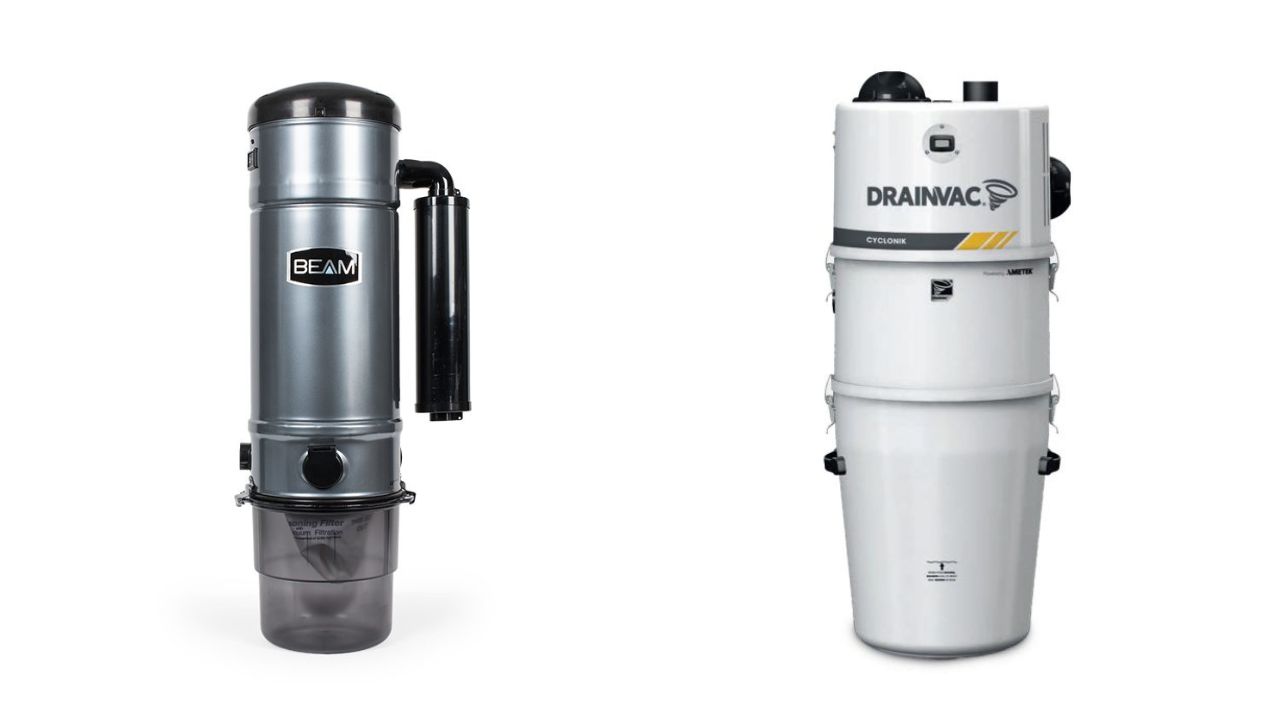
Here’s the 2024 shake-up. Nuera Air, the Laval company that owned Beam, DuoVac, Cana-Vac and Cyclovac, filed for bankruptcy in April 2024 and stopped production. Trovac Industries, another Quebec maker, took over those brands by mid-2024 and kept building them. Comparing older reviews? Check our Nuera Air central vacuum models reviewed breakdown so you know which legacy units still have parts support.
DrainVac has built central vacuums in Quebec since 1982 and stayed independent through all of it. It also picked up the Broan-NuTone vacuum line in 2023. Its drain-to-sewer Automatik units flush dirt and water straight to the sewer, a win for any three-dog household.
Where Nilfisk fits and where it doesn’t
Nilfisk is Danish, not Canadian-made, so service leans on local distributor support rather than a Quebec factory down the highway. Choose it when global engineering reputation matters more to you than next-day local parts.
Nilfisk, part of the Danish Nilfisk Group, carries a strong commercial pedigree. But a power unit shipped from a European supply chain leaves you waiting longer for a warranty motor than a Quebec brand serviced locally. Confirm Canadian warranty and parts support in writing first.
Want a homegrown alternative at a friendlier price? Johnny Vac, a Canadian-distributed brand, offers central units that pair well with a proper bypass motor. We put the lineup through its paces in our Johnny Vac central vacuum models reviewed guide.
The reliability data dealers won’t print
A quality central power unit runs 20 to 30 years with basic filter and bag upkeep. Dealers rarely print that, because long life means fewer replacement sales. The catch is build quality: serviceable, well-cooled motors last, and cheap throwaway units don’t. Take DrainVac’s Broan-NuTone line. The BQ650 and PP6501 deliver 650 air watts with sealed HEPA filtration, build entirely in Canada, run a 6-US-gallon pail with a disposable bag you swap about every six months, and carry warranties up to eight years. Read the full Broan-NuTone central vacuum specifications straight from the maker.
The rule is simple. A motor you can pull and replace, in a unit with a real cooling fan, outlives a sealed budget power head every time. Costco-style units advertise big air watt numbers on a tiny motor that quits in a few years. Buy the motor, not the sticker.
Bagged, bagless, or true HEPA for allergies
For an allergy household, filtration type decides how much fine dust escapes back into your air. A true HEPA filter or a bagged unit vented outside protects you. A bagless cyclonic unit cuts running cost but needs a quality final filter.
| Type | Filtration | Upkeep | Running cost |
|---|---|---|---|
| Bagged | Highest, traps fines in the bag | Swap bag about every 6 months | Bag cost yearly |
| Bagless (cyclonic) | Good, depends on the final filter | Empty canister, rinse filter | Lowest, no bags |
| Hybrid | Use with or without a bag | Your choice | Flexible |
“HEPA-style” bags versus a real HEPA filter
“HEPA-style” is a marketing phrase with no certified rating behind it. A true HEPA filter captures 99.97% of particles down to 0.3 microns. For asthma or allergies, demand the real HEPA spec, not the lookalike label.
You read the box twice because someone at home has asthma. Smart. The word you’re hunting is the number: a certified HEPA filter captures 99.97 percent of particles at 0.3 microns. HEPA-style means the maker copied the look and skipped the test. For an allergy home, only the certified rating counts.
Why venting exhaust outside changes allergy season
A central system vents up to 100% of its exhaust outdoors or to a remote utility room, so the fine dust it captures leaves your living space for good. A portable recirculates that same air through the room you’re standing in.
One reader in a 1990s Ontario bungalow ran an old upright for years and sneezed through every cleaning. The exhaust pushed fine dust back at face height. She switched to a central unit vented through the foundation wall, and the after-vacuum sneezing just stopped. The dust had nowhere to go but outside.
The bagless suction myth, actually tested
Bagless doesn’t mean weaker suction over time. A cyclonic unit spins debris out of the airstream before it reaches the motor or filter, so airflow holds steady as the bin fills. Bagless also drops your ongoing bag cost to zero.
Cyclonic separation works like the spin cycle on your washer. The dirty air whips in a tight circle, centrifugal force flings the heavy debris to the canister wall, and clean air heads to the motor. The filter barely loads up, so suction holds. The trade is a final filter you rinse instead of a bag you buy.
Where your inlets go decides everything
Inlet placement decides whether one hose reaches every corner of your home. Get it wrong and a 30-foot hose still leaves a dead zone. Plan inlets by square footage per floor before any drywall closes, because you can’t move them after.
Mapping inlets by square footage per floor
Plan one inlet for roughly every 600 to 800 square feet of livable space per floor, then check that a 30-foot hose plus your reach covers every room from each valve. Count by floor, not by total home size.
A reader in a new build let the installer place one main-floor inlet near the front door. Tidy on paper. In practice, the hose died three feet short of the back bedroom, so that room got the broom for a year. Moving an inlet after drywall costs a wall repair.
How many inlets for a 2,500-square-foot home? Three to four, placed so no room sits beyond a 30-foot hose pull.
Why 2-inch PVC and fire code matter
Canadian central vacuum systems run on 2-inch Schedule 40 PVC, the standard tubing nationwide. Code has a say too: the Canadian Electrical Code requires a dedicated receptacle for a cord-connected power unit.
Most guides quote US wiring rules. You’re in Canada, so the Canadian Electrical Code (CSA C22.1) is the one that matters. It calls for at least one receptacle for each cord-connected central vacuum where the full duct system is installed. Tell your electrician before the unit goes in.
The pipe itself is 2-inch Schedule 40 PVC almost everywhere in Canada. Use long sweep elbows instead of tight 90-degree turns, because the gentle curve costs less airflow at every bend. And check your local fire code, since some jurisdictions require metal tubing through certain firebreaks.
Retrofit reality in an older Canadian home
An inherited or aged system is worth keeping, but only if the in-wall piping is sound. Old PVC joints crack and leak, and a hidden leak quietly bleeds your suction. Test the pipe before you trust it, then swap only the power unit if the runs check out.
“The pipes looked fine at the inlets. The leak was buried in the wall, killing half my suction.”
Good news for anyone who bought a house with a dusty unit in the utility room: the pipe network is the expensive part, and a new power unit bolts right onto standard 2-inch tubing. Modern fittings mate with Beam, Cana-Vac, DrainVac, Cyclovac and most North American systems.
The exceptions bite, though. Some older Vacuflo models used a proprietary low-voltage connection, and early Sears and Kenmore central vacs used a non-standard bore that needs an adapter for a modern hose. Test the existing runs for leaks first. A cracked joint behind drywall steals 30 to 40 percent of your suction without a single visible clue.
Is it even worth it? The honest math
For most homes over about 1,500 square feet, yes, a central vacuum pays off in convenience and cleaner air across two to three decades. For a small single-floor condo or a rental, no, the install cost rarely makes sense.
| Central vacuum | Premium portable | |
|---|---|---|
| Upfront cost | Higher (unit plus install) | Lower |
| Lifespan | 20 to 30 years | 5 to 8 years |
| Suction at the floor | Strong, vented outside | Drops as the bin fills, recirculates |
| Convenience | No lugging, light hose | Carry it everywhere |
The Reddit complaint that scares every buyer
The scary post is real: an owner claims their system had a quarter the suction of a cheap upright. The cause is never the concept. It’s a bad install or a neglected filter, and right-sized air watts prevent it.
“Paid thousands for the built-in, and it pulls about a quarter of my $200 upright.”
That post should make buyers careful, not scare them off. Dig into those threads and the same culprits show up: a builder-grade motor, a pipe run with too many tight elbows, and a filter nobody touched in five years. Size the air watts, run sweep elbows, change the filter, and that complaint never gets written.
What 20 to 30 years really costs you
Spread across 20 to 30 years, a central system costs surprisingly little per year. The upfront quote stings, but the math flips in your favor. Say the install runs a few thousand dollars. Stretch that over 25 years and the hardware costs less per year than a mid-range upright you’d replace three or four times in the same span. Add a bag every six months, the occasional powerhead brush, and a few minutes emptying the canister. That’s the whole running cost.
When a portable vacuum genuinely wins
A portable wins in a small condo, a rental, or a single-floor apartment where you can’t run pipe and won’t recoup the install. No shame in skipping the central system when the space doesn’t justify it.
A reader in a 650-square-foot Vancouver condo asked us whether to install one. Short answer: no. One floor, no wall cavities for pipe, a landlord who’d say no anyway. A good cordless and a HEPA portable covered the whole place in ten minutes. Central vacuum is the wrong tool for that home, and we’ll always tell you so.
Your buying framework before you spend a dollar
Match air watts to your real square footage and longest pipe run, confirm the motor type and warranty, then pick a brand with local service. Do that and you’ll out-shop any dealer’s wattage pitch.
Match air watts to your real square footage
Size air watts to livable square footage and your longest pipe run, then oversize a notch for multi-level coverage. Small homes do fine near 400 to 500 air watts, mid-size homes want 500 to 600, and large homes need 600-plus on a 7.2-inch or larger bypass motor.
| Home size | Air watt target | Motor note |
|---|---|---|
| Up to 1,800 sq ft | 400 to 500 AW | Single or two-stage fine |
| 1,800 to 3,000 sq ft | 500 to 600 AW | Two-stage bypass |
| 3,000 sq ft and up, or pets | 600 AW and up | 7.2-inch or larger bypass |
Best central vacuum for a large home in Canada? A 600-plus air watt unit on a high-stage bypass motor, sized to the farthest inlet.
Oversize a notch when your home has three floors or a long basement-to-attic run. You spend a little suction on distance, so buy the headroom up front. A bigger motor costs less than re-piping a house.
Questions every dealer should answer first
A good dealer answers four questions without flinching: the air watt rating at the hose, the motor type and fan diameter, the warranty length, and where you’ll get local parts. A dealer who pushes wattage over air watts just told you to walk.
Ask every dealer these, in order:
- What’s the air watt rating measured at the hose?
- Is the motor thru-flow or tangential bypass, and what’s the fan diameter?
- How long is the warranty, and what does it cover?
- Where’s the nearest service depot, and are parts stocked in Canada?
“Ask for air watts at the hose. Answer with motor wattage instead, and you’ve found a salesperson, not a specialist.”
Warranty terms, local service, and parts availability separate a brand that’ll back you in year twelve from one that ghosts you. A dealer who keeps steering you toward motor wattage just earned a polite goodbye.
Conclusion
You came in trusting a big motor wattage number on a dealer’s spec sheet. You’re leaving knowing the number that cleans is air watts at the hose, and that where your inlets sit matters as much as the motor.
Tonight, measure your livable square footage per floor and write down your longest basement-to-attic run. Take those two numbers shopping. Then check who actually builds each brand now with our central vacuum brand lookup tool. Here’s the honest reason this beats every upright you’ve owned: the dust leaves your living space for good, and one well-built unit outlasts the next two portables you’d have bought.
Frequently Asked Questions
What is a central vacuum system and how does it work?
A central vacuum system is a stationary power unit piped through your walls that pulls dust to a canister and vents exhaust outside. You plug a hose into wall inlets, and the suction travels through hidden 2-inch PVC to the motor in your garage or basement.
Are central vacuum systems worth it in Canada?
Yes, for most homes over about 1,500 square feet. The cleaner air and no-lugging convenience pay off across 20 to 30 years, especially in sealed winter homes with pets. Skip it for a small condo or rental.
What is the difference between air watts and water lift in a central vacuum?
Water lift is sealed suction with no air moving, while air watts blend that suction with airflow into one cleaning number. Air watts predict floor performance. Water lift alone tells you only half the story.
Thru-flow vs tangential bypass: which motor lasts longer?
Tangential bypass, by a wide margin. Its separate cooling fan keeps the motor cool under restriction, so a well-built bypass unit runs 20-plus years. Thru-flow motors cool with dirty air and wear out faster.
Who makes Beam, DuoVac and NuTone central vacuums now?
Trovac Industries makes Beam and DuoVac after Nuera Air’s 2024 bankruptcy. DrainVac makes NuTone, having bought the Broan-NuTone vacuum line in 2023. All three still build in Quebec.