You’re staring at a wall of names like Beam, DrainVac, VacuFlo, CycloVac, and NuTone, and every one promises the same powerful, quiet, allergy-friendly clean. Here’s the part nobody on the shelf tells you: most of those names roll out of the same two or three factories, so the badge says almost nothing about who actually engineered and built your unit.
By the time you finish here, you’ll know who makes what, which 2024 buyouts quietly reshaped the entire market, and how to shop the manufacturer behind the badge instead of the marketing.
Central Vacuum Brands
The brand name on a central vacuum rarely matches the company that engineers and builds it. Two Canadian manufacturers and a small handful of U.S. factories produce nearly every unit on the market. Shopping the maker behind the badge is the only move that protects your investment long term.The brand name rarely tells you who built it
The badge on a power unit is almost never the name of the factory that made it. One manufacturer supplies units to three or four competing brands at once, and the buyer never sees that connection on the product page.
Why one factory sells under five different names
One factory supplies multiple competing brands at once, so you can pay a premium price for a badge that covers identical hardware underneath. Private labeling is the practice of selling manufactured units under different brand names, at different price points, without changing the core components.
A Quebec manufacturer like DrainVac International (the company that acquired the Broan-NuTone central vacuum product line in 2023) supplies units wearing the Broan, NuTone, and PurVac names, all built around the same motor and dirt-separation design. The spec sheet exposes this faster than any dealer conversation.
Two products sharing the same motor wattage, dirt bin volume, and airflow rating are almost certainly rolling off the same factory floor in different packaging. Price gaps between private-label siblings exist because dealers and distributors set their own margins, not because the manufacturer built anything different.
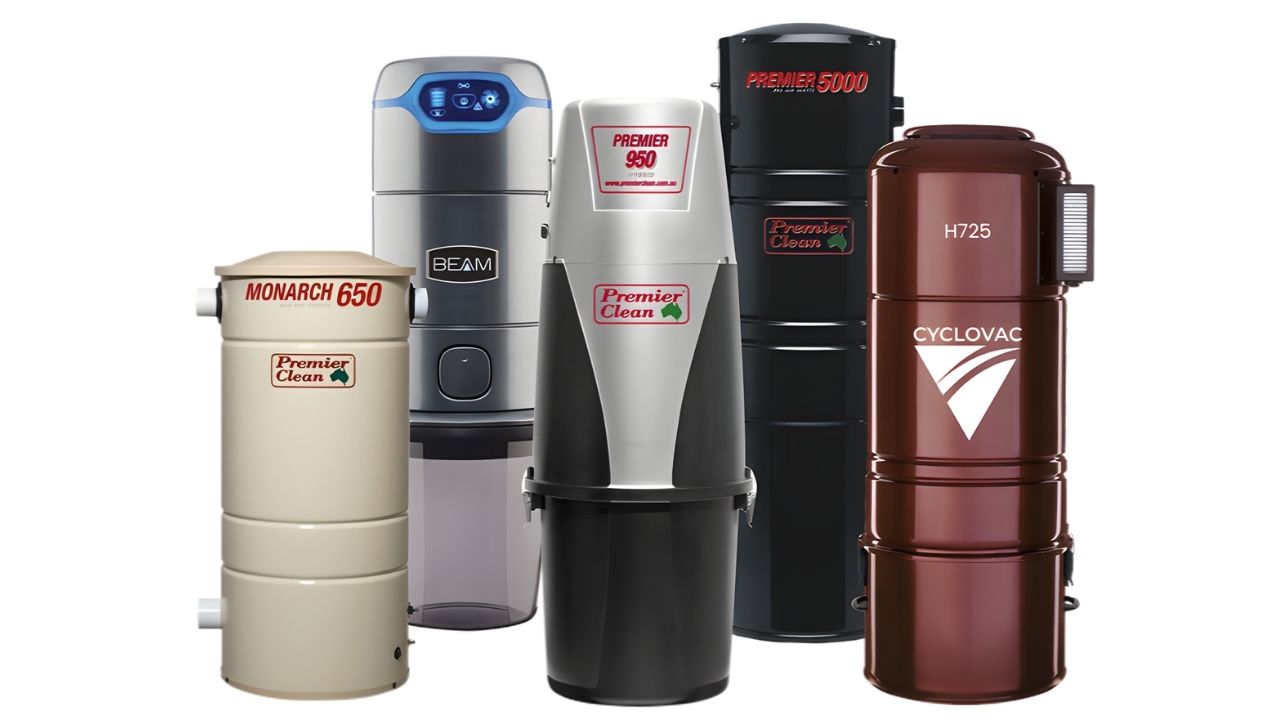
The 2024 Trovac acquisition made private labeling even more prevalent across North American central vacuum. Trovac now badges the same core production across more than a dozen names, and the engineering decisions flow from one team. When you sit across from a dealer who presents Beam and DuoVac as separate choices, ask for each unit’s air watt rating, motor stage count, and dirt bin volume side by side. Numbers that match mean hardware that matches. Your buying decision should go to whichever badge comes with the better local dealer, not the one with the nicer box art.
What private label actually means for your warranty
Warranty service routes to the real manufacturer, not the name printed on the lid. That distinction matters most when the badge company exits the category or sells its product line to someone else. When DrainVac acquired the Broan-NuTone central vacuum line in 2023, DrainVac took on the warranty obligations for those units. Read the warranty card before you buy, because it names the legal entity obligated to repair or replace your unit. A five-year promise from a brand with no factory of its own is only as strong as whoever actually honors the claim.
For a full look at what the 2023 acquisition means for current Broan owners, read our Broan central vacuum breakdown.
Honeywell is a licensed trademark attached to central vacuum units, not a manufacturer. A third-party maker pays for the name and handles production. For a closer look at which company actually builds those units and what that means for warranty, see the full Honeywell central vac overview.
How do you find the real maker behind central vacuum brands?
Three quick checks expose the actual manufacturer behind any central vacuum badge.
- First, read the warranty card: it names the legal entity obligated to honor the claim, and that entity is the real maker.
- Second, search the power unit’s model number prefix across multiple brand sites, because private-label siblings share prefixes even when the name on the lid differs.
- Third, run the model number through a parts distributor like MD Direct or Universal Vacuum Parts and check which manufacturer’s components appear in the results.
The name attached to those parts is who built your unit.
Use our searchable central vacuum brand directory to map every active badge to its parent manufacturer and skip the research entirely.
The two Canadian giants that build most systems
Two Quebec-based manufacturers now control more brand names in the central vacuum category than any other companies in the world. Together, Trovac Industries and DrainVac International hold the majority of North American market output.
Trovac now owns Beam, Husky, DuoVac, and more
Trovac Industries now owns Beam, Husky, DuoVac, SoluVac, Smart, InterVac, Mvac, SuperVac, Rhino Vac, Hayden, CycloVac, and Cana-Vac under a single corporate roof. The Trois-Rivières, Quebec manufacturer became the dominant force in North American central vacuum when it absorbed the entire Nuera Air brand portfolio in June 2024. Trovac already owned CycloVac and Cana-Vac before the buyout closed, which means Trovac Industries, the parent company of Beam and CycloVac now operates well over a dozen active brand names from a single Quebec production base.
Read Cyclo Vac central vac lineup and features for a look at the performance specs and filtration design of the CycloVac line that Trovac held before the 2024 deal expanded the portfolio.
See how the Canada line holds up for real-world performance data on the Canadian-manufactured units now under the Trovac umbrella.
DrainVac quietly absorbed Broan and NuTone in 2023
DrainVac International (a Quebec-based manufacturer specializing in wet-dry and drain-capable power units) acquired the Broan-NuTone central vacuum line in 2023. Broan-NuTone discontinued its entire central vacuum lineup, including the Venmar brand, effective August 31, 2023, and now refers all central vacuum inquiries directly to DrainVac. PurVac is a separate badge that DrainVac also controls. A buyer researching NuTone today for parts or warranty service needs to contact DrainVac, not Broan-NuTone, regardless of when the original unit was purchased.
What this consolidation costs you as a buyer
Fewer independent factories mean fewer genuinely different engineering choices. That’s the honest cost of consolidation. Buyers can still compare motor size, filtration type, and water lift between brands, but the design philosophy behind many of those brands now comes from the same engineering teams. Shared parts can work in your favor: a Beam motor that cross-references to a CycloVac specification widens your sourcing options for future repairs. What consolidation doesn’t deliver is price competition between brands that share a factory. Badge price gaps between Trovac-owned lines reflect dealer margins and marketing positioning, not hardware differences.
Use side-by-side central vacuum comparisons to verify whether spec differences between Trovac-badged or DrainVac-badged units actually justify any price gap before you commit.
What the 2024 Nuera Air collapse really meant
Nuera Air’s failure was the biggest single disruption to the North American central vacuum market in decades. The Montreal-based manufacturer stopped all production in April 2024, and the impact hit dealers, owners, and parts distributors almost simultaneously.
Why Beam and Husky nearly vanished overnight
Nuera Air ceased all manufacturing in April 2024 with no staged wind-down, which left distributors holding zero production pipeline and owners uncertain about parts and warranty coverage. Beam alone accounts for a significant share of installed central vacuum units across North America, so the supply gap hit dealers hard and fast. Husky, DuoVac, SoluVac, Smart, InterVac, Mvac, SuperVac, Rhino Vac, and Hayden all went dark at the same moment. Owners with units built before April 2024 faced real uncertainty about whether parts would stay available and who would honor a warranty from a manufacturer that no longer existed.
The answer took two months to arrive.
How Trovac stepped in and kept them alive
Trovac Industries acquired the entire Nuera Air brand portfolio by June 2024 and resumed manufacturing by September 2024. Units built from that date forward carry Trovac-backed warranties. The 2025 Beam lineup followed the production restart. Trovac’s existing infrastructure as the owner of CycloVac and Cana-Vac meant it absorbed the Beam production line without building new capacity from scratch, which shortened the gap between acquisition and restart considerably.
For detailed specs and warranty terms under the new ownership, read a closer look at Husky units.
What older Beam owners should check right now
Beam owners with units built before September 2024 need to confirm whether their warranty transferred under Trovac’s acquisition terms. Contact Trovac directly with your unit’s serial number and build date before you need a repair, not after. Stock the proprietary parts your unit requires, particularly the Beam-specific hose connection. That non-standard hose end is incompatible with standard 1.5-inch tools and requires an adapter, which has frustrated owners across multiple Beam generations. Solving the adapter situation before a service visit costs far less than scrambling for parts during one.
Check your filter condition while you’re at it. Pre-2024 Beam units with clogged or damaged filters run hotter, and sustained heat shortens motor life faster on units that may no longer be covered under the original manufacturer’s terms. A clean filter is cheap insurance when Trovac’s transition warranty coverage for legacy units isn’t fully settled.
The American brands still standing on their own
A small group of U.S. manufacturers builds central vacuum equipment domestically and has held that ground through two rounds of Canadian consolidation. These brands source their own motors, build their own cabinets, and honor their own warranties without relying on a parent holding company.
VacuFlo and HP Products, the true cyclonic veteran
VacuFlo is the oldest central vacuum brand still in active production today, built by H-P Products (the Canton, Ohio manufacturer that has produced residential central vacuums since 1955). H-P Products introduced the first True Cyclonic central vacuum that same year, meaning the unit spins debris centrifugally into a collection bucket with no filter or bag in the primary airstream. H-P Products, the Ohio manufacturer of Vacuflo also produces the Element, Vroom, Dirt Devil, and Chameleon lines from the same Ohio facility.
The limitation: True Cyclonic separation captures roughly 96 to 98 percent of debris by particle mass, so the finest sub-micron particles can still exit through the exhaust port. That matters depending on where your exhaust vents. The EPA guidance on indoor air quality explains why exhaust destination affects indoor particulate levels, and it’s worth reading before you choose a bagless cyclonic unit that vents into your utility room rather than outside.
Where VacuFlo earns its reputation is in raw suction consistency across long pipe runs. A family of four in a 3,200 square foot two-story colonial running a VacuFlo 560 reported consistent suction at the upstairs bedroom inlet, 58 feet of pipe from the basement power unit, across 11 years of daily use with no motor service. That kind of real-world durability reflects the durability advantage of keeping the airstream clean by design.
MD Manufacturing builds SilentMaster, ModernDay, and Flo-Master
MD Manufacturing (a California-based manufacturer that has built all-steel central vacuum units since 1961) produces the SilentMaster, ModernDay, and Flo-Master lines. SilentMaster spans 495 to 900 air watts across its lineup, where air watts are the ASTM-standardized measure of combined airflow and suction output.
The 900 air-watt SilentMaster sits at the top of what any dual-motor unit residential central vacuum produces. At that output level, a home with 6,000 square feet and eight inlets across three floors gets consistent suction at the farthest point without the cost of a dual-motor setup. MD pairs its steel housing designs with Ametek/Lamb motors, the motor brand that supplies central vacuum manufacturers globally, which means motor replacements source from widely available aftermarket stock.
The limitation: MD’s dealer network is thinner than Trovac’s national footprint, so service quality depends heavily on your region. A strong dealer in your city makes MD an excellent long-term choice; no dealer nearby makes it a risk.
Lindsay builds VacuMaid, the all-metal workhorse
Lindsay Manufacturing (an Oklahoma-based manufacturer) builds VacuMaid, AstroVac, and Valet from the same internal architecture. VacuMaid targets commercial-grade durability with all-metal construction and HEPA-grade filtration, meaning filtration rated to capture 99.97 percent of particles at 0.3 microns.
Lindsay units appear in clinics, hotels, and warehouses, which reflects their duty-cycle design rather than residential-only engineering. The limitation: AstroVac and Valet share the same internals as VacuMaid, so paying more for a different Lindsay badge buys a name change, not a hardware upgrade. All three are warranted by Lindsay Manufacturing and use cross-compatible Ametek motors.
Aerus and Centralux, the old Electrolux USA bloodline
Aerus (the renamed Electrolux Corporation USA, operating since 1924 and selling under the Aerus name following its separation from the international Electrolux brand) sells Centralux central vacuum units exclusively through its franchise dealer network across North America.
Centralux’s washable filter captures 99.97 percent of particles at 0.3 microns, which delivers HEPA-grade performance without the recurring cost of replacement bags. The franchise distribution model means your service experience depends entirely on your regional Aerus dealer. The limitation: Aerus dealers aren’t uniformly distributed across the country, and buyers in rural areas find service access significantly more limited than buyers near an Aerus franchise location.
How to read air watts before a brand does
Methodology note: Air watt ratings in this section draw from ASTM F558 test standards and manufacturer-published specifications. Rated figures represent controlled laboratory conditions that differ from installed performance in a typical home.
Every air watt number in a brochure is a best-case figure produced under lab conditions. Knowing how the number gets generated protects you from shopping a spec sheet instead of an actual vacuum system.
The air watt formula every dealer skips explaining
Air watts measure actual vacuum output power, not the electrical draw of the motor. The formula defined by ASTM F558 (the American Society for Testing and Materials standard governing central vacuum performance measurement) is: air watts equal CFM (cubic feet per minute of airflow) multiplied by water lift (the measure of sealed suction, expressed in inches of water) divided by 8.5. A motor pulling high raw wattage from the wall still produces weak air watts when its fan design sacrifices sealed suction for airflow. The wattage printed on the motor label describes electrical consumption, not cleaning performance.
Check independent central vacuum test ratings for third-party air watt figures that come from controlled testing rather than brand marketing copy.
Why the rated number drops once installed
The rated air watt figure on any spec sheet is tested with a clean filter, an empty dirt bin, and no pipe or hose attached to the unit. Real-world suction runs 15 to 30 percent below that figure once you add pipe, elbows, and a full run to the farthest inlet. Every 90-degree elbow costs you suction.
Long pipe runs in large homes compound that loss progressively. A unit rated at 700 air watts under lab conditions can deliver under 550 at the tool head in a home with a long upper-floor pipe run. Size your unit for the installed reality, not the specification on the product page.
Single stage versus two stage motors explained
A two-stage motor routes air through two fan assemblies in sequence, which generates higher water lift for long pipe runs without sacrificing too much airflow volume. A single-stage motor uses one fan assembly and suits smaller homes with shorter runs where the extra sealed suction of a two-stage design isn’t needed. More fan stages produce more sealed suction, not more raw airflow volume.
Homes over 3,000 square feet or with three or more floors benefit from two-stage motors because the added lift keeps suction consistent at distant inlets. Homes under 2,500 square feet with a single-story layout rarely justify the added cost of a two-stage unit.
Thru-flow vs. tangential bypass: the durability spec that matters most
Motor cooling architecture divides the central vacuum market more meaningfully than price tier does.
A thru-flow motor cools itself by routing vacuumed air directly through the motor chamber. Every particle the filter doesn’t capture — fine dust, pet dander, carbon debris — passes across the bearings and brushes. Wear accelerates in proportion to filtration quality. Thru-flow motors appear most often in entry and builder-grade units because they cost less to manufacture.
A tangential bypass motor draws clean room-temperature air through a dedicated cooling port entirely separate from the vacuumed airstream. Debris never enters the motor chamber. Operating temperature stays lower under sustained load, and bearing and brush wear accumulates at a fraction of the rate. Tangential bypass motors are standard across MD Manufacturing, DrainVac, and CycloVac mid and premium tiers.
The practical rule: a thru-flow motor paired with a sealed HEPA bag lives longer than one running bagless, because less fine particulate reaches the motor. But a tangential bypass motor outlasts any thru-flow motor by design — regardless of filtration type or bag condition. For a 20-year installation, tangential bypass is not a luxury spec. It’s what makes the 20-year timeline realistic rather than aspirational.
Bagged, bagless, or true cyclonic by brand
Filtration type is the single most consequential decision you’ll make when choosing a central vacuum brand. It determines maintenance cost, indoor air quality at emptying time, and long-term motor health across the full life of the system.
True cyclonic means no bag and no filter
True cyclonic means the unit spins debris centrifugally into a collection bucket with no filter media in the primary airstream. VacuFlo’s True Cyclonic design (introduced by H-P Products in 1955) is the benchmark for this approach. You empty a bucket instead of buying bags, and there’s no filter to wash or replace.
The tradeoff: cyclonic separation doesn’t capture the finest sub-micron particles the way a sealed HEPA bag does, so a true cyclonic system performs best when paired with an exterior exhaust that routes fine particles outside the home. Buyers attracted to the no-bag, no-filter promise need to confirm their home’s rough-in allows an exterior exhaust run before committing.
Bagged units that protect your lungs and motor
Sealed HEPA bags capture fine dust at the bag surface and contain it until you pull the bag out, which protects both motor life and air quality during disposal. The motor never sees the fine dust load that passes through a bagless system, which extends motor service life in dusty environments. Allergy and asthma households benefit most from this design because sealed bag disposal produces no dust cloud at emptying time. The ongoing cost of replacement bags is the trade, and it adds up meaningfully across a 20-year system life.
For research on a brand that no longer manufactures, see Dyson central vacuum models and specs. Dyson has exited the central vacuum category entirely and no longer manufactures or supports those models.
Where DrainVac wet/dry drainage fits the picture
DrainVac’s Automatik model drains liquid waste directly into a sewer line, making it the only mainstream central vacuum system designed to handle wet spills as a routine function rather than an accident. That capability requires a proper drain connection at the power unit location in a utility room or mechanical room with sewer access. The DrainVac Cyclonik takes a different path and targets pet-heavy homes with a bagless design built for heavy hair and debris loads. The limitation: the Automatik’s plumbing requirement adds installation cost and rules the model out for homes where the power unit location lacks drain access.
Discontinued brands and the repair or replace call
Some brand names that dominated the 1980s and 1990s no longer exist as active manufacturers. The repair-or-replace decision on those units depends on what actually failed, not on the badge attached to the canister.
Brands you will only find used now
Eureka, Filtex, Frigidaire, and Kenmore no longer manufacture central vacuum units. Galaxie, M&S, Dust Care, and Power Star have faded or exited the category in recent years. Parts for these brands still move through cross-compatible Ametek replacement motors and universal hose connectors in many cases, so discontinued doesn’t always mean unsupported.
Read how Eureka vacuums stack up for the Eureka central vacuum product history and the current parts situation for owners of those discontinued units.
See Kenmore built-in vacuum options explained for the Kenmore central vacuum lineup history and the service options available to current owners.
The motor is the most serviceable component on any discontinued brand’s unit, and Ametek’s wide cross-compatibility means a dead motor isn’t automatically a death sentence for the whole system.
When fixing the old unit still makes sense
Fixing the old unit makes sense when the canister is all-metal and the motor is the only failure. An Ametek motor replacement on a solid steel body extends system life by a decade or more at a fraction of full replacement cost.
The pipe inside your walls is almost certainly still serviceable: central vacuum pipe is Schedule 40 PVC (a standard-weight polyvinyl chloride pipe rated for the pressure differentials central vacuum systems generate) , and 20-year-old pipe in good condition doesn’t need replacing just because the power unit changes. The existing pipe, wall inlets, and low-voltage wiring represent the largest portion of any central vacuum installation’s cost. Replacing only the power unit preserves that investment entirely.
Read everything worth knowing about Miele for motor replacement economics on one of the highest-build-quality central vacuum units in the category, and use it as a reference when deciding whether an older all-steel unit is worth saving.
When a new power unit beats a repair
A cracked plastic body or a dead control board on a discontinued brand both point toward replacement, not repair. A cracked plastic housing can’t maintain a vacuum seal regardless of motor condition, and patching it adds cost without restoring performance. Control boards for discontinued brands are hard to come by. The good news: a new power unit mounts to your existing pipe, uses your existing wall inlets, and works with your current hose and attachment set. You’re replacing the motor and canister, not the entire system.
Read the Nilfisk range for whole-home cleaning for the Danish manufacturer’s all-steel lineup, purpose-built for power-unit replacement scenarios where the new unit needs to match an existing pipe layout.
What owners say after twenty years online
Long-term owner feedback on specialist forums like VacuumLand and in home improvement communities captures something spec sheets can’t: what a system actually feels like to maintain across decades of real use, and which brands live up to their claims once the warranty expires.
The brands owners praise after two decades
All-metal construction and a local dealer with parts in stock are the two factors long-term owners credit most consistently. Old Aerus and Broan units running past 17 years appear repeatedly in forum threads from owners who replaced nothing but the motor and the bag across that entire span. Consider a specific example: a 2,800 square foot two-story home in Ohio with a 1998 Broan power unit, original PVC pipe, and copper-clad inlets still delivering strong suction at all seven inlets after 22 years, with one Ametek motor replacement at year 14 and no inlet work whatsoever.
That’s the steel-body, local-dealer story played out in practice. Owners who bought from a dealer who still stocks their brand’s parts report better experiences consistently, compared to owners who bought on price from a big-box retailer and later found no local service option.
See the top-rated built-in vacuum picks for current brands and models with verified long-term durability ratings.
The complaints that show up again and again
Beam’s proprietary hose end connection draws the most consistent complaint across owner communities. The non-standard fitting requires an adapter for any third-party tool, and owners of pre-2024 units report that adapter availability has grown less predictable since the Trovac acquisition. Budget badges lose suction faster than owners expect, and the culprit is almost always a neglected filter that restricts airflow until the motor overheats. The 2024 Nuera Air collapse raised concerns about long-term parts access for pre-Trovac Beam units, and those concerns haven’t fully settled even with the 2025 production restart.
Is the most expensive brand actually the best?
Price buys a badge and a dealer network, not necessarily raw suction power. A mid-tier unit from MD Manufacturing or H-P Products backed by a strong local dealer outperforms a premium badge from a consolidated brand whose nearest service center is three hours away. Air watts are a useful comparison tool when you hold the filtration type constant: a 700 air-watt bagged unit and a 700 air-watt true cyclonic unit won’t deliver the same experience at the inlet even when the spec number matches on paper. Verified air watt output from a third-party test source and confirmed dealer access in your area are more reliable guides than any price tier.
Matching a brand to your actual home
Brand selection matters least when the unit can’t reach your farthest inlet with enough suction to clean effectively. Size and dealer access are the two constraints that should frame every brand conversation before price enters the picture.
Size the unit to square footage per floor
Match motor output and inlet count to your home’s square footage per floor, not the whole-home total. A 3,000 square foot home built across three floors puts the farthest inlet on a long pipe run from the power unit, and suction drops with every elbow and linear foot of pipe in between. A practical sizing guide: one inlet per 600 to 800 square feet of floor area per level, positioned so no cleaning path exceeds 30 feet from the inlet to the work area. Oversizing wastes money. Undersizing kills convenience on upper floors and overworks the motor on long runs.
Homes above 5,000 square feet with multiple floors are a different calculation. A single motor at 700 air watts, no matter the brand, loses too much suction across the pipe run to the farthest inlet in a home of that size. That’s where a dual-motor setup (two motors wired in parallel inside a single canister, which doubles airflow capacity and maintains water lift across a longer pipe network) earns its cost. MD Manufacturing’s SilentMaster and CycloVac’s top-tier models both support dual-motor configurations. Draw the inlet layout before you shop a brand, because motor output requirements follow from that layout.
Pick a brand with a real local dealer
A nearby dealer means faster service, installation advice from someone who has seen the job in person, and a direct parts channel when something fails years later. Online-only purchase deals save a few hundred dollars upfront and cost more in downtime and freight charges when you need a repair. Trovac, DrainVac, and MD Manufacturing all operate real dealer networks, but regional coverage varies. Confirm dealer presence in your area before committing to any brand.
See Best Nz options for modern homes for the brand and dealer landscape in New Zealand specifically.
Read the Cleaner Uk central vacuum product line for a walkthrough of brands available through UK dealer networks.
See International whole-house vacuum capabilities for the technical and warranty differences that apply to units sold outside the manufacturer’s home market.
Conclusion
Two Canadian manufacturers and a handful of U.S. factories build nearly every central vacuum on the market. Pull the model number off any unit you’re considering and search who legally warranties it. That one step tells you more than every brochure and dealer pitch combined.
For context on niche brands outside the major ownership groups, read what makes Galaxie vacuums different.
Smart is now part of the Trovac portfolio. See our complete Smart central vac guide for current specs and dealer coverage under new ownership.
For long-term owner feedback no manufacturer spec sheet captures, see owner reviews of built-in vacuum systems.
Read Silent Master central vacuum range reviewed for MD Manufacturing’s full lineup with verified air watt figures and dealer notes.
The right central vacuum, built on a serviceable motor and backed by a real local dealer, cleans your home for 20 years or more. The brand name on the lid is just the starting point for finding out who actually built it.
Frequently Asked Questions
What are the main central vacuum brands and who makes them?
The major active manufacturers are Trovac Industries (Beam, CycloVac, DuoVac, Husky, Cana-Vac, Smart, InterVac, Mvac, SuperVac, Rhino Vac, and Hayden), DrainVac International (Broan, NuTone, PurVac), H-P Products (VacuFlo, Element, Vroom, Dirt Devil, and Chameleon), MD Manufacturing (SilentMaster, ModernDay, and Flo-Master), Lindsay Manufacturing (VacuMaid, AstroVac, and Valet), Nilfisk, and Aerus (Centralux). Honeywell is a licensed trademark applied to units built by a third-party manufacturer, not a brand from a company that makes central vacuums.
Who makes Beam central vacuums now that Nuera Air stopped manufacturing?
Trovac Industries (the Trois-Rivières, Quebec manufacturer) acquired the Beam brand from the bankrupt Nuera Air in June 2024 and resumed production by September 2024. The 2025 Beam lineup carries Trovac-backed warranties. Units built before September 2024 fall under transition-period warranty terms that Trovac now handles directly. Contact Trovac with your unit’s serial number and build date to confirm your specific coverage status.
Are NuTone and Broan central vacuums discontinued?
Yes. Broan-NuTone discontinued its entire central vacuum line, including the Venmar brand, effective August 31, 2023. DrainVac International acquired the product line and now handles parts and warranty support for existing units. Broan-NuTone refers all central vacuum inquiries to DrainVac. New Broan or NuTone branded central vacuum units are not in production.
Which central vacuum brands are made in the USA?
H-P Products (VacuFlo, Element, Vroom, Dirt Devil) manufactures in Canton, Ohio. MD Manufacturing (SilentMaster, ModernDay, Flo-Master) builds in California and has operated there since 1961. Lindsay Manufacturing (VacuMaid, AstroVac, Valet) builds in Oklahoma. Aerus assembles Centralux units domestically. Trovac Industries and DrainVac International both manufacture in Quebec, Canada.
Do all central vacuum brands use the same motor?
Not exactly, but Ametek/Lamb motors power the majority of central vacuum units across nearly every brand and price tier. What differs is the fan count (single-stage versus two-stage), the fan diameter, and the filtration system built around the motor. Some brands pair Ametek motors with proprietary housings that affect service access. Motor type and fan configuration determine real-world performance differences more reliably than brand affiliation does.
Which central vacuum brand has the best warranty and parts availability?
MD Manufacturing, H-P Products, and Lindsay Manufacturing hold the strongest domestic parts availability records among current independent brands, largely because stable U.S. ownership and domestic production keep supply chains short. Within the Trovac portfolio, parts access has stabilized following the 2024 production restart. DrainVac covers Broan and NuTone warranty obligations, but transitional parts availability varies by model year and unit age. Nilfisk and Miele offer strong parts support for their European-made all-steel units across most North American markets.
Is it worth paying more for a premium central vacuum brand?
A higher price justifies itself when it buys all-steel construction, a two-stage motor matched to your home’s square footage, and a strong local dealer with parts in stock. A premium badge on a unit that shares its internals with a mid-tier option from the same consolidated manufacturer doesn’t justify the difference. Check the motor type and housing material first, then confirm dealer presence in your area. Independent air watt figures from third-party testing matter more than the number on a product page or the brand’s marketing position.