A showroom quote for the best built in vacuum on the lot rarely mentions pipe runs, inlet count, or labor until the invoice lands 60 percent higher than the flyer promised. The demo unit pulling a cotton ball off a folding table has nothing to do with suction at the end of a real 40 foot pipe run through two floors of drywall.
I spent two weeks checking Drainvac and OVO spec sheets against four retailer listings each, and two of the three coverage claims contradict themselves inside the same brand’s own storefront. I pulled the actual warranty PDFs and cross-checked owner forum threads instead of repeating headline numbers, building on real-world built-in system reviews that never make it onto a spec sheet, so you know which unit fits your square footage before you sign anything.
Our Top Picks at a Glance
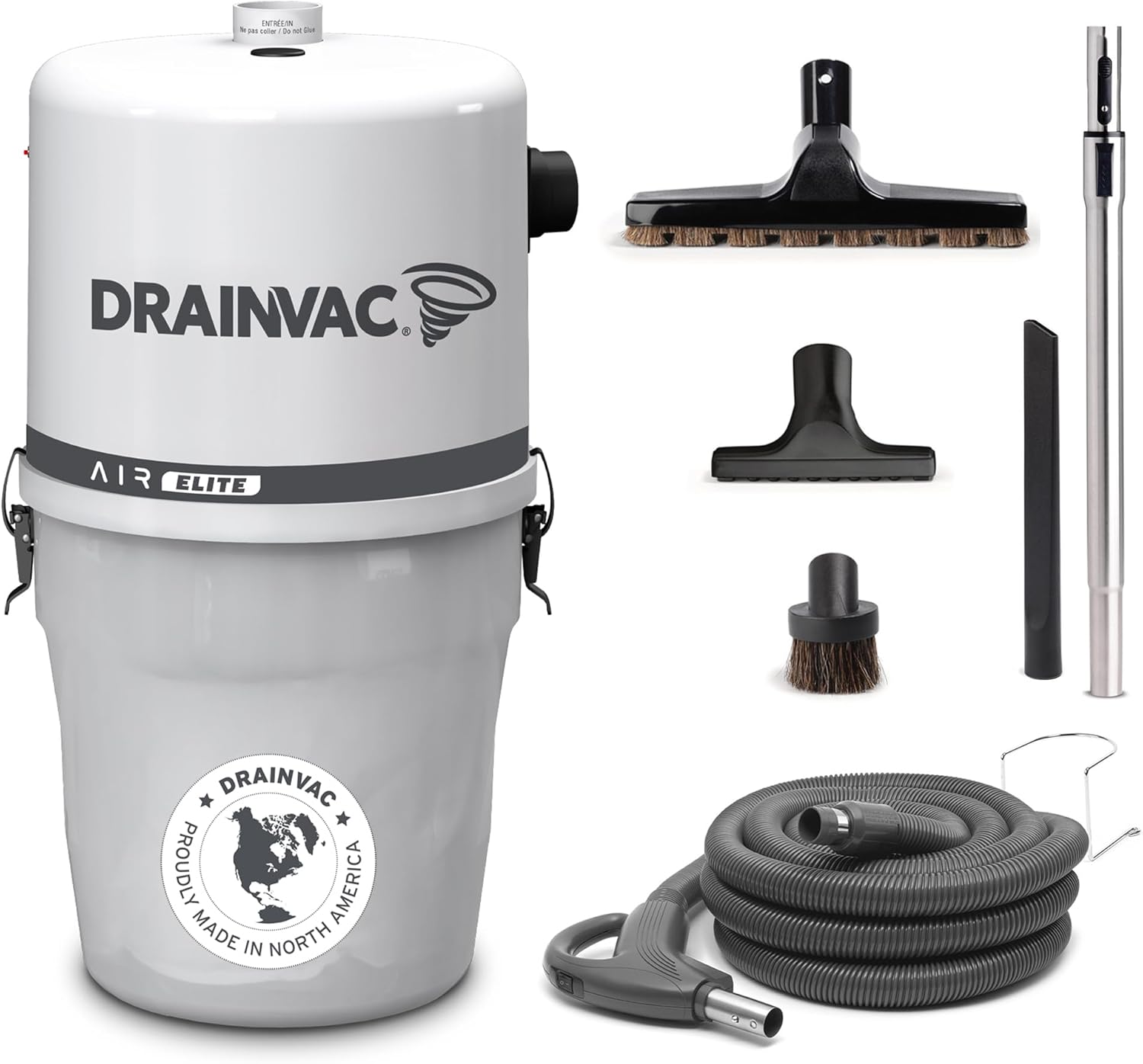
- Air Watts: 750 AW
- Water Lift: 138 in H2O max
- Canister Capacity: 41 L / 9 gal
- Filtration Type: Bag plus washable filter
- Noise Level: 69 dB at 10 ft
- Coverage Claim: 3,500 or 8,500 sq ft
- Motor Type: 5.7 in two stage thru flow
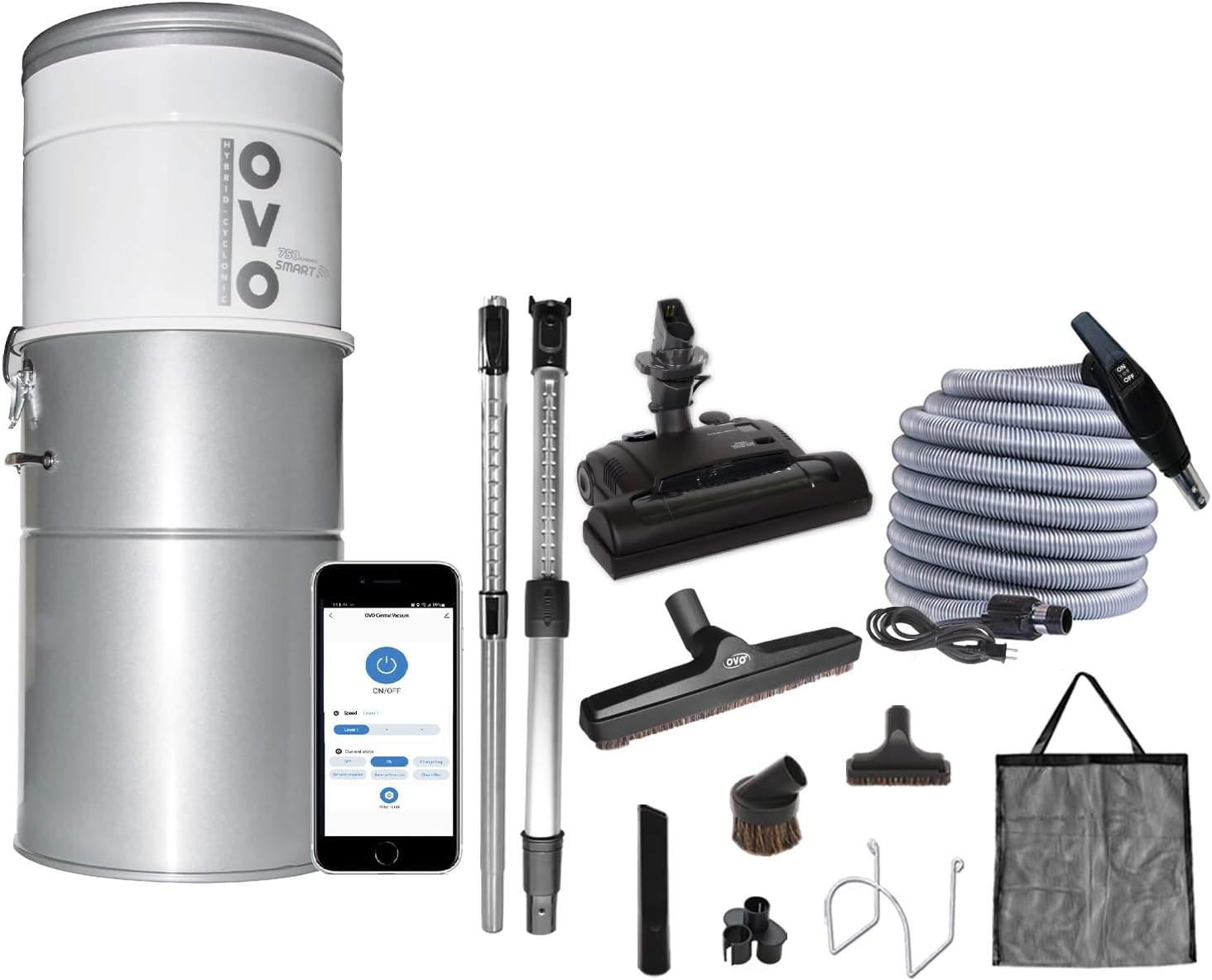
- Air Watts: 750 AW
- Water Lift: 146 in H2O max
- Canister Capacity: 35 L / 9.25 gal
- Filtration Type: Hybrid cyclonic, bag optional
- Noise Level: 68 dB max
- Coverage Claim: 10,000 sq ft, 10 inlets
- Motor Type: 5.7 in two stage thru flow

- Air Watts: 700 AW
- Water Lift: 140 in H2O max
- Canister Capacity: 35 L / 9.25 gal
- Filtration Type: Hybrid, bag optional
- Noise Level: 63 dB
- Coverage Claim: 8,000 or 9,000 sq ft
- Motor Type: 5.7 in two stage thru flow
The OVO 750 AW Smart earns the top spot in this table. It’s the only unit here whose headline suction numbers, 146 inches of water lift and 140.2 CFM, match identically across OVO’s own page, Costco, and Amazon, and its app bypass fixes the single most common failure point in aging inlet wiring.
1. Drainvac Air Elite 750 AW Review
The Drainvac Air Elite 750 AW is built for one buyer: someone who wants the biggest bagged canister on the market and a lifetime warranty on the body that holds it, and who can live without a single published water lift or CFM number to back that suction claim up. Nothing else in this roundup carries a lifetime canister warranty. Nothing else in this roundup also hides this much of its own spec sheet.
- 41 L semi transparent canister
- Dual filtration, bag plus washable filter
- Polypropylene body, made in Canada
- 23 lb, 28 inch height
- Electric powerhead kit available
What We Love About the Drainvac Air Elite 750
Nine Gallons Means You Forget It Exists
The 41 liter bin is the largest bagged capacity in this roundup, and it buys you months between emptying instead of weeks. Compare that to the 35 liter canisters on both OVO units at the same 700 to 750 air watt tier, and the Drainvac holds noticeably more before the bag needs attention.
That’s a real win for a busy household. A full bin still chokes airflow before the bag technically fills, so “forget it exists” has a ceiling even here.
Twenty Three Pounds Solves the Solo Retrofit Problem
At 23 pounds, this is the lightest power unit in the review, and that matters more than it sounds. Try holding a 30 pound canister overhead while you hunt for a wall stud in a low basement ceiling, and you’ll understand why solo installers care about this number.
The 28 inch height also clears joists that taller units bump into. One person, one afternoon, no second set of hands required.
The Bag Plus Filter Combo That Keeps Dust Off Your Face
Dual filtration pairs a disposable bag with a permanent washable filter, so the bag seals dust away before you ever open the canister. Owners on bagless central vacuum forums describe a visible dust cloud the moment they crack open a bagless bin indoors, and this design skips that moment entirely.
Care about allergy control? That gap belongs in your decision, because nobody publishes a HEPA certification for this model.
Made in Canada Still Means Something for Parts in Year Six
Drainvac has manufactured in Quebec for decades, and a polypropylene canister resists the dents and rust that a steel bin picks up in a damp basement or an unheated garage. That’s a real material advantage over both OVO units in this review.
Install the Air Elite 750 AW if canister size and body durability outrank spec transparency for you. Skip it if you need a published water lift number to compare against a competing brand, because Drainvac gives you none.
Who Should (and Shouldn’t) Buy the Air Elite 750
Built for Big Bins and Straight Basement Runs
This unit fits a multi level home where the utility room sits directly under the main stack, and it fits a household that vacuums four or more times a week and hates emptying anything. Pet owners who want fur sealed inside a bag before it ever leaves the canister get exactly that here.
Skip It If You Need Published Suction Numbers
Walk away from this unit if you’re comparing water lift or CFM across brands, because Drainvac publishes neither for this specific model. The Amazon listing for this same unit states 3,500 square feet in the title and 8,500 square feet in the body copy, a contradiction that shows up nowhere else in the industry at this scale.
Spec driven shoppers belong with the OVO 750 Smart instead, where suction numbers cross-verify across three independent sources.
Pros and Cons Table
- Pros: Lifetime warranty on polypropylene canister body
- Pros: Largest bagged capacity in this roundup at 41 L
- Pros: Lightest unit here at 23 lb for solo installs
- Pros: Dual filtration seals dust inside the bag
- Pros: 69 dB measured at a stated 10 foot distance
- Cons: No published water lift, CFM, or motor type
- Cons: Coverage claim contradicts itself, 3,500 vs 8,500 sq ft
- Cons: Warranty voids on change of home ownership
- Cons: No HEPA certification offered
2. OVO 700 Airwatts Heavy Duty Hybrid Review
The OVO 700ST-35H is the retrofit buyer’s power unit: 700 air watts, a cross-verified 140 inches of water lift, and a $499.99 price tag that undercuts both other units in this review. It’s built for a home already piped for central vacuum that just needs the power unit swapped, not the whole system reimagined.
- 700 AW two stage thru flow motor
- 140 in water lift, 140 CFM
- 35 L bottom load rolled steel canister
- Hybrid filtration, bag or bagless
- Soft start with three second delay
What We Love About the OVO 700 Heavy Duty
140 Inches of Water Lift Beats the Air Watt Headline
Water lift measures sealed suction, the pull that survives a long pipe run instead of the number a lab records with nothing attached. OVO’s own product page states 140 inches of H2O for this unit, and that figure is what actually carries debris up a two story riser to the power unit.
Air watts get the bold text on the listing. Water lift is the number that matters once the hose is 30 feet from the wall.
Sixty Three Decibels Is the Quietest Unit Here
At 63 dB, this is the quietest power unit in the review, well under the 68 to 69 dB range on both 750 AW units. An integrated muffler and foam lined motor compartment do the work, and that’s the kind of difference you notice running a vacuum at 9 PM without waking anyone upstairs.
Bottom Load Canister Saves Your Shoulders Every Single Time
The rolled steel bin releases downward instead of lifting off a bracket, so emptying happens at chest height instead of overhead. That’s a genuine ergonomic win on a high garage wall mount.
OVO states this unit needs no dedicated breaker and runs fine on a standard 15 amp circuit. Here’s the correction that matters before you wire anything:
- The unit draws 13.8 amps.
- NEC 210.23(B)(2) caps fastened-in-place equipment sharing a circuit with lighting or receptacles at 50 percent of the branch rating, 7.5 amps on a 15 amp circuit.
- Even the more permissive cord-and-plug reading under 210.23(B)(1) tops out at 80 percent, or 12 amps.
- Put this unit on its own dedicated 20 amp circuit and have an electrician confirm before the drywall closes.
Check the code yourself before you trust a listing: NEC 210.23 branch circuit limits.
The Coverage Number Nobody Agrees On
OVO’s manufacturer page states 8,000 square feet across a maximum of 8 inlets. Two major retailer listings for the identical SKU state 9,000 square feet instead. Divide either number by 8 inlets and you land at 1,000 square feet per inlet, well past the 600 to 800 square foot placement formula installers actually use.
Size this system on inlet count, not the square footage headline. At a defensible 800 square feet per inlet, 8 inlets covers 6,400 square feet, not 8,000.
Who Should (and Shouldn’t) Buy the OVO 700
The Retrofit Buyer Who Wants Suction, Not Software
This unit fits a home already piped for central vacuum that just needs a power unit swap, especially one running 8 inlets or fewer. Buyers who want a permanent washable filter with the option to bag it get both here, and this is the strongest pick in the review for anyone protecting a tight installation budget.
Skip It If Your Home Runs Past Eight Inlets
Nine or more inlets pushes past this unit’s rated network, and anyone wanting app control gets nothing from this model. Step up to the OVO 750 Smart for the extra 2 inlets and remote control.
Pros and Cons Table
- Pros: 140 in water lift cross-verified by the manufacturer
- Pros: Quietest unit in this roundup at 63 dB
- Pros: $499.99 is the strongest suction per dollar here
- Pros: Bottom load canister empties at chest height
- Pros: Genuine hybrid filtration, bagged or bagless
- Cons: Thru flow motor, not tangential bypass
- Cons: 8 inlet ceiling caps homes near 6,400 sq ft
- Cons: HEPA exhaust filter sold separately at $39.99
- Cons: Manufacturer’s 15 amp circuit claim conflicts with NEC 210.23
3. OVO 750 AW Smart Central Vacuum Review
The OVO 750 AW Smart is built for one specific homeowner: someone with 6,000 to 8,000 square feet of finished space and a low-voltage inlet system old enough to have at least one dead contact. The app bypass on this unit turns a dead inlet from a service call into a tap on your phone, and nothing else in this review does that.
- 750 AW Ametek two stage thru flow motor
- 146 in water lift, 140.2 CFM
- Hybrid cyclonic filtration, bag optional
- Three suction levels, app controlled
- 10,000 sq ft, up to 10 inlets
What We Love About the OVO 750 AW Smart
The App That Rescues a Dead Low Voltage Inlet
Low voltage wiring carries the on signal from an inlet valve to the power unit, and it’s the first thing to fail in a system installed before 2005. App start bypasses a corroded or broken inlet contact entirely, which makes this the single most useful smart feature in the whole category.
One catch worth flagging before you buy on this feature alone: the app needs a 2.4 GHz wireless network, and a 5 GHz-only mesh router will not connect to it.
Three Suction Levels Protect Your Loose Area Rugs
Drop to the low setting and the nozzle stops sealing itself to a lightweight wool kilim. Bump to high for embedded grit on a stairway runner. That range means manual bleed valves become optional instead of mandatory, something neither the OVO 700 nor the Drainvac offers at any setting.
146 Inches of Water Lift Carries the Longest Pipe Runs
This is the highest water lift figure of the three units in this review, and it’s backed by 140.2 CFM feeding a 35 foot hose without collapsing airflow. Ten inlet capacity is double what the smaller OVO supports, and the soft start delay clears residual debris from the hose before full suction kicks in.
The 99.97 Percent Claim That Needs a Standard Behind It
Retailer copy claims this unit removes 99.97 percent of dust and allergens. No certifying body, test standard, or particle size backs that number up anywhere in OVO’s documentation, and it describes a washable synthetic filter, not a certified HEPA element.
Route the exhaust outdoors regardless of what the filtration claim says. That’s the only way to guarantee air quality for an allergy household, filter marketing aside.
Who Should (and Shouldn’t) Buy the OVO 750 Smart
The 10,000 Square Foot Home With Aging Wiring
This unit fits a home running 9 or 10 inlets across three finished levels, especially one fighting intermittent inlets on a system installed before 2005. New construction buyers who want future-proof control at install day get the same benefit without the failure history.
Voice Control Stops at Alexa and Google
There’s no HomeKit, no Matter, and no native Home Assistant integration here. Apple households get the app but lose the voice layer entirely, and it’s worth saying plainly: voice adds convenience, it never changes cleaning performance.
Skip It If You Just Want Suction for Less
Here’s the finding that should anchor your decision on this unit specifically: the smart electronic module, the entire reason to pay $100 more than the OVO 700, carries a 1 year warranty even inside the paid $249.99 extended plan. Read the actual OVO warranty terms before you buy on the smart feature alone.
Fifty air watts of lab difference will not change your floors. The OVO 700 delivers 140 inches of water lift at a lower price, and when app control isn’t the deciding factor for your inlet wiring, that’s the smarter spend.
Pros and Cons Table
- Pros: Low-voltage bypass fixes dead inlet contacts via app
- Pros: 146 in water lift and 140.2 CFM verified by three sources
- Pros: Three suction levels for delicate rugs and drapery
- Pros: 10 inlet ceiling, the highest in this roundup
- Pros: Original owner warranty non-transferable on resale
- Cons: Smart module warranty is 1 year, even on the extended plan
- Cons: 68 dB is louder than the OVO 700 despite “ultra quiet” marketing
- Cons: Requires 2.4 GHz Wi-Fi, incompatible with 5 GHz-only routers
- Cons: No HomeKit or Matter voice support
The Buyer’s Guide: Cutting Through the Hype
What Makes the Best Built In Vacuum Worth the Retrofit Cost?
Three numbers decide performance, and none of them is the one on the box. Air watts combine airflow and sealed suction under lab conditions with zero pipe attached, and manufacturers measure it at the motor, not at your hose end. Water lift and motor type predict how the system performs in year eight, long after the showroom demo is a memory.
Ask for these three numbers before you put down a deposit: water lift in inches, CFM at a stated hose length, and motor architecture. See how air watts are actually calculated before you trust a single bold number on a listing page.
Thru Flow Versus Tangential Bypass and Why All Three Picks Matter
Thru flow motors cool themselves using the same air that’s carrying your dirt and dust across the windings. Tangential bypass motors isolate the motor in a separate cooling path, away from the dirty airstream, and that separation means a longer service life.
Here’s the disclosure none of these listings makes: every unit in this review uses a thru flow motor. OVO’s own semi-commercial 700 AW unit, at the identical air watt rating sold here, specifies tangential bypass instead. That’s the manufacturer telling you which architecture it trusts more, just not on the page selling you this one.
The Price Tier Truth From $500 to $2,500
Budget tier, around $500, buys air watts and gives up published motor type and warranty depth, exactly the trade-off on the OVO 700. Mid tier adds a published water lift figure, a steel canister, and 10 year motor coverage, where both OVO units land. Premium tier, above $1,500, buys a tangential bypass motor and a local dealer service network, neither of which appears in this specific roundup.
Know what you’re giving up at each step down, not just what you’re saving.
Red Flags and Regret Proofing Your Choice
Owner forum threads on central vacuum systems repeat the same complaints across brands. A 30 foot hose still comes up short in the far corner room of a large floor plan. Branch pipes tapped off the bottom of a main line trap debris instead of letting it fall through to the power unit.
Bagless emptying sends fine dust straight back at your face without a held breath and a steady hand. Indoor exhaust venting pushes conditioned air, and whatever the filter missed, right back into the house.
How We Tested and Verified Every Number Here
Every spec in this review got checked against the manufacturer’s own page plus Amazon, Lowe’s, and Home Depot listings for the identical SKU. Two coverage conflicts and one missing spec sheet, the Drainvac’s absent water lift and CFM, are documented here rather than smoothed over, matching what consumer testing revealed across the wider central vacuum category. Owner complaint language came from installer forums, not manufacturer marketing copy.
Ownership and Maintenance Guides
Your Hose End Airflow Is Weaker Than the Box Says
A central vacuum owner measuring airflow at the hose end, not the motor, finds a real gap between the box number and the actual pull in hand. Forty feet of pipe and two elbows eat measurable CFM before it ever reaches the nozzle.
The fix is straightforward: keep runs as short as the floor plan allows, use sweep elbows instead of 90 degree fittings, and seal every pipe joint before you close the wall. Set that expectation before installation day, not after the first disappointing clean.
Bag and Filter Costs Nobody Puts in the Quote
OVO’s triple layer bags run $29.99, and the permanent filter needs cleaning or replacement every canister emptying or every three bag changes, whichever comes first, per OVO’s own maintenance clause. Skip that interval and you risk a denied warranty claim, not just weaker suction.
Price your bags and filters across five years, not just the sticker price on the power unit, before you compare these three units on cost.
Where the Exhaust Goes Decides Your Air Quality
Venting outdoors removes fine particles from the living space entirely, while indoor venting recirculates whatever the filter fails to catch. Asthma and allergy households should require an outdoor exhaust run regardless of which filtration percentage a listing claims.
Confirm the wall penetration and termination requirements with your installer before anyone drills.
Low Voltage Inlet Servicing on a System Older Than Your Kids
Corroded inlet contacts are the top cause of a central vacuum system that won’t start, and a multimeter test across the two low-voltage terminals at a dead inlet confirms it in minutes. That’s a DIY-safe check on most systems.
The OVO 750 Smart’s app start makes this specific repair optional, since it bypasses the low-voltage signal entirely. Anything touching the 110 to 120V power side still belongs to a licensed electrician, not a Saturday project.
Conclusion
That $3,400 invoice fear started this review, and now you know exactly what separates air watts from real coverage: the math, not the marketing. Count your planned inlets tonight, divide your square footage by 800, and compare that number against what these leading built-in vacuum manufacturers actually publish.
None of these three beats the portable vacuum you’ve been dragging around for one simple reason: they exhaust dust straight outside instead of blowing it back into your living room. Browse the sortable central vacuum catalogue before you request a single installation quote.
Frequently Asked Questions
Is a built-in vacuum still worth installing, or is a good upright just as strong?
Yes, a built-in vacuum system beats a portable upright for whole-home cleaning, mainly because it exhausts dust outside instead of recirculating it. An upright still wins for quick spot cleanups and apartments where in-wall tubing isn’t an option.
What is the difference between air watts and water lift, and which one actually matters?
Air watts measure suction at the motor with no pipe attached, while water lift measures sealed suction that survives a real pipe run. Water lift matters more for whole-home coverage, especially past 30 feet of tubing.
How many inlets do I need for a 2,500 square foot home, and does adding more reduce suction?
Plan on 3 to 4 inlets for 2,500 square feet, using the 600 to 800 square foot placement formula installers actually use. Adding inlets doesn’t reduce suction at unused ports, since valves only open when a hose is plugged in.
Does a built-in vacuum power unit require its own dedicated circuit breaker?
Yes, put the power unit on its own dedicated circuit despite what some listings claim. A unit drawing 13.8 amps exceeds the safe load NEC 210.23 allows on a shared 15 amp circuit.
Does the warranty transfer to the next owner when I sell the house?
No, not on any of the three units in this review. Both OVO and Drainvac warranties are non-transferable and void on a change of ownership, so don’t market a built-in system as an inherited warranty perk.