You keep seeing “700 air watts” stamped on every brochure, and somewhere along the way you started believing a bigger number means a cleaner floor. Air watts central vacuum ratings get treated like a final score, when the number is really one lab reading taken under conditions your house will never match.
Dealers tell you to double your square footage and match the air watt figure. Owners on forums quietly report units with higher air watts that died first. Finish this guide and you’ll read any air watt rating for what it measures, spot the specs worth demanding instead, and stop letting one number make a four-figure decision for you.
Air Watts Central Vacuum
Air watts measure a motor’s peak performance in a lab, with no hose, filter, or tool attached, so the brochure figure is a ceiling you’ll never reach at home. It comes from one ASTM formula, not a cleaning test, and predicts motor potential, not durability, filtration, or how that power holds up across a real pipe run.The One Number Every Brochure Wants You To See
Every central vacuum brochure leads with air watts because it’s the one spec that ends a comparison in seconds. That speed is exactly why it deserves a second look.
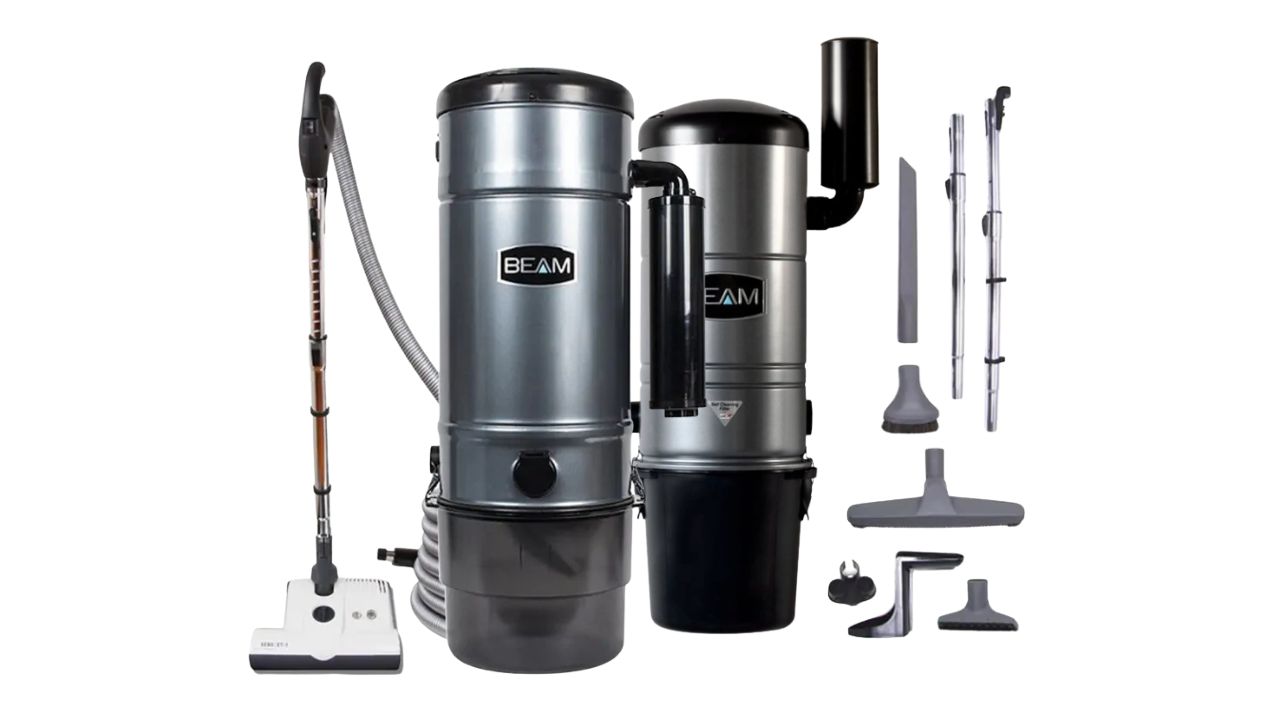
Why dealers lead with air watts and almost nothing else
Dealers lead with air watts because a single figure does the persuading they’d otherwise have to do themselves. It feels objective in a way water lift and CFM never quite manage alone.
A bigger number photographs well on a spec sheet, and it ends the showroom conversation fast. You walk out comparing one digit instead of comparing the machines those boxes actually contain. That’s a sales shortcut, not a buying strategy.
What that number quietly leaves out of the room
Air watts measure peak suction power at the motor, so the rating stays silent on the parts of ownership you’ll notice for years. Two power units can carry the identical air watt number and still live very different lives bolted to your utility room wall.
One runs quiet and steady for fifteen years. The other loses noticeable pull by year three. The figure says nothing about filtration grade, canister capacity, or what a motor replacement costs down the road. For the broader picture of how these systems fit together, our complete central vacuum guide covers the full system, not just the motor spec.
What would you actually want to know before paying for that number? Keep reading.
What Air Watts Actually Measure And What They Miss
Air watts is a calculated value, not a direct measurement, built from two readings that pull in opposite directions. Knowing the formula changes how you read every spec sheet.
The formula nobody on the showroom floor explains
Air watts equal airflow in CFM multiplied by water lift, divided by 8.5, under the ASTM F558 vacuum cleaner air-performance test method. Water lift is raw pulling strength, measured in inches of water it can lift up a sealed tube. CFM, cubic feet per minute, is how much air actually moves.
Think of it like a tug-of-war team. Water lift is how hard each person pulls. CFM is how many people show up. One person pulling with everything they’ve got moves less rope than a full team pulling moderately hard. The airwatt unit and how it’s derived traces back to this same vacuum cleaner industry math, not a general electrical measurement.
Why both halves of the spec have to work together
A unit can inflate its water lift number while airflow quietly drops, and the air watt figure still looks strong on paper. That’s the trap. Single-motor central vacuums land between 500 and 800 air watts, and that range only means something once you check both inputs behind it.
Big CFM with weak water lift stalls the moment a hose adds resistance. Big water lift with thin CFM moves almost no air through a 30-foot pipe run. Watch for this too: at least one manufacturer publishes its air watt formula using a 7.5 divisor instead of the ASTM-standard 8.5, inflating the number before you’ve compared anything. Ask for the divisor before you trust the math.
What the standard itself admits about the rating
ASTM F558 measures maximum potential air power at a fixed test orifice, and the standard doesn’t claim that figure reflects how the unit performs once a brush and a carpet enter the picture. That’s printed into the methodology, not a marketing omission.
The governing standard openly treats brush contact, surface type, and tool attachment as variables outside its scope. Treat the brochure figure as a best case, never a promise.
Where The Air Watt Number Is Actually Born
The number on the box comes from a test bench, not a finished installation, and that distinction explains almost every gap between the brochure and your living room.
Inside the test that has no hose attached
Labs measure air watts at the bare motor, with no piping, no filter, and no cleaning tool attached. Every part you bolt onto that motor at home, the PVC trunk line, the canister filter, the hose, the power nozzle, only subtracts from that clean lab number.
The bench result is the ceiling. Your house lives well below it, because your house has parts the test bench never included.
The orifice trick that sets the headline figure
Manufacturers test across a range of opening sizes and report only the single orifice where air watts peak, somewhere near a 20 to 25 mm opening. Your installation almost never runs at that exact opening, since hose diameter, tool restriction, and carpet contact all shift the effective working orifice away from the peak point.
That gap is exactly why your floor never feels like the brochure promised. Quick gut check: does the brochure even state the test orifice size? Most don’t, and that omission tells you how much weight to give the number.
Why Two Motors Never Add Up Like You Think
Dual-motor units get sold with mental math that doesn’t hold up, worth correcting before you pay for a number that isn’t real.
The 2 X 500 label that fools careful shoppers
Two 500 air watt motors do not combine into a 1,000 air watt machine. Air watts can’t be added across motors the way a spec sheet’s font size implies. The honest label reads as 2 X 500, and that difference matters at checkout.
| Configuration | Typical water lift | Typical airflow | Honest takeaway |
|---|---|---|---|
| Single motor | Moderate | Moderate | Air watts apply directly; one number, one motor |
| Dual motor, series wiring | Higher | Similar to single | Boosts pulling strength for long or tall pipe runs |
| Dual motor, parallel wiring | Similar to single | Higher | Boosts moved air volume, not raw pull |
A second motor raises one half of the formula at a time, water lift or airflow, depending on the wiring. It never simply doubles the air watt rating.
When a second motor actually earns its keep
A second motor earns its cost on tall homes and long pipe runs, where series wiring adds the extra water lift needed to push air the full distance without going flat. Outside that scenario, you’re paying for heat and electricity you’ll never use.
Match the motor count to your actual floor plan. A 2,000 square foot ranch with a centrally located power unit rarely needs what a three-story home with a 90-foot run to the farthest inlet requires. Systems rated for sustained heavy use, what the industry calls continuous duty rated systems, hold their air watt output across longer cleaning sessions better than standard-duty motors, which matters more than motor count once you clean for an hour at a stretch.
The Spec Fights Owners Caught That Dealers Skip
Forum owners have spent years documenting air watt numbers that contradict each other, catching problems no brochure admits to.
Why one unit posts higher air watts with worse CFM
A higher air watt rating doesn’t guarantee better airflow, and one owner on the VacuumLand forum logged exactly that contradiction. The owner found a popular hybrid model rated roughly 6 percent lower in air watts than a rival, despite measuring higher actual airflow on the same test rig.
Peak air watts depend on the precise orifice where each motor happens to max out, and that orifice differs motor to motor. The bigger number on the box can belong to the weaker airflow machine, the opposite of what most shoppers assume walking into a showroom.
The 50 year motor that aged better than its rating
Longevity hides in motor build quality, not the air watt figure, and one VacuumLand member’s story proves it better than any spec table. The owner ran a NuTone unit, the brand now produced under DrainVac International after the industry’s brand consolidation, for fifty years before the rotor burned out.
Modern units with bigger air watt numbers rarely carry a fifty-year expectation. NuTone’s current lineup carries a shorter warranty than that vintage motor’s reputation suggests, so don’t assume the brand name alone buys you that run today. A brochure number has never once predicted a motor’s fiftieth birthday.
Do central vacuums really lose most of their suction?
No, the dramatic 90-percent suction loss claims circulating in forum threads overstate a real but smaller problem. A technician on one thread measured roughly 150 CFM at the bare motor dropping to about 80 CFM by the time air reached the nozzle.
That’s a meaningful drop, close to half, worth planning around. It’s nowhere near the catastrophic loss some forum posts describe, and treating every system as doomed to near-zero suction ignores how much of that loss comes from fixable choices like hose length and elbow count, covered next.
How Distance And Hose Quietly Eat Your Suction
Air watts assumes a straight shot from motor to opening, and your house never gives it one. Distance and hardware both take their cut before air reaches the carpet.
The price you pay for every foot of pipe
Long pipe runs and tight 90-degree elbows bleed airflow before it reaches the inlet, and a high air watt rating can’t buy that loss back. Every elbow beyond the manufacturer’s stated maximum chips away at the same airflow the brochure measured with a bare motor.
Inlet placement decides your daily cleaning experience as much as motor rating does. A unit with excellent air watts feeding a poorly routed pipe network still leaves the farthest bedroom weaker than the hallway closet next to the power unit.
Why a 30 foot hose changes the whole equation
The brochure test runs with zero hose attached, and your cleaning session starts with 30 feet of it between you and the canister. Friction inside that length drops both airflow and effective suction by the time air reaches the brush roll.
A representative comparison from owner-reported testing puts a mid-range central vacuum near 600 air watts and roughly 125 CFM against a top-tier canister portable near 230 air watts, and the central system still wins on sustained real-world pull because its motor sits far from the cleaning end with room to spare in the design. Plan inlet placement so no single run forces the system to fight its own pipe network. To see how motor placement and pipe routing differ across system styles, how different system types compare breaks down the layout differences that matter here.
Matching Air Watts To Your Real Floor Plan
Forget the dealer’s square-footage shortcut. Sizing a system means looking at the whole pipe network, not one multiplier applied to one number.
How many air watts central vacuum buyers actually need?
Most homes under 3,000 square feet run well on a single motor in the 500 to 650 air watt range, while homes past 4,000 square feet or three stories need the added water lift a dual-motor, series-wired unit provides.
| Home profile | Typical air watt range | Fit notes |
|---|---|---|
| Under 2,000 sq ft, single story | 500 to 600 AW | Standard single motor handles short runs comfortably |
| 2,000 to 4,000 sq ft, two stories | 600 to 750 AW | Watch total pipe length and elbow count, not just square footage |
| Over 4,000 sq ft or three stories | 750+ AW, dual motor common | Series wiring needed to maintain water lift across long vertical runs |
Dealers say to simply double your square footage and match that number to the air watt rating. That shortcut ignores ceiling height, total pipe length, and how many inlets the system runs off one trunk line. Size for your longest run and busiest room, not a tidy multiplier that skips both. Run the numbers instead of estimating them with our central vacuum sizing tool, which factors pipe length and inlet count into the recommendation.
When chasing more air watts is just wasted money
Once a unit comfortably covers your square footage and pipe layout, additional air watts stop translating into cleaning improvement. The performance curve flattens past that margin.
Oversized units burn more electricity maintaining suction you’ll never feel at the carpet. Buy the headroom your house needs, then stop paying for a number that mostly wins showroom comparisons.
The Spec That Outlasts Air Watts: Motor Build
Motor construction predicts how long that air watt number holds up, a spec almost no brochure puts next to the rating itself.
Thru flow versus tangential bypass in plain language
A thru-flow motor cools itself using the same dirty air it pulls through the system, which keeps manufacturing costs down. A tangential bypass motor cools on a separate, clean air path, which costs more to build but tends to run longer.
Think of it as a sprinter against a workhorse. Both can post fast numbers on a single test. Only one is built to keep that pace for years. A cheaper thru-flow motor can post a higher air watt number than a premium tangential bypass motor while wearing out in a fraction of the operating hours, because the same dirty air that cools it also carries fine dust across the windings every time it runs. Ametek Lamb Electric, the dominant supplier of motors across the central vacuum industry, builds versions of both designs, though Ametek doesn’t sell directly to homeowners, so any warranty claim still routes through whichever vacuum brand installed that motor.
The questions that beat any air watt rating
Three questions tell you more than the air watt number ever will:
- Ask the motor type, thru-flow or tangential bypass, and the fan diameter behind the rating.
- Ask for water lift and CFM as separate figures, not just the blended air watt calculation.
- Ask for the motor’s warranty term specifically, separate from the power unit’s overall warranty.
A long, separate motor warranty tells you more about expected lifespan than any number printed on the box. That’s the spec that should change your buying decision, not the one the brochure leads with.
Conclusion
You walked in believing a higher air watt number meant a cleaner floor. You leave knowing it’s a lab ceiling that shrinks the moment a hose, a filter, and 30 feet of pipe enter the picture.
Tonight, pull up the two units you’re weighing and write down their water lift, CFM, motor type, and warranty term side by side, not just the air watt figure alone. A portable vacuum dies in a closet after a few years of hard use. A correctly sized central system keeps the same quiet pull at the wall inlet for decades, long after the brochure’s headline number stops mattering to anyone but the dealer who printed it.
Frequently Asked Questions
What does air watts mean on a central vacuum?
Air watts is a calculated measure of a motor’s peak air power, combining water lift and airflow into one number under the ASTM F558 test method. It’s measured at the bare motor in a lab, not through an installed hose and pipe network.
How are air watts calculated for a central vacuum?
The formula multiplies CFM by water lift, then divides by 8.5, per ASTM F558. Watch for brochures using a 7.5 divisor instead, since that inflates the result and breaks any apples-to-apples comparison.
What is the difference between air watts, CFM, and water lift?
Water lift measures pulling strength, CFM measures how much air moves, and air watts blends both into one derived figure. Read all three together, since a strong number in one can hide a weak number in the other.
How many air watts does a central vacuum need for my home size?
Most homes under 3,000 square feet run well on 500 to 650 air watts from a single motor. Homes over 4,000 square feet or three stories generally need a dual-motor, series-wired unit for the added water lift across longer pipe runs.
Is a higher air watt central vacuum always better?
No, a higher air watt rating doesn’t guarantee better performance or a longer-lasting motor. A cheap thru-flow motor can post a bigger number than a premium tangential bypass motor while wearing out far sooner.