You yank the cord free, drag twenty pounds of plastic up the stairs, and your shoulder aches before you’ve vacuumed one room. A central vacuum is a whole-house system built around one fixed motor in your basement or garage, wired to in-wall piping and wall inlets, so you carry only a light hose between rooms. A dealer once told a buyer that 1,400 watts meant strong suction. It didn’t. That number measured electricity, not cleaning power.
This guide explains what a central vacuum is, how air watts expose that dealer trick, what it costs over twenty years, and which homes should skip it.
What Is Central Vacuum
A central vacuum is a fixed power unit wired to in-wall PVC piping and wall inlets, so a light hose plugs in instead of a machine you haul around. The motor and dirt canister stay in one utility space for the system’s life. Air watts, not electrical wattage, show how hard it cleans. It fits anyone building, remodeling, or replacing a worn-out unit who wants dust gone from the air they breathe.This evaluation draws on manufacturer spec sheets, ASTM test method documentation, and owner accounts from long-running vacuum enthusiast forums, not one dealer’s product line.
The vacuum you drag upstairs and quietly resent
A central vacuum exists because lugging a portable up a flight of stairs gets old fast, and the dust it kicks up doesn’t help your lungs either. The fixed power unit and the light hose are the two design choices that fix both problems at once.
Why the hose feels like a workout you didn’t sign up for
Owners on enthusiast forums like AnandTech admit the same thing: hauling the hose and canister room to room got old fast, and complaints usually start within the first year. A central vacuum keeps the motor and dirt canister parked in one utility space, so the only thing you carry is a hose weighing a few pounds.
That single change is why central vacuums earn loyalty. Carrying a light hose instead of a twenty-pound canister up two flights changes how often you actually clean. Homeowners who only ever owned portable central vacuum options call the switch the difference between a chore and a quick errand.
The cord, the dust cloud, the closet you avoid
The cord catches the doorframe corner every time you turn into a hallway. Portable bags puff fine dust back into the room the moment you pop them open. And the hall closet, stuffed with a machine nobody wants to drag out, becomes the spot everyone avoids cleaning behind.
Is a central vacuum better than a regular vacuum? For dust control and daily ease, yes, because the motor and collection canister sit far from where you breathe.
What central vacuum means and where it hides
A central vacuum is a fixed motor wired into pipes hidden behind your drywall, not a fancier upright. It is the system, not the hose, that does the work, and the hose is just the part you ever see.
So what is central vacuum in plain words?
Think of it as a lung built into your house. The motor stays put in one location and pulls air through a network of pipes, the same way your lungs pull air through one set of passages no matter which room you’re standing in. Only the hose moves; the muscle never does.
Read how ducted central vacuum systems are built into a home for the full mechanical breakdown if the pipe layout still feels abstract.
Where the power unit actually lives in your home
Most power units hang in a garage, basement, or a utility room nobody spends time in. That distance is the entire reason the motor noise never follows you to the bedroom upstairs. Dust, dirt, and fine debris end up in a canister far from where you sleep, eat, and breathe.
A family running a central vacuum through a finished basement utility closet reports the unit is barely audible one floor up, even mid-cycle.
A short, surprising history you can skip or savor
Central vacuum cleaning is not a new gadget chasing a trend. The concept traces back to the 1850s in Sweden, where horse-powered fans pulled air through copper tubing from a basement bellows chamber. PVC piping and electric motors replaced the horse, but the core idea, one stationary power source feeding the whole house, never changed.
The four parts that make the whole thing work
Every central vacuum, regardless of brand, breaks down into four parts: the power unit, the pipe network, the inlet valves, and the hose. Skip understanding any one of them and the system stops making sense as a whole.
The motor and canister doing the heavy lifting
The power unit houses the motor and the dirt collection tank in a single sealed box. Because nobody has to lift or carry it, manufacturers fit bigger, heavier motors in here than any portable could manage. Most owners empty the canister only two or three times a year.
Ametek/Lamb builds many of the motors inside these units, regardless of brand name. Two designs matter: thru-flow motors cool themselves with the same dirty airstream they vacuum, which keeps the unit compact but exposes the windings to dust over time. Tangential bypass motors separate cooling air from the dirty airflow entirely, so the motor never breathes debris and runs cooler longer. Homes that vacuum daily, kids, pets, or both, get more mileage from continuous duty central vacuum units built on bypass motors rather than the cheaper thru-flow design.
The PVC pipes hidden inside your walls
A network of two-inch Schedule 20 PVC pipe runs behind your drywall, connecting every inlet back to the power unit. This piping commonly outlasts two or three motors and brand changes over the life of the house. Sweep elbows, gentle curved fittings instead of sharp 90-degree turns, keep airflow from choking at every bend.
Forum veterans warn against gluing every joint during install. Loose-fit joints near likely clog points let you pull pipe apart by hand instead of cutting into a wall later.
Inlet valves and the hose that brings it together
Inlet valves are the wall ports where the hose plugs in, and the connection triggers the motor through low-voltage contacts wired separately from your main circuits, governed by NEC (NFPA 70) low-voltage rules. Place inlets by square footage per floor, not whole-house size, since one inlet rarely reaches every corner of a large level.
Run the math with a central vacuum sizing calculator before settling on an inlet count. Under-placing inlets is the most common retrofit regret owners report after move-in.
Can you add a central vacuum to an existing home? Yes, but inlet placement gets harder once walls are finished, which is why sizing the layout first matters more in a retrofit than in new construction.
Air watts, water lift, and the number dealers dodge
Air watts, not electrical wattage, tell you how hard a central vacuum actually cleans, and the formula is set by ASTM and AHAM testing standards rather than a marketing department. Get this one number right and every other spec on the sheet stops mattering as much.
What air watts really measure at the floor
Air watts combine airflow and suction into one number that reflects real cleaning power at the hose end. ASTM F558 defines the math: air watts equal CFM, airflow in cubic feet per minute, multiplied by water lift, divided by 8.5. Think of it as the actual pull you feel where the brush meets the carpet, not a number pulled from the electrical panel.
Manufacturer documentation around air watts and central vacuum performance is worth reading closely, since the same rating from two brands can move very different amounts of air depending on pipe diameter and run length.
Why water lift alone can fool you
Water lift measures suction only at the moment the hose end is fully sealed, a condition that never happens while you’re actually vacuuming carpet. Some manufacturers narrow the airflow path on purpose to push that number higher on paper. A scary-high water lift figure printed alone, with no airflow number beside it, tells you almost nothing about hallway performance.
A higher air-watt rating sometimes performs worse in a small home with short, straight pipe runs, because the motor was tuned for resistance that never shows up over a 30-foot run. Competing buying guides almost never mention this trade-off.
The wattage trick that means almost nothing
Electrical watts measure how much power the motor draws from your outlet, not how much dirt it actually lifts off the floor. A “1,400 watt” sticker sounds powerful and tells you nothing useful about cleaning performance. Ask any dealer for air watts tested to ASTM F558 or F2609, and watch how many can’t produce the number.
How does a central vacuum system work without that number on the box? It still works fine. You just can’t compare it fairly to anything else without it.
Bag, bagless, or cyclonic, how it traps dirt
Central vacuums collect dirt three ways, bagged, bagless filtered, and true cyclonic, and the method you pick changes how often you touch the canister and where the exhaust air ends up. Reviewing the different types of central vacuum systems side by side before you buy saves a retrofit regret later.
| Collection method | Mess at emptying | Exhaust handling |
|---|---|---|
| Bagged | Minimal, sealed bag lifts straight out | Can vent indoors if filtration is fine enough |
| Bagless filtered | Moderate, filter needs shaking or rinsing | Best vented outside for fine dust |
| True cyclonic | Low dust contact, spins debris into canister | Must vent outside, no exception |
The bagged unit most installers quietly prefer
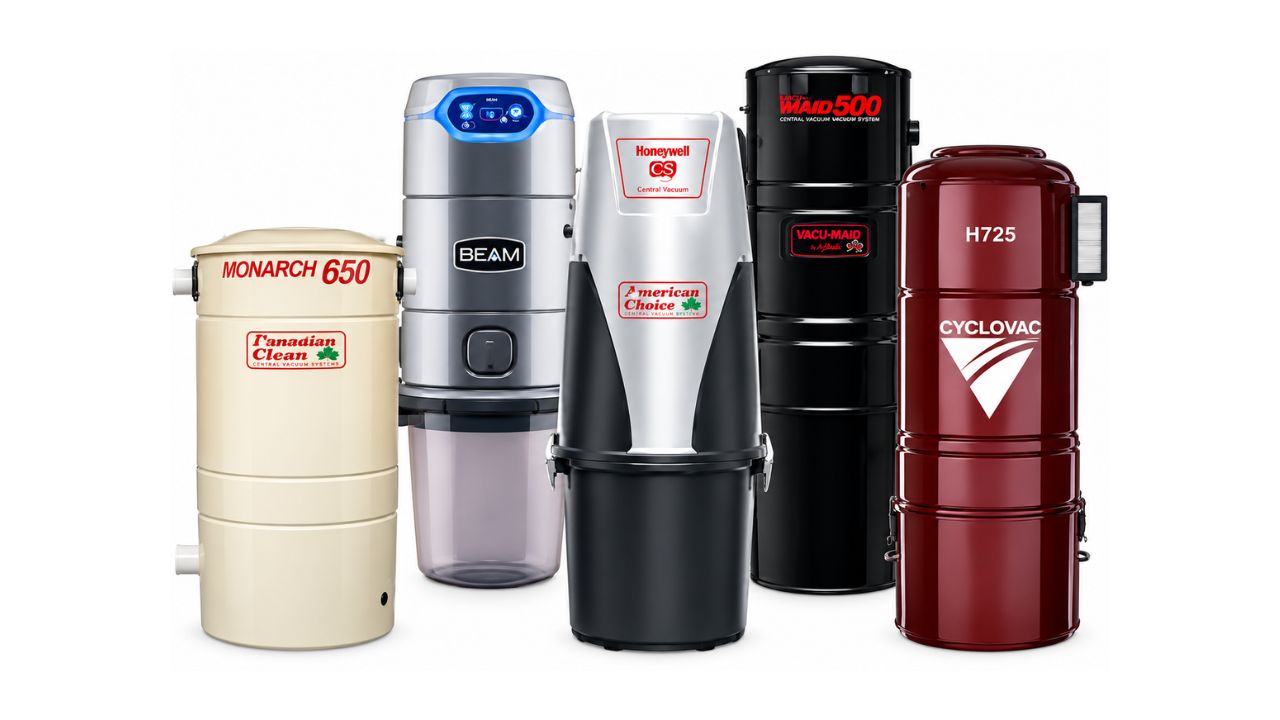
A sealed bag traps dust inside itself, so emptying the canister never kicks a cloud back into the room. Many bagged units filter fine enough to vent safely indoors instead of needing outdoor ductwork. Vacuflo, made by H-P Products, and Beam, now built by Trovac Industries after Nuera Air, which had bought the brand from Electrolux, stopped manufacturing in 2024, both sell bagged power units as their mainstream lineup.
Most installers default to bagged systems for one reason: fewer dust complaints. Homes that occasionally need to lift spilled water or fine debris instead lean toward wet dry central vacuum models, trading some bagged convenience for versatility.
True cyclonic power and the catch nobody mentions
True cyclonic units spin debris out of the airstream using centrifugal force, with no bag and no filter doing the trapping. MD Manufacturing built its reputation on this design. The catch competing guides skip: true cyclonic units must vent outside with no exception, which means emptying the canister still happens near a small amount of escaping dust, a real concern for anyone managing allergies.
Shoppers comparing bagless central vacuum systems should weigh that outdoor venting requirement against the appeal of never buying a bag again.
HEPA versus HEPA style, the words that matter
Certified HEPA filtration captures 99.97% of particles at 0.3 microns, a figure backed by the EPA’s definition of a true HEPA filter. Labels reading “HEPA-style,” “HEPA media,” or “99.5% efficient” carry no certified capture guarantee behind them. For a household managing asthma or severe allergies, demand the certified 99.97% number printed on the spec sheet, not a lookalike phrase designed to sound the same.
Does it really help allergies or just sound good
A central vacuum reduces airborne allergens better than a portable because the motor and exhaust sit away from the rooms you live in, not because the marketing says “allergy friendly.” That single design choice, distance, does more for indoor air than any filter upgrade bolted onto a portable.
Why venting dust outside changes the air you breathe
The motor lives in a garage or basement, so its exhaust air never blows directly on anyone in the house. Vented outdoors, fine dust particles leave the building entirely instead of recirculating through the same air you’re standing in. This single mechanical fact is why central vacuums show up repeatedly in allergy and asthma management recommendations.
What LEED says about indoor air credit
LEED for Homes awards one point for a central vacuum with true HEPA final filtration and exhaust routed outdoors, away from any fresh-air intake. That credit only applies when both conditions are met together, not either one alone. It signals the allergy case has engineering backing, not just sales language.
Does a central vacuum vent dust outside the house? Only the bagless and true cyclonic designs require it. Sealed bagged units can vent indoors if the filtration is rated fine enough.
What forum owners love and quietly regret later
Long-time owners on vacuum forums report two honest patterns: real satisfaction after the first year, and a specific set of regrets that show up once the novelty wears off. Both deserve equal airtime here.
The wins owners brag about years later
One owner joked that his wife actually uses the vacuum now, since the hose weighs nothing compared to her old upright. Carpeted stairs, the chore everyone dreads most, get noticeably easier with a light hose and a motorized powerhead instead of a canister bumping down each step. Many owners report emptying the canister only once every six months.
Should you glue the pipes? Owners say no
Forum veterans are consistent on this point: skip the glue at every joint during install.
- Glue only the runs behind permanently sealed walls where access will never matter.
- Leave joints near bends, basements, and likely clog points dry-fit so they pull apart by hand.
- Keep pipe runs as straight and short as the layout allows to protect suction over distance.
The regrets that show up after a season
Cheap, builder-grade units installed to hit a spec sheet line item leave some owners with suction that fades within the first year. A short factory hose that can’t reach the farthest bedroom corner turns into a daily annoyance nobody warned them about. Dragging a bare hose across hardwood and trim scuffs both, so a hose sock, a fabric sleeve that slides over the hose, solves a problem nobody mentions before move-in.
Installation, lifespan, and the twenty-year payoff
A properly installed central vacuum routinely runs twenty years or more on the original piping, with the motor as the only part likely to need replacement along the way. That lifespan is the actual return on a cost most buyers assume is too high before they run the numbers.
New build versus retrofit, what to expect
| Scenario | Typical cost range | What drives it |
|---|---|---|
| New construction | $800 to $1,500 installed | Open walls, easy pipe routing before drywall |
| Retrofit into a finished home | Roughly double new-construction cost | Wall access, attic or crawlspace routing, patching |
National cost data from HomeAdvisor and Angi puts a full installed system between $800 and $3,500, with equipment running $400 to $2,000 and labor adding $400 to $1,500. Retrofitting an existing home costs roughly twice what new construction does, since installers must open or access finished walls instead of running pipe before drywall.
One forum owner kitted out a DIY system bought online for around six hundred dollars, proving the equipment floor is lower than most dealer quotes suggest. An independent home-inspection overview of central vacuum systems is worth reading before any retrofit, since an inspector’s checklist catches wall-access issues a sales rep won’t flag. Budget-minded owners sometimes ask about using a shop vac as a central vacuum instead, though the portability and noise trade-offs return the moment you try it.
How to keep it running past twenty years
Swap bags or filters on schedule and the motor keeps running for decades without complaint. Most parts, hoses, inlet valves, even the motor, swap out independently, so one worn part is a repair, not a system replacement.
Before assuming a home warranty has you covered if the motor fails, check whether home warranties cover central vacuums, since coverage on built-in systems varies more than most buyers expect.
An electric powerhead beats the air driven kind
An electric powerhead, a motorized brush head with its own small motor, consistently outperforms an air-driven turbine head on carpet. It needs a nearby outlet to power that motor, so plan the outlet location before drywall closes on new construction. The stronger brush action pulls embedded pet hair out of carpet pile faster than airflow alone manages.
Learning how to use a central vacuum system properly from day one, including matching the powerhead to your flooring, gets more years out of the brush motor than guessing ever will.
Conclusion
You arrived thinking a bigger wattage number meant more power. You leave knowing a central vacuum is a fixed motor, in-wall pipe, and inlet valves working together, and that air watts tested to ASTM F558 tell the real story, not the sticker on the power unit. Tonight, measure your largest floor’s square footage and count how many inlets it actually needs before calling anyone for a quote. Unlike any portable you’ve dragged up a staircase, this system sends dust out of the air you breathe and keeps working two decades later.
Frequently Asked Questions
What is a central vacuum system and how does it work?
A fixed power unit wired to in-wall PVC piping and wall inlets. A light hose plugs into any inlet, and the motor pulls dirt back to a canister far from the room you’re cleaning.
Is a central vacuum better than a regular vacuum?
Yes, for daily ease and indoor air quality. You carry a few pounds of hose instead of a twenty-pound canister, and the motor’s exhaust never blows dust back into the room.
Does a central vacuum vent dust outside the house?
Bagless and true cyclonic units must vent outside with no exception. Sealed bagged units can vent indoors if the filtration is rated fine enough.
How much does it cost to install a central vacuum?
Expect $800 to $3,500 installed. New construction lands on the lower end; a retrofit into a finished home runs roughly double because of wall access work.
When is a central vacuum NOT worth it?
Skip it in a small single-level condo, a rental, or a finished home with no attic, crawlspace, or wall-chase access, since installation cost outweighs the benefit at that scale.