The moment standing water hits your central vacuum inlet, you realize you have no idea where that water is actually going. A wet dry central vacuum isn’t one product. It’s two completely different machines wearing the same label, and the difference decides whether water travels through your in-wall PVC or never gets past the hose at all.
Every dealer page quotes the 10-gallon canister on the Drainvac Cyclonik and calls it a day. The owner’s manual tells a different story: a 16-liter liquid limit buried on page three of the safety instructions. I spent two weeks cross-referencing that manual against Drainvac’s own product page, called the company to confirm the conflicting numbers, and read owner complaints on VacuumLand and RedFlagDeals before writing a word. Start with understanding central vacuum basics first, if the in-wall tubing concept is still new to you. By the end, you’ll know which system fits your square footage, which one dies the day you sell your house, and which single number should decide your purchase before you request a quote.
Our Top Picks at a Glance

- Air Watts: 700
- Water Lift: 145 in. H2O
- Airflow: 136 CFM
- Liquid Capacity: 16 L rated limit
- Wet Method: Water enters the wet line
- Noise Level: 62 dB
- Motor Warranty: 10 yrs, voids at resale
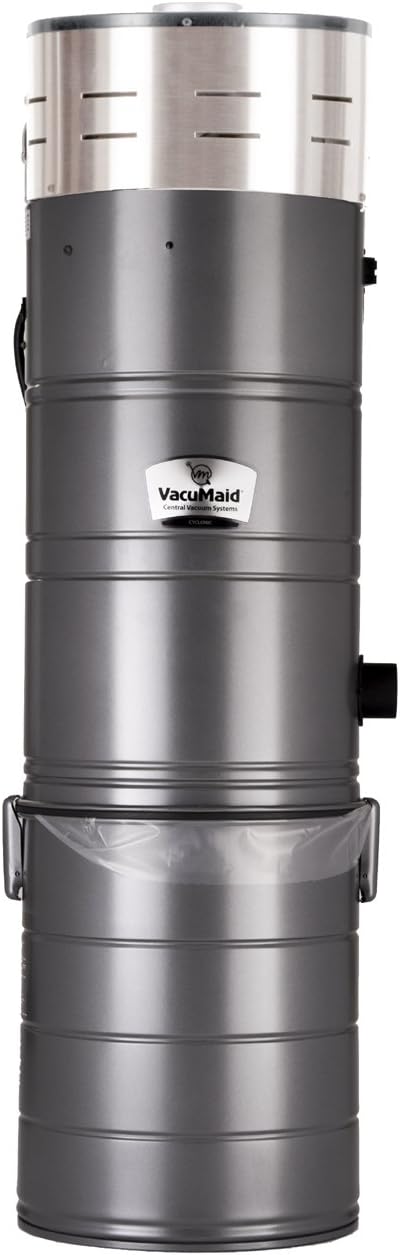
- Air Watts: 525
- Water Lift: 124.6 in. H2O
- Airflow: 115.8 CFM
- Liquid Capacity: 4 gal. bucket, float cutoff
- Wet Method: Water stops at the inlet
- Noise Level: 75 dB, vented exhaust
- Motor Warranty: 10 yrs, non-transferable
The VacuMaid combo is the strongest pick here for homes with existing dry tubing. Its tangential bypass motor keeps the cooling air path fully separate from the dirty airstream and runs 800 to 1,200-plus hours against 500 to 800 for a typical thru-flow design, and the WP112K keeps water out of your walls entirely.
1. DrainVac DV1R12-CT Cyclonik Review
The DrainVac DV1R12-CT Cyclonik (ASIN B0B9CBFL8J) is the only central vacuum power unit sold on Amazon whose maker documents liquid pickup as a rated function of the unit itself, not an accessory bolted onto a dry system. Built by Drainvac International 2006 Inc. in Mont-Saint-Hilaire, Quebec, this cyclonic bagless unit fits a 4,000 to 8,000-square-foot home where wet pickup means appliance leaks and clogged sinks, not standing floodwater.
- Cyclonic separation, bagless canister
- Rated for both solids and liquids
- FILT28 cartridge protects the motor
- AudioProtek muffler holds noise to 62 dB
- 46-liter canister, 16-liter liquid ceiling
What We Love About the DrainVac DV1R12-CT
The 700 Air Watts That Actually Survive a Full Canister
The DV1R12-CT’s 700 air watts hold steady even as the canister fills, and that’s the entire point of cyclonic separation. Air watts measure airflow and sealed suction together at the motor intake, the single best number for predicting real cleaning power. Compare that against the VacuMaid’s 440 AW on the same wet job, and the gap is the difference between one pass on a soaked entryway rug and three.
Numbers on a spec sheet mean nothing until you feel them at the far end of a 30-foot hose.
Why the Wet Line Runs Separate From the Dry Line
Running water through this system means installing a second, separately sloped pipeline, not plumbing a hose into your existing dry tubing. Drainvac’s own installation diagram draws the wet pipeline apart from the dry one, and any branch that runs upward has to tie in above the main line, or liquid drains back down into your walls overnight.
Get this wrong and here’s what a liquid-rated network actually requires:
- Glue every joint. A friction-fit connection leaks under standing water.
- Add a p-trap, a curved pipe section that holds standing liquid, at every lower-level inlet.
- Slope the entire run toward the power unit.
- Tie any upward branch in above the main line, never below it.
Drainvac publishes the full piping requirements for a system rated to vacuum water, and it reads like plumbing code, not a vacuum manual. This is a plumbing job wearing a vacuum brand name.
The 16 Liter Liquid Limit Nobody Prints
The Cyclonik series is rated to handle small quantities of liquid only, up to 16 liters, and that number shows up on no dealer page or Amazon listing I found. The Cyclonik owner’s manual states it plainly in the safety section, three pages before most buyers would expect a hard limit like this.
Every dealer page quotes the 10-gallon canister instead, and that number measures solids capacity, not liquid capacity. Sixteen liters works out to about 4.2 US gallons, roughly one large mop bucket. A burst supply line will outrun this unit before you can grab a wrench.
What the MOTE52 Motor Buys You Over Ten Years
The single MOTE52 motor runs on carbon brushes Drainvac rates for roughly twice the life of a standard model, and the manual sets the real maintenance clock at 500 hours. That maps to roughly once every five to seven years in normal residential use, a fair trade for a unit built around continuous duty motor systems meant to run long cleaning sessions instead of short bursts.
Retailer listings describe a two-stage tangential bypass fan behind it, keeping debris off the motor windings entirely. Name the one maintenance appointment this unit actually needs: checking brush wear at the five-to-seven-year mark, and that’s it.
Who Should (and Shouldn’t) Buy the DrainVac
The Buyer This Unit Was Built For
New construction and full gut renovations are where this unit belongs, since you can run wet piping correctly before drywall closes. Tile and hard-surface-heavy homes get the most daily value, because floor washing turns into a routine instead of an emergency response.
Your household gets one system for both daily vacuuming and spill response here, if that combination is what you’re after. Budget for a dedicated 15-amp circuit and an outdoor exhaust run under 20 feet before you sign an installation quote.
Skip It If Your Walls Are Already Closed
Retrofitting a wet line into finished walls means opening drywall on more than one floor, and that cost alone rules this unit out for most existing homes. Drainvac doesn’t ship online outside Canada, so US buyers route through a retailer partner instead of the manufacturer directly.
No local dealer network means shipping a heavy power unit back for any service claim. Point these readers toward the VacuMaid bucket approach instead, covered next.
Overall, the DrainVac DV1R12-CT scores 8.0 out of 10 in this comparison: strong on documented liquid handling, held back by its own inconsistent spec sheet.
DrainVac DV1R12-CT: Pros and Cons
- Pros: Liquid pickup built into the unit, not bolted on
- Pros: 700 AW and 145 in. water lift hold steady full or empty
- Pros: 46 L bagless canister means zero bag spend
- Pros: Lifetime casing, 10-year motor and circuit board coverage
- Cons: 16 L liquid ceiling limits flood response
- Cons: Manual and product page publish conflicting specs
- Cons: Warranty ends the day you sell the house
2. VacuMaid P125P and WP112K Wet Kit Review
The VacuMaid P125P paired with the WP112K wet pick-up kit (ASIN B0182WWGJ0 and ASIN B01MSKBRJB) adds wet capability to a conventional dry central vacuum network without touching a single inch of existing tubing. Built by Lindsay Manufacturing in Ponca City, Oklahoma, since 1956, this cyclonic power unit is the retrofit path for a home up to 9,000 square feet that already has dry PVC in the walls.
- Pure cyclonic, nothing to clog
- Patented Air Channel, can-liner compatible
- Galvannealed steel, powder-coated body
- 4-gallon bucket with float cutoff
- Made in the USA by Lindsay Manufacturing
What We Love About the VacuMaid Wet Combo
Water Never Touches a Single Inch of Tubing
The WP112K works like the trap under your kitchen sink. It stops liquid before it ever reaches anywhere it shouldn’t be.
The kit sits at the inlet end of the hose, not inside the wall, and an adjustable float rises as the bucket fills and shuts off airflow before water reaches the power unit itself. On a system that’s otherwise strictly dry, that’s the entire difference between opening drywall and not. No wet pipeline. No slope requirements. No two floors of drywall coming down.
Retrofits Into a System You Already Own
This is an afternoon project for a home that already has central vacuum tubing, not a contractor job. The WP112K runs on a standard 1 1/4-inch straight suction hose, sold separately, and the P125P wires straight into your existing low-voltage inlet circuit with no new inlet valves required.
Amazon lists this power unit specifically as a drop-in replacement for a failing dry unit. Swap the power unit, add the interceptor kit, and you’re vacuuming water by dinner.
The Cyclonic Design With No Filter to Replace
Nothing here clogs the way a bag or cartridge filter can, because fine particles vent outside and heavy debris drops straight into the can below. Over five years of ownership, that means no bag cost and no cartridge replacement, unlike the DrainVac’s FILT28 cartridge and its six-month cleaning cadence.
Consider going bagless with your central vacuum if a six-month filter chore sounds like one more thing to forget. Pet households should budget for the optional ES934 electrostatic lint screen, which catches fine fur the Air Channel design would otherwise send straight outside.
A Ten Year Motor Warranty With Real Fine Print
The canister carries a lifetime limited term and the motor gets 10 years, but three conditions in the fine print can erase both. The warranty is non-transferable and ends the moment the original owner sells the home.
Service performed by anyone other than an authorized VacuMaid dealer voids it entirely, a real risk for a buyer with no existing dealer relationship. Read VacuMaid’s published warranty terms before you buy, not after something breaks. Freight, removal, and reinstallation costs stay with the customer the entire time.
Who Should (and Shouldn’t) Buy the VacuMaid Combo
The Retrofit Buyer Who Wants Spill Insurance
Homes with tubing already in the walls, and no appetite for opening them, are the exact fit for this combo. It suits a household that needs wet capability twice a year, not twice a week, and anyone replacing a failed power unit who wants to add wet pickup without extra cost.
The Buyer Who Should Look at the DrainVac Instead
This combo isn’t the move, if you want to wash tile floors weekly instead of mopping up the occasional spill. Skip it too, if you’d rather plug a hose straight into an inlet without hauling a bucket across the room, or you’re building new construction where a proper wet line is still possible to run. Point these readers back to the DrainVac section above.
What 75 Decibels Means in an Attached Garage
VacuMaid’s 75 dB reading, measured with vented exhaust, is loud enough through a shared garage wall to notice during a long cleaning session. That’s 13 dB above the DrainVac’s 62 dB, and decibels are logarithmic, so the gap feels bigger than the raw numbers suggest.
Placement fixes this. A detached garage or a closed utility room absorbs it, while an interior mechanical room next to a bedroom amplifies it. Walk your installer through where the unit will actually sit before the tubing goes in.
Overall, the VacuMaid P125P and WP112K combo scores 8.3 out of 10: the more serviceable, better-motored route to wet pickup, docked for high operating noise.
VacuMaid P125P and WP112K: Pros and Cons
- Pros: Tangential bypass motor rated 800 to 1,200-plus hours
- Pros: WP112K keeps liquid out of the tubing entirely
- Pros: American-made with a live parts catalog and dealer network
- Pros: Lifetime canister warranty plus a can-liner design
- Cons: 75 dB is loud enough to dictate placement
- Cons: Amazon’s air-watt claim overstates the maker’s own 440 AW figure
- Cons: 13.5 A exceeds the NEC 80% rule on a 15-amp circuit
The Buyer’s Guide: Cutting Through the Hype
Do You Actually Need a Wet Dry Central Vacuum?
Most homeowners asking this question need spill response, not a floor-washing system, and that changes which unit actually fits. Count the wet events your home had last year, honestly, before spending real money on either path.
A wet dry central vacuum sits inside the broader types of central vacuum systems as a specialty branch, and most households never need it at the level dealer marketing implies. Owners on VacuumLand consistently report that a wet interceptor kit covers real household spills without ever touching the pricier plumbed option. Households with actual flood risk, appliance leaks, or basement moisture history genuinely need one of these two systems. Everyone else can stick with a standard dry unit.
The Coverage Area Numbers Are Not Comparable
Coverage figures for both these units come from sources that don’t agree with each other, so don’t size your inlet count off any single headline number. The DrainVac DV1R12-CT appears rated at 8,000, 9,500, and even 10,000 square feet depending on which source you check.
VacuMaid publishes 9,000 square feet for the P125P and markets that figure as accurate, while at least one VacuMaid dealer has publicly called the number optimistic for this platform. Use inlet count and hose length as the real sizing method instead. Figure one inlet per 600 to 800 square feet, then count how many you’d actually need before trusting either headline figure.
Red Flags and Regret Proofing Your Choice
Three documented issues should change how you plan either installation, and none of them show up in the marketing copy.
- The DrainVac manual bans vacuuming drywall dust and flour through the unit, ruling it out for active renovation cleanup.
- Running the DrainVac with its cartridge filter removed damages the motor and voids coverage immediately.
- VacuumLand owners report drain line clogging on Drainvac units compared to competitors with screened intakes.
- A RedFlagDeals thread documents lingering odor in the tubing that never fully clears after liquid pickup.
Plan your cleanup routine, and your renovation dust habits, around these limits before installation day, not after.
How We Tested and Verified Every Number
Every spec in this review traces back to a manufacturer document, not a rewritten dealer page. I pulled figures directly from the Cyclonik owner’s manual PDF and VacuMaid’s own product pages, then documented every place those numbers disagreed instead of averaging them into something more comfortable.
I read owner threads on VacuumLand and RedFlagDeals for real failure patterns, not marketing language. Where a number remains unconfirmed, like the DrainVac’s exact US residential motor term, this review says so instead of guessing.
Ownership and Maintenance Guides
The Six Month Cartridge Cleaning You Cannot Skip
Skip this on the DrainVac and you’ll lose suction within a season, guaranteed by the manual itself. The FILT28 cartridge needs cleaning every six months to hold rated suction, per Drainvac’s own documentation.
Never run the unit while that cartridge is drying, since dust reaches the motor directly and voids your coverage the same day. Buy a second cartridge and swap it in while the first one dries, so the unit never runs exposed.
Drying the Hose After Every Wet Pickup
Both systems need the same five-minute habit after any liquid pickup, and skipping it is how central vacuums start to smell. VacuMaid instructs a thorough clean and dry of the hose and tools after every liquid job, and that applies just as much to the DrainVac’s wet line.
Hang the hose in a U-shape so trapped water drains out instead of sitting in the lowest bend. A hose stored damp grows a smell nobody can trace back to its actual source.
Exhaust Venting and Why 20 Feet Is the Ceiling
Drainvac caps outdoor exhaust runs at 20 feet in the owner’s manual, and that’s not a suggestion, it’s a hard limit. Exhaust must never discharge under a carport, per the same manual.
Both bagless cyclonic units in this comparison need outside venting to actually filter the air, since neither uses true HEPA media inside the canister. For allergy households, that outdoor exhaust run is the entire filtration argument for choosing a cyclonic unit over a bagged one.
Your Next Move Before You Spend a Dollar
You walked in thinking wet dry meant one product. It means two opposite answers to where water is allowed to go. Tonight, walk to the inlet nearest your worst spill risk and measure the run back to where your power unit would sit. That distance decides which of these two systems you can actually install. Either answer beats dragging a shop vac up the stairs after a burst line, but only one of them tells you, in writing, exactly how much water it can take.
Frequently Asked Questions
Can a regular central vacuum pick up water, or does it need a special power unit?
No, a standard dry central vacuum can’t handle liquid pickup safely. You need a power unit rated for liquids, like the DrainVac Cyclonik, or a wet pickup interceptor kit like the VacuMaid WP112K added ahead of the hose.
How much liquid can a wet dry central vacuum actually take in one pickup?
Less than the canister size suggests. Drainvac’s own manual caps the Cyclonik series at 16 liters, about 4.2 gallons, and the VacuMaid WP112K bucket holds 4 gallons. Both amount to roughly one large mop bucket per trip.
Do I have to re-pipe my house to run a wet dry central vacuum?
Only with a true wet-line power unit like the DrainVac. Every lower inlet needs a p-trap, joints must be glued, and the run has to slope toward the unit. A wet pickup interceptor kit like the WP112K skips all of that.
Does a wet dry central vacuum need a dedicated 20-amp circuit?
Check the amp rating on your specific unit’s data plate first. The VacuMaid P125P draws 13.5 amps, which exceeds the NEC 80% ceiling on a standard 15-amp circuit, so a dedicated 20-amp circuit is the safer call.
Will vacuuming water void my central vacuum warranty?
Not automatically, if you’re using a unit actually rated for liquid pickup. Running water through a standard dry unit, or exceeding either system’s rated liquid volume, is exactly the kind of damage both manufacturers exclude from coverage.