You want the suction of a whole home central vacuum without opening a single wall. That is what a portable central vacuum promises, and it is why the search results are such a mess. Three sellers quote three amp ratings for the same motor family, and “portable” gets stamped on a unit that needs an 11 by 6 inch hole cut into a finished wall.
We pulled manufacturer documentation only, not dealer copy, on the InterVac GarageVac GH120, the InterVac RoadVac CS8, and the Allegro MU2100. By the end you will know which one actually lifts off the wall, which one needs a dedicated circuit, and which warranty quietly excludes its own marketed use case.
Portable Central Vacuum Our Top Picks at a Glance

- Air Watts: 525
- Water Lift: 125 inches
- Airflow: 121 CFM
- Max Amps: 13.8
- Dirt Capacity: 0.5 gallon
- Filtration: Washable cloth, bagless
- Warranty: 3 years parts

- Air Watts: 512
- Water Lift: 110 inches
- Airflow: 121 CFM
- Max Amps: 10.7
- Dirt Capacity: 1 gallon
- Filtration: Bagged, three stage
- Warranty: 2 years
- Air Watts: 394
- Water Lift: 104 inches
- Airflow: 111 CFM
- Max Amps: 10
- Dirt Capacity: 1 gallon
- Filtration: Bagged, Y10 series
- Warranty: 2 years
The Allegro MU2100 earns the strongest pick in this table because it is the only unit publishing a full matched spec sheet, air watts, water lift, CFM, amps, and decibels, that a buyer can actually verify against the box.
1. InterVac GarageVac GH120 Review
The GarageVac GH120 is a wall mounted power unit built for a garage, workshop, or utility room, and it is the only one of these three you can unscrew and physically carry somewhere else. It fits homes and garages between 400 and 900 square feet where a standard 15 amp outlet already exists on the wall.
- Lifts off the wall in seconds
- Stretch hose runs 8 to 35 feet
- Nine pound polycarbonate body
- Onboard caddy holds every tool
- Flush mounts into 2×4 framing
What We Love About the GarageVac GH120
Which Portable Central Vacuum Actually Comes Off the Wall?
The GH120 is the only unit here you can genuinely relocate. Nine pounds means one hand lifts it down, no tools, no helper. One owner moved a GH120 from a garage wall to a boat cabin over a single weekend, unscrewing four mounting screws and rehanging the bracket on the other end.
Compare that to the RoadVac CS8, which lives inside a cut wall permanently once installed, secured behind a cutout frame with clamp screws you cannot back out without disturbing the panel around it. That difference is the whole point of the word portable, and it belongs to exactly one unit here.
Why 512 Air Watts and 415 Air Watts Both Appear
InterVac’s own documents disagree with each other on this unit’s suction rating. The GH120 product page lists 512 air watts, a measurement that combines airflow and sealed vacuum pressure into one working suction number, while InterVac’s own owner manual states 415. ThinkVacuums lists a third figure at 400, with no test standard named anywhere.
Buy on the 415 figure. It comes from the manual, the more conservative of the two InterVac sources, and conservative is the right way to shop a spec that already contradicts itself.
Does the Stretch Hose Reach the Driveway or Not?
InterVac and both Amazon listings agree on 35 feet, though several third party retailers claim 40. That five foot gap decides whether the hose reaches the far side of a parked car or stops short at the bumper.
Owners describe the stretch hose fighting them on the pull, coiling back toward the wall port the moment they stop. InterVac sells a standard 30 foot hose without the stretch coil for buyers who would rather drag a straight line than wrestle a spring.
What a One Gallon Canister Means for Real Garage Debris
One gallon and seven pounds of compacted debris is the published capacity, and InterVac rates each Y08-5 bag at roughly four months of life. That number assumes light detailing work, not a seasonal cleanup. Sweep up one fall’s worth of leaves and grass clippings, or clean up after a drywall patch job, and you will fill that bag in one session. Budget replacement bags as a recurring line item, because at $3.77 per bag the real cost tracks how much debris moves through the unit, not the calendar.
Curious how this compares to a full pipe network running through the walls? Read how central vacuum systems work before you commit to either path.
Who Should Buy the GH120 and Who Should Skip It
The Detailer With a Finished Garage Wall
Buy the GH120 for car interiors, workbenches, and a garage under about 800 square feet where the vacuum needs to stay visible, not buried in a cabinet. The tool caddy matters more here than raw suction, since a detailer switches tools constantly during a single job.
Skip It If You Vacuum Drywall Dust Weekly
Skip the GH120 if fine drywall or saw dust is a weekly part of your cleanup. InterVac’s CS series manual bars drywall and saw dust outright, and the same bagged motor family applies here. Fine dust loads a bag fast and starves airflow, and starved airflow cooks a motor already running at 10.7 amps. Choose the Allegro MU2100 instead for fine debris, then read its residential-only warranty clause before you buy.
Pros and Cons: InterVac GarageVac GH120
- Pros: Runs on a standard 15-amp outlet
- Pros: Only unit here you can truly relocate
- Pros: Ribbed bag chamber holds suction until full
- Pros: Lowest annual bag cost in this roundup, about $11
- Pros: Onboard caddy keeps every tool within reach
- Cons: Marketed for outdoor use InterVac’s own manual forbids
- Cons: Suction drops noticeably at full 35-foot hose extension
- Cons: Air watts, CFM, and amps conflict across InterVac’s own sources
2. InterVac RoadVac CS8 Review
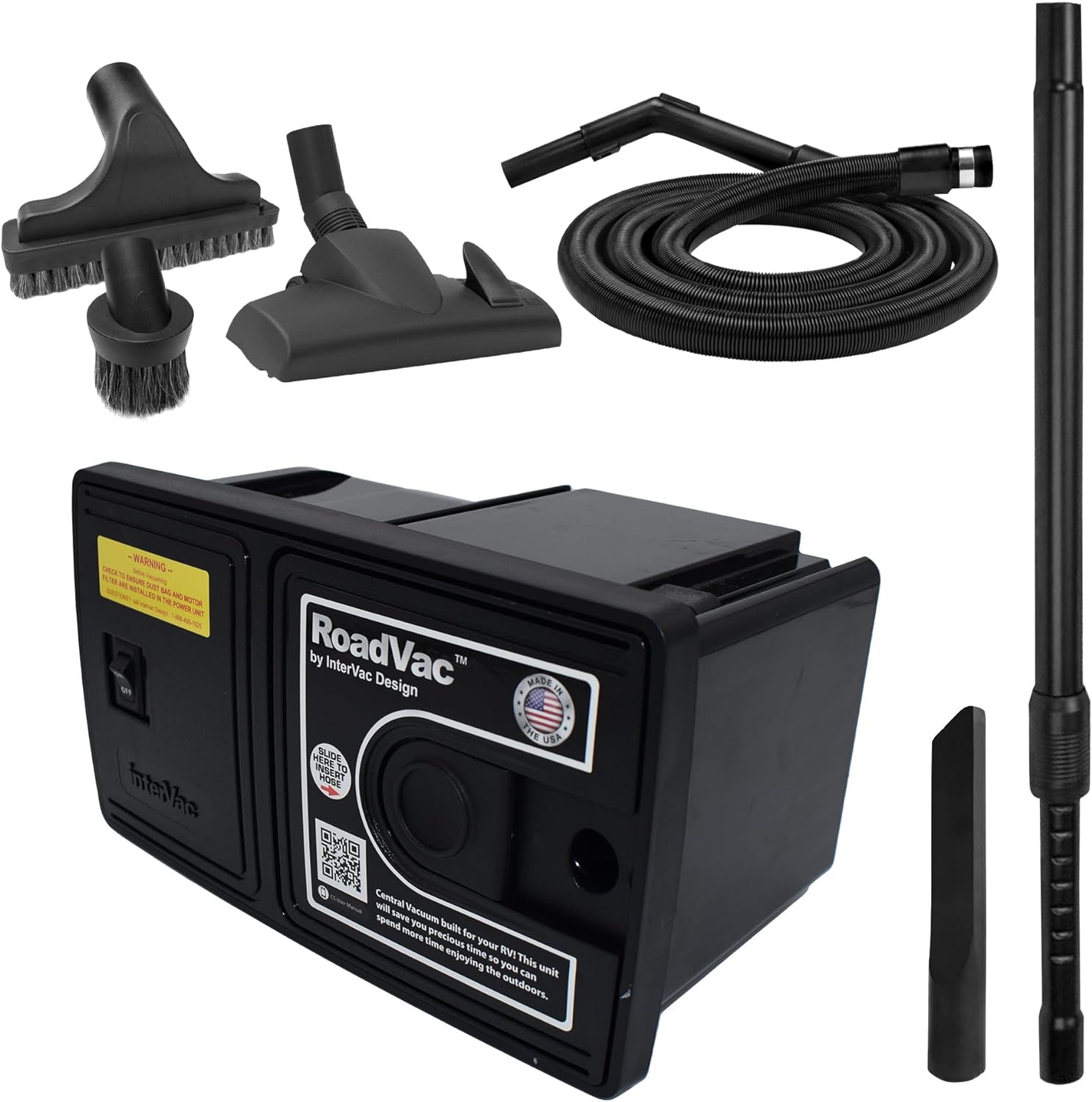
The RoadVac CS8 is the smallest footprint in this roundup, built to disappear entirely inside a cabinet wall in a travel trailer, Class B van, or tiny home. It fits where total depth behind the wall is under 7 inches, and the tradeoff is a near total absence of published performance data.
- Smallest footprint of the three
- Hides fully inside cabinet walls
- Ships with 35 foot stretch hose
- Weighs roughly five and a half pounds
- Lowest entry price of the group
Why This Unit Publishes No Suction Number at All
InterVac never states an air watt, water lift, or CFM figure for the CS8, anywhere. The product page lists dimensions, housing material, and UL certification in detail, then calls the unit “the most powerful vacuum in its class” without a single number behind it.
Every competing review we found repeats that line without noticing the missing figure. Call InterVac and request the air watt rating in writing before you buy at this price. A decline to put a number on paper is itself the answer.
The Cutout That Makes Portable the Wrong Word
Installing the CS8 means cutting an 11 inch wide, 6 inch high, 6 inch deep hole into a finished wall, with wall thickness required to fall between three eighths of an inch and one full inch. Cut that hole into a travel trailer wall and you have modified the coach permanently, not installed an appliance you can remove without a patch job.
This is a built in unit sold at a portable price, and the difference matters the moment you go to sell the RV. For a sense of what a permanent pipe based system looks like by comparison, see other central vacuum system types.
What Happens When You Bury It in a Cabinet
InterVac’s manual requires an exhaust path out of any confined cabinet install, either a 3 inch louvered vent or the AS-61 exhaust fitting routed outside the cabinet. Skip that step and trapped exhaust recirculates heat straight back into the motor housing.
A clogged hose triggers a thermal shutoff, and the manual specifies a full hour cooldown before restarting. Owners on iRV2 and etrailer both report units shorting and throwing sparks after running buried in an unvented cabinet, exactly the install Amazon’s own listing photos promote.
Who Should Buy the CS8 and Who Should Skip It
The Class B Owner With One Cabinet to Spare
Buy the CS8 for van conversions and small trailers running a single tile or vinyl floor plan from one central cabinet. It ships with the full tool kit, so there is no hidden accessory purchase, and you already accept a permanent cutout in exchange for a unit that disappears completely once installed.
Skip It If You Want Published Performance Data
Skip the CS8 if you need a number to compare against anything else you are considering. No air watts, no water lift, no CFM means there is nothing to benchmark. Choose the GH120 if you want a verified suction figure at a similar price point, or choose the MU2100 if you want a full spec table backed by a named replacement motor.
Pros and Cons: InterVac RoadVac CS8
- Pros: Smallest documented install footprint in the category
- Pros: Manufacturer supplies a paper cutout template
- Pros: Factory exhaust fitting solves the cabinet overheating failure
- Pros: Lowest entry price in this roundup at $177.91
- Cons: Zero published air watts, water lift, or CFM
- Cons: Wall thickness window and vent requirement hide in the manual only
- Cons: Sealed housing means no owner-serviceable motor repair
3. Allegro MU2100 RV Central Vacuum Review
The Allegro MU2100 is the correct pick for a bus conversion, boat, workshop, or cottage running a 20 amp circuit, and it is the only unit here with a fully published spec sheet you can hold up against any full size power unit. That transparency comes paired with an amp draw that rules it out for a lot of the RVs it gets marketed toward.
- Full published spec table
- Two stage bypass tangential motor
- All steel body, washable filter
- Hangs on bracket or sits freestanding
- Ametek Lamb replacement motor available
What We Love About the Allegro MU2100
Bypass Motor Design Is Why Bagless Works Here
A bypass motor cools itself on a separate air path, never the dirty stream you are vacuuming, which is why running this unit without a bag does not shorten its life.
Allegro’s spec sheet names the MU2100’s motor two stage, 5.7 inch, bypass, tangential discharge, built by Ametek Lamb under part number 119913. A thru flow motor cools on the same dirty air it pulls in, so running one bagless wears it out faster. The washable cloth filter here is a safe design choice, not a corner cut, because the motor architecture supports it.
Does 525 Air Watts Beat Both InterVac Units?
Allegro publishes 525 air watts, 125 inches of water lift, a measurement of sealed suction that determines whether grit actually pulls out of carpet pile, and 121 CFM. The GH120 posts 110 inches of water lift by comparison, and the CS8 posts nothing at all.
This is the only unit in the roundup you can benchmark directly against a full size whole home power unit, because Allegro is the only manufacturer here disclosing all three headline numbers together.
The Only Unit You Can Set on the Floor
Allegro ships a wall bracket with the MU2100, and the company’s own copy describes it as a stand alone machine or a piped system, buyer’s choice. One owner moved a single MU2100 between a cottage, a barn, and a travel trailer across three seasons, setting it on a shelf each time. At 8.5 inches across and 20 inches tall, it fits a storage bay or under a sink with room to spare.
No cutout required, genuinely movable between properties in a way the CS8 never will be.
Half a Gallon Against a 3,000 Square Foot Claim
Allegro rates the MU2100 at 3,000 square feet of coverage on a 0.5 gallon collection chamber, half the GH120’s capacity covering roughly four times the marketed floor area. A real 3,000 square foot install also needs four to five inlet valves at $29.99 each, none of which ship in the box.
Treat the 3,000 square foot figure as a description of what the motor can theoretically push through pipe, never a promise about how often you will empty the chamber. In a household with pets, plan on emptying it every session.
Who Should Buy the MU2100 and Who Should Skip It
The Fifth Wheel Owner Running 50 Amp Service
Buy the MU2100 if your rig runs 50 amp shore power or a home garage circuit rated for 20 amps. At 13.8 amps, this unit draws nearly half of a 30 amp shore power pedestal before anything else in the coach turns on, so a 30 amp RV needs to stage the air conditioner and microwave around it rather than run them together.
Skip It If Your Warranty Claim Would Be an RV
Skip the MU2100, or get it in writing first, if you are installing it in an RV, boat, or bus. Allegro’s warranty document states coverage applies to residential applications only, while the company markets this exact unit for RVs, buses, boats, barns, and cottages. The corrosion guarantee runs for as long as you own your home, a condition no coach or hull can ever satisfy. Get written confirmation from Allegro before you buy for a vehicle install, because the marketing copy and the warranty document do not describe the same product.
Pros and Cons: Allegro MU2100
- Pros: Only fully published spec sheet in this roundup
- Pros: Confirmed two-stage bypass motor with a named OEM part
- Pros: Zero recurring bag cost from the washable filter
- Pros: Field-replaceable motor and control module
- Pros: Draws roughly 46% of a 30-amp RV pedestal alone
- Cons: Exceeds 15-amp circuit limit, requires 20-amp service
- Cons: Warranty covers residential applications only
- Cons: No HEPA stage, and a 0.5-gallon chamber empties often
The Buyer’s Guide: Cutting Through the Hype
The Three Specs That Decide a Portable Unit
Air watts, water lift, and amp draw are the three numbers that decide whether a portable central vacuum fits your home. Air watts combine airflow and sealed suction into one working performance number. Water lift in inches decides whether grit lifts out of carpet pile or just gets pushed around.
Amp draw decides whether the unit runs at all on a 30 amp shore power line without tripping a breaker. A seller who publishes none of these three is asking you to buy blind, and the CS8 is the clearest example of that gap.
Portable, Compact, and Built In Are Not the Same Word
Portable means you lift it and carry it, no tools, no cutout, no wall patch left behind. Compact just means small, and small tells you nothing about whether the unit actually moves. Built in means a permanent hole, which is what the CS8 requires no matter how the listing photos frame it. Check the installation manual before you trust the word on the sales page, because retail copy and manufacturer instructions do not always agree.
Red Flags and Regret Proofing Your Choice
RV owners on iRV2 describe wrestling a stretch hose across a carpeted coach like fighting an anaconda, and one owner running three coaches called central vac not worth the money against a good stick vacuum. Two independent owners report units shorting and throwing sparks before failure, both tied to buried, unvented cabinet installs.
Factory units sometimes ship with spare bags stored inside the housing, strangling suction on the first run until someone finds them. None of this shows up in a five star Amazon rating, because it surfaces weeks after the return window closes.
What Amazon Listings Do Not Tell You About Kits
The Allegro ASIN in this roundup is listed unit only, with the hose, adaptor, and every tool sold separately at checkout. Adding Allegro’s deluxe hose package or the air turbo powerhead reshapes the total cost by well over a hundred dollars before you have vacuumed a single room.
Using the MU2100 as an actual working central vacuum requires an inlet kit and a hose adaptor assembly at minimum. Both InterVac ASINs include a full tool kit in the box, which changes the real price comparison once you price out what the Allegro needs to function.
How We Tested
Every spec in this review came from manufacturer spec tables and owner manuals, never retailer copy. Every place a manual disagreed with a product page, we printed both figures rather than averaging them into one clean number neither source actually published. Owner failure patterns came from verified buyer threads on iRV2, Garage Journal, and etrailer. Blank cells in our comparison table stayed blank on purpose, because a manufacturer declining to publish a number is itself a finding, not a gap to paper over.
Ownership and Maintenance Guides
Bag and Filter Costs Over Five Years
InterVac’s two bagged units carry a permanent recurring bag cost the Allegro simply does not have. The MU2100’s washable cloth filter costs nothing to replace, though it needs a full rinse and a full dry between uses. InterVac’s four month bag estimate assumes light detailing loads, not seasonal deep cleans or a busy household. Multiply your actual fill rate, not the manufacturer’s estimate, across five years before you call the CS8 the cheap option in this roundup.
Rinsing the Cloth Filter Without Voiding Coverage
Allegro voids the MU2100’s warranty for removing the filter, whether that removal was intentional or accidental during a cleaning session. Running the unit even briefly without the filter in place voids coverage under that same clause. Dry the cloth filter completely before reinstalling it, since a damp filter blinds airflow and can trip the same overheating protection a clogged hose does.
Vacuuming drywall dust or other fine material voids the warranty outright, on this unit and on both InterVac models.
Clearing a Clog Before You Call It Dead Suction
Check the hose first, since it is narrower than any pipe or duct behind it and clogs faster than anything else in the system. Pull any spare bags stored inside the housing out before the first use on a new unit, a step that solves a surprising number of first day complaints.
Check every friction fit flex pipe joint next, since owners report these separating and creating a hidden clog point behind the wall. A hose clog trips a thermal shutoff on all three units, so give the motor a full hour to cool before restarting.
Thermal Shutoff and What It Actually Signals
The lower body runs hot during normal use, and InterVac says so directly in its manual rather than treating it as a defect. Restart the unit with the hose completely removed and run it for ten minutes to confirm the clog was in the hose. Repeated shutoffs point to a starved filter or a buried cabinet install with no exhaust path, not a failing motor. Cabinet installs need a cut exhaust path from day one, and it is the step most owners skip during a rushed weekend install.
Living With 75 Decibels Inside a Trailer
Allegro publishes 75 decibels for the MU2100, and neither InterVac unit publishes a noise rating at all. In a house, a full size power unit sits in the garage or basement, so the noise never reaches the living space in any meaningful way. In a trailer, boat, or garage bay, the motor runs in the same room you stand in, so that 75 decibel figure is not a background number, it is what you hear at arm’s length. Allegro sells a universal exhaust muffler worth adding on any interior install where the motor and the people share the same air.
For an unconventional budget route around all three of these units, see converting a shop vac for central use.
Conclusion
Portable is a listing word here, not a spec, and now you can tell the difference. The GH120 actually relocates. The CS8 is a built in unit wearing a portable price tag. The MU2100 has the most honest spec sheet and the least honest warranty for how it gets marketed.
Measure your cabinet depth and check your shore power rating tonight, before you request a quote or click buy. Real central vacuum suction with no wall cutting is the whole point of this category, and now you know which unit delivers it. Need help sizing a full pipe based system instead? Start with our guide to find the right unit size for your home.
Frequently Asked Questions
Is a portable central vacuum actually portable, or is it a built-in unit?
It depends entirely on the model, not the word on the box. The GarageVac GH120 is genuinely portable, unscrew it and carry it elsewhere. The RoadVac CS8 requires a permanent wall cutout, which makes it a built in unit at a portable price.
Can a compact central vacuum be installed inside a cabinet or under a sink?
Yes, but only with proper exhaust ventilation. InterVac’s own manual requires a 3 inch louvered vent or an exhaust fitting for any confined cabinet install. Skip that step and the motor overheats, shuts down, and can throw sparks in extreme cases.
Does a portable central vacuum need its own circuit breaker?
Sometimes. The GarageVac GH120 and RoadVac CS8 both stay under the 12 amp ceiling for a standard 15 amp circuit. The Allegro MU2100 draws 13.8 amps and needs a dedicated 20 amp circuit that no seller discloses on the product page.
Do compact central vacuum units have true HEPA filtration?
No, not among the three units in this roundup. None publish the EPA and DOE HEPA threshold of 99.97% capture at 0.3 microns. The GH120 describes “hypoallergenic” filtration without an efficiency number, and the MU2100 has no HEPA stage at all.
Does the manufacturer warranty still apply if I install the unit in an RV or boat?
Get it in writing before you buy, because the answer is not automatically yes. Allegro’s warranty document states coverage applies to residential applications only, even though the MU2100 is marketed directly for RVs and boats.