A central vac power unit is the motor and canister that decide whether your whole-house vacuum still pulls hard in year fifteen. Most buyers shop the one number on the box: air watts. That figure is measured at the motor, not your hose end, and it hides the motor type inside.
This guide names the three specs that predict real performance, the motor type worth paying for, and the wiring rule that sets your install cost. Whether you’re swapping a tired motor or replacing your central vacuum system, you’ll know what to demand and what to skip.
Central Vac Power Unit
A central vac power unit is the motor and dirt canister, mounted away from living space, that power every inlet in a whole-house vacuum system. Motor type and air wattage decide whether it lasts five years or twenty. It matters most to first-time buyers and anyone replacing a dead motor.What You’re Buying When You Buy a Power Unit
A central vac power unit is the sealed motor assembly and dirt canister that hang in a garage, basement, or utility closet, not the pipes or inlets in your walls. Everything that wears out fast lives outside this box. Everything that lasts decades lives inside your walls already.
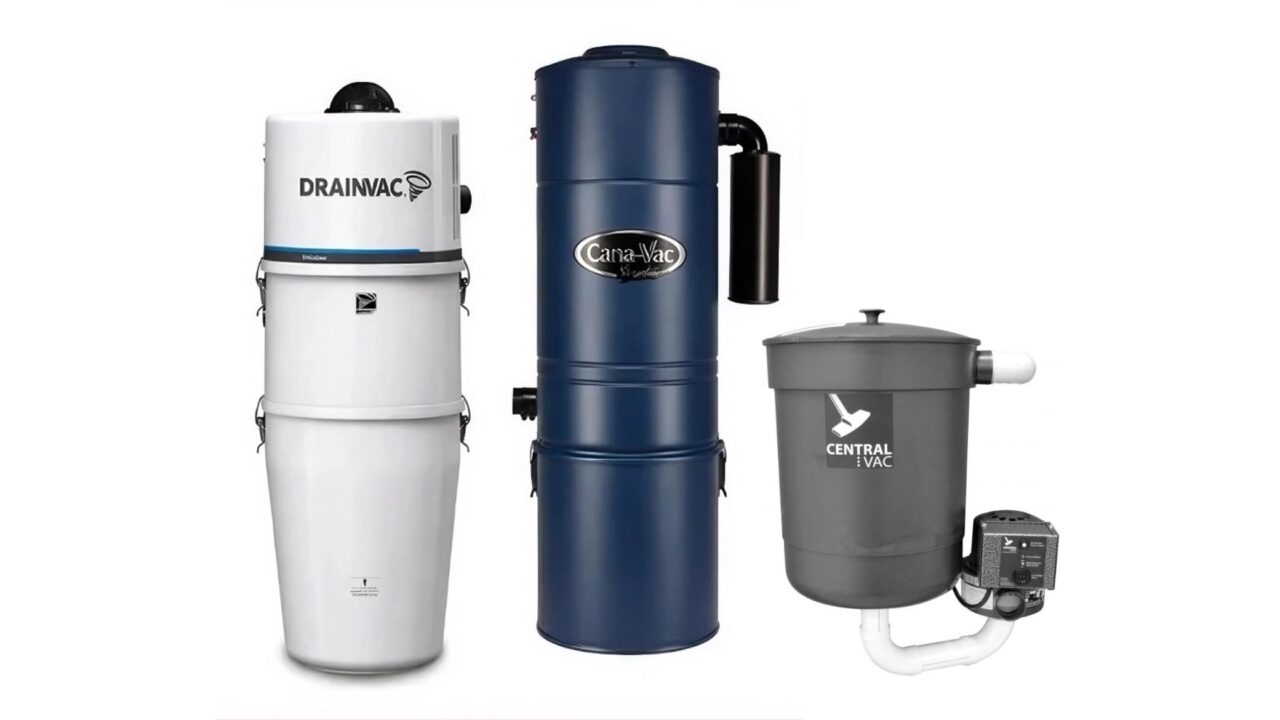
It’s the Motor and Canister, Not the System
The power unit is just the motor and canister mounted away from living space, separate from the pipe network you already have or are about to install. Your in-wall pipes will outlast every power unit you ever hang on that wall. PVC tubing doesn’t wear, corrode, or lose suction on its own.
And here’s what nobody tells first-time buyers: swapping the unit later is a bolt-off, bolt-on afternoon, not a renovation. Most replacement power units mount on the same bracket, on the same two pipes, with the same low-voltage wire. You’re not redoing your house. You’re replacing one box.
Why This One Box Decides Your Next Twenty Years
This one box decides your next twenty years because hoses, handles, and powerheads wear out on a five-to-seven-year cycle while the motor unit is the long bet you make once. Owners on vacuum forums say the unit rarely fails first. Hoses crack at the cuff. Handles lose their switch contact. The motor keeps running underneath all of it.
Buy for the motor inside the box, not the accessory kit bundled around it. A retailer who leads with “free hose and powerheads included” is padding margin on the one part of the system that needs replacing anyway. Ask what’s spinning inside the canister before you ask what’s in the box.
What’s actually spinning in there? That’s the next question worth answering before you compare a single price tag.
The Air Watt Number Most Dealers Hope You Trust
Air watts measure cleaning power by blending suction strength and airflow into one figure, but that figure is captured at the motor under a restricted test orifice, not at your hose end where you actually clean. Some listings skip air watts entirely and advertise units rated by motor horsepower instead, which creates a separate kind of confusion since horsepower and air watts measure different things.
What Air Watts Measure, and What They Hide
Air watts blend two separate forces, water lift and airflow, into a single cleaning-power number. Think of water lift as how hard the motor pulls, like sucking soda up a straw, and airflow as how wide the straw is. ASTM recognizes air watts as the standard formula for comparing vacuum motors: air watts equal CFM multiplied by water lift, divided by 8.5.
The catch is where that number gets measured. The brochure figure is the peak reading, taken at the motor through a tightly restricted orifice, not at the end of your 30-foot hose after it’s traveled through pipe, elbows, and a power brush. Your real number at the inlet is always lower than the box.
Why a Cheaper Motor Can Beat a Premium One
A cheaper motor can post the same air-watt number as a premium one and still be the wrong buy, because the rating only matches near a specific orifice size, not across the motor’s whole life. Ametek/Lamb, the motor maker behind most major central vacuum brands, tested a 700 air-watt thru-flow motor against a 717 air-watt tangential bypass motor.
Near the real working orifice of 5/8 inch, the two motors performed almost identically. Same pull. Same number on paper. But the cheap thru-flow motor runs hot using the same dirty air it just vacuumed, and it burns out years sooner than the bypass unit sitting right next to it on the spec sheet. That matching air-watt number quietly lied about the one thing that matters most: how long it lasts.
Here’s the question that number never answers: would you pay the same price for two products if one dies three times faster?
The Dual Motor Math Nobody Explains to You
Two motors rated at 500 air watts each do not add up to a 1,000 air-watt unit, because how they’re wired together changes what you actually gain. Motors wired in series stack their water lift, the pulling strength, while motors wired in parallel stack their airflow, the volume moving through the pipe.
You never get both gains for free from the same pair of motors. A dual-motor unit wired for series gain suits long pipe runs and big square footage where lift matters most. A dual-motor unit wired for parallel gain suits homes that need more airflow at multiple inlets running close together. Ask the dealer which wiring configuration their dual-motor unit uses, because “dual motor” alone tells you nothing about which problem it solves.
Motor Type Quietly Decides How Long It Lasts
Motor type, not air watts, decides whether your power unit survives five years or twenty, because how a motor cools itself determines how fast it wears out. Three designs dominate the market, and they age at completely different rates.
| Motor Type | Relative Cost | Typical Lifespan | Noise |
|---|---|---|---|
| Flow-through (thru-flow) | Lowest | Shortest, near the category floor | Quietest |
| Peripheral bypass | Mid-range | Longer than flow-through, shorter than tangential | Moderate |
| Tangential bypass | Highest | Longest, rated near 1,500 hours in premium models | Slightly louder |
Flow Through Motors, Quiet and Cheap but Fragile
Flow-through motors cool themselves using the same dirty air stream they just vacuumed, which keeps them quiet and cheap but exposes the motor to the debris running through it. That design is why budget power units default to thru-flow motors. Fewer parts, lower manufacturing cost, simpler airflow path.
Run one without solid filtration in front of it and you cook that motor early. Fine dust and pet dander pass straight across the windings every time you clean. A flow-through motor paired with a true cyclonic canister and no secondary filter is the single fastest way to shorten a power unit’s life that nobody warns you about at the checkout counter.
Bypass Motors, The Boring Choice That Survives
Bypass motors pull a separate stream of clean air from outside the canister to cool the windings, which is the boring engineering choice that happens to survive the longest. Tangential bypass units cost more upfront because that second air path adds parts and assembly steps. They’re the pick for large homes, workshops, and anyone who plans to own the unit past the ten-year mark.
VacuMaid rates some of its tangential bypass motors near 1,500 hours of service life, roughly triple the rough average across the flow-through category. Cana-Vac and MD Manufacturing also build tangential bypass units in this tier, aimed at the same buyer: someone sizing for a long pipe run who doesn’t want to think about the motor again for a decade.
How Many Fans Are Stacked Inside
The number of fans stacked inside the motor housing, called stages, decides whether a unit leans toward suction strength or airflow volume. A single-stage motor uses one fan and moves the most air of any configuration, but it generates the least water lift, the weakest pulling strength.
A two-stage motor stacks a second fan behind the first, sacrificing some airflow to gain real suction strength. Most whole-home power units use two-stage motors for exactly this tradeoff. Three-stage motors exist for the longest pipe runs and largest square footage, trading even more airflow for maximum lift at the farthest inlet.
Bagged, Bagless, or Cyclonic: Pick Your Tradeoff
Filtration type decides how clean the air leaving the canister is and how much dust you breathe in when you empty it, and the four common designs trade cleanliness, maintenance, and motor protection against each other in different amounts.
| Filtration Type | Motor Protection | Venting Need | Allergy Fit |
|---|---|---|---|
| Paper bag | Best | Indoor or outdoor | Best, sealed disposal |
| Bagless inverted filter | Moderate | Indoor or outdoor | Moderate |
| Filtered cyclonic | Lower | Outdoor exhaust required | Good if vented properly |
| True cyclonic | Lowest | Indoor or outdoor | Worst, dust release on emptying |
The Four Filtration Types, Honestly Ranked
Four filtration types exist in central vacuum power units: paper bag, bagless inverted filter, filtered cyclonic, and true cyclonic, and they rank in nearly reverse order for cleanliness versus airflow. Paper bag systems stay cleanest at emptying time and shield the motor from debris best, since dirt never touches a reusable filter or the motor housing directly.
True cyclonic systems sit at the opposite end. They deliver the best raw airflow because nothing restricts the air path, but they give the motor the least protection since no bag or filter sits between debris and the fan. Bagless inverted-filter units land in the middle on both counts.
Why Bagless Units Can Wreck Your Allergies
Bagless units can wreck your allergies specifically at emptying time, when dumping a true cyclonic canister puffs fine dust straight back into the air you’re breathing. An allergy sufferer who installs a cyclonic unit to avoid buying bags ends up with worse symptoms on cleaning day than they had with a portable vacuum.
Manufacturers themselves warn allergy and asthma sufferers against this design for exactly this reason. Filtered cyclonic units solve the dumping problem but create a different one: they must vent fully outside the home, or trapped exhaust builds odor and the unit loses suction as the filter clogs with no escape path for fine particles.
Got allergies in the house? That changes which filtration type belongs on your shortlist before you compare a single brand.
What True HEPA Actually Means Here
True HEPA means a filter captures 99.97% of particles at 0.3 microns in diameter, a specific standard defined by the EPA definition of a true HEPA filter, not a marketing description. That distinction matters because two very different products get sold using similar-sounding language.
“HEPA style” and “HEPA media” carry no certified capture promise at all. Those phrases describe a filter shape or material family, not a tested performance number. For sealed filtration that protects someone with allergies or asthma, confirm the unit is UL listed and the listing states the 99.97% figure directly, not a softened variant of the term.
Size the Unit to Your Home, Not the Box
Sizing a central vac power unit means matching it to your real square footage and pipe distance, not the “up to” coverage number printed on the carton, because that number assumes ideal conditions your house probably doesn’t have.
Why the “Up To” Square Footage Is a Trap
The “up to” square footage rating is a trap because installers themselves double the home’s real size before trusting any manufacturer coverage claim. A 3,100-square-foot home should shop power units rated for 6,200 square feet or higher, not units rated near the home’s actual footprint.
Older homes with narrow-bore pipe or long, elbow-heavy runs need an even bigger buffer. For older or narrow-bore pipe networks, multiply your square footage by 2.5, or by 3 for runs with multiple tight turns. Buying to the sticker number alone is how a homeowner ends up disappointed at the farthest bedroom inlet.
How Pipe Distance Steals Your Suction
Pipe distance steals suction gradually, with every additional foot of pipe between the power unit and an inlet pulling the available suction down a measurable amount. In one documented case, 60 feet of pipe run produced a 13% suction loss at the far inlet compared to the closest one on the same system.
Mount the unit centrally in the home’s footprint instead of tucking it in the farthest corner of the basement to save a few feet of visible pipe. A central location shortens the average run to every inlet, not just the nearest one. That single placement decision does more for whole-house performance than upgrading to a bigger motor.
How Much Should a Central Vac Power Unit Cost?
A bare central vac power unit commonly costs anywhere from the high hundreds into the low thousands of dollars, with a 650 to 700 air-watt name-brand unit sitting near the middle of that range. Price tracks motor type and warranty length far more closely than it tracks the air-watt number on the box.
Pay for the motor type and the warranty, not the bundled hose kit and plastic tool caddy thrown in to make the price feel bigger. Budget separately for electrical work, too. Most residential power units draw somewhere near 12 to 15 amps, and under NEC 210.23(A)(2) and 422.15, a listed central vacuum needs its own separate 15-amp circuit once draw exceeds 7.5 amps, or a dedicated 20-amp circuit past 10 amps. See the NEC branch-circuit requirements for central vacuums for the exact code language. In practice, that makes a dedicated circuit close to mandatory, and skipping it is a documented cause of tripped breakers in garage installs.
What Real Owners Wish They Knew First
Real owners say the unit itself rarely disappoints; the surprise is everything dealers don’t mention before the sale, from how loud a weak motor sounds at full hose length to how many hose replacements come before the motor ever quits.
“Every salesman tells you their unit is the strongest one made. Measure the CFM yourself or find someone who already owns it.”
The Suction Doubt That Haunts Buyers Online
The suction doubt that haunts buyers online is the fear that a new central vac will feel as weak as the upright it’s replacing, and forum testing shows that fear is sometimes justified. One VacuumLand owner worried a budget power unit would feel exactly like his old upright vacuum once installed.
Measured at a 30-foot hose length, weaker units in that same testing thread dropped to near 72 CFM, noticeably soft for whole-room cleaning. Stronger single-motor units in the same comparison pushed past 110 CFM at the same hose length. That’s the real-world gap brochure air watts never show you side by side.
Hoses and Handles Fail Long Before the Motor
Hoses and handles fail long before the motor does, which is exactly the order of failure veteran owners report across forums and repair threads. One forum owner replaced a single hose and three separate handles before his original power unit finally quit.
Budget for a quality hose upfront, since it absorbs the daily dragging, kinking, and stairwell abuse that the motor never feels. Vacuflo, manufactured by H-P Products, the U.S. manufacturer behind Vacuflo, and NuTone, produced under DrainVac International’s ownership of the brand’s central vacuum line, both have owners reporting units still running past seventeen years of daily use.
The Quiet Win Owners Mention Most
The quiet win owners mention most is simply silence, since the motor lives in the garage or basement while you clean without a roaring canister at your feet. That single design fact is the most-cited reason owners say they’d never go back to a portable.
One owner described hearing a dropped coin ping its way through every pipe elbow on its trip to the canister, a small, satisfying confirmation that the suction was actually working the whole length of the run. Small detail. It’s the kind of thing nobody puts in a brochure.
Reading the Spec Sheet Without Getting Played
Reading a spec sheet without getting played means checking three specific numbers in a specific order, because each one tells you something the others can’t, and skipping straight to air watts is how most buyers get steered wrong.
The Three Specs That Predict Real Performance
The three specs that predict real performance are motor type first, water lift second, and airflow in CFM third, checked in that order rather than starting with the headline air-watt figure. Water lift tells you sealed suction strength, the pulling power that lifts embedded debris out of carpet pile.
CFM, or cubic feet per minute, tells you how much air volume moves debris along the pipe once it’s lifted. A unit can have strong water lift and still clean poorly with weak CFM, so shop units with higher airflow and CFM when your home has long runs or multiple inlets used back to back. Air watts blend both numbers, but only at the motor, so treat that combined figure as a starting point, never the deciding one.
Red Flags That Should Make You Walk
A listing with no named motor type is the clearest red flag, because that omission hides a budget flow-through motor behind an impressive air-watt number. “HEPA style” wording without the 99.97% figure stated directly is marketing fog, not a tested filtration claim.
A few more red flags worth checking before you buy:
- Coverage claims with no mention of pipe distance or elbow count, since those ignore your real suction loss entirely.
- No listed warranty length on the motor itself, separate from the accessory kit.
- Brand names with no clear parts or service network after 2024’s industry consolidation, when Nuera Air ceased manufacturing and Trovac Industries took over former Nuera Air brands including Beam, Husky, and DuoVac. Confirm a current dealer can actually source a replacement motor before you commit to a brand.
Conclusion
You walked in chasing the biggest air-watt number on the shelf. You’re leaving knowing that motor type and honest sizing decide whether this thing still pulls hard in year fifteen. Tonight, measure your floor square footage, double it, and write down the motor type of any unit you’re considering. A listing that won’t name that motor type has already answered the question for you.
Unlike the portable you’ve wrestled up the stairs for years, the right power unit quietly outlasts a decade of hoses and keeps dust out of the room you breathe in. And if the motor you’re replacing is older than its pipes, upgrading your entire central vacuum setup at once can cost less in the long run than patching one tired part at a time.
Frequently Asked Questions
How many air watts does a central vacuum power unit need for my home size?
Match the unit’s coverage rating to roughly double your real square footage, not the number on the box. A 2,000-square-foot home should shop units rated near 4,000 square feet, more for older or narrow-bore pipe.
What’s the difference between a tangential bypass and a thru-flow motor?
A tangential bypass motor cools itself with a separate clean-air stream and lasts longer; a thru-flow motor cools itself with the dirty air it just vacuumed and wears out faster. Bypass costs more upfront and pays it back in motor life.
Should I get a single-motor or dual-motor power unit?
Single-motor units handle most homes under roughly 4,000 to 6,000 square feet; dual-motor units make sense for larger homes or long pipe runs, depending on whether they’re wired for lift or airflow. Ask how the dual motors are wired before assuming more motors means more power.
Does a central vacuum power unit need its own dedicated electrical circuit?
Yes, almost always. Most units draw 12 to 15 amps, and NEC rules require a separate branch circuit once draw passes 7.5 amps, which covers nearly every residential power unit on the market.
Can I replace just the power unit and keep my existing pipes and inlets?
Yes, in most cases, since pipes and inlets outlast power units by decades. Confirm the new unit’s inlet voltage and pipe diameter match your existing network before buying, since a few older systems used nonstandard fittings.