You opened an MD price list, saw four product lines and a wall of air watt numbers, and quietly froze. The trap is treating that single air watt figure as the one score that ranks every MD central vac systems model from best to worst. Every dealer page reinforces it because simplicity sells units faster than accuracy does.
By the end of this guide, you’ll know which MD line your home actually needs, which specs justify the premium, and which big number you can safely walk away from.
Central Vacuum Power Unit
MD builds four central vacuum power unit tiers on the same Ametek motors, so the right choice comes down to home size, filtration tolerance, and motor design, not the highest spec on the label. Match the line to your floor plan and pipe-run length before you match it to any air watt number.What You Are Actually Buying From MD
MD Manufacturing has assembled central vacuum power units in Bakersfield, California since 1961, but the company you’re buying from today is not the same one that built your neighbor’s unit fifteen years ago.
Who Builds Your MD Power Unit Now?
In 2025, Hide-A-Hose, the company behind retractable central vacuum hose systems, acquired a controlling interest in MD Manufacturing. That’s the ownership shift most buyers never hear about from the dealer selling them a unit.
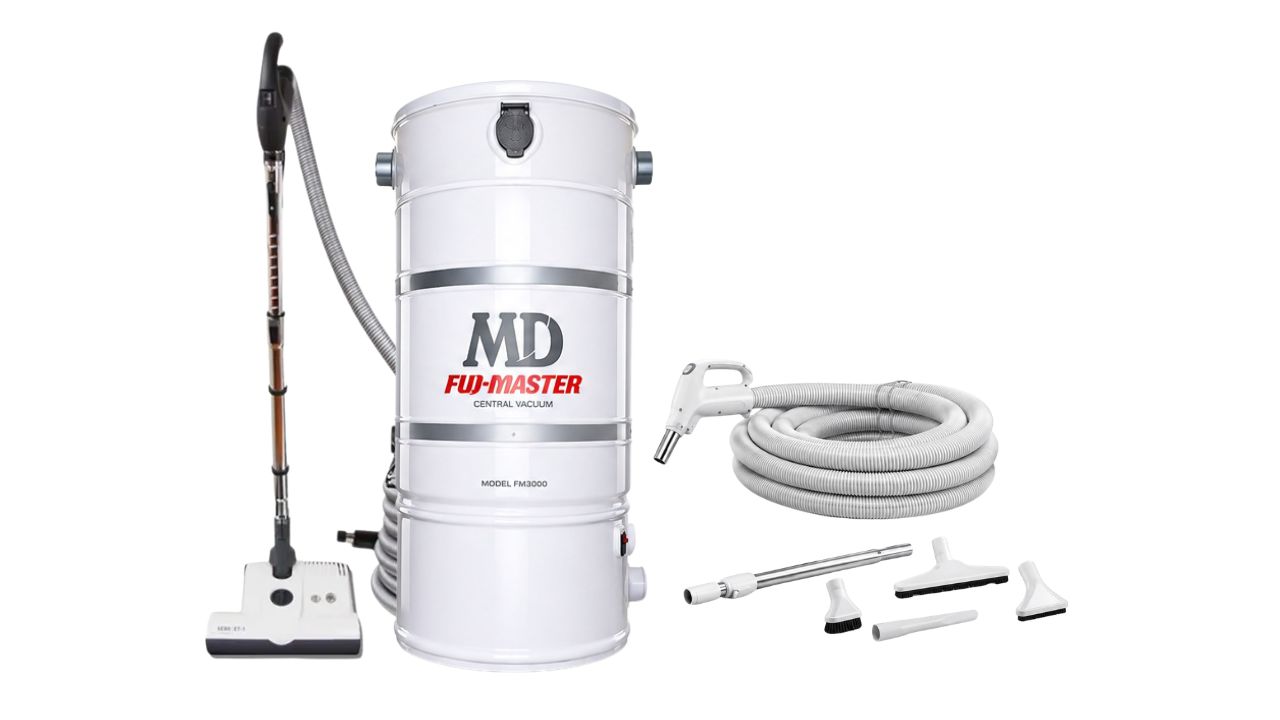
MD operated as a family-owned California business for decades. When a larger company takes a controlling stake, parts pipelines, warranty administration, and dealer support all reorganize. Get every warranty promise in writing before you sign anything.
Made in California Still Means Something Here
MD power unit bodies are assembled and tested in Bakersfield, not drop-shipped from an overseas fulfillment center. The steel housing and Ametek motor specifications are the core reasons owners consistently report fifteen-plus-year lifespans on well-maintained units. A family of four with two large dogs running a six-year-old MD Modern Day unit through a 2,600 square foot two-story home described it this way: “It still pulls like it did the first month. We’ve never touched the motor.”
What the 2025 Hide-A-Hose Deal Changes
Existing MD warranties carry through on MD-branded units purchased today. But confirm your dealer is an authorized MD service center under the new ownership structure, not just the prior one. Dealer authorization sometimes lapses during brand transitions, and a warranty call becomes an out-of-pocket expense when the authorization chain breaks. Founded 1961, acquired 2025, now part of one of North America’s largest central vacuum umbrella companies.
Decode The Four MD Power Unit Lines
MD organizes its central vacuum power unit lineup into four tiers, and the motor design differences between them have real consequences for how long a unit lasts in daily use.
| Line | Motor Type | Filtration | Home Size Range | Warranty |
|---|---|---|---|---|
| Flo Master | Thru-flow | Bagged | Up to ~3,000 sq ft | 10 yr (verify at publish) |
| Air Master | Thru-flow | Bagless cyclonic | Up to ~3,000 sq ft | 10 yr (verify at publish) |
| Modern Day | Tangential bypass | Hybrid bagged | Up to ~6,000 sq ft | 10 yr (verify at publish) |
| Silent Master | Tangential bypass, dual motor | Bagged | 6,000+ sq ft | 12 yr transferable (verify) |
Verify all warranty terms on MD’s current manufacturer page before publishing.
Flo Master and Air Master for Tighter Budgets
Flo Master is MD’s value entry point: single-motor thru-flow units targeting smaller homes and first-time central vacuum buyers. Air Master is the bagless line for owners who genuinely hate changing bags. Both do the job well in a compact, single-story home with short pipe runs.
The catch is motor design. Both lines run thru-flow motors, where the working airstream and the cooling airstream share the same path through the motor. For a 1,400 square foot condo with three inlet valves, the Flo Master is a perfectly reasonable call. For buyers set on bagless convenience, the Airmaster series from MD is the cleaner choice in this segment. Read the filtration section before you commit.
Modern Day Sits in the Value Sweet Spot
The Modern Day line gives you the good engine without the flagship badge price. Units like the M715H pair an 8.4-inch tangential bypass motor with hybrid bag filtration, and owners on vacuum forums consistently call it nearly as strong as the Silent Master for meaningfully less money. Many honest dealers quietly recommend it first for the 2,500 to 5,000 square foot home, the segment where bypass motor reliability matters but the dual-motor Silent Master cost isn’t justified by square footage alone.
Silent Master Is the Flagship Dual-Motor Tier
Silent Master is where MD’s engineering stops holding back. Two Ametek tangential bypass motors run at lower RPM than a single high-speed motor, sharing the load to produce consistent suction and quieter operation across long pipe runs. The S900R2 runs on 240V and targets very large homes and light commercial installations.
The twelve-year transferable warranty shows up in home inspection reports and buyer negotiations in ways a portable vacuum never does. For buyers prioritizing quieter residential operation before committing to Silent Master’s price point, quieter Stealth vacuum units are worth comparing side by side.
Same Motors Wearing Very Different Price Tags
Here’s what most brand pages won’t tell you: the G23, now sold as the M965H2, shares its core Ametek motor configuration with the S900R2 Silent Master flagship. One dealer with twenty years of MD sales history noted the retail price gap between these two models runs roughly thirteen dollars at some distributors.
“People buy the S900R2 thinking they’re getting something fundamentally different under the hood,” that dealer said. “The motor is the same. What you’re paying for is the nameplate.” Knowing the shared motor architecture lets you ask the right question before you pay a premium.
The Air Watt Number That Misleads Buyers
Air watts are the most quoted spec in central vacuum marketing and the least understood. Useful for comparing two MD units side by side. Used to predict actual cleaning performance at a wall inlet, it misleads.
Why Max CFM and Water Lift Never Add Up
Air watts measure suction power at one specific point on a vacuum motor’s performance curve. The calculation per ASTM F558, the standard governing vacuum performance measurement, combines airflow in CFM with water lift in inches of H2O. But CFM peaks when airflow is completely unrestricted, and water lift peaks when airflow is completely choked off. Those two peaks never occur simultaneously.
When an MD CV300 lists 650 air watts, 130 CFM, and 143 inches of water lift, those three figures come from three separate points on the motor’s performance curve. None of them represent actual cleaning conditions.
What Air Watts Really Measure at the Head
The air watt figure captures the single peak where the product of airflow and suction is highest. It’s a bare-motor lab measurement, not the number at your inlet or your cleaning head. The gap between a 650 and 720 air watt unit can disappear entirely once both move air through the same real-world pipe run. Use it as a directional signal within one brand’s lineup. Stop there.
How Suction Fades Over Long Pipe Runs
Every elbow in your pipe run costs suction. Every ten feet of Schedule 20 PVC costs more. The thirty-foot hose you pull from the wall eats a substantial fraction of what the motor’s bench number promised.
Owners tracking performance in central vacuum forums have measured roughly a third of total airflow lost through a single thirty-foot hose alone. Add a 60-foot pipe run with four 90-degree sweep elbows and the farthest bedroom inlet delivers noticeably weaker performance than the one six feet from the power unit. Size your MD unit around your longest pipe run.
Bypass Versus Flow-Through Motors Inside MD
The thru-flow versus tangential bypass distinction is the most decision-relevant technical spec in the entire central vacuum power unit category. It’s also the one almost every dealer page skips.
| Line | Motor Design | Cooling Air Path | Relative Longevity |
|---|---|---|---|
| Flo Master | Thru-flow | Dirty working airstream | Shorter service life |
| Air Master | Thru-flow | Dirty working airstream | Shorter service life |
| Modern Day | Tangential bypass | Separate dedicated fan | Longer service life |
| Silent Master | Tangential bypass, dual | Separate dedicated fan | Longest service life |
Which MD Lines Run Cooler Bypass Motors?
A tangential bypass motor routes cooling air through a completely separate fan path that never touches the dirty working airstream, so the motor cools itself regardless of how clogged the canister is. Modern Day and Silent Master units both use this design, which is why these tiers outlast the value lines. As one technician with fifteen years of service calls put it: “The bypass motor doesn’t care what’s in the canister. That’s why I still see these motors running strong at twelve, fifteen years.”
Why Flow-Through Motors Run Hotter and Shorter
A thru-flow motor uses the dirty incoming air to carry heat away from the motor windings. Think of an engine cooled only by the exhaust it’s already pushing. Block that airflow with a full bag or a clogged filter, and motor temperature climbs without relief. Most Flo Master and Air Master units operate in this hotter-running camp. Regular bag changes are not optional on these lines. They’re the maintenance schedule the motor depends on.
The Carbon Brush Check That Saves Your Motor
Worn carbon brushes, not a failing motor housing, cause a surprising number of premature central vacuum motor deaths. One Silent Master owner replaced the motor twice in four years before a technician found the brushes worn to stubs. Both prior motor replacements were unnecessary.
Carbon brushes make electrical contact between the power supply and the spinning commutator. When they wear out, current transfer degrades, performance drops, and a neglected commutator eventually sustains damage that turns a cheap brush swap into a full motor replacement. Inspect brushes every three to five years. It’s the maintenance step most dealers never mention at the point of sale.
The Filtration Choice Dealers Gloss Over
Filtration is where central vacuum marketing is most misleading and where the buying decision most directly affects daily-use experience.
How the Tapered Support Bag Keeps Airflow Strong
MD’s bagged units hang a tapered cloth support bag that exposes most of the disposable bag’s surface area to the passing airstream. Think of a pour-over coffee filter using its full funnel surface versus one pressed flat against the bottom of a canister. MD’s tapered design distributes debris across the entire bag surface, keeping resistance low as the bag fills. Competing flat-wall canister designs show suction drop well before the bag is actually full.
Tru Seal Bags Versus the Messy Open Bag
MD’s older open-top bag held eight gallons but made every swap a dust event. One dealer described pulling sixty pounds of fine drywall dust from an open-bag unit during a renovation cleanup. The Tru Seal closed-bag system seals debris inside on removal and connects to both intake ports. Owners describe it as the change that finally made bag swaps clean enough to handle in a finished utility room.
HEPA-Style Claims Versus True HEPA Filtration
True HEPA filtration captures 99.97% of airborne particles at 0.3 microns per the US Department of Energy standard. That’s what qualifies as a true HEPA filter under EPA guidance. MD’s marketing references multi-ply microfiltration bags, which are not the same certified performance rating. Ask for the filtration certification by name. A dealer who can’t produce it isn’t selling true HEPA performance, regardless of what the bag sleeve says.
Why Bagless Can Blow a Central Vacuum Motor
Bagless central vacuum units protect the motor through a cyclonic separator and a foam pre-filter. Skip cleaning that filter and motor temperature climbs without relief. Central vacuum forum technicians report blown motors traced directly to neglected foam filters on otherwise healthy power units. A bagged MD unit forgives a missed cycle or two. A clogged foam filter on a bagless unit forgives almost none.
What MD Owners Say After Many Years
Owner sentiment around MD units skews warmer than most central vacuum brands. The source of that warmth matters.
The Loyalty That Shows Up on Vacuum Forums
On VacuumLand and central vacuum installer forums, owners describe MD units replacing dead NuTone systems, now manufactured by DrainVac International after its 2023 acquisition of the Broan-NuTone central vacuum product line, and Vacuflo systems, made by H-P Products in Canton, Ohio, and outlasting both. One post that still circulates: “I will never buy another brand. Three NuTone units in twenty years, one MD unit, still running.” Owner sentiment, not a lab study. The pattern repeats across enough independent reports to be meaningful.
When a Single Motor Unit Died Early
A 2012 Silent Master installation developed motor failure in 2019, seven years in. Carbon brush inspection had never been performed. The foam pre-filter had been cleaned twice in seven years. Single-motor units draw harder when restriction builds, because there’s no second motor sharing the load. The early failure traces to skipped maintenance, not a defective unit.
Why Dealers Dominate the Praise You Read
Many of the strongest MD endorsements online come from self-identified MD dealers. Dealers have real reasons to favor the brand: reliable warranty claims, consistent quality, and margins that support a business. It’s a business relationship that shapes tone in ways worth recognizing. Read dealer posts as a directional signal, then look for owners with no financial stake in the answer.
Match The Unit To Your Real Home
The right MD central vacuum power unit comes down to your largest floor’s square footage, your pipe-run length to the farthest inlet, and how many rooms one 30-foot hose must cover per floor.
Which MD Central Vacuum Power Unit Fits Your Home?
| Home Size | Stories | Recommended MD Line | Notes |
|---|---|---|---|
| Under 2,500 sq ft | 1 | Flo Master | Single motor, budget entry |
| 2,500 to 4,000 sq ft | 1 to 2 | Modern Day | Bypass motor, better service life |
| 4,000 to 6,000 sq ft | 2 | Modern Day or Silent Master | Size up if pipe runs exceed 50 ft |
| Over 6,000 sq ft | 2+ | Silent Master | Dual motor required |
Match the unit to your largest floor’s square footage, not your total home square footage. A 4,000 square foot two-story home has roughly 2,000 square feet per level. A well-specified Modern Day handles that. The Silent Master becomes the right call when pipe runs stretch beyond 50 feet to the farthest inlet, or when total square footage exceeds 6,000.
Why Dealer Square Footage Ratings Run Optimistic
Published coverage ratings are measured under ideal lab conditions: short pipe runs, no elbows, stable voltage, and a clean filter. A unit rated for 8,000 square feet rarely delivers that coverage in a real installation with long trunk lines, multiple 90-degree fittings, and a filter two months into its cycle. Treat the top of any published range as a ceiling achievable only under perfect conditions. One experienced installer puts it plainly: “I mentally halve whatever coverage number a manufacturer publishes and size up from there.”
Plan Inlets Per Floor, Not Whole House
A four-story townhome with no inlet valve on the top floor means dragging the hose up two flights of stairs on bedroom-cleaning days. That’s the exact inconvenience central vacuum is supposed to eliminate.
Place inlets so a single 30-foot hose reaches every point in each room. In a typical bedroom, one inlet near the doorway covers the full floor. In an open great room, two inlets on opposing walls prevent hose strain at the center. Map inlet placement before drywall closes. Retrofitting inlets into finished walls is costly enough that most owners who skip this step simply live with the inconvenience.
Buy Smart and Skip the Pressure
A central vacuum power unit is a fifteen-to-twenty-year decision. Getting the wrong tier means living with inadequate suction or replacing the unit years early.
Single Motor or Dual Motor for You?
Think of single motor versus dual motor the way you’d think of a sedan versus a work truck. A sedan handles daily use. A truck earns its cost when you’re actually hauling loads. Single motor MD units suit single-story and smaller two-story homes well. Dual motor Silent Masters earn their price in homes over 4,000 square feet or with pipe runs exceeding 60 feet to the farthest inlet. Buying more motor than your home requires wastes money at purchase and electricity on every cleaning cycle.
What the Warranty Actually Protects
The Silent Master’s twelve-year transferable warranty carries to the next homeowner, a documented resale asset that shows up in home inspection reports. But normal wear items, including carbon brushes and pre-filters, often fall outside coverage language even on premium units. Read the warranty document specifically for exclusions. Get every promise in writing, and verify current terms directly on MD’s manufacturer page. The 2025 acquisition is recent enough that some dealer materials may still reflect prior ownership terms.
Where to Buy Without Overpaying
Authorized dealers bundle installation support and service relationships that online retailers skip. When you’re deciding where to locate the power unit relative to your pipe network, or how many sweep elbows your trunk line can handle before suction drops, that dealer relationship has real value.
Online retailers often beat dealer pricing on the bare power unit. Know whether you’re optimizing for support or for the lower sticker before you start comparing quotes.
Conclusion
You arrived thinking the highest air watt MD unit was simply the best, and you leave knowing the right tier depends on your floors, your filtration needs, and your motor design. Tonight, measure your largest floor’s square footage and count the rooms a single 30-foot hose must reach from each inlet, then map inlet placement before you call a dealer. Unlike the portable you’ve been hauling upstairs twice a week, the right MD central vacuum power unit hums out of sight for fifteen years and stops making vacuuming the chore you dread.
Frequently Asked Questions
What is a central vacuum power unit and where is it installed?
It’s the motor-and-canister assembly that generates suction for the entire built-in vacuum system, installed in a utility room, garage, or basement and connected to PVC tubing running through walls to inlet valves throughout the home.
How many air watts does a central vacuum power unit need for my home size?
For a home under 2,500 square feet, a unit in the 500 to 650 air watt range suits most single-story layouts. Homes between 2,500 and 6,000 square feet benefit from 650 to 750 air watts with a bypass motor. Verify current model specifications at publish. Figures shift by model year.
What’s the difference between a thru-flow and a tangential bypass motor?
A thru-flow motor cools itself using the same dirty airstream it cleans with, running hotter and wearing faster when airflow is restricted. A tangential bypass motor cools through a separate dedicated fan path that never touches the dirt stream, making it more durable and more tolerant of a full bag or clogged filter.
Should a central vacuum power unit exhaust outside or filter the air indoors?
Exhaust outside when possible. Vented units remove 100% of exhaust particulates from the living space. Indoor-filtered units require true HEPA-certified filtration. A “HEPA-style” bag does not meet the 99.97% capture rate at 0.3 microns that certified true HEPA requires.
How long does a central vacuum power unit last?
A well-maintained tangential bypass unit lasts fifteen to twenty or more years. Thru-flow units in the value tiers typically run ten to fifteen years with consistent maintenance. The most common cause of early failure is skipped carbon brush inspection and neglected filtration.
Can I replace my old power unit with a different brand on my existing pipes?
Yes, in most cases. Standard 2-inch fittings are compatible with MD, Beam (now owned by Trovac Industries following its 2024 acquisition), DuoVac, CycloVac, and most North American systems. Older Vacuflo and early Sears or Kenmore installations sometimes used non-standard connections requiring an adapter. Measure your existing inlet bore before ordering.