The airmaster central vacuum lineup runs from A450 to A900, and most buyers freeze on the spec table. Dealers quote air watts like a single decisive number, but peak air watts, peak water lift, and peak CFM are three different moments on the same fan curve. No unit delivers all three at once, and the model you pick turns on which moment matters most for your home.
By the end of this guide, you’ll match one model to your square footage, floor type, and filtration need without guessing. You’ll know the specs worth demanding, what to skip, and when a different unit deserves your money instead.
AirMaster Central Vacuum
AirMaster is MD Manufacturing’s bottom-emptying central vacuum line, assembled in Bakersfield, California and covering homes from 1,000 to 10,000 square feet. Every classic model runs a North American-made Ametek thru-flow motor. Buy it for bottom-drain convenience and a transferable 10-year warranty. Know going in: it is a thru-flow design, not a bypass motor.What the AirMaster Actually Is and Is Not
A Bottom-Emptying Line From One California Maker
AirMaster is the bottom-emptying power unit line from MD Manufacturing, now operating as Hide-A-Hose MD after Hide-A-Hose acquired a controlling interest in MD Manufacturing in 2025. The brand assembled its units in Bakersfield, California for decades, and the A-series covers homes from 1,000 to 10,000 square feet.
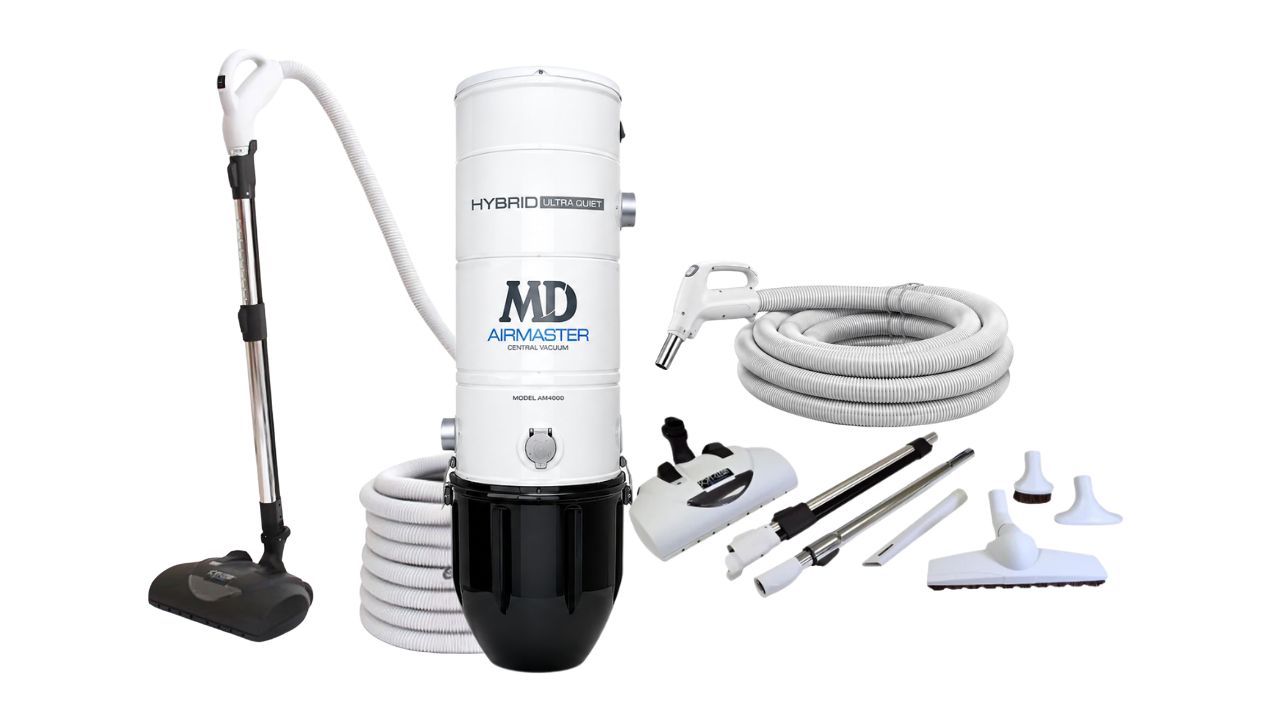
Here’s what that looks like in practice. A family who replaced a 1985 central vac in the same utility closet last year dropped a current A650tv into the original 2-inch PVC footprint without touching a single inlet. Standard 2-inch fittings are compatible with Beam, Drainvac, CycloVac, OVO, and most North American systems. Older Vacuflo models with proprietary low-voltage connections and early Sears/Kenmore non-standard bore installs require an adapter.
AirMaster competes against VacuFlo, Beam, and CycloVac on suction output, filtration, and a 15-to-20-year service life, not against portable canisters.
Classic Versus XL and Why the Gap Matters
The classic AirMaster (A450t through A700tv) uses a 5-gallon high-impact ABS lower bucket. The XL line (A715, A850, A900) jumps to an 8-gallon all-metal lower bucket. That size difference feels abstract until you own two large dogs and vacuum twice a week.
| Classic (A450t to A700tv) | XL (A715 to A900) | |
|---|---|---|
| Canister capacity | 5 gallons | 8 gallons |
| Lower bucket material | High-impact ABS | All-metal |
| Voltage options | 120V | 120V or 240V |
| Filtration | Hybrid Microtex or Tru-Seal bag | Hybrid Microtex or Tru-Seal bag |
| Typical coverage | 1,000 to 5,000 sq ft | 4,000 to 10,000 sq ft |
The XL is not just a bigger can. The heavier A715, A850, and A900 motor configurations generate enough heat and vibration that the all-metal bucket earns its cost. For a 3,500-square-foot home with hard floors and no pets, the classic A650tv is enough.
The Ametek Motor Doing the Real Work
Every AirMaster runs a North American-made Ametek/Lamb motor, the dominant central vacuum motor supplier and the same manufacturer behind motors in VacuFlo and CycloVac units. The motor choice, not the brand sticker, sets your longevity ceiling.
A great motor feeding a poorly designed pipe run loses every time. The classic A450t through A700tv use a single two-stage 5.7-inch Ametek motor. The XL line steps up to a larger 8.4-inch platform found across mid-tier central vacuum installations.
The Model Lineup Without the Sales Pitch
A450 Through A700: The Single-Motor Classics
| Model | Air Watts | Water Lift (in) | CFM | Max Amps | Voltage |
|---|---|---|---|---|---|
| A450t | ~450 | ~110 | ~110 | ~10 | 120V |
| A575h | ~575 | ~130 | ~120 | ~12 | 120V |
| A650tv | 650 | 143.1 | 130.2 | 15 | 120V |
| A700tv | 700 | 138.1 | 137.5 | ~16 | 120V |
The A650tv is the most commonly installed model. At 650 air watts and 143.1 inches of water lift, it delivers consistent suction across a 90-foot pipe run from a basement unit to a second-floor bedroom inlet in a two-story colonial: the real test, not a lab spec.
The A700tv chases CFM. The A650tv chases lift. For carpet-heavy homes with embedded pet dander, lift wins. For comparing central vac power units across the full MD lineup by motor spec and suction ratings, that resource maps every configuration side by side.
One limitation: the A450t carries only a 3-year warranty on electrical components. Buy the A575h or higher for a decade-long ownership horizon and the full 10-year protection.
A715, A850, and A900: The XL Heavy Hitters
| Model | Air Watts | Water Lift (in) | CFM | Max Amps | Voltage |
|---|---|---|---|---|---|
| A715h XL | 718 | 150 | ~145 | ~18 | 120V |
| A850 | ~850 | 257 | 92 | ~20 | 240V |
| A900 rQ | 905 | 136 | 191 | 27.8 | 120V/240V |
The A850 lists 257 inches of water lift against only 92 CFM, built for thick carpet and embedded debris. The A900 rQ flips that: 191 CFM against 136 inches of lift, built for large open-plan homes where airflow carries the dust.
The A900 rQ at 27.8 maximum amps on 120V almost always forces a dedicated circuit and pushes buyers toward 240V planning, an electrical cost no dealer spec sheet includes.
Which AirMaster Matches Your Square Footage Honestly
MD cites coverage from 1,000 to 10,000 square feet depending on model. Treat those as starting points. The real sizing variable is your longest pipe run, not your square footage.
Map the farthest inlet, add 5 feet per elbow, and choose the motor that maintains suction at that point. A 2,400-square-foot two-story home with a basement unit and a far second-floor inlet can demand a stronger motor than square footage alone suggests. Match inlet count to square footage per floor, not the whole house.
Is the MD AirMaster Central Vacuum Right for You?
Pick AirMaster for bottom-drain convenience, USA assembly, and the 10-year transferable electrical warranty on models A575h and above.
Skip AirMaster for the absolute lowest entry price per air watt in a single-motor unit, or when consistent filtration discipline is unlikely in your household. For allergy-heavy households where filter maintenance is inconsistent, the bypass motor design in MD’s Stealth central vac series separates the motor cooling path from the dirty airstream in a way the thru-flow AirMaster does not.
Your floor plan decides this, not the marketing wattage.
Air Watts, Water Lift, and the Spec Games
Why Peak Water Lift and Peak CFM Never Coexist
Water lift is the sealed suction force that drags debris up the pipe. CFM is the open airflow volume that carries dust through the system. Both peak at opposite ends of the fan curve.
At zero airflow (completely sealed), water lift maxes out. At zero restriction (completely open), CFM maxes out. A spec sheet listing both peak numbers is listing two moments that never exist simultaneously during normal cleaning. The moment you attach a hose and run the power brush, you are somewhere in the middle of that curve, not at either extreme.
A competitor listing a thru-flow unit at 700 air watts and a bypass unit at 700 air watts is listing the same number for two different cleaning experiences 60 feet from the power unit.
The One Suction Number Dealers Wave Around
Air watts are the honest middle ground. Calculated under ASTM F558, the air-watts measurement standard, the formula is: air watts = (CFM x water lift) divided by 8.5.
| Spec | What it measures | When it peaks | Cleaning relevance |
|---|---|---|---|
| Water lift | Sealed suction force | At zero airflow | Carpet, embedded debris |
| CFM | Open airflow volume | At zero restriction | Hard floors, long pipe runs |
| Air watts (ASTM F558) | Combined at load | Mid-curve | General comparison |
Any source using a different divisor is quietly inflating the number. Ask the dealer to name the standard before comparing air watt claims across brands.
Reading the A850 Versus A900 Power Split
The A850 and A900 rQ share the same dual-motor XL platform. Same chassis, two personalities. The A850 lists 257 inches of water lift against 92 CFM. Buy it for heavy carpet. The A900 rQ lists 191 CFM against 136 inches of lift. Buy it for a large open-plan home with hardwood and long pipe runs where CFM drives cleaning performance more than raw pull.
Both require 240V planning at their rated configurations and both push into amperage ranges that demand a dedicated circuit. Factor a licensed electrician into your budget before the unit arrives.
Filtration Honesty: From Hybrid to Tru-Seal
Bagless Microtex Versus the Hyperflow Bag Choice
The classic AirMaster ships with a hybrid setup built around an inverted Microtex cloth filter, a reusable fabric barrier you shake out and reinstall. A pet owner in a 2,200-square-foot ranch with three cats and hardwood floors empties that filter every three to four weeks.
The alternative is a Hyperflow micro-filtration bag in the same canister. Bags run roughly $5 to $15 each. They eliminate the dust cloud that comes with shaking out a cloth filter. For allergy households, the recurring cost (roughly $30 to $60 per year at average use) earns its keep. For everyone else, bagless saves money and adds one messy step to your maintenance routine.
Is Tru-Seal Filtration Actually Certified HEPA?
MD markets its Tru-Seal microfiltration bag as capturing particles down to 0.3 micron. A capture size is not the same as a certified efficiency rating.
According to the EPA’s definition of a true HEPA filter, true HEPA means 99.97 percent capture at 0.3 micron per the US Department of Energy standard. That is the threshold separating a certified HEPA filter from a HEPA-style marketing claim on bag media.
Ask the dealer in writing whether the Tru-Seal bag is tested to that standard or merely described as capturing that particle size. Those are different claims, and the distinction matters for any asthma or severe allergy household.
What the 0.3 Micron Claim Really Means
A capture size claim without a corresponding efficiency percentage is an incomplete spec. Capturing at 0.3 micron at 60 percent efficiency versus 99.97 percent produces radically different outcomes for someone with dust mite sensitivity.
For any home where filtration integrity is the primary concern, venting the motor exhaust outside the living space sidesteps the certification question entirely. Exterior venting routes 100 percent of exhaust outdoors, and a properly vented AirMaster reduces airborne allergen load compared to any bagless portable regardless of what the bag media claims.
The Reliability Question Owners Actually Ask
Thru-Flow Motors and the Dust That Kills Them
Thru-flow motors cool themselves with the same air that passed through the filtration system, which is why filtration discipline is non-negotiable on a thru-flow unit.
A thru-flow motor running behind a neglected filter is being cooled with warm, particle-laden air. Owner accounts on VacuumLand describe fine dust slipping past a dirty bag into the motor housing, abrading the windings over years of use. A tangential bypass motor runs a dedicated clean-air fan, separating the cooling path from the dirty airstream entirely. Bypass motors tolerate skipped filter changes far better.
Change the filter on schedule and the motor runs for years. Ride it dirty and you replace it sooner than the warranty suggests.
How Long Do These Motors Really Last?
Central vacuum technicians peg typical Ametek motors at roughly 800 to 900 operational hours under normal use. Controlled bench tests on VacuumLand showed units running approximately 1,420 hours with clean filtration and an air-relief valve installed. The 8.4-inch XL platform reportedly ran past 2,200 hours under clean conditions.
The spread between 800 and 2,200 hours is filtration discipline, not motor quality. A motor replacement on an A650tv-class unit runs roughly $150 to $250 in parts plus labor. A well-maintained motor never needs replacing across a 15-year horizon. A neglected one does in year five.
The Brush Check Nobody Remembers to Do
MD recommends inspecting motor brushes every three years. Almost no one does.
One owner documented on a central vacuum forum killed two motors in quick succession before a technician found the carbon brushes worn to nothing. The windings burned because the brushes could not maintain contact. A 15-minute brush inspection during an annual filter change costs nothing. Set a calendar reminder tonight or you will not remember in three years.
AirMaster XL Versus SilentMaster: The Upside-Down Twin
Same Machine Flipped, Sometimes Priced Higher
An MD source quoted on VacuumLand described the A900 rQ as the S900 turned upside down. Both share the same motor platform and canister. Motor on top for the SilentMaster, motor on bottom for the AirMaster XL. That orientation changes the air path, the noise profile, and how you empty the unit. It does not change the motor or suction output.
Owners comparing prices have found the SilentMaster priced lower at some dealers for equivalent internals. The AirMaster XL premium is bottom-emptying convenience, not a better motor. And the SilentMaster’s 12-year electrical warranty surpasses AirMaster’s 10-year coverage, so the bypass twin edges out on warranty depth too.
When Bottom Emptying Is Worth Paying For
Bottom emptying wins when the power unit sits high in a utility cabinet or in a tight corner where reaching a top lid requires a step stool. A basement install at eye level makes the premium less compelling; a garage unit on a high shelf makes it worth every dollar. The spec sheet won’t tell you which situation is yours.
Who Owns MD Now and Why It Matters
Hide-A-Hose Bought MD in 2025
In 2025, Hide-A-Hose acquired a controlling interest in M.D. Manufacturing, the Bakersfield company behind AirMaster, SilentMaster, ModernDay, and Flo-Master central vacuum lines. The brand now reads Hide-A-Hose MD. Headquarters operations have shifted toward Monroe, Washington while Bakersfield continues as the assembly site.
The service network is in transition. Call before assuming your nearest MD dealer stocks the Ametek motor for your unit’s serial number.
What the Merger Means for Parts and Warranty
| Line | Electrical warranty | Workmanship warranty | Transferable? |
|---|---|---|---|
| AirMaster (A575h and above) | 10 years | Lifetime | Yes |
| AirMaster A450t | 3 years | Lifetime | Yes |
| SilentMaster | 12 years | Lifetime | Yes |
Buy the A575h or higher for the full 10-year transferable protection, a feature that adds resale value when the home sells. The SilentMaster’s 12-year coverage surpasses AirMaster by two years and argues for the bypass twin whenever bottom emptying is not a priority.
Buying Online Versus Through a Local Dealer
A buyer who purchased an A700tv online and self-installed during a renovation reported zero issues with the unit and one frustrating week tracking down a compatible low-voltage relay. The part was available. The dealer diagnostic support was not.
Online buyers get factory pricing but own their installation entirely. A local dealer handles warranty service and knows whether your municipality requires a licensed electrician for the dedicated circuit the higher-amperage models demand. Weigh the price cut against who answers the phone in year eight.
Installation Truths That Protect Your Warranty
Inlet Distance and Suction Loss Over Pipe
Suction drops with every 10-foot pipe extension and every elbow beyond the manufacturer’s maximum specification. A poorly placed inlet on a two-story home with a basement power unit and 70 feet of 2-inch PVC delivers noticeably less suction than the motor spec sheet implies.
Plan the farthest run first. Measure from your planned power unit location to the farthest inlet, add 5 feet per elbow, and choose the motor that maintains adequate suction at that point. Use sweep elbows at every turn. A sweep elbow reduces restriction and maintains airflow across the full run in a way a sharp 90-degree elbow never can.
Venting Outside Versus Dumping Into the Garage
Venting the motor exhaust outside solves three problems at once: it drops interior noise, removes fine exhaust particles from the living space, and prevents humid motor-cooling air from recirculating into wall cavities.
One owner who converted a garage-vented AirMaster to exterior exhaust described the noise reduction as startling. The sound that bled through the garage wall vanished to a quiet hum. Exterior venting is required by code in confined locations in many jurisdictions. For a thru-flow design specifically, separating the exhaust stream from the living area adds years to the motor’s life by keeping the cooling cycle clean.
The Fine Print That Quietly Voids Coverage
Running the unit without filters voids the warranty outright. MD’s terms exclude damage from filter-free operation, commercial use, unauthorized service, and any modification outside manufacturer specifications.
Read that clause before a non-authorized shop touches your power unit. Get warranty service documentation in writing before authorizing any work on a unit still inside the coverage window.
Conclusion
You arrived worried about overpaying for a wattage number you didn’t fully trust, and you leave reading water lift, CFM, thru-flow motor design, and filtration discipline like a buyer who cannot be upsold. Tonight, measure the longest pipe run from your planned power unit location to the farthest inlet, then size from that one number. For everything MD makes beyond the AirMaster line, the complete MD central vacuum lineup is the next stop. A right-sized AirMaster runs quietly behind a wall for twenty-plus years. No portable canister you have ever dragged upstairs comes close.
Frequently Asked Questions
Who makes AirMaster central vacuums and where are they built?
AirMaster is built by MD Manufacturing, now operating as Hide-A-Hose MD following a 2025 acquisition, assembled in Bakersfield, California with a North American-made Ametek motor inside every canister.
What is the difference between air watts, water lift, and CFM on an AirMaster unit?
Air watts, calculated under ASTM F558 as (CFM x water lift) divided by 8.5, capture real suction at the cleaning head under load. Water lift peaks at zero airflow; CFM peaks at zero restriction; air watts capture the useful middle point where actual cleaning happens.
Does AirMaster use a thru-flow or tangential bypass motor, and does it matter?
Yes, it matters. Classic AirMaster models use a thru-flow motor that cools itself with filtered vacuum air; a tangential bypass motor uses a dedicated clean-air fan and tolerates neglected filtration better. MD’s SilentMaster line uses a bypass configuration for households where filter discipline is inconsistent.
Which AirMaster model do I need for my home’s square footage?
The A650tv covers most homes up to 3,000 square feet; move to the A700tv or A715h XL for homes above 4,000 square feet or long second-floor pipe runs; choose the A850 or A900 rQ for homes exceeding 5,000 square feet with complex pipe layouts.
What is the difference between the AirMaster A650tv, A700tv, and the AirMaster XL?
The A650tv and A700tv are single-motor 120V classics in a 5-gallon ABS canister, with the A650tv optimized for water lift (carpet) and the A700tv for CFM. The AirMaster XL (A715 and above) uses an 8-gallon all-metal bucket and a larger motor platform, with the A850 and A900 rQ adding dual motors and 240V wiring.
How long is the AirMaster warranty and is it transferable to a new homeowner?
AirMaster carries a 10-year transferable warranty on electrical components (3 years on the A450t only) and a lifetime warranty against material and workmanship defects, and it transfers to a subsequent homeowner at the time of home sale.
Where can I buy AirMaster parts and replacement motors now that the brand changed hands?
Parts remain available through MD dealer networks and builtinvacuum.com; call an authorized dealer with your unit’s serial number before ordering an Ametek replacement motor online to prevent a mismatch.