The canavac xls 970 looks like an easy decision on paper. It has an 8.4-inch motor, a 7-gallon canister, and suction numbers that beat most current midrange units. But half the dealers show it out of stock, one site swears it makes 805 air watts while another says 675, and nobody explains the gap or the missing warranty years.
By the end of this guide, you’ll know whether to track down the last new stock, repair the unit you own, or pick its real replacement. Read this full CanaVac central vacuum guide for broader product context.
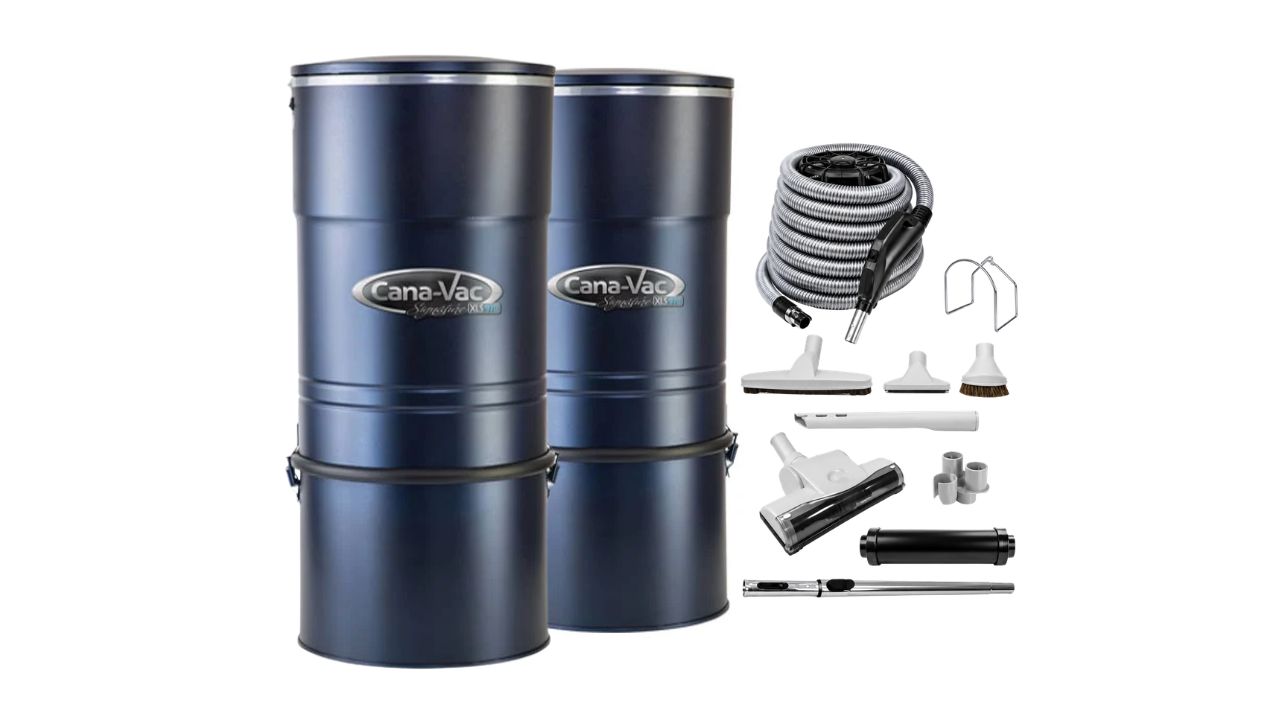
CanaVac XLS 970
The XLS 970 is a discontinued premium central vacuum delivering 675 air watts and 147 inches of water lift from an 8.4-inch tangential bypass motor. It runs a 7-gallon hybrid bag/bagless canister rated for homes to roughly 9,000 sq ft under real conditions. The question is not whether it cleans well, but whether an orphaned model still makes sense.Why the XLS 970 Got Hard to Find
The CanaVac XLS 970 dropped out of the active Signature lineup after Trovac Industries acquired Cana-Vac and rebuilt the product line. Dealers still listing it are selling leftover stock, not fresh inventory.
Trovac Bought CanaVac and Changed Everything
Trovac Industries Ltd., headquartered in Blainville, QC and the maker of CycloVac, acquired Cana-Vac and rebuilt the entire Signature range. The modernized lineup (the 490, 590, 690, and 790) doesn’t include the old 8.4-inch motor the 970 ran. Installers who spec both brands confirm it consistently. The motor class shrank, the body style changed, and the parts ecosystem split.
The 970 Is Now an Archived Model
Cana-Vac’s current active Signature lineup documentation lists the 490, 590, 690, and 790 as active production units. The XLS 970 does not appear. Dealers still selling it are clearing warehouse stock, not receiving new shipments. You’re not buying a supported product with an active service network. You’re buying one of the last units from a run that ended.
Why a Discontinued Unit Still Tempts Buyers
That 8.4-inch motor delivered power the current CanaVac lineup can’t match. Owners with long pipe runs or multiple inlets on different floors feel the difference: suction at the farthest inlet holds in ways a smaller bypass motor can’t replicate at the same pipe distance. The catch is parts that thin out year by year. Third-party suppliers still stock XLS 970 motors, bags, and circuit boards right now. That window doesn’t stay open forever.
The Air Watt Number Two Sites Disagree On
The multi-source consensus for the CanaVac XLS 970 is 675 air watts at 147 inches of water lift. One outlier listing claims 805, the same number assigned to the larger XLS 990, and should be treated as a copy error until confirmed by a printed spec sheet.
What Air Watts Actually Measure
Air watts measure real cleaning power at the hose, not the motor’s electrical draw. A motor consuming 1,200 input watts might deliver 675 air watts at the hose end, and that second number tells you how much debris actually lifts from carpet pile into the canister. Water lift, measured in inches, is sealed suction with zero airflow: the pull a motor sustains against a fully blocked hose. Both are tested under ASTM F558.
Why One Site Claims 805 and Others Say 675
Independent retailers including eVacuumStore, State Vacuum, Not Just Vacs, and Powell Vacuum list the XLS 970 at 675 air watts and 147 inches of water lift. One listing runs 805 air watts, apparently carried over from XLS 990 copy. No manufacturer spec sheet confirms 805 for the 970.
| Spec | Verified (Multi-Source) | Outlier Listing |
|---|---|---|
| Air Watts | 675 AW | 805 AW (unverified) |
| Water Lift | 147 inches | Not specified |
| Canister Capacity | 7 gallons (28 L) | Not specified |
| Motor Class | 8.4-inch bypass | Not specified |
Ask the dealer to pull the actual spec sheet. That one step catches the error before it shapes your decision.
Is the CanaVac XLS 970 Still Worth Buying?
At 675 air watts, the XLS 970 still outmuscles most current midrange central vacuum units. But premium money for an orphaned model is a real gamble: last-run stock sometimes costs as much as a fully supported current unit without the warranty infrastructure. Weigh the power advantage against parts risk before you commit.
What the 8.4-Inch Motor Actually Buys You
The 8.4-inch tangential bypass motor is why the XLS 970 built a following among owners and retrofit specialists, and it’s the spec dealers stopped printing the moment Trovac moved to a smaller motor class.
Tangential Bypass Versus Flow-Through Motors
| Motor Type | Cooling Method | Typical Lifespan | Dirt Contact |
|---|---|---|---|
| Tangential Bypass | Separate cooling air intake | 15,000 to 20,000 hours | None |
| Flow-Through | Dirty vacuum air stream | 10,000 to 15,000 hours | Direct |
A tangential bypass motor pulls cooling air through a separate intake, isolated from the debris stream. The motor’s windings never see the dust, pet hair, or fine particles traveling through the vacuum path. That isolation is why bypass motors run quieter and last longer. When a dealer steers you toward a flow-through unit and calls it equivalent, ask for the motor cooling spec in writing.
Who Really Supplies This Motor
CanaVac Signature units, including the XLS 970, ran Ametek/Lamb bypass tangential motors, the same manufacturer supplying motors to Beam, CycloVac, Drainvac, and OVO. Third-party parts suppliers carry compatible Ametek/Lamb motors without relying on Trovac’s supply chain, which keeps your repair options alive long after a brand stops listing parts.
Single Stage or Two Stage Confusion
Some XLS 970 listings say single-stage; others say two-stage. A two-stage motor uses two fans in series for higher static pressure and stronger water lift; a single-stage motor prioritizes airflow. The 147-inch water lift figure points toward two-stage, but confirm the stage count from a spec sheet before you buy.
Why Bigger Motors Fade on Long Runs
Suction drops with every foot of Schedule 20 PVC between the power unit and the farthest inlet, and each 90-degree sweep elbow adds roughly five to seven feet of equivalent pipe resistance. For a unit in this power class, keep the farthest inlet within 35 to 40 feet of effective run from the canister. A powerful motor can’t rescue a poorly routed layout.
HEPA Membrane Versus the 99.4 Percent Bags
The XLS 970 is a hybrid unit. Run it bagless with the HEPA membrane filter and it hits true HEPA capture rates. Switch to the disposable Allerex bags and it drops to 99.4 percent. Effective filtration, but not certified HEPA.
What HEPA Actually Certifies
True HEPA, as defined by the U.S. EPA, captures 99.97 percent of airborne particles at 0.3 microns. The XLS 970’s non-stick HEPA membrane filter meets that threshold in bagless mode, stopping fine dust, pollen, pet dander, and mold spores before they reach the exhaust stream. For allergy and asthma households, bagless mode is the right choice.
Why the Bags Only Reach 99.4 Percent
| Filtration Mode | Capture Rate | True HEPA | Best For |
|---|---|---|---|
| Bagless HEPA Membrane | 99.97% at 0.3 microns | Yes | Allergy/asthma households |
| Allerex Disposable Bag | 99.4% | No | Convenience, easy emptying |
The Allerex bags capture 99.4 percent, above most portable vacuums and comparable to many “HEPA-rated” bagged units. For households without severe allergy concerns, bags offer real convenience over opening a 7-gallon chamber packed with accumulated debris. Choose bags when easy disposal matters more than the last decimal point of filtration.
Sizing This Unit for Your Real Floor Plan
Dealer listings quote XLS 970 coverage between 9,000 and 15,000 square feet for the same unit. The gap is methodological, not a measurement error.
Why the 15,000 Square Foot Claim Misleads
The higher figure assumes ideal conditions: no pipe distance penalty, no elbows, no layout inefficiency. Add a 60-foot pipe run, four 90-degree elbows through finished walls, and a power unit at the far end of the basement, and coverage shrinks fast. Reduce the headline figure by 30 to 40 percent for real conditions. The XLS 970 reliably covers roughly 9,000 to 10,500 sq ft in most two-story homes with standard layouts.
Size Per Floor, Not Total Square Footage
Map the pipe run from the power unit to the farthest inlet on each floor separately. A 4,000 sq ft ranch with inlets strung along a 55-foot hallway demands far more from the motor than a two-story with inlets stacked vertically. If existing PVC is in your walls, a good installer calculates effective pipe distance before recommending motor size.
The budget-friendly 060115 model suits smaller homes where the pipe layout and square footage don’t justify the 970’s power class.
What Owners Say After Years of Use
Owner experience with the XLS 970 runs consistently positive on two metrics: suction that holds past the five-year mark, and a steel canister body that handles real-world abuse.
The Reliability Owners Actually Report
A Cana-Vac owner on RedFlagDeals ran the XLS 970 for eight years through a tricky crawl space installation and called it amazing, reporting consistent performance across a layout that strains weaker motors. Owners who check brushes annually after year five report lifespans well past the warranty period. These are owner sentiment reports, not controlled lab results.
Where CanaVac Sits Among Enthusiasts
VacuumLand regulars place Cana-Vac as solid middle tier: respected, reliable, not exotic. CycloVac, its Trovac sibling, rates a step above for motor quality and parts depth. Use that framing before paying premium for leftover XLS 970 stock.
Watch for Dealers Pushing Old Inventory
One forum buyer got steered from a bypass unit toward a flow-through design by a dealer claiming flow-through performed better. It doesn’t. Flow-through motors cool through the debris stream, run hotter, and fail sooner. Ask for the motor spec sheet before accepting that recommendation.
Repair the 970 or Replace It Now
The repair-versus-replace decision comes down to motor condition. A functional motor in a galvanized steel body is worth repairing. Two simultaneous major component failures in a unit with dwindling parts availability is the signal to look elsewhere.
When Repairing the Orphan Still Makes Sense
| Scenario | Repair Cost (Est.) | New Unit Cost | Verdict |
|---|---|---|---|
| Motor brushes worn | $40 to $80 DIY | $600 to $900+ | Repair |
| Circuit board failure | $80 to $150 | $600 to $900+ | Repair |
| Full motor swap | $200 to $350 | $600 to $900+ | Repair if under 10 years |
| Motor and board both failed | $300 to $450 | $600 to $900+ | Replace |
The Ametek/Lamb motor family that powered the XLS 970 is still widely stocked by third-party parts suppliers. Motor carbon brushes, which need replacement every five to seven years, are a simple DIY job. Check brush length after year five. Brushes worn under 3/8 inch need replacement before they score the commutator and turn a $60 fix into a $300 motor swap. The galvanized steel canister body outlasts the motor reliably.
The Closest Current Replacement You Can Buy
The Cana-Vac Signature LS-790 (ACAN790A) is the nearest active-production equivalent: 659 air watts, 145 inches of water lift, a 5.3-gallon canister, and a manufacturer coverage claim of 10,000 sq ft. You trade raw power and canister volume for a current production unit with an active warranty and live parts network.
Why the Warranty Length Quietly Changed
Older XLS 970 listings promised 15-year warranties. Current Cana-Vac Signature units carry 10-year warranties. Confirm the exact coverage, including parts and labor terms, in writing before purchase. A discontinued model’s warranty is only as useful as the service network willing to honor it.
Conclusion
You arrived chasing a powerful 8.4-inch motor with spec numbers that hold up, and you leave knowing the XLS 970 is a discontinued unit whose production ended after the Trovac acquisition, whose air watt conflict resolves at 675, and whose 7-gallon hybrid design remains capable for the right home. Tonight, email one dealer and ask for the exact air watts, warranty terms, and current stock count in writing. Whether you repair the 970 you already own or buy the last new stock through the certified CanaVac dealer network, a bypass central vacuum cleans quieter and lasts far longer than any portable you’ve dragged up the stairs.
Frequently Asked Questions
How many air watts does the CanaVac XLS 970 have?
675 air watts at 147 inches of water lift, confirmed across multiple independent dealer sources. One listing claims 805 air watts, but no spec sheet confirms that figure for the 970. Treat it as a copy error from the XLS 990 until a dealer provides written documentation.
Is the CanaVac XLS 970 discontinued, and what replaced it?
Yes, the XLS 970 is discontinued. After Trovac dropped the 8.4-inch motor class, the closest current replacement is the LS-790 (ACAN790A) at 659 air watts and a 5.3-gallon canister, a step down in both power and capacity.
What replacement bags fit the CanaVac XLS 970?
The XLS 970 uses Allerex disposable allergen filtration bags, rated at 99.4 percent particle capture. Third-party suppliers still stock these. Confirm the part number before ordering, since generic-label bags that fit the same canister dimension vary in filtration quality.
Who makes Cana-Vac central vacuums now?
Trovac Industries Ltd., based in Blainville, Quebec, makes both Cana-Vac and CycloVac. The two brands share platform components and motor suppliers under the same parent company.
How long does the CanaVac XLS 970 motor last, and can I replace it myself?
With proper maintenance, the Ametek/Lamb bypass motor lasts 15 to 20 years. Motor carbon brushes need replacement every five to seven years. Check brush length annually after year five.
Should I repair my CanaVac XLS 970 or buy a new central vacuum unit?
Repair unless two major components have failed simultaneously. Brushes and a circuit board together cost $120 to $230 to fix, versus $600 or more for a comparable new unit. A full motor swap still wins on cost when the canister body and wiring are sound.
What size home is the CanaVac XLS 970 rated for?
Dealer claims range from 9,000 to 15,000 square feet. Under real pipe-run conditions, expect reliable performance in homes up to 9,000 to 10,500 square feet with standard two-story layouts. Long ranch-style homes with multiple 90-degree elbows may see suction loss at the farthest inlets.