You searched “canavac central vacuum,” landed on a dealer page with an “up to 10,000 sq ft” coverage sticker, and still don’t know which model to buy or whether the brand is even the same company it was a decade ago. That number means almost nothing for your actual floor plan, and most forum advice describes a motor lineup CanaVac no longer makes.
By the end of this guide, you’ll know who owns CanaVac today, which motor to pay for, and which specs to ignore before you write a check.
Canavac Central Vacuum
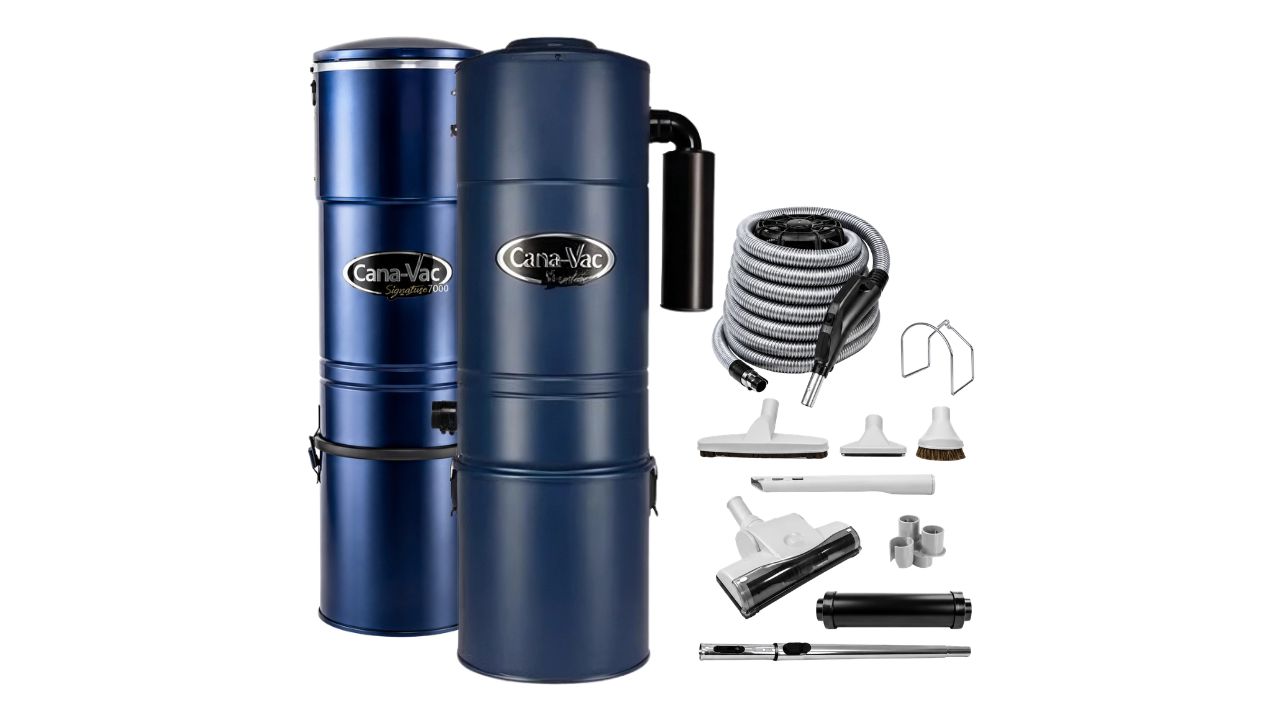
CanaVac central vacuum is a Canadian-assembled built-in vacuum system now produced by Trovac Industries of Blainville, Québec, the same manufacturer behind Cyclo Vac. The lineup divides into tangential bypass Signature units for larger homes and thru-flow Ethos units for lighter budgets and smaller spaces.Who Actually Builds Canavac Today?
CanaVac is no longer an independent Ontario company. Trovac Industries (Les Industries Trovac Ltée) of Blainville, Québec, the maker of Cyclo Vac, acquired CanaVac and rebuilt the entire lineup on Trovac bodies. The unit you buy today shares a manufacturing floor and parts supply chain with Cyclo Vac, which has real consequences for service, warranty coverage, and parts availability over a long ownership window.
Why the Name on the Box Hides the Real Maker
Canadian since the 1970s under the Leonard-Budd-era CanaVac Systems Inc., the brand ran out of Ontario with Ametek motors as wide as 8.4 inches and a loyal following built on dealer-direct service. Then ownership shifted quietly, and most buyers never heard about it.
Trovac Industries, CanaVac’s current parent company, is one of North America’s largest central vacuum manufacturers. Bodies look different now because they share a Trovac-engineered chassis. Forums still describe the old Ontario units in detail, which is how buyers end up spec-shopping for a motor that hasn’t shipped in years.
Where Is Canavac Made and Is It Still Canadian?
Still assembled in Canada. That claim survives the buyout intact, and for buyers who consider Canadian assembly a meaningful differentiator, it holds. The Blainville facility is a real manufacturing operation, not a label swap on imported units.
“Made in Canada” is not the same as “made the way it used to be made.” Owners who grew up with Ontario-era units trust the hardware and miss the old motor specs. Both things can be true.
The Trillium Connection Most Listings Never Mention
Choose a specific Trovac-era CanaVac model and you’ll often find what looks like a twin sold under a different name. The Trillium T170 is one example of how Trovac’s manufacturing consolidation plays out at the retail level. Knowing about these platform siblings stops you from paying a markup for a rebadged unit when the same chassis ships under another label for less.
Ask the dealer: “Does another brand share this chassis and parts number?” The answer changes both the negotiating math and future service costs.
Signature Versus Ethos: The Motor Decides Everything
The motor type is the single most important decision in any CanaVac purchase, and it’s the one most dealer pages skip. Signature series units use a tangential bypass motor. Ethos series units use a thru-flow motor. The price gap between them is real, and so is the performance difference over a decade of actual use.
What a Tangential Bypass Motor Actually Buys You
A tangential bypass motor routes filtered air around the motor to cool it. Dirty intake air never passes through the motor windings. Think of it like a separate engine cooling circuit instead of blowing hot exhaust back through the engine itself.
Signature units use this configuration. Current models like the LS750 (CLS-750 class, approximately 625 air watts and 132 inches of water lift) and the LS790 (approximately 659 air watts and 145 inches of water lift) run cooler under sustained load. An owner in Ottawa reported five years of daily vacuuming on a Signature unit with no motor service and consistent suction at a 55-foot pipe run to the farthest bedroom inlet. Pay for the bypass motor once, it’s cheaper than replacing a burned thru-flow motor in year seven.
Why Thru-Flow Ethos Units Cost Less and Die Sooner
A thru-flow motor pulls dirty air straight through the motor chamber. Fine debris, pet dander, and construction dust ride that airstream past the motor windings every time the unit runs. Cheaper to build, cheaper to buy, shorter ceiling for longevity in high-use homes.
Fine for a two-bedroom condo vacuumed twice a week. Risky for a 2,800 sq ft home with two dogs and daily use. The Ethos lineup makes sense for budget buyers in smaller spaces. It doesn’t make sense if you’re replacing a motor that burned out after five years and wondering why.
Which Canavac Series Fits Your Real Lifestyle?
| Feature | Signature Series | Ethos Series |
|---|---|---|
| Motor type | Tangential bypass | Thru-flow |
| Motor cooling | Bypass air circuit | Direct airflow through motor |
| Estimated motor life | 15 to 25+ years | 8 to 15 years |
| Best for | Heavy daily use, large homes, pet and allergy households | Light use, smaller homes, budget buyers |
| Relative price | Higher | Lower |
Match the series to how hard you actually vacuum, not how hard you think you vacuum.
The Air Watts Trap Nobody Warns You About
A single air watts number does not predict cleaning performance. CanaVac listings lead with it anyway. Air watts combine airflow (CFM) and suction (water lift) into one figure, but that combined number hides the balance between the two forces that actually determine whether a unit cleans carpet or bare floors better in your specific home.
Why One Air Watt Number Tells You Almost Nothing
Two units can each claim 650 air watts while delivering entirely different cleaning behavior. One pulls 145 inches of water lift with moderate airflow; the other pulls 100 inches with higher airflow. The first lifts embedded pet hair from carpet pile. The second moves more air across bare hardwood. Same number, different results for your floor plan.
This isn’t CanaVac-specific. Buyers with pet or allergy households need to understand it before settling for a “the second-highest model should be fine” recommendation from a dealer who never asked about the home’s layout.
Reading Airflow and Water Lift Together the Right Way
Water lift is raw pulling strength, measured in inches of water. CFM is how much air moves per minute. You want both strong, because carpet cleaning needs lift to extract embedded debris and bare floors need airflow to sweep it toward the inlet.
The LS790 lists approximately 659 air watts and 145 inches of water lift. At a 60-foot pipe run from a basement power unit to a second-floor bedroom inlet, that water lift figure is what keeps suction from feeling sluggish at the farthest point. The air watts headline doesn’t tell you that. The water lift number does.
The Spec Discrepancy You Will Spot Across Retailers
The same LS790 shows 145 inches of water lift on one dealer site and 149 inches on another. When retailers disagree on a single model’s specs, the manufacturer’s data sheet is the tiebreaker. Pull it directly from canavac.com before you buy. Dealer sites copy specs from each other, not always from the source, and errors propagate across the SERP before anyone catches them.
What Trovac Quietly Changed After the Buyout
When Trovac rebuilt the CanaVac lineup, two things changed that buyers researching the brand would have cared about: the motor diameter shrank, and the spec sheets stopped printing it. Neither change was announced with any fanfare.
The Discontinued 8.4-Inch Motor Owners Still Mourn
The old XLS990 flagship ran an 8.4-inch Ametek motor. Large-diameter motors produce high torque at lower electrical load and tend to run cooler under the same sustained workload. A thread on VacuumLand called the discontinued motor “the end of an era” for the brand, and it wasn’t an overstatement.
Trovac moved the entire line to a 6.6-inch two-stage motor shared with current Cyclo Vac units. The design is proven, but it is not the motor that built CanaVac’s reputation. For top-end models like the CanaVac XLS 970 premium unit, that platform transition is the most significant spec change from the unit’s previous iteration, and no current dealer listing explains it.
Why Current Spec Sheets Hide the Motor Size
New CanaVac listings no longer print motor diameter. They print air watts, water lift, and CFM. Motor diameter enabled direct comparison with Ametek-era units, and once it shrank, the incentive to publish it disappeared.
Ask the dealer directly: “What is the motor diameter, and who manufactures the motor?” A dealer who can’t answer that question isn’t positioned to size a system correctly for your home.
Buying an Orphaned Older Model Before Stock Runs Out
Some dealers still hold discontinued CanaVac units with the larger legacy motor. Pre-Trovac models surface occasionally in dealer clearance inventory, and the suction specs on those units hold up. The lower price reflects discontinuation risk, not performance failure.
Weigh that against parts access. Motor brushes, capacitors, and gaskets for discontinued models get harder to source as dealer stock ages. Go in with that calculation already done.
Is “HEPA Membrane” the Same as True HEPA?
It isn’t, and the distinction matters most for buyers treating a CanaVac as an allergen management tool.
What Canavac Actually Means by HEPA Membrane
Signature series units use a HEPA membrane inverted bag rated at 99.97% capture at 0.3 microns. That figure matches the U.S. Department of Energy HEPA threshold, which defines what a properly sealed HEPA vacuum actually requires under EPA renovation rules.
But “HEPA media bag” and “sealed HEPA system” are not the same claim. A sealed system routes all intake air through the filtration media with zero bypass leakage. A HEPA bag inside a canister that isn’t fully sealed can allow fine particles to escape around the bag during operation or at emptying. The bag’s rating doesn’t cover the gaps in the housing.
Why the Filter Rating and the Bag Rating Differ
The HEPA membrane bag claims 99.97% capture. The standard allergen bag in the same lineup claims 99.4%. For a household without allergy concerns, the difference is negligible. For a household managing dust mite or pet dander sensitivity, 0.57% of 0.3-micron particles at CanaVac’s airflow volumes is not a rounding error.
Choose a sealed bag configuration if anyone in the home has diagnosed dust or pet dander allergies, and empty the unit outside. A bagless canister emptied indoors re-releases the fine fraction of everything the motor just captured.
Does the Self-Cleaning Filter Really Clean Itself?
No. CanaVac has acknowledged that the self-cleaning filter label is marketing language rather than a technical description. What actually happens: a debris cake builds on the filter surface and contributes to filtration efficiency even as it slowly restricts airflow. Replace it every two to three years. Don’t wait for suction to drop. By then the filter has already been reducing motor cooling efficiency for months.
Size Canavac to Your Home, Not the Box
The “up to 10,000 sq ft” figure describes a hypothetical installation with short pipe runs and minimal elbows. No real house matches that scenario, and actual usable coverage drops the moment you add floor changes, corners, and wall penetrations.
Why the 10,000 Sq Ft Claim Needs Cutting in Half
Halve the printed coverage to get a working target for a real installation. A unit rated to 10,000 sq ft under ideal conditions performs reliably in a 4,500 to 5,000 sq ft home under real-world pipe routing.
For compact installs, like a condo considering the Cana Vac 060115 in detail, the math still applies. An entry-level unit rated to 3,000 sq ft works comfortably in a 1,400 sq ft condo with a single pipe run and two inlets, because short runs keep suction strong at every inlet.
The 35-Foot Inlet Rule That Protects Your Suction
Suction drops with every foot of pipe and every elbow the air passes through. Keep inlets within 35 feet of the power unit measured along the actual pipe run. Every 90-degree elbow adds roughly 7 feet to the effective run distance for suction purposes.
Plan inlet placement per floor based on hose reach and square footage per zone, not by dividing the box’s total coverage claim across the whole home.
How Many Inlets Your Floor Plan Really Needs
A two-story, 2,400 sq ft home typically needs three to four inlets: one near the main living area, one per upper-floor bedroom zone, and one in the basement or garage. Every point in the home should fall within a 30-foot hose reach of the nearest inlet.
Map this before rough-in. Fixing inlet placement in finished walls means cutting drywall, which costs more than the power unit.
What Real Owners Say After Five Years
Five years of real use produces consistent feedback across Canadian home improvement forums: suction holds, maintenance is light when bagged, and frustration surfaces when the install didn’t account for pipe-run distance.
The Five-Year Reliability Reports Worth Trusting
An LS750 owner on RedFlagDeals reported five years of daily use with no motor service and consistent pull from a 55-foot run to the farthest bedroom inlet in a two-story Ottawa home. That report holds because it names the model, the use pattern, and the pipe-run length.
Failures in the same forums cluster around Ethos thru-flow units under heavy daily use, or installs with sharp elbows that cut suction before the air reaches the power unit. The Signature praise is consistent. The Ethos complaints are predictable once you understand the motor difference.
The One Maintenance Habit Every Owner Repeats
Always bag.
Owners who use CanaVac in bagged configurations repeat this across every forum thread. A bag keeps fine debris off the motor intake filter, extends the motor’s service interval, and makes canister emptying a 10-second task. One VacuumLand member posted a 22-year update on a Signature CanaVac with the original motor running, bagged from day one, filter replaced three times. That is what the habit buys.
Is a Canavac Central Vacuum Worth Buying Today?
Yes, with clear-eyed understanding of what you’re buying. The hardware earns trust. Signature tangential bypass units deliver sustained performance in large Canadian and US homes. But you’re buying a Trovac-era product, and that changes the comparison set.
Worth it if you value Canadian assembly, genuine Trovac dealer service, and a home that justifies the tangential bypass motor. Not worth it if you’re chasing a pre-buyout model based on five-year-old forum recommendations, or if your home is under 1,500 sq ft and the Ethos pricing feels uncomfortable against the alternatives.
The honest comparison: Beam, owned by Electrolux Group since its acquisition of the brand’s central vacuum assets, offers comparable bypass motor units with a wider North American dealer footprint. DuoVac, also Canadian-assembled, competes directly on bypass motor specs. CanaVac’s advantage is Trovac parts continuity and Canadian manufacturing. Its limitation is thinner US dealer coverage outside Québec and Ontario, which can mean shipping the power unit to a Canadian depot for warranty service.
Picking and Installing Your Canavac the Right Way
Match the unit to the home, plan pipe runs before drywall, and bag the system from day one. Those three decisions determine whether a CanaVac lasts 12 years or 25.
Matching a Specific Model to Your Square Footage
| Real Home Size | Recommended Tier | Motor Type | Air Watts (approx.) |
|---|---|---|---|
| Under 2,000 sq ft | LS399 / Ethos entry | Thru-flow | ~465 |
| 2,000 to 3,500 sq ft | LS650 / Signature mid | Tangential bypass | ~590 to 625 |
| 3,500 to 5,500 sq ft | LS750 / CLS-750 | Tangential bypass | ~625 |
| 5,000 to 7,000 sq ft | LS790 | Tangential bypass | ~659 |
The LS399 suits a condo or small townhouse with one or two inlet runs. The LS790, with approximately 659 air watts and 145 inches of water lift, covers a large two-story home with a pipe run pushing the 60-foot mark. Choose Ethos only if the home is genuinely small and usage genuinely light.
Installation Basics That Protect Your Warranty
Glued PVC runs, sweep elbows instead of sharp 90-degree turns, and inlet distances within the 35-foot target keep suction where the specs promise it and keep the warranty intact. CanaVac requires Schedule 20 or Schedule 40 PVC, properly glued joints, and low-voltage inlet wiring that triggers the power unit at the hose end.
A sloppy pipe run creates two problems: suction loss at every inlet and warranty exposure the dealer cites when the motor runs hot from restricted airflow. Use a CVAC-certified installer, or at minimum, a contractor with documented central vacuum rough-in experience.
Maintenance That Pushes a Canavac Past Twenty Years
Swap the filter every two to three years. Empty the canister at two-thirds full, not when suction weakens. Replace inlet valves at the first sign of sticking, because a sticky inlet cycling the motor on and off degrades the capacitor faster than normal use ever would.
Owners who bag, maintain the filter, and replace aging inlets report CanaVac units outlasting the homes they sit in. Not miracle engineering. Discipline.
Conclusion
You arrived trusting a coverage sticker and one air watts figure. You leave reading motor type, water lift, and ownership history like someone who has specced these systems before. Tonight, pull up your floor plan and measure the longest pipe run from your planned power unit to the farthest corner. Count the inlets that fall within 35 feet of that run.
A bagged Signature unit pulls dirt completely out of the living space instead of cycling it back through an exhaust stream, something no portable vacuum you’ve owned has actually done. Ready to move forward? Find an authorized CanaVac dealer and ask them to confirm the motor type and current motor diameter before you commit.
Frequently Asked Questions
Who makes CanaVac central vacuums now, and are they still made in Canada?
Trovac Industries of Blainville, Québec makes CanaVac units today and still assembles them in Canada. Ownership transferred from the original Ontario-based CanaVac Systems Inc. to Trovac, the same manufacturer behind Cyclo Vac.
What is the difference between the CanaVac Signature and Ethos series?
The Signature series uses a tangential bypass motor that routes dirty air around the motor, extending service life to 15 to 25+ years. The Ethos series uses a thru-flow motor that runs dirty air directly through the motor chamber, lowering the upfront price but shortening longevity in heavy-use households.
Is a tangential bypass motor worth the extra cost over a thru-flow motor?
Yes, for homes over 2,000 sq ft or households vacuuming more than three times per week. The bypass motor’s longer service life outweighs the price gap across a 15 to 20-year ownership window, often by the cost of one or more thru-flow motor replacements.
Does CanaVac really use a true HEPA filter, and does emptying the bag release allergens?
The Signature HEPA membrane bag captures 99.97% at 0.3 microns, matching the DOE HEPA threshold, but the canister is not a fully sealed HEPA system. Empty the unit outside and choose a sealed bag configuration if anyone in the home has diagnosed dust or pet dander allergies.
How does CanaVac compare to Beam, Cyclo Vac, and DuoVac for reliability and parts availability?
CanaVac Signature and Cyclo Vac now share a manufacturing base through Trovac, so parts depth is effectively the same. Beam has a wider US dealer network. DuoVac matches CanaVac most closely on bypass motor specs. CanaVac’s advantage is Canadian assembly continuity; its limitation is thinner dealer coverage outside Québec and Ontario.