You already own a central vacuum, and you still grab a broom for the small stuff. The wallyflex central vacuum inlet promises to fix that: pull a stretch hose off a wall console and skip the hose walk. Dealer pages can’t agree on the spec, some say 14 feet, Trovac says 13, and none mention the hose wears out.
This guide settles the spec fight and names the failure point owners keep flagging, so you know where a WallyFlex earns wall space when choosing the right vacuum outlet.
Wallyflex Central Vacuum Inlet
The WallyFlex is a wall-mounted stretch hose inlet wired into existing central vacuum piping, giving instant suction at one wall without a hose walk. It suits laundry rooms, bathrooms, and garages with small daily messes. It isn’t for owners wanting hidden hardware or a hose that never wears out.What a WallyFlex Actually Is and Who Builds It
A WallyFlex is a wall console holding a coiled stretch hose wired into a central vacuum, ready to pull in seconds. It’s not a stand-alone vacuum, it’s an accessory sharing suction and pipe with the rest of the house, evaluated here against Trovac’s catalog, its owner’s manual, MD Manufacturing’s install documentation, and verified purchaser reviews, not syndicated dealer copy.
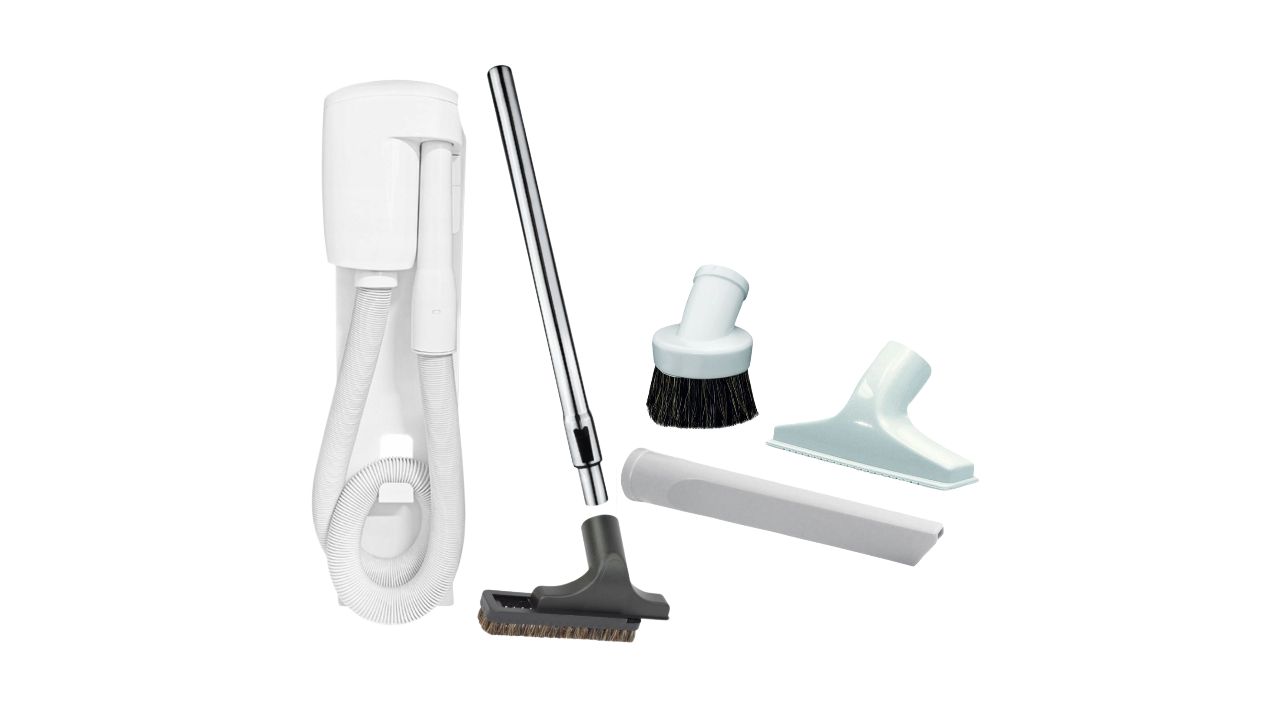
The butler on your wall, explained in plain terms
Think of it like a coiled garden hose mounted beside a light switch instead of a spigot. Pull the nozzle, flip the low-voltage switch on the console’s right side, and the power unit kicks on through the pipe already behind your walls. Standard 1 1/4-inch attachments snap onto the handle, so a crevice tool from any other inlet works here too.
Trovac Industries owns it, and that name matters
Trovac Industries Ltd., headquartered in Blainville, Quebec, holds the WallyFlex’s patent-pending design and one-year warranty. The company also distributes it through its Cyclovac and Mvac catalogs and through MD Manufacturing’s US dealer network, all selling identical hardware. Parts and warranty service trace back to one manufacturer, not a dealer’s private label.
Why “The Butler” and WallyFlex are the same product
ThinkVacuums and a handful of other retailers sell the identical console as The Butler by WallyFlex, the same Trovac hardware, not a competing design. Comparing listings side by side prevents paying a markup for a rebranded name. Check for the part numbers, TFWALLYN for black or TFWALLYB for white, before checkout.
The 13 Foot vs 14 Foot Spec Confusion
The WallyFlex hose maxes out at 13 feet (4 meters) per Trovac’s own catalog and owner’s manual, even though several US dealer pages list 14 feet.
Why does the same hose have three different lengths online?
| Source | Stated length |
|---|---|
| Official WallyFlex specifications in the Trovac Mvac catalog | 13 ft (4 m) |
| Owner’s manual safety warning | “Do not overstretch hose (maximum 13 feet / 4 meters)” |
| Most US dealer product pages | 14 ft |
Trovac’s catalog states the hose extends up to 13 feet, and the owner’s manual repeats that figure as a safety limit, not a suggestion. Most American dealer pages round it up to 14. European listings convert the same hose to 4 meters, matching 13, not 14. When a spec sheet and a safety warning disagree with a sales page, trust the warning.
The honest reach is shorter than any spec sheet says
Fully stretched, the coiled hose fights to snap back, and suction drops near the end of that pull. A verified Amazon purchaser called it fantastic only for messes within 6 to 7 feet of the console, matching how the coil behaves under load, not the number on the box. Plan placement around 7 usable feet, not 13.
Installing One Is Just Adding Another Inlet
Installing a WallyFlex means running the same 2-inch PVC pipe, low-voltage wire, and backing plate used for any other inlet. Nothing about the tie-in is proprietary.
Same pipe, same wire, same backing plate as any inlet
The console mounts on a standard backing plate like part 517, the same plate used under any wall valve. Branch 2-inch pipe off the trunk line with a three-way tee, then splice the wire into the signal wire already running the pipe. MD Manufacturing’s WallyFlex installation guidance confirms the same pipe, fittings, and wire used for any inlet apply here.
Mounting height decides whether you’ll actually use it
Trovac’s manual recommends mounting the console about 48 inches off the floor, light-switch height. Go lower, and you’re bending for every pull. Go higher, and shorter household members can’t reach it. Closet and cabinet installs work too, if pipe and wire reach that wall.
The switch detail dealers gloss over
A WallyFlex needs a manual pull on the console’s right-side switch, unlike automatic systems that fire the moment you pull the hose. Removing the nozzle exposes the switch; pulling it activates the unit, and the seal keeps every other inlet at full vacuum while stowed. Pressing it again stops the unit instantly.
How long does this job really take?
Dealer copy says it “installs like a standard inlet” and stops there. The real sequence:
- Mount the backing plate level, 48 inches up, with pipe and wire stubbed in.
- Tee the pipe into the trunk line and splice the wire into the existing run.
- Power down the unit, seat the console, and wire the terminal screws.
- Restore power and test suction before locking the hose in.
An open basement ceiling below the wall makes this a one-hour job. A finished two-story wall with no attic access turns it into a fishing expedition.
The Hose Tears, and Nobody Warns You
The WallyFlex’s known weak point is the flexible hose itself. Verified owners report it splitting near the console attachment well before the rest of the unit fails.
Owners report splits right where the hose meets the wall
One verified Amazon purchaser described gluing new holes shut with E6000 every few weeks, with a fresh split opening at the next loop shortly after. The flex point closest to the console absorbs the most bending, and stretching toward far corners accelerates wear at the coils.
The replacement hose problem that filled one closet with dead units
For years, WallyFlex sold no standalone replacement hose, so a torn coil meant buying an entire new console to fix one part. The warranty covers domestic use only, for one year, and excludes commercial or industrial use, so a business running one hard every day voids coverage fast. A wear-prone part with no standalone fix is the biggest complaint across verified owner reviews.
Where to actually find a replacement or upgrade hose today
| Hose option | Length | Approx. price |
|---|---|---|
| Stock WallyFlex replacement hose | 13 ft (4 m) | ~$80 |
| Upgrade stretch hose | 6 to 30 ft | Varies by seller |
Aftermarket sellers now stock standalone replacement hoses for around 80 dollars, closing the gap that used to force a full console purchase. A 6-to-30-foot upgrade hose exists too, for rooms where 7 feet isn’t enough. Budget a hose swap every few years, and count that cost as part of the real price, not a rare repair.
WallyFlex vs Vroom vs Spot vs VacPan
The WallyFlex is the cheapest wall-mounted option, but Vroom hides more hose in cabinetry, Spot hides hose fully in the wall, and VacPan skips the hose entirely for floor sweeping.
Four quick clean tools, four different philosophies
| Tool | Mount | Hose reach | Activation | Best room |
|---|---|---|---|---|
| WallyFlex | Wall console | 13 ft, manual pull | Manual switch | Laundry, bath, garage |
| Vroom (H-P Products) | Cabinet | Up to 24 ft | Automatic | Kitchen, laundry |
| Spot (H-P Products) | Inside wall | 15 ft | Automatic | Mudroom, pet zones |
| VacPan | Toe-kick slot | No hose | Foot-activated | Kitchen, bath floors |
WallyFlex mounts a visible console with a manual switch. Vroom, from H-P Products, stores up to 24 feet of retractable hose in a footprint about 3 inches wide, small enough for a kitchen cabinet, and starts automatically. Spot hides up to 15 feet of hose fully inside the wall near a dryer or mudroom. VacPan skips a hose altogether: kick open a toe-kick slot and sweep debris into the pipe.
Homeowners weighing a switched valve instead of a stretch hose should also compare Electravalve inlet alternatives before committing to any of these four.
Is the WallyFlex central vacuum inlet worth adding to your system?
Yes, when your mess zone sits within 7 feet of a wall with pipe access nearby. No, if you want automatic start or hidden hardware, since Vroom and Spot beat WallyFlex there. Vroom wins cabinets, VacPan wins kitchen and bathroom floors, and WallyFlex wins bare walls where a visible console isn’t a dealbreaker.
What each option demands from your existing pipe network
All four tap into the same 2-inch pipe and low-voltage wire, so none need a specialized trunk line. Vroom and Spot need pipe routed inside cabinetry or wall cavities built to hide the retraction mechanism, raising retrofit difficulty in a finished home. Retrofit difficulty, not price, usually decides the winner.
Rooms Where It Earns Its Wall Space
A WallyFlex earns its keep in laundry rooms, bathrooms, and garage workbenches, the spots verified owners rank highest for daily use, and it shows up often in kitchen vacuum inlet setups too, for the same reason: crumbs and spills within a few feet of one wall.
Laundry rooms are the killer application
A verified builtinvacuum.com reviewer in Gloucester, Massachusetts, installed a WallyFlex to clean lint off the dryer’s filter and vent area, replacing the old habit of dragging the main hose across the floor. Owners across multiple verified reviews rank laundry installs as their highest-satisfaction placement.
Bathrooms, hair, and the makeup counter problem
Hair and powder cleanup off tile doesn’t need the main hose hauled up a flight of stairs. One verified owner in Winston-Salem hid the console inside a bathroom closet during new construction and now sweeps hair and countertop mess without touching the 35-foot main hose. Standing water and wet spills stay off-limits, per the manual’s own warnings.
Garage workbenches and the sawdust radius
Sawdust and small hardware cleanup off a workbench lands easily within the stretch radius when the console mounts nearby. Cold winters in unheated garages stiffen the hose, shortening comfortable stretch even further than the 13-foot maximum suggests. Fine drywall dust belongs in a separator ahead of the main filter, not straight into the canister.
Real Cost, Warranty Fine Print, and Where to Buy
A WallyFlex console runs about 120 Canadian dollars at manufacturer suggested retail, before pipe, fittings, wire, and the hose replacements you’ll eventually need.
The sticker price is only the entry fee
Trovac’s own Mvac catalog lists the WallyFlex at 120 dollars Canadian, manufacturer suggested retail, in black or white. US dealer pricing varies enough that comparing three sellers is worth the ten minutes it takes. Add a backing plate, pipe, fittings, and wire for a self-install, or budget for the typical cost to add a central vacuum inlet if a pro ties in the branch line, generally 130 to 300 dollars per added outlet.
One year of coverage, and what it quietly excludes
Trovac backs the WallyFlex with a one-year limited warranty for domestic use only, far short of the multi-year coverage buyers expect on a power unit. That warranty excludes commercial use and damage traced to a bad install, so a rushed tee-in job voids coverage on the exact part most likely to need it.
Dealer, online, or marketplace: does the source change anything?
| Source | Price range | Support |
|---|---|---|
| Authorized dealer | Full MSRP plus install | Best warranty and service support |
| Online specialist | Mid-range | Stocks standalone replacement hoses |
| Marketplace listing | Often lowest | Inconsistent replacement-part support |
The console itself is identical everywhere, since one manufacturer builds it, but returns and support differ sharply by seller. Online specialists stock standalone replacement hoses that marketplace listings often skip. Confirm any listing shows the genuine part number, TFWALLYB or TFWALLYN, before checkout.
The Real Verdict on the WallyFlex
You arrived thinking the WallyFlex was a gimmicky wall gadget with contradictory specs. Now you know it’s a legitimate inlet built on a 13-foot hose, a 48-inch mounting height, and a consumable coil that wears out faster than the pipe behind it.
Tonight, stand in your messiest room and measure 7 feet from the nearest wall with pipe access. That circle tells you whether this purchase makes sense. No portable vacuum sits permanently ready at arm’s reach the way this one does, and that constant readiness, not raw suction, is what you’re actually paying for.
Frequently Asked Questions
What is a WallyFlex and how does it work with a central vacuum system?
A WallyFlex is a wall console holding a stretch hose wired into your existing piping. Pull the nozzle, flip the switch, and the shared power unit runs suction through that hose until you re-seat it.
How long does the WallyFlex hose stretch, and how far can I realistically clean with it?
The hose maxes out at 13 feet per Trovac’s own catalog and manual, though some dealers list 14. Plan on 6 to 7 feet of comfortable working reach before suction and coil tension start fighting you.
Can I install a WallyFlex on my existing central vacuum system myself?
Yes, as long as your walls already have pipe and low-voltage wire access nearby. The job uses the same backing plate, pipe, fittings, and wire as any other inlet, so anyone comfortable gluing PVC and splicing wire can tee one in over a weekend.
How does the WallyFlex turn the central vacuum on and off?
You start it with a manual pull switch on the console’s right side, not automatically like a retractable system. Removing the nozzle exposes the switch, and re-seating it stops suction and reseals the inlet for the rest of the house.
Is the WallyFlex durable, and what’s the most common failure point?
The flexible hose near the console attachment fails first. Verified owner reviews describe splits forming there within weeks under heavy use, though a standalone replacement hose now runs about 80 dollars instead of a whole new console.