You bought a new central vacuum outlet hose, walked to the wall, and it wouldn’t go in. A vacuflo inlet connects that hose to your home’s pipe network, and not every inlet accepts every hose. The myth trapping buyers: central vacuum inlets are universal. Genuine Vacuflo 4900-series valves use a smaller, proprietary opening that rejects the industry-standard 1.5-inch hose end, and dealers rarely mention it.
By the end, you’ll know which inlet type is in your wall, what fits it, and how to convert it for more hose and powerhead options, plus when converting isn’t worth the trouble yet.
Vacuflo Inlet
A vacuflo inlet is the wall valve connecting your hose to the pipe network, either a proprietary 4900-series design or an industry-standard opening. It determines which hoses and powerheads you can buy. Replacement shoppers and inherited-system owners need to identify it before spending a dollar.This guide draws on Vacuflo’s own valve and installation FAQs from manufacturer H-P Products, current dealer installation guidance, and spec sheets from MD Manufacturing, a leading maker of industry-standard replacement parts for proprietary systems. Where retailer claims and manufacturer documentation disagreed, the manufacturer source won.
The Wall Plate That Decides Which Hose You Can Buy
A vacuflo inlet does more than hold a door shut. It’s the handshake point between your hose, the pipe network, and the low-voltage wire that tells the power unit to turn on.
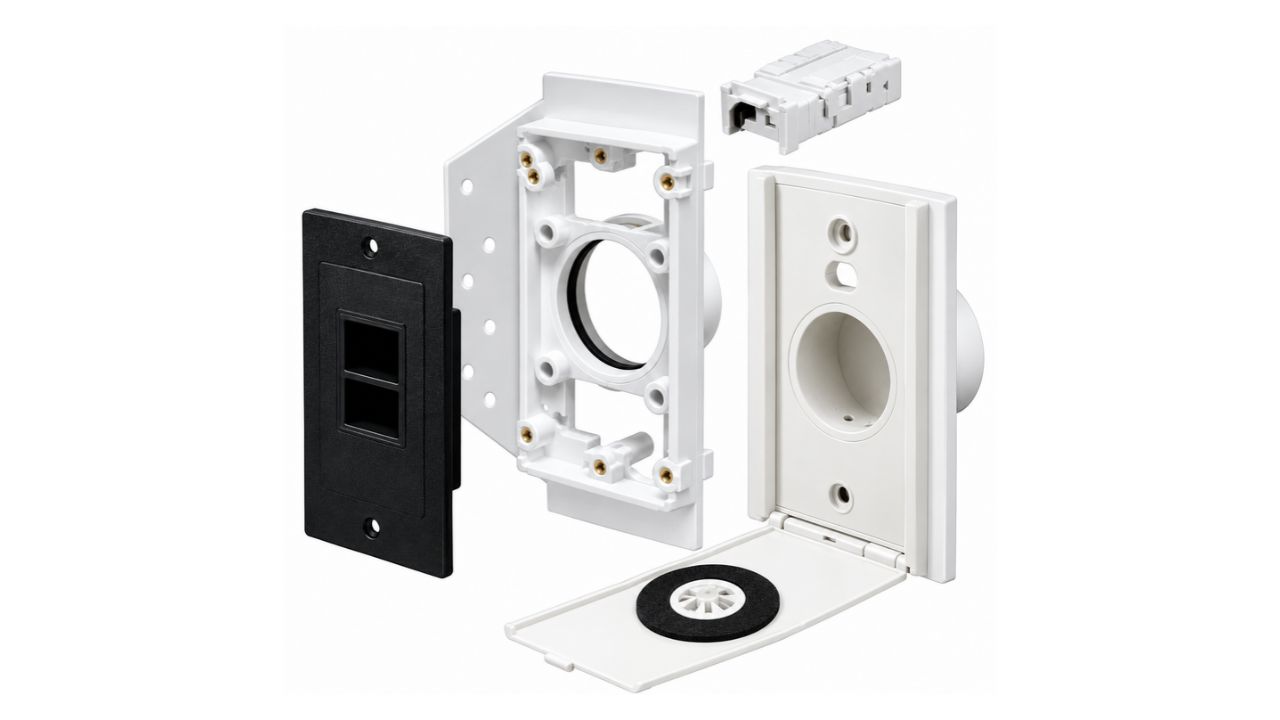
What an inlet valve actually does behind your wall
An inlet valve seals the pipe network and completes a low-voltage circuit the instant your hose locks in. Behind the faceplate sit two metal contacts wired to 20-gauge low-voltage wire that runs back to the power unit. Push the hose cuff in, the pins touch the contacts, and the motor spins up. Directly behind almost every valve sits a short 90-degree adapter elbow, and that elbow isn’t an installation shortcut. It’s there on purpose, to catch oversized debris before it ever reaches the buried trunk line.
Why won’t a standard hose work in my Vacuflo inlet?
Genuine Vacuflo, manufactured by H-P Products, builds its 4900-series inlet valves to a proprietary opening, not the industry standard. An owner who orders a fresh 30-foot universal hose and pushes it toward a 4940-style valve gets nothing but resistance, because the opening on these models runs smaller than the 1.5-inch bore that nearly every hose sold today is built around. Standard industry inlets, the kind found in about 99% of homes with universal hardware, accept that full 1.5-inch hose end without a fight.
The one number to check before spending a dollar
Open the valve door and read the model number stamped inside before you buy anything. A number reading 4935, 4940, 4941, or 4949 means you own a proprietary Vacuflo valve, and standard hoses with handle switches will not connect. Any other rectangular valve, especially one without contacts mounted above the opening, almost certainly takes universal replacement parts off the shelf.
Inside Vacuflo’s 4900 Series Proprietary Valve Family
The 4900 series is Vacuflo’s own low-voltage valve line, and understanding how it starts the vacuum explains why swapping hoses gets complicated fast.
Semi automatic valves and the door trick nobody explains
A semi-automatic 4900-series valve fires the power unit the moment its door opens, no handle switch required. Think of it as a refrigerator light in reverse: lifting the lid closes a circuit instead of opening one. That felt clever when H-P Products introduced the design decades ago, and it still works fine for a quick pass through the hallway. It just limits which hose ends will ever plug into that opening. The family covers four color options: 4935-S in white, 4940-S in ivory, 4941-S in brown, and 4949-S in almond.
The two prong hose connection, explained honestly
Two low-voltage pins sit above the valve opening on genuine 4900-series inlets, not inside the hole itself, and completing that circuit requires a genuine Vacuflo two-prong hose. Retailers selling universal replacement hoses openly print warnings on their product pages that these hoses skip 4940-style valves entirely, because the wall end of a proprietary hose is something only Vacuflo and its dealer network supply. That single design choice is the reason aftermarket parts sites can sell you a compatible hose body but never the matching wall-end connector.
What the proprietary design quietly costs you over 20 years
Staying on proprietary 4900-series valves shrinks your hose market from dozens of competing brands down to one supplier, and that lack of competition shows up in price. A proprietary system also can’t run a corded 120-volt powerhead through the wall, since the valve only carries the low-voltage signal circuit. Genuine replacement valves cost more, simply because Vacuflo’s dealer channel faces no price pressure from open-market sellers.
Feeling boxed in by four color options and one hose supplier? That’s the tradeoff every 4900-series owner runs into.
Why a New Hose Refuses to Fit Your Wall
The forum complaint that repeats every winter
Owners order a universal low-voltage hose online every holiday season and discover the prongs never touch the valve’s contacts. Sellers now print explicit compatibility warnings on hose listings because this return keeps happening. The frustration isn’t the refund. It’s feeling trapped by a wall plate nobody explained before the house closed.
Rotating the hose to start the vacuum is a symptom
A hose that only starts the vacuum when twisted a quarter turn is not “just how it works.” That workaround masks failing pin contact, worn internal springs, or corrosion building up inside the valve body. Owners who live with the twist trick past one season find the contacts fully seized soon after. For other hose symptoms, H-P Products’ hose and accessory troubleshooting guide covers kinking, static shocks, and low suction at the handle.
Mixed inlet homes and why one wall behaves differently
Additions and retrofits sometimes mix universal valves in with the original proprietary ones, so one hallway inlet behaves nothing like the bedroom next to it. Test each inlet by touching a screwdriver blade across both contacts before blaming the hose itself.
| Symptom | Likely cause |
|---|---|
| Hose won’t start unless twisted | Worn or corroded contact pins |
| One inlet dead, others fine | Broken low-voltage wire run |
| New hose won’t insert at all | Proprietary 4900-series opening |
| Suction weak at every inlet | Leak at gasket or backwards fitting |
Converting Proprietary Vacuflo Inlets to Industry Standard
The upgrade kits both sides of the market sell
Vacuflo itself sells upgrade hardware that opens its systems to standard attachments, and MD Manufacturing, a compatible-parts maker rather than the original equipment manufacturer, sells its own inlet adapter kit built for proprietary Vacuflo valves. Either path unlocks the full universal hose and powerhead market.
| Option | What it swaps | Opens up |
|---|---|---|
| Vacuflo upgrade kit | Faceplate and contact assembly | Vacuflo-branded standard tools |
| MD inlet adapter kit | Full valve to universal opening | Any 1.5-inch universal hose or powerhead |
What a full valve swap involves at the wall
A universal rectangular valve replaces roughly 99% of older wall inlets using the same mounting footprint. The bracket’s front opening runs about 1.5 inches, with mounting screws spaced 4 inches apart and a 1-5/8-inch bore on the back for the PVC pipe connection. A stem extension handles walls thicker than standard drywall and blocking. Work over a towel, since the tiny contact springs inside escape the moment you tip the old valve out.
When keeping the proprietary valves actually makes sense
A working genuine hose paired with light cleaning doesn’t automatically justify tearing into the wall. Door-activated startup is genuinely convenient for a fast pass through the garage before guests arrive. Convert when the hose finally dies, not while the current one still works.
Low Voltage or Electric: Choosing Your Inlet Type
Low voltage inlets and what your handle switch really does
A low-voltage inlet carries only the 24-volt signal circuit that starts and stops the power unit, nothing else. The hose handle switch works like a light switch wired down a long cord, shorting that circuit whenever you press it. Every universal low-voltage hose pairs with every universal low-voltage inlet, the whole appeal of leaving the proprietary world behind.
Electric inlets, super valves, and the 120 volt question
An electric SuperValve inlet combines the low-voltage signal circuit with a full 120-volt supply for a corded powerhead, through one plug, and every direct-connect hose H-P Products sells fits it. Each ElectraValve ships with a 6-foot length of 120-volt wire a certified electrician has to hardwire into the panel, though an installer can mount the valve itself. A tripped GFI breaker, not a dead valve, explains many “broken” electric inlet calls.
The pigtail compromise for carpet lovers on a budget
A pigtail-style hose draws brush power from a nearby wall outlet instead of the inlet valve. That setup lets you keep low-voltage inlets throughout the house and still run a corded electric powerhead in the room where deep carpet cleaning matters most.
Retrofit wiring options that skip the wasted Romex
Newer ElectraValve II kits accept 12 or 14 gauge wire you supply at whatever length the run requires, instead of a fixed factory pigtail. That flexibility saves real money on retrofits sitting far from the panel, where a fixed factory wire would leave several feet coiled uselessly inside the wall cavity.
Inlet Placement Math Dealers Rarely Explain
The string test that beats every square footage chart
Hold a 30-foot length of string or cord at a proposed inlet location and walk it around the room before anyone drills a hole. The hose has to reach every corner, including around furniture, not just in a straight line to the farthest wall.
How many inlets your home honestly needs
Vacuflo’s own product documentation puts coverage at roughly 600 square feet per inlet with a standard 30-foot hose, while broader dealer guides stretch that to 700 or 800 square feet depending on layout. Overlapping coverage zones on purpose beats a dead spot in the guest room a year after drywall goes up.
Where inlets go wrong in two story homes
Hallways, stairwell landings, and doorway edges cover the most floor area per valve, since a hose reaches multiple rooms from one spot. Interior walls also save you a fight with insulation and vapor barriers. Keep the farthest inlet within the pipe-length limits listed in the current and archived Vacuflo product manuals for your power unit.
When an Inlet Stops Turning the System On
The rusted contact problem hiding behind the faceplate
Contact pins corrode over years of use and eventually stop closing the signal circuit reliably. Cleaning them from behind the removed valve, with fine sandpaper or contact cleaner, revives plenty of inlets that otherwise looked dead. Watch the tiny retention springs; lose one and you’re buying a whole new valve to replace a part smaller than a paperclip.
Testing an inlet without buying a single part
Touch a screwdriver blade across both contacts inside the open valve. The power unit starting confirms the wiring back to it is intact, pointing the fault at the hose or handle switch instead. Suspect a broken low-voltage wire run rather than the valve itself, when nearby inlets work fine but one distant valve stays silent.
Clogs love the elbow right behind the valve
Lift the door and check the first 90-degree elbow directly behind the faceplate before assuming a clog sits deep in the wall. That fitting is designed to trap oversized debris before it reaches the buried trunk line, and it’s the first place anything gets stuck. A butter knife or the fitting-clearing tool from a maintenance kit dislodges most of these clogs in minutes.
Specialty Inlets Most Vacuflo Owners Never Hear About
Utility valves for garages and workshops
A utility valve starts the system purely by the airtight seal of its door opening, with no electronics involved. These fit standard 2-inch central vacuum pipe and hold up to sawdust and workshop grit better than a finished-room valve ever would.
Toe kick sweep inlets that replace the dustpan
A VacPan-style sweep inlet sits low in a kitchen or laundry baseboard, letting you push crumbs toward a slot instead of bending for a dustpan. Flexible pipe makes the tight connection behind a toe kick possible during installation without reframing the cabinet base. According to Vacuflo’s own valve FAQ, the toe kick cover on these units is replaceable on its own through a repair kit, unlike a standard 4900-series valve where the whole assembly has to go. Homeowners weighing a kitchen or laundry retrofit can browse floor-level inlet models before picking a spot.
Retractable hose inlets and what they change
A retractable system, like Vacuflo’s Chameleon line, stores the hose inside the pipe network itself instead of on a rack. Fewer valves cover more floor area this way, though the hardware is specific to that system and won’t mix freely with standard inlets. Retrofitting one into a home built for standard inlets depends on existing access to the tubing behind the wall, worth confirming with a garage-specific inlet valves installer or your local dealer before committing.
Conclusion
You arrived assuming a wall inlet was just a hole with a door. You’re leaving knowing it’s the gatekeeper for every hose, tool, and powerhead you’ll ever buy for this system. Tonight, open every inlet door in your house and photograph the number printed inside each one before you shop for a replacement hose or valve. Cross-check that number against a find compatible parts for your system database before you order anything. Unlike a portable vacuum, the inlets already in your walls will outlast three power units, so the twenty minutes spent identifying them now pays off for decades.
Frequently Asked Questions
How do I tell which type of Vacuflo inlet valve I have?
Open the door and read the model number printed inside. A 4935, 4940, 4941, or 4949 stamp means a proprietary low-voltage valve; anything else with a plain rectangular opening is very likely industry standard.
Why doesn’t a standard central vacuum hose fit my Vacuflo inlet?
Your inlet is a genuine 4900-series proprietary valve. Its opening runs smaller than the 1.5-inch industry-standard bore, and its contact pins sit above the hole instead of inside it, so only a genuine Vacuflo two-prong hose completes the circuit.
What is the difference between a semi-automatic and fully automatic Vacuflo valve?
A semi-automatic valve starts the vacuum the instant its door opens, while a fully automatic valve relies on a handle switch at the hose end to turn the unit on and off. Both still require the correct proprietary or universal hose to physically connect.
Can I replace just the door on a Vacuflo inlet valve, or do I need the whole valve?
No, the door alone isn’t sold separately on standard 4900-series valves. Vacuflo’s official valve maintenance and troubleshooting FAQ confirms the entire valve has to be replaced through a local authorized dealer.
How do I fix a Vacuflo inlet valve that leaks suction?
Check the gasket seal around the valve body first, since a worn gasket lets outside air in and drops suction system-wide, not just at that one inlet. Corroded contacts or a cracked valve body mean full replacement rather than a spot repair, when the gasket itself still looks intact.
Can I convert Vacuflo proprietary inlets to standard inlets to use any hose?
Yes, both Vacuflo’s own upgrade kit and MD Manufacturing’s inlet adapter kit convert a proprietary opening to an industry-standard 1.5-inch inlet. Once converted, any universal low-voltage or electric hose on the market fits.
Do I need an electrician to install a Vacuflo ElectraValve?
Yes, for the 120-volt portion. The valve ships with a 6-foot length of 120-volt wire that must be hardwired into your electrical panel by a certified electrician, even though the low-voltage side is your installer’s job.