A cracked central vacuum system inlet cover dangling by one screw in the hallway is the kind of thing every guest notices. Amazon makes replacement look simple: grab the cheapest white rectangle and move on. That assumption gets people burned twice.
Not every wall inlet shares one spec. VacuFlo-style pin inlets, older NuTone square plates, and 1980s Kenmore installs all break the “universal” rule sellers count on. Finish this guide and you’ll identify your cover type in two minutes, then order the right part the first time. See the main central vacuum outlet resource for the full pipe network picture.
Central Vacuum System Inlet Cover
A central vacuum system inlet cover is the wall plate, hinged door, and contact assembly that seals a pipe network and triggers the power unit. Most covers made since the 1990s share one universal spec. Three exceptions break it: VacuFlo’s pins, Kenmore’s 1.25 inch bore, and 120-volt electric valves.That Little Wall Door Works Harder Than You Think
This small hinged door works harder than most homeowners realize. Every time a hose goes in, it seals the pipe network airtight and closes the circuit that starts the power unit two floors away, and you touch it more often than the power unit itself.
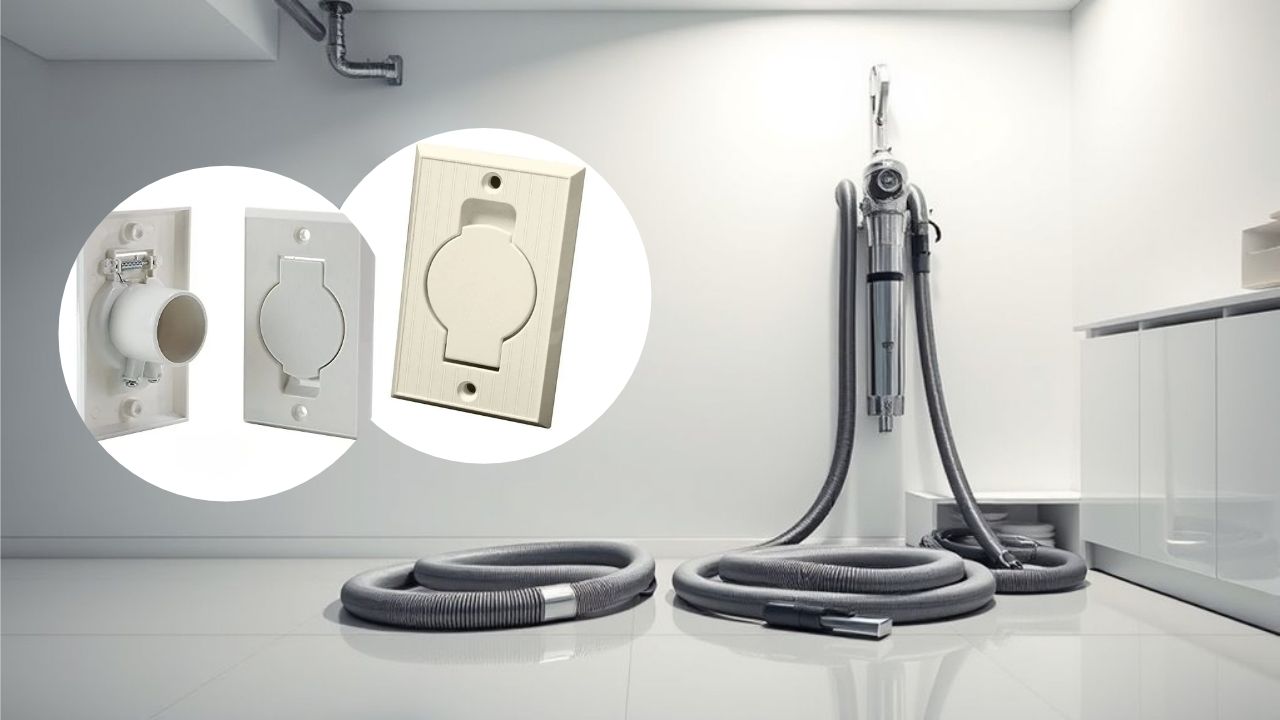
Why I Call It the Handshake Between Hose and House
Inserting the hose does two things in one motion: it seals the pipe airtight and completes a low-voltage circuit that starts the motor, much like a spaceship airlock double-checking its seal before the door opens.
- The cover seals the pipe network shut so suction survives elsewhere.
- Two metal contacts inside the hole start the motor on hose insertion.
- Touch both contacts with a spoon and the whole system fires.
The Anatomy Hiding Behind That Spring Loaded Door
Four parts work together behind that spring-loaded door: the face plate, the hinged door, the gasket neck, and two rear terminal screws wired to a low-voltage loop.
- Face plate, hinged door, gasket neck, and two rear terminal screws.
- The low-voltage circuit (the 24-volt loop that triggers the relay when the hose contacts close) does the actual signaling.
- The neck gasket, not the door, does the real sealing work.
Door Styles Ranked by How Fast Kids Destroy Them
Full-face covers survive kids and slammed doors longest; round and square doors snap at the hinge first.
- Full-face covers are the most durable style sold today.
- Round and square doors snap at the hinge under repeated slams.
- Newer side-opening full-face kits replace older Hayden 2050 SuperValves, made by Hayden, now part of Trovac Industries after the brand’s central vacuum lines were consolidated under that manufacturer.
The Measurement That Decides If Your Replacement Fits
Three numbers decide fit: a hose opening just under 1.5 inches, mounting screws spaced roughly 4 inches apart, and a 1-5/8 inch round opening in the wall bracket.
| Measurement | Spec |
|---|---|
| Hose opening | Just under 1.5 in |
| Mounting screw spacing | 3-7/8 to 4 in on center |
| Wall bracket opening | 1-5/8 in round |
The Universal Spec Almost Nobody Prints on the Package
The universal spec that matters is the physical measurement, not the brand printed on the box. A 1.5 inch hose opening, 4 inch screw spacing, and a 1-5/8 inch bracket hole fit roughly 98 to 99 percent of inlets installed since the 1990s, per MD Manufacturing’s parts documentation. MD Manufacturing, the company behind Hide-A-Hose retractable systems, publishes the most complete fit reference in the category.
- Standard covers take a 1.5 inch diameter hose end.
- Mounting screws sit roughly 3-7/8 to 4 inches apart on center.
- The plate fits a 1-5/8 inch hole in the wall bracket.
- Rectangle covers replace 99% of older inlets across nearly every brand, with two exceptions: 1-1/4 inch hose openings and copper or button-activated inlets.
See the universal inlet cover fit specifications by valve style for a style-by-style breakdown.
Brand Names on Covers Are Mostly Marketing Theater
Brand names on inlet covers are mostly marketing theater. Beam, NuTone round, Electrolux, and VacuMaid inlets all share the same physical footprint, and most of the covers behind those labels come from just two manufacturers.
- Beam, owned by Trovac Industries, along with NuTone round, Electrolux, and VacuMaid inlets, shares the universal footprint.
- Hayden and Canplas Vaculine, owned by IPEX under the Aliaxis Group, make most covers dealers rebadge under their own names.
- Match the spec and door style, not the logo, with the universal compatibility lookup tool.
Dealer sites sell the identical Hayden and Canplas covers under six different brand labels, marked up two or three times over.
What Is a Central Vacuum System Inlet Cover Exactly?
A central vacuum system inlet cover is the wall plate, hinged door, and contact assembly that mounts over the in-wall bracket, sold under names like inlet valve, wall plate, or face plate depending on the retailer.
- It is the wall plate, door, and contact assembly sold as one replaceable unit.
- Sellers call it an inlet valve, wall plate, or face plate interchangeably.
- The pipe and bracket stay in the wall; only the cover swaps.
This guide covers wall inlets only. Toe-kick inlets like VacPan or CanSweep, and retractable hose inlets such as Hide-A-Hose, use entirely different parts, and a standard wall cover won’t fit either.
Basic or Electric: Read Your Cover Before You Buy
One glance at the front of your existing cover tells you which aisle to shop in. Two small holes above the main opening mean electric; no holes mean basic low-voltage.
Two Tiny Holes That Change the Entire Replacement Job
Two prong holes spaced 3/8 inch apart above the main opening signal an electric inlet built for powerhead hoses, not a basic low-voltage inlet.
- Basic covers carry only the 24-volt contact circuit.
- Electric covers add a 110-volt receptacle for powerhead hoses.
- Never insert anything into those two small front holes.
SuperValve and ElectraValve Look Alike and Refuse to Swap
SuperValve and ElectraValve covers look nearly identical but never swap. SuperValve uses permanent wire leads; ElectraValve uses a molded plug on 110-volt romex, and the two formats are not interchangeable.
- Hayden SuperValve covers use permanent wire leads behind the plate.
- Canplas ElectraValve covers hold a molded plug on 110-volt romex.
- The new E-box ElectraValve does not fit older, discontinued ElectraValve boxes. Check Electravalve-specific inlet models before ordering.
When to Hand This Job to an Electrician
Hand this job to an electrician the moment the cover carries a 110-volt connection; low-voltage-only covers stay safe homeowner territory.
- Shut off the breaker first on any cover carrying 110 volts.
- The Class 2 circuit (a low-voltage signal circuit under NFPA 70 Article 725 a homeowner may service with the power unit unplugged) covers basic inlets only.
- Manufacturers recommend an electrician for direct-connect face plate swaps.
The Covers No Standard Replacement Will Fix
About one inlet in a hundred won’t accept a standard replacement cover at all. Genuine VacuFlo, old NuTone square, and pre-1990s Kenmore inlets all use a proprietary bore or contact style.
VacuFlo 4940 and NuTone Square: The Proprietary Holdouts
VacuFlo 4940-style valves and NuTone square inlets reject standard covers because both use non-standard contact geometry. VacuFlo, made by H-P Products, relies on two pins rather than the industry-standard contact ring, and NuTone, produced under license by DrainVac International, uses a dedicated square bore.
| Valve type | Why standard covers fail | Upgrade path | Hose implications |
|---|---|---|---|
| VacuFlo 4940 | Two-pin contacts, 1.65 in opening, 4-screw plate | Conversion kit (such as 07-0600-07) to the universal format | Needs a VacuFlo-specific hose end until converted |
| NuTone square | Dedicated square bore, not round | Brand-specific replacement cover | Standard hoses fit once the cover matches |
- VacuFlo 4940-style valves reject industry-standard hoses entirely.
- NuTone square inlets need their own dedicated replacement covers.
- Conversion kits bring both onto the universal standard, and a full swap often means replacing a damaged inlet valve rather than just the cover.
See the VACUFLO hose and inlet compatibility documentation for the pin-to-ring distinction.
Old Kenmore Inlets Measure 1.25 Inches and Nothing Fits
Some 1980s Kenmore and Sears inlets run a 1.25 inch opening, a quarter-inch narrower than the modern 1.5 inch standard, so every current hose sits loose.
- Some older Kenmore and Sears inlets run 1.25 inch openings.
- Standard 1.5 inch covers and hoses will not seat properly.
- Hose adapters solve the fit; a full cover swap needs bracket work behind the wall.
Copper Press and Button Activated Doors From Another Era
Copper press and button-activated inlet doors predate the contact-ring standard entirely, and no current catalog stocks a matching cover.
- Inlets activated by pressing copper strips predate the contact standard.
- Single-button trigger valves accept modern hoses but lose automatic switch function.
- These systems justify a full inlet modernization instead of a cover swap.
A Cracked Cover Quietly Bleeds Your Suction Away
A cracked cover or missing door gasket bleeds vacuum from the whole system, not just the inlet it sits on, and it’s the hidden cause behind most weak-suction complaints blamed on the motor.
The Leak Test That Takes One Lap Around Your House
Walk the house with the power unit running and listen. A broken door leaks air with a high-pitched hiss right at the inlet.
- A broken door leaks air even at inlets you never use.
- Air sounds louder and higher-pitched right at a leak.
- Check hidden inlets in closets, garages, and behind furniture.
The Electrical Tape Trick Dealers Use on Service Calls
Wrapping one or two layers of electrical tape around the valve neck rebuilds a deteriorated gasket well enough to reseat the door tight, and it’s the fix manufacturer troubleshooting flowcharts list before replacement.
One leaky inlet valve costs up to 5 percent of total system suction.
- Wrap one or two tape layers around the valve neck.
- The tape rebuilds a deteriorated gasket for a tighter seat.
- Manufacturer troubleshooting flowcharts recommend this exact fix before replacement.
Replacing One Yourself Before Dinner Gets Cold
Replacing a central vacuum system inlet cover takes about fifteen minutes with one screwdriver, no wall damage, and no dealer visit.
Two Screws, Two Wires, and One Spring to Respect
Two mounting screws, two low-voltage wires, and one small contact spring stand between the old cover and the new one.
- Score the painted edges first so the drywall paper doesn’t tear.
- Pull the cover forward gently; the low-voltage wires follow behind it.
- Work over a towel; the tiny contact springs pop loose fast.
Wiring the Back Without a Multimeter or Panic
The back of an inlet cover wires like a doorbell, not like an outlet: two screws, two wires, no risk of shock from the low-voltage contacts.
- Loosen the rear screws.
- Swap the wires onto the new cover’s matching screws.
- Retighten firmly and reseat the plate.
- The 24-volt circuit cannot shock you at the contacts.
- Corroded contacts alone can kill an inlet; cleaning them sometimes revives it before you buy anything.
The Fifteen Dollar Fix Forums Keep Celebrating
Basic replacement covers run under twenty dollars each, and one RedFlagDeals forum owner summed up the whole job as fifteen dollars and a few minutes.
- Basic covers commonly run under twenty dollars per inlet.
- Multi-packs make whole-house refreshes cheap and color-consistent.
- Compare that cost against a dealer service call before booking one.
What Homeowners Learn the Hard Way on Forums
Three real forum stories cover the mistakes a spec sheet won’t warn you about: a dead retrofit inlet, a hose that won’t start the motor, and a cover eaten by new flooring.
The Inlet That Went Absolutely Nowhere Behind the Wall
One RedFlagDeals owner found a decorative inlet with no pipe behind it at all, a leftover from a retrofit that never got finished.
- Retrofit installs sometimes leave decorative inlets with no pipe connection.
- No vibration behind the plate while the unit runs means no pipe.
- The owner solved it with a forty-dollar hose extension instead of new plumbing.
New Hose, Old Cover, and the Contact Gap Mystery
A new hose that won’t start the motor on an old cover usually comes down to a contact gap: newer hose ends sit shorter than older recessed contacts expect.
- Newer hose ends sometimes sit shy of older recessed contacts.
- Twenty-year-old covers with worn contacts cause intermittent starts.
- Updating the cover costs less than returning the new hose.
Taller Baseboards Ate My Inlet Cover After New Floors
New flooring and taller baseboards collide with low-mounted inlet covers more often than any renovation checklist mentions.
- New flooring and baseboard heights collide with low-mounted covers.
- Standard cover dimensions run about 3.5 by 5.2 inches.
- Plan inlet height before flooring crews start, not after.
Trim Plates, Blanks, and Extensions Nobody Mentions
Trim plates, blank plates, and extensions finish a swap that a bare replacement cover leaves half-done, and each costs only a few dollars.
Covering the Scars a Swap Leaves on Painted Walls
A trim plate hides the ghost outline an old, larger valve leaves behind on painted walls after a swap.
- Trim plates hide paint gaps and wall damage around new covers.
- Hayden and VacuValve trim plates fit their matching inlet footprints.
- Colors span white, ivory, almond, black, and stainless look finishes.
Blank Plates and Extensions for Odd Walls and Dead Inlets
Blank plates seal abandoned inlets shut, and stackable extensions solve thick-wall gaps a standard cover can’t bridge.
| Accessory | Problem it solves | Typical price | When you need it |
|---|---|---|---|
| Blank cover plate | Seals an abandoned inlet hole | Under $10 | Removing or relocating an inlet |
| Stackable extension | Adds 3/4 in per piece for thick walls | $5 to $10 each | Tile or extra drywall layers |
| Plaster guard | Protects an open inlet during renovation | Under $10 | Drywall or remodel work in progress |
- Blank cover plates seal abandoned inlet holes cleanly and permanently.
- Stackable extensions add 3/4 inch each for thick tile walls.
- Plaster guards protect open inlets during drywall or renovation work.
Conclusion
That cracked door in the hallway isn’t a proprietary mystery. One universal spec covers nearly every inlet built since the 1990s. Three exceptions cover the rest: VacuFlo’s pins, Kenmore’s narrow bore, and 120-volt electric valves. Tonight, open one inlet door, measure the hole, and photograph the plate front and back before you order anything. A five-dollar gasket protects a pipe network that will outlast every portable vacuum you ever plug in.
Frequently Asked Questions
What does a central vacuum inlet cover do?
It seals the pipe network airtight and closes the low-voltage circuit that starts the power unit when a hose goes in. Without it, the whole system loses vacuum, not just that one inlet.
Are central vacuum inlet covers universal, or do I need my system’s brand?
Universal, for about 98 to 99 percent of systems installed since the 1990s. VacuFlo, old NuTone square, and pre-1990s Kenmore inlets are the exceptions that need brand-specific parts.
How do I know if my inlet is low-voltage or electric?
Check the front plate for two small holes spaced 3/8 inch apart above the main opening. Two holes mean electric with a 110-volt receptacle; no holes mean basic low-voltage.
Can a broken inlet cover or missing door gasket cause my central vacuum to lose suction?
Yes. A single leaky inlet costs up to 5 percent of total system suction, even at inlets you never use.
Do I need an electrician to replace an electric (direct-connect) inlet valve?
Electrician-recommended, yes. Low-voltage-only covers are safe homeowner work, but anything carrying a 110-volt connection deserves a breaker shutoff and a professional swap.