Look up any central vacuum brand’s inlet, hose, motor, and filter compatibility, plus ownership history, in one searchable database.
This central vacuum compatibility chart exists because parts sourcing for built-in vacuum systems is scattered across dozens of dealer subpages, forum threads, and phone calls to retailers who would rather sell you a new unit than confirm your old one still works. This page maps brand ownership, inlet and hose standards, filter and motor cross-references, and sizing rules in one place, and it names the exceptions dealers tend to leave out. Start with the finder below, or jump straight to a brand in the index.
New to your system's parts? Read central vacuum outlet basics first for the terminology used throughout this database.
Brand and Model Finder
Select a brand to see its parent company, parts status, and the inlet, hose, and filter standard it uses. Results update instantly.
Brand Ownership Map and Industry History
Central vacuum brands have changed hands repeatedly since the 1980s, which is the reason so many owners cannot find who makes their parts anymore. The three groups below cover the majority of North American installations; independents and private-label builder-grade units are noted separately.
Corporate Family Groups
| Current Parent | Brands Under This Parent | Notes |
|---|---|---|
| Trovac Industries | Beam, Hayden, DuoVac | Trovac acquired Hayden Industries in 2017, the DuoVac brand portfolio by mid-2024, and Beam from bankrupt Nuera Air in 2024. |
| DrainVac International | DrainVac, NuTone, Broan, Venmar | DrainVac became the central-vac owner of NuTone, Broan, and Venmar effective August 31, 2023, when Broan-NuTone discontinued its own central vacuum line. |
| H-P Products Inc. | VacuFlo, Dirt Devil (central vacuum), Royal, Element, Chameleon | All manufactured from the same Louisville, Ohio facility. See the dedicated cross-reference below. |
| Electrolux Group (Sweden) / Aerus LLC | Electrolux Central Vacuum (pre-2018), Aerus, Centralux, Eureka Central Vacuum | Aerus is the rebranded (2003) independent North American dealer network and is a separate company from the Beam-by-Electrolux central vacuum business Electrolux sold in 2018. This split is the single most common source of owner confusion in the category. |
| MD Manufacturing | Modern Day, Hide-A-Hose, Silent Master, Flo Master, Air Flo | Best known for the Hide-A-Hose retractable-hose format, covered in Hose Compatibility below. |
| Nuera Air Solutions (defunct) | Formerly Beam; Husky, Smart, SoluVac, InterVac status uncertain | Nuera Air acquired Beam from Electrolux in 2018 for $37 million, then ceased manufacturing operations, with bankruptcy first reported April 2, 2024. Beam moved to Trovac afterward. Husky, Smart, SoluVac, and InterVac were also under the Nuera Air umbrella; their current parts status was not independently confirmed for this database and should be treated as unverified until you get a direct answer from a parts supplier. |
Independent and Currently Active Brands
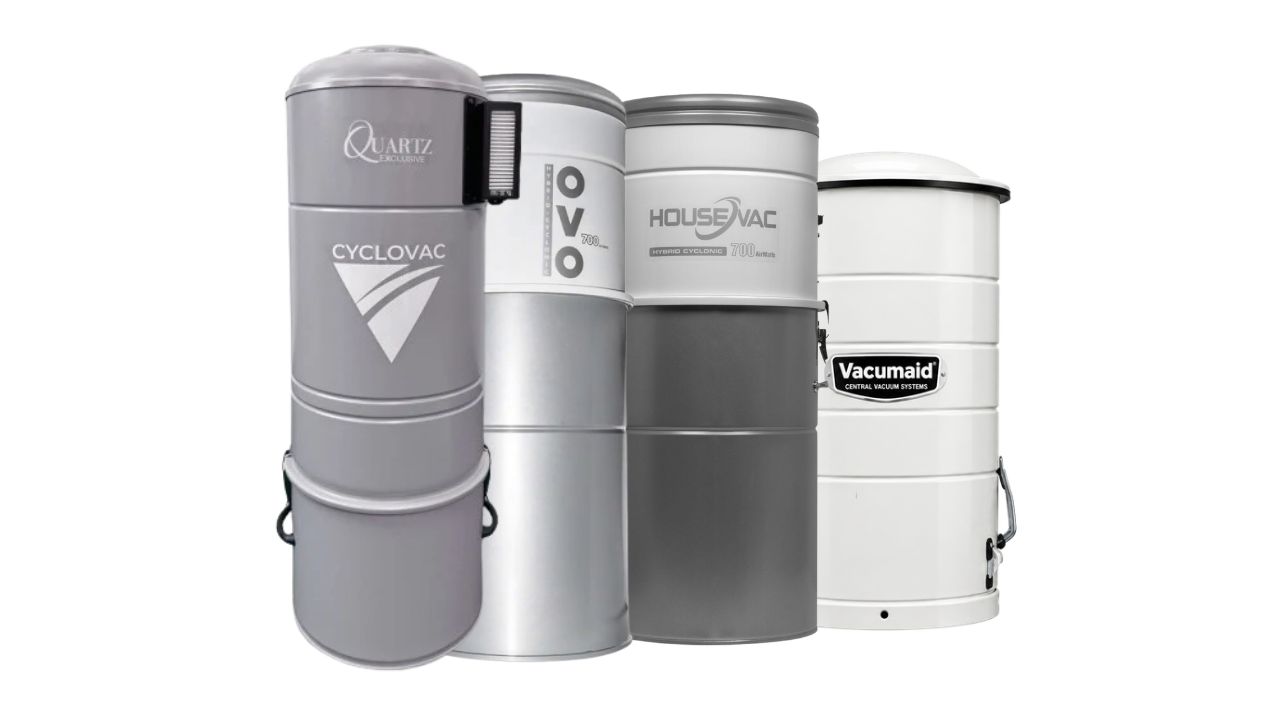
Galaxie, VacuMaid, Canavac, Imperium, CycloVac, OVO, Nadair, and Prolux continue to operate as independent manufacturers or distributors as of this update, each producing OEM parts for their own current model lines.
Acquisition Timeline
| Year | Event |
|---|---|
| 1957 | Beam Industries founded by Robert Sampson in Webster City, Iowa. |
| 1987 | Electrolux AB acquires Beam Industries. |
| 2003 | Electrolux's independent North American dealer network rebrands as Aerus LLC, splitting from Electrolux-branded central vacuum production. |
| 2007 | Beam Industries rebrands under Electrolux ownership as "BEAM by Electrolux." |
| 2015 | AirVac reported to have ceased operations. Not independently verified for this database; treat as unconfirmed. |
| Jan 2017 | Trovac Industries acquires Hayden Industries. |
| Aug 8, 2018 | Nuera Air Solutions acquires the global Beam central vacuum business from AB Electrolux for $37 million. |
| Aug 31, 2023 | Broan-NuTone discontinues its central vacuum line; DrainVac International becomes the new owner of the NuTone, Broan, and Venmar central vacuum brands. |
| Apr 2, 2024 | Nuera Air Solutions' bankruptcy first reported; manufacturing operations cease. |
| 2024 | Trovac acquires the DuoVac brand portfolio and, separately, acquires Beam out of the Nuera Air bankruptcy. |
System Identification Guide
Identify your power unit, inlet, hose, and filter type before you order anything. Misidentifying any one of these four is the most common reason a replacement part arrives and does not fit.
Find Your Power Unit Model Number
Check the canister body, inside the dirt collection area, on a sticker on the back or bottom of the unit, or on the motor housing itself. Format varies by brand: Beam typically uses three or four-digit numbers, VacuFlo uses an FC-prefix, Royal uses a CS-prefix, and Dirt Devil uses CV-prefix for whole-house models and DB-prefix for bag models.
Label worn off or missing? Measure the canister diameter, the bag opening style or filter dimensions, and the motor diameter, then compare those measurements using the Brand and Model Finder above.
Identify Your Wall Inlet
- Hose insertion hole diameter: 1.5 inch (38mm) is the universal standard; 1.25 inch (32mm) indicates an older proprietary system, most often Sears/Kenmore or Budd.
- Mounting screw spacing: roughly 3-7/8 to 4 inches on center is universal; anything else indicates a proprietary bracket, most often VacuFlo series 4940 or NuTone 360-style.
- Two small holes roughly 3/8 inch apart at the top or bottom of the main hole mean an electric/direct-connect inlet. No small holes means a basic low-voltage inlet.
- Activation method: metal contacts that respond to the spoon test are standard universal; a copper strip you press, or a push button, both indicate an older proprietary inlet.
Identify Your Hose
| Hose Type | How to Tell |
|---|---|
| Basic | No switch, no cord. Suction only. |
| Low-voltage | On/off switch at the handle, two metal contacts on the wall-end cuff, no power for motorized attachments. |
| Electric, pigtail | Switch at the handle plus a roughly 6-foot power cord that plugs into a nearby wall outlet. |
| Electric, direct-connect | Switch at the handle plus a two-pin plug that inserts directly into an electrified inlet valve. Requires electrified inlets. |
Identify Your Filtration Type
Inverted cloth self-cleaning filters (Beam and some NuTone units), disposable paper bags (VacuFlo bag models, Broan-NuTone, CycloVac, DrainVac), pleated cartridge filters (VacuFlo, Royal, Dirt Devil, Titan), and cyclonic/bagless systems each require different replacement parts. Full detail in Bag and Filter Compatibility below.
Measuring your exhaust port for a muffler upgrade? The standard is a 2 inch OD port; confirm before ordering since a small number of brand-specific units deviate from it.
Power Unit Sizing Matrix
Match power unit air watts to your home's square footage, floor count, and inlet count, not just the square footage alone. Undersizing shows up as weak suction at the farthest inlet; oversizing wastes money and adds noise.
| Home Size | Inlets (at 1 per 700 sq ft) | Minimum Air Watts Target |
|---|---|---|
| Under 2,000 sq ft | 1 to 3 | 400 to 450 |
| 2,000 to 3,500 sq ft | 3 to 5 | 450 to 550 |
| 3,500 to 5,000 sq ft | 5 to 7 | 550 to 650 |
| 5,000 to 7,000 sq ft | 7 to 10 | 650 to 750, consider dual-motor |
| 7,000 to 10,000 sq ft | 10 to 14 | 750+, dual-motor recommended |
| Over 10,000 sq ft | 14+ | Dual-motor engineered layout, consult a CVAC-certified installer |
Illustrative starting point based on the common "1 inlet per 600 to 900 sq ft" industry rule and the "double your square footage" air watt convention. Actual requirements depend on pipe-run length and elbow count; do not treat this table as a substitute for a layout-specific calculation.
Why Longer Pipe Runs Change the Math
Suction drops with every added foot of pipe and every 90-degree elbow beyond the manufacturer's specified maximum run. A power unit rated for a 2,000 sq ft home on paper will underperform at the farthest inlet in a home with a long, elbow-heavy pipe run even if the square footage matches the rating table. Homes with inlets more than roughly 75 to 100 feet of pipe from the power unit, or with more than 6 to 8 elbows in a single run, should size up regardless of what the square footage table suggests.
Single-Motor vs. Dual-Motor
Dual-motor units become worth considering once total pipe run and inlet count push past what a single 650 to 700 air watt motor can maintain at the farthest point, which in practice tends to line up with homes over roughly 6,000 to 7,000 sq ft or with unusually long single-run distances. Below that, a correctly sized single motor is almost always the more reliable and less expensive choice.
Reading the Specs Correctly
- Air watts measure sealed suction power at the motor and are the primary comparison metric between units.
- CFM (cubic feet per minute) measures airflow volume, which matters for carrying larger debris through the pipe.
- Water lift (inches of water) measures suction strength and matters most on long pipe runs.
- Amp ratings and horsepower figures are not reliable for comparing suction between units, since manufacturers calculate them differently.
Motor Compatibility
Most central vacuum power units use an Ametek/Lamb motor regardless of the brand printed on the canister, which is why the motor tag, not the unit's brand name, is the most reliable way to source a replacement.
How the Numbering Works
Ametek/Lamb motors are identified by a base model number stamped on the motor tag, with configuration details covered by the motor's diameter, stage count, and bypass or thru-flow design rather than a universal suffix code that applies the same way across every product line. Record the full tag exactly as printed, including any letters, before calling a supplier.
- Motor diameter: 5.7 inch and 7.2 inch are the two common residential sizes; diameter must match for a direct swap.
- Stage count: single, two-stage, and three-stage motors are not interchangeable with each other even at the same diameter, since stage count changes both airflow and suction characteristics.
- Bypass vs. thru-flow: thru-flow motors pass working air directly through the motor to cool it, and are common in dry central vacuum systems. Bypass motors separate cooling air from working air so exhaust can be ducted outside the home. Swapping a thru-flow motor into a unit designed for a bypass motor, or the reverse, is not a safe compatibility assumption.
OEM vs. Aftermarket Motors
A direct OEM replacement is worth it when the motor tag matches an active part number. An aftermarket or upgraded motor with the same mounting pattern and diameter is worth considering when the OEM number is discontinued but a newer motor shares the mount. Full unit replacement becomes the better math once the motor, hose, and powerhead all need replacing at the same time, since kit pricing typically undercuts buying each part separately.
Motor Replacement vs. New Unit Cost
| Path | Typical Cost Range | When It Makes Sense |
|---|---|---|
| Motor only | $150 to $450 | Motor tag matches an active part number and the rest of the system is sound. |
| Power unit replacement, existing piping and inlets kept | $400 to $1,200 | Piping and inlets test clean but the power unit is at end of life. |
| Full system replacement | $1,094 to $2,194 (average $1,583) | Piping is damaged, undersized, or the home is being built or majorly renovated. |
Inlet Valve Compatibility
Roughly 99% of central vacuum brands use the same universal inlet standard, which is why a basic wall inlet from one manufacturer almost always fits a system from a completely different one, aside from a short, well-documented list of exceptions.
The Universal Standard
- Hose insertion diameter: 1.5 inch (38mm)
- Mounting bracket hole: 1-5/8 inch diameter
- Mounting screw spacing: approximately 3-7/8 to 4 inches on center
- Two low-voltage metal contact points inside the hose insertion hole, activated by the spoon test
Critical exceptions: VacuFlo series 4940, Budd, older Sears/Kenmore systems, and some Filtex and VacuMaid installations use proprietary hole sizes or bracket spacing that will not accept a universal inlet without an adapter or bracket swap.
Inlet Categories
| Category | How It Works |
|---|---|
| Basic low-voltage | Two metal contacts, activated by hose insertion. Oval, square, and full-face door styles are interchangeable on the same bracket. |
| Electric / direct-connect | Same two low-voltage contacts plus two small 110V connection holes. Requires both low-voltage and 120V AC wiring at the box. Two manufacturer families dominate this category: Hayden SuperValve and Vaculine/Canplas ElectraValve. |
| VacPan / toe-kick / baseboard | Installed under cabinets, activated by a toe tap. Brands include Plastiflex VacPan, Canplas CanSweep, and VacPort. |
| WallyFlex retractable | Replaces a standard wall inlet with a retractable 14-foot hose and fits the standard universal mounting bracket. |
| Floor-mounted | Requires a 2-3/8 inch hole and a metal cover; check joist clearance before cutting. |
Placement Rule of Thumb
Plan for 1 inlet per 600 sq ft on the conservative end, 1 per 700 sq ft as a moderate target, and 1 per 800 to 900 sq ft as the minimum. Prioritize central hallways and stairway access first, then the garage, kitchen, and entryway or mudroom.
Hose Compatibility
Hose compatibility comes down to two questions: does the insertion diameter match your inlet, and does the hose's electrical type match what your inlet and powerhead need.
Diameter
Standard universal hoses insert at 1.5 inch. Budd and older Kenmore/Sears systems commonly use a 1.25 inch insertion diameter and need an adapter to accept a 1.5 inch universal hose. Measure your inlet's insertion hole before ordering to confirm which size you need.
Choosing a Hose Type
| Home Situation | Recommended Hose Type |
|---|---|
| All hard floors | Basic or low-voltage |
| Mixed hard floor and carpet | Electric with a switchable powerhead |
| All carpet or pet households | Electric with a dedicated electric powerhead |
Upgrading from a basic hose to a pigtail electric hose does not require rewiring, since the pigtail draws power from a standard nearby wall outlet rather than the inlet itself.
Length by Home Size
- Up to 2,000 sq ft: 30-foot hose
- 2,000 to 3,000 sq ft: 30 to 35-foot hose depending on inlet placement
- 3,000+ sq ft: 35 to 40-foot hose recommended
Longer hoses reach farther but are heavier and harder to maneuver around furniture and stairs, and suction diminishes slightly at greater lengths.
Hide-A-Hose Retractable Systems
Hide-A-Hose replaces the standard hose-and-inlet setup with a retractable hose stored inside the wall pipe, available in 30, 40, 50, and 60-foot lengths per inlet. Standard electric powerheads will not work with it, since the retractable hose carries no electrical cord; use a battery-powered powerhead (CX1000, KX1000) or an air-driven turbine (TurboCat) instead. Beam and MD Manufacturing both offer Hide-A-Hose integration.
Discontinued Brand Hose Replacement
AirVac, Electrolux Central Vacuum, Centralux, Aerus, and Eureka Central Vacuum hoses are all cross-compatible with modern universal-standard hoses. Kenmore/Sears owners should confirm inlet diameter first, since older units may use the 1.25 inch proprietary size covered above.
Powerhead Compatibility
Your hose's electrical type determines which powerhead categories will work; an electric powerhead physically will not receive power through a basic or low-voltage hose.
| Hose Type | Compatible Powerheads |
|---|---|
| Basic or low-voltage | Air-driven / turbine only (TurboCat, Turbo Team, generic turbines) |
| Electric, pigtail or direct-connect | Electric powerheads, plus air-driven powerheads run in suction-only mode |
| Hide-A-Hose retractable | Battery-powered or air-driven turbine only, never corded electric |
Neck Fitting and Cord Length
Most powerhead necks use a standard 1.25 inch friction fit that accepts most wands and hose handles; some newer models use a button-lock connection instead of friction fit, so check before assuming interchangeability. Electric powerhead cords commonly come in 37 inch or 46 inch lengths, and the wrong length will not reach the hose handle's plug position.
Brand-Specific Exceptions
Older Aerus/Electrolux systems use an oblong Epic-style wand fitting that rejects standard friction-fit accessories entirely. Beam Solaire-series units and some NuTone powerheads also use connection types that are not universal; confirm fit before ordering an aftermarket powerhead for either.
Bag and Filter Compatibility
Filtration type is brand and model specific, but the underlying categories are shared across the industry, which is what makes cross-brand replacement possible once you know which category your unit uses.
Filtration Types
- Disposable paper bags: used by NuTone, VacuFlo bag models, CycloVac, and DrainVac. Replace on the manufacturer's interval rather than waiting for a visible suction drop.
- Microfilter bags: higher particle capture than standard paper, available as an upgrade on many of the same units.
- HEPA bags: true HEPA is rated to capture 99.97% of particles at 0.3 microns; confirm the specific bag carries that rating rather than a generic "HEPA-style" label before relying on it for allergy control.
- Self-cleaning cloth filters: a weighted drop-down mechanism knocks debris off the filter automatically. Used by Beam, Electrolux-era units, Honeywell, Husky, Cana-Vac, and Rhinovac.
- Pleated cartridge filters: used by VacuFlo, Royal, Dirt Devil, and Titan; check whether your specific model's cartridge is washable or disposable before cleaning it.
- Foam and mesh filters: secondary, motor-protection filters that are typically washable and reusable.
Finer filtration reduces exhaust particulate but can also reduce airflow slightly; this trade-off is worth knowing before upgrading a healthy system purely for filtration grade.
Dirt Devil / VacuFlo / Royal Cross-Reference
All three brands are manufactured by H-P Products Inc. in Louisville, Ohio, and many models share identical internals under different branding, which is why a filter or bag listed under one name frequently fits a canister sold under another. The exact model-to-model pairing changes as product lines are updated, so treat any specific cross-reference number as a starting point and confirm the current pairing with H-P Products (800-822-8356) or your supplier before ordering, since a mismatch here is one of the more expensive ordering mistakes in the category.
Reverse Lookup: Common Cross-Brand Part Categories
| Category | Type | Brands Commonly Using This Category |
|---|---|---|
| 7-inch cartridge filter | Pleated, washable | Royal, Dirt Devil, VacuFlo, Titan |
| 10-inch cartridge filter | Pleated, washable | Dirt Devil, VacuFlo, Royal |
| 11-inch self-cleaning cloth filter | Inverted cloth | Beam (post-2009 and pre-2009 versions differ, confirm year) |
| Paper bag, VX-series | Disposable | NuTone |
| GS/GX-series bag and carbon dust filter set | Disposable plus carbon secondary | CycloVac |
| Open-top bag | Disposable | Modern Day, Silent Master, Flo Master, Air Flo (MD Manufacturing family) |
Replacement Signals
Replace a bag before it appears full if you notice suction loss, motor strain, or the unit running hotter than usual. Replace or clean a cartridge filter on the manufacturer's interval even if it looks clean, since fine particulate clogs the pleats from the inside before it is visible from the outside.
Belt Reference
Powerhead belts are not interchangeable across brush types; a flat belt will not do the job of a geared belt and the reverse is also true.
- TurboCat and TurboCat Zoom powerheads use brand-specific belt sizes that vary by generation; match by powerhead model, not by brand alone.
- Beam Q-Series and Alliance powerheads use their own belt specifications, distinct from third-party universal powerheads.
- Wessel-Werk powerheads, used across multiple central vacuum brands as an OEM or aftermarket component, share belt specifications within the Wessel-Werk model line.
Wear indicators: a belt that has stretched, glazed, or cracked will slip under load, the brush roll will spin slower than the motor sound suggests, or it will stop turning entirely while the powerhead still has suction. If the brush roll does not spin at all even with a new belt installed, the issue is more likely the powerhead's motor or gear housing than the belt.
Wands, Mufflers, and Accessories
Wands and Hand Tools
Standard wand fittings use a 1.25 inch (1-3/8 inch) friction fit that is genuinely universal across nearly every brand, so basic hand tools like crevice tools, dusting brushes, and upholstery nozzles fit almost any system. The one notable exception is older Electrolux Epic-style wands, which use a proprietary oblong connection that rejects standard friction-fit accessories.
Mufflers and Exhaust
Most exhaust mufflers fit any unit with the standard 2 inch OD exhaust port; measure your port before ordering since a small number of brand-specific units deviate from that standard. In-line mufflers and exhaust filter/muffler combination units both mount on the same 2 inch OD pipe. Expect a noise reduction in the range of a few decibels rather than a dramatic change; treat any specific dB figure a retailer quotes as a marketing estimate unless it comes from independent test data.
Storage, Trim, and Covers
Hose hangers and hose racks are broadly universal. Tool caddies vary: clip-on caddies are sized to a specific wand diameter, while wall-mount tool racks are generally universal.
Inlet trim plates and covers are not universal in shape, NuTone's square door style will not sit flush over a bracket cut for a round universal cover. Confirm door style first, then see finding the right cover plate for sizing before you order a replacement.
Vroom Retractable Hose System
Vroom is a retractable hose product line related to the Dirt Devil/VacuFlo family through the shared H-P Products manufacturing relationship, available in Vroom 18 (18-foot hose), Vroom 24 (24-foot hose), and Vroom Garage Retract Vac (30-foot hose) configurations. Compatibility with your existing power unit depends on the specific model; confirm with your supplier before assuming it can be added to an existing installation without modification.
Repair vs. Replace Decision Framework
Match the symptom to the most likely cause before spending money, since a $30 filter can look identical to a $400 motor failure from the homeowner's side of the wall.
| Symptom | Likely Cause | Typical Action |
|---|---|---|
| Loss of suction | Full bag, clogged filter, pipe blockage, or a cracked hose | Repair component. DIY-feasible in most cases. |
| Motor will not start | Failed motor, tripped breaker, or bad low-voltage wiring | Test wiring first; motor replacement if wiring checks out. |
| Motor runs but weak performance | Worn motor brushes, failing bearings, or an undersized unit for the home | Motor replacement, or power unit replacement if the system was always undersized. |
| Strange noises | Worn bearings, loose impeller, or debris in the motor housing | Professional inspection recommended before continued use. |
| System is 15+ years old | General end-of-life wear across multiple components | Evaluate full power unit replacement rather than chasing individual repairs. |
| Piping damage or blockage | Cracked PVC, crushed run, or a lodged object | Professional service; full system replacement if damage is extensive. |
| Upgrading for allergies or pets | Current filtration grade too coarse for the household's needs | Filter or bag upgrade first; power unit replacement only if airflow can't support finer filtration. |
Cost Comparison
| Path | Cost Range | Average |
|---|---|---|
| Component repair (service call plus parts) | $129 to $560, service call fee $150 to $250 on top of parts | $321 |
| Motor replacement only | $150 to $450 | Varies by motor diameter and stage count |
| New system installation | $1,094 to $2,194 | $1,583 |
Age and Warranty
Central vacuum motors commonly last 15 to 25 years depending on type and daily use, with bypass motors and lower-duty-cycle households at the longer end of that range. Once repair costs on a single visit start approaching a third of a full unit's replacement cost, replacement is usually the better long-term value. Check your unit's warranty terms directly, since installing a third-party motor can void coverage on units still under manufacturer warranty, and this varies by brand rather than following one industry-wide rule.
Discontinued Model Replacement Pathways
Ownership changes in this industry rarely mean parts vanish overnight, but they do mean the sourcing path changes, sometimes more than once.
- Beam (pre-2018 Electrolux-era units): parts and service now route through Trovac, following the 2018 sale to Nuera Air and the 2024 Trovac acquisition out of bankruptcy.
- NuTone, Broan, Venmar central vacuum lines: route through DrainVac International following the 2023 acquisition.
- AirVac: reported ceased operations; no confirmed current OEM source. Universal-standard hoses, inlets, and accessories from any manufacturer are your practical replacement path.
- Electrolux Central Vacuum, Centralux, Aerus-branded, Eureka Central Vacuum: hoses and accessories are cross-compatible with universal-standard replacements; power unit parts should be sourced through Aerus or a central vacuum parts retailer that stocks legacy Electrolux-era components.
- Kenmore/Sears: these units were manufactured by various OEMs depending on era, so check inlet diameter (1.25 inch on many older units) before ordering, since there is no single "Kenmore parts" source.
- Husky, Smart, SoluVac, InterVac: current parts availability following the Nuera Air bankruptcy was not independently confirmed for this database. Contact a central vacuum parts retailer directly for current status before assuming parts are unavailable.
Common Compatibility Mistakes
| Mistake | The Fix |
|---|---|
| Buying a standard dual-voltage hose for a NuTone square inlet valve system | Confirm door style and bracket compatibility before ordering; NuTone's square format is not interchangeable with round universal covers. |
| Buying a low-voltage hose expecting it to power an electric powerhead | Low-voltage hoses carry no 110V; you need an electric pigtail or direct-connect hose for a corded powerhead. |
| Ordering Epic-style Electrolux accessories for a post-acquisition Beam-by-Electrolux system | Confirm which era your unit is from; the Epic-style oblong fitting predates the standard friction-fit wands used later. |
| Assuming a pigtail-cord hose works with a direct-connect inlet | These are different connection systems; a pigtail hose needs a nearby wall outlet, not an electrified inlet. |
| Assuming the new E-box ElectraValve replaces the old ElectraValve | It shares a name only. Confirm generation before ordering; see the Electravalve compatibility note in Inlet Valve Compatibility above. |
| Buying a universal inlet for a VacuFlo series 4940 system | Series 4940 uses a proprietary bracket; a universal inlet will not mount without an adapter. |
| Buying a universal inlet for an older Sears/Kenmore 1.25 inch system | Measure the insertion hole first; 1.25 inch systems need an adapter or a matching proprietary inlet. |
| Confusing basic and electric inlets | Check for the two small 110V pinholes before ordering a hose that depends on an electrified inlet. |
| Forgetting trim plates when replacing inlets with a different door style | Order the matching cover plate at the same time as the valve, not after. |
| Buying a muffler for a non-standard exhaust diameter | Measure the port; most units are 2 inch OD but exceptions exist. |
| Not testing the system before closing the wall after an inlet swap | Run the hose test at every inlet on the circuit before drywall goes back up. |
OEM vs. Aftermarket Accessories
OEM parts matter most for motors, electrified inlets, and anything still under manufacturer warranty. Aftermarket parts perform identically to OEM in most low-voltage, non-electrical categories, hand tools, wands, hose hangers, and basic hoses among them.
- Installing aftermarket accessories on a system still under manufacturer warranty can affect coverage on the power unit itself; check your specific warranty terms rather than assuming either way.
- Commonly referenced aftermarket brands in the category include Cen-Tec, Wessel-Werk, TurboCat, ZVac, MD Manufacturing, and EnviroCare, based on how frequently retailers stock and reference them; this is not an endorsement of any single brand over another.
- Aftermarket pricing on hoses, powerheads, bags, and filters typically runs below OEM pricing for the same category, but the gap varies enough by part that it is worth a direct price check rather than assuming a fixed discount.
Methodology and Cost Factors
How This Database Was Built
Brand ownership and acquisition dates were checked against manufacturer press releases, official acquisition announcements, and manufacturer "about us" pages current as of July 2026. Universal inlet, hose, and wand standards were cross-checked against multiple independent central vacuum retailer and installer documentation sources. Repair and installation cost ranges come from HomeAdvisor's 2025-2026 published cost data. Sizing rules and suction-loss guidance reflect commonly cited industry conventions from central vacuum installers and manufacturer estimating guides rather than a single laboratory source.
Not every claim in this database carries the same confidence level. Facts drawn from primary sources (acquisition announcements, manufacturer documentation) are presented as verified. Industry conventions without a single authoritative source (sizing rules, suction-loss-per-foot estimates, specific cross-brand model pairings) are labeled as illustrative or estimated, and should be confirmed with a supplier or CVAC-certified technician before you rely on them for a purchase.
Cost Factors That Move the Numbers
- Home size and inlet count: more inlets means more pipe, more labor, and a larger power unit, all of which raise installation cost.
- New construction vs. retrofit: retrofitting finished walls costs more in labor than running pipe during framing, sometimes substantially more depending on wall cavity access.
- Single vs. dual-motor units: dual-motor power units cost more upfront but can be the only reliable way to hit target suction in very large homes.
- Electrified vs. basic inlets: electrified inlets require running both low-voltage and 120V wiring to each box, which adds labor cost per inlet.
- Regional labor rates and dealer markup: installation labor cost varies by region, and the same unit can carry different pricing between dealers.
Frequently Asked Questions
Will any central vacuum hose fit any wall inlet?
My central vacuum brand doesn't exist anymore. Can I still get parts?
Is my old Kenmore or Sears central vacuum system worth keeping?
What is the difference between the old and new Electravalve?
Do Dirt Devil, VacuFlo, and Royal parts really interchange?