Central vacuum exhaust is the mystery pipe nobody explained before you bought your system. One dealer calls outside venting a fire hazard from the 1970s. Your manufacturer says skip it on a true cyclonic unit and void the warranty. Both sound certain, and the truth depends on one spec, not opinion.
Finish this guide knowing whether your unit demands an outdoor vent, how long that run can be, and which accessory is worth buying. Central Vacuum Lab’s whole-house vacuum guide covers every other component of the build.
Central Vacuum Exhaust
Central vacuum exhaust is the working air a power unit expels after pulling dirt through the pipe network. Whether it must vent outside depends on filtration type. True cyclonic units require an exterior vent. Filtered and bagged units make it optional. Thru-flow motors can’t be ducted at all.What That Exhaust Port Actually Does
That capped pipe on your power unit is where the air you vacuum leaves the system, carrying heat, moisture, and whatever debris slipped past the filter. Every central vacuum has one. Understanding what passes through it is the first step to deciding where it should go.
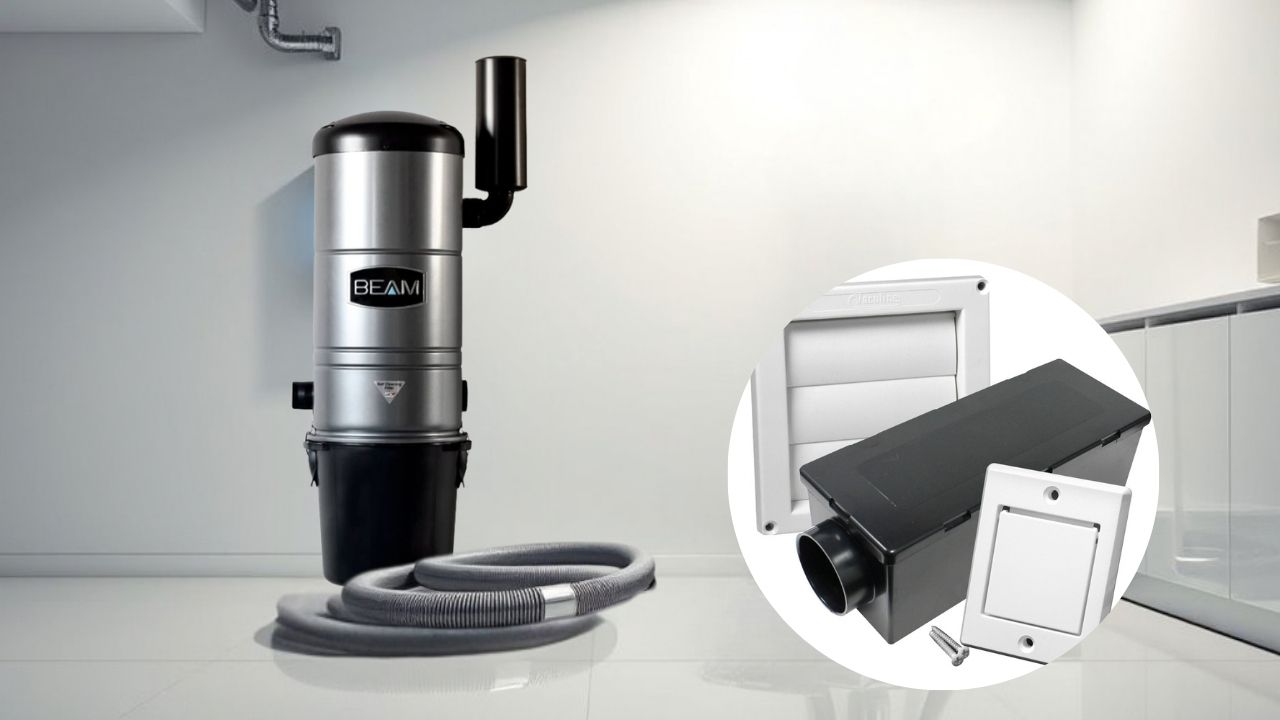
The Air You Vacuum Has to Go Somewhere
Working air is the dirty airflow that drags debris from the inlet valve through the pipe network to the power unit, and it has to exit somewhere. Think of it like holding your breath while you clean, then exhaling hard the second you’re done.
- Every cubic foot pulled from your hallway leaves through this single port.
- The air arrives warm and compressed, carrying whatever the filter missed.
- On a system with a 40-foot inlet run, that air has already picked up friction heat before it reaches the exhaust.
Your Motor Doesn’t Breathe the Air You Vacuum
Most central vacuum motors never touch the air you’re pulling off the carpet. A tangential bypass motor, the design used in many units including motors built by Ametek/Lamb, cools itself with a separate fan loop, keeping the dirty working air and the motor’s cooling air completely apart.
- A thru-flow motor works the opposite way, pushing the working air straight through the motor housing to cool it.
- That design makes a thru-flow motor cheaper to build, but it can’t accept a ducted exhaust pipe at all.
- Check your motor type before planning any exhaust run. It decides whether ducting is even possible.
What Escapes the Filter and Rides the Exhaust Out
Roughly 5 to 10 percent of fine debris in a filterless cyclonic unit passes straight through the motor fans and out the exhaust port. That’s the dust, dander, and odor a bag or filter never touches.
- Bagged units trap almost everything larger than a few microns, but sub-micron dust and odor molecules still slip through.
- Pet dander and cooking odor molecules pass filters rated for visible dust without slowing down.
- A family of five running a 20-year-old Beam central vacuum, manufactured by Trovac Industries, through a 2,800 sq ft ranch home may notice a faint musty smell near the power unit years before any dust becomes visible.
Sound familiar?
The Industry Fight Over Venting Outside
Manufacturers and dealers disagree about central vacuum exhaust because their incentives point in different directions. This guide weighs that disagreement using manufacturer installation documentation, published green building standards, and peer-reviewed research instead of dealer sales copy.
Manufacturers Say Vent It, Some Dealers Say Don’t
VacuMaid’s own installation guidance calls outside venting cheap insurance for dust-free indoor air, published directly on the manufacturer’s site. A well-known Florida dealer page argues the opposite, blaming outside vents for fires, flooding, and rodent entry, while promoting the HEPA exhaust muffler it sells as the fix.
- Notice who profits from each argument before trusting it.
- The manufacturer has no accessory to sell either way.
- The dealer’s anti-venting page doubles as a product page for its own indoor filter.
Green Building Standards Already Settled This Argument
LEED for Homes awards 1 point for a central vacuum exhausted outside, away from any ventilation intake. The National Green Building Standard, section 902.1, awards 5 points for the same feature, one of the larger single line items in that category.
- Neither program awards anything for an indoor exhaust muffler or filter.
- Five points from NGBS puts outside venting ahead of many bigger-ticket upgrades on that same checklist.
- Outside venting is a documented checklist line item, not a nice-to-have, for a builder chasing green certification.
Why the Anti Venting Argument Isn’t Entirely Wrong
Outside venting does cost you conditioned air, and that part of the dealer argument holds up. An open exhaust pipe left without a proper cap does invite bugs, nesting birds, and wind-driven rain.
- The fix is a sealed, gravity-flap vent cap, not skipping the vent altogether.
- A capped, low-mounted exhaust solves the pest and weather problem without giving up the air quality benefit.
- Weigh the real cost of a vent cap against the alternative: dust and odor recirculating through your living space.
Does a Central Vacuum Exhaust Have to Go Outside?
Yes, for a true cyclonic unit with no bag or filter. No, for a filtered, cyclonic, or bagged unit, where outside venting is a strong recommendation instead of a requirement.
Which Is Your Unit: Cyclonic, Bagged, or Inverted Filter
Your power unit’s filtration type decides the rule, not your dealer’s preference. Vacuflo, manufactured by H-P Products, states plainly that true cyclonic systems must be exhausted outside, while its filtered cyclonic units are designed with exhaust as optional.
| Filtration type | Exhaust requirement | What happens if you skip it |
|---|---|---|
| True cyclonic (no bag or filter) | Mandatory outside vent | Fine dust and odor exhaust directly into the room housing the power unit |
| Filtered cyclonic | Optional outside vent | Minor odor buildup near the unit over years, no dust escape |
| Bagged (including MD Manufacturing’s Hide-A-Hose retractable systems) | Optional outside vent | Rare odor from sub-micron particles that bypass the bag |
See Vacuflo’s installation requirements for true cyclonic units for the manufacturer’s full breakdown of both categories.
The Two Motor Unit Surprise Nobody Mentions at Purchase
A dual-motor power unit needs two separate exhaust runs to the exterior, not one, and buyers usually learn this after the unit is already sitting in the basement. Planning both runs early also means mapping the low-voltage wiring involved in linking the unit to your inlet switches, since installers typically route both at the same stage of the job.
- Two runs mean two wall penetrations, two vent caps, and double the drilling.
- Ask this question before buying a dual-motor unit, not after the pipe’s already behind drywall.
What Salespeople Skip When Pitching Filterless Systems
No-bags-ever marketing hides one mandatory requirement: a hole through your exterior wall. A salesperson who skips this detail is skipping the one fact that could rule out a true cyclonic unit for your home entirely.
- Power units far from an exterior wall face a run-length problem before they face a filtration problem.
- Pressing a salesperson on venting requirements is a fast way to judge how straight the rest of the pitch is.
Which one’s sitting behind your drywall?
The Conditioned Air Cost Nobody Prices Out
Every cubic foot your central vacuum exhausts outside pulls a cubic foot of unconditioned air back into your house through cracks and gaps. The cost is real, but it’s smaller than most owners fear.
How Much Heated Air One Cleaning Session Throws Away
A power unit moving 150 CFM exhausts roughly the air volume of a 14 by 14 foot room every 10 minutes, based on one owner’s math shared on a RedFlagDeals forum thread. Over a full hour of whole-house cleaning, that adds up to real replacement air in the middle of winter.
- The energy cost is measurable but small next to leaving a door open for that same hour.
- Homes with a tight envelope feel this more than drafty older houses do.
Tight Houses Turn This into a Safety Question
Depressurizing a tight home while combustion appliances run raises real backdraft risk, and this is where central vacuum exhaust stops being just a comfort question. Peer-reviewed research on depressurization-induced backdrafting found that exhaust devices operating alongside other exhaust equipment dropped indoor pressure by 3 to 8 pascals on average, enough to hinder natural draft in atmospherically vented appliances.
- Atmospherically vented water heaters and furnaces are the highest-risk equipment in this scenario.
- A homeowner in a home tested at 0.9 ACH50 on GreenBuildingAdvisor planned dedicated makeup air specifically before adding a central vacuum exhaust run.
- Homes with sealed-combustion, direct-vent appliances face far less of this risk.
The Attic and Crawlspace Shortcuts That Backfire
Venting a central vacuum exhaust into the attic feels like a compromise, but it delivers the worst outcome available. Fine dust settles directly into insulation above the bedrooms, while the house still loses the same conditioned air it would through a proper outside vent.
- Run the exhaust pipe straight to an exterior wall, never into attic or crawlspace airspace.
- Terminate with a sealed vent cap positioned low and away from windows or intakes.
- Treat attic and crawlspace routing as a dead end, not a shortcut, no matter how much shorter the run looks on paper.
Every credible manufacturer and installer source rejects attic venting for this reason.
Worth a second look at your water heater’s vent, isn’t it?
Planning the Exhaust Run Before You Drill
Plan the power unit’s location around the shortest possible straight run to an exterior wall before committing to a spot in the basement or utility room. Distance and elbow count decide how much suction survives the trip.
Why Maximum Run Length Depends on Who You Ask
Published maximum exhaust run lengths range from 10 feet on the most conservative manufacturer spec to 25 feet from independent installers, so match your unit’s manual to the shorter number when picking a power unit location. Pipe diameter for proper exhaust flow matters as much as length, since a run built with undersized fittings chokes airflow even under the length limit.
- One manufacturer caps its exhaust run at just 10 feet total.
- Independent installers publish 20 to 25 feet as a working ceiling for most residential setups.
- Shorter is always better, so choose the power unit’s location with the exhaust run in mind, not just the inlet network.
Mount It Low, Aim It Away from Openings
Mounting the exhaust termination low on the wall cuts the motor noise that carries outside, while aiming it away from windows, doors, and HVAC intakes keeps exhaust air from drifting back indoors.
- One owner found fine dust settling on garage shelves after mounting the exhaust above head height, right next to a window.
- Low placement near grade also makes the vent cap easier to inspect and clean.
Why You Can’t Just Tee into the Dryer Vent
Tying a central vacuum exhaust into a dryer vent line fails on two counts, and a RedFlagDeals forum thread shows this exact shortcut getting shot down by installers every time it comes up. Dryer heat softens PVC pipe rated for cool airflow, and vacuum dust loads the duct with material that raises dryer lint fire risk.
- Building codes treat dryer exhaust as its own dedicated, uninterrupted run for this exact reason.
- Schedule 20 PVC pipe used for central vacuum tube and fittings meets ASTM F2158 dimensional and impact specs, but that standard assumes cool working air, not dryer exhaust heat.
Measured your run yet?
Vent Caps, Flaps, and What Crawls In
A bare elbow left open to the weather invites rain, wind, and insects into your exhaust line. A proper vent cap with a gravity flap closes automatically the moment the motor shuts off.
Louvered Caps versus the Bare 45 Degree Elbow
Gravity-flap caps close against rain, wind, and insects the instant the vacuum stops running, while a bare elbow stays open around the clock.
| Cap style | Pest protection | Airflow restriction | Price |
|---|---|---|---|
| Bare 45-degree elbow | None | Lowest | Cheapest |
| Louvered gravity-flap cap | High | Slight | Moderate |
| Screened bird-guard cap | Highest | Moderate | Highest |
- Some owners run open elbows for years without trouble, then regret it all at once.
- One forum member described cleaning three rotting birds out of an unscreened vent after a single nesting season.
The Two Inch Problem at the Hardware Store
Standard dryer vent caps sold at hardware stores measure four inches, while central vacuum exhaust pipe measures two, so the cap you grab off the shelf won’t fit.
- Vacuum-specific caps and bird shields exist, but local stores rarely stock them.
- Order the correctly sized cap with your venting kit, not as an afterthought once the drywall’s closed.
When You Can’t Vent Outside: Mufflers and Exhaust Filters
Choose an exhaust muffler if noise is the main complaint. Choose a certified HEPA exhaust filter if dust and odor are the concern. Neither replaces outside venting for a true cyclonic unit, but both help when outside venting isn’t possible.
What a Muffler Actually Changes
A foam-lined exhaust muffler claims roughly 6 decibels of noise reduction, absorbing high-pitched motor whine more than dropping overall volume.
- One owner described the difference as less annoying rather than meaningfully quieter.
- Most low-noise power units already ship with a muffler installed from the factory.
Read the Exhaust Filter Spec Before Trusting It
A filter marketed as HEPA-style material rated at 99.997 percent above one micron is not the same claim as certified HEPA. True HEPA, high efficiency particulate air, is defined by a U.S. Department of Energy standard confirmed on EPA’s HEPA filter definition as capturing at least 99.97 percent of particles at 0.3 microns, the hardest particle size to trap.
- A filter rated only above one micron misses the smallest, most penetrating particles the HEPA standard is built around.
- Treat HEPA-style marketing language on an exhaust accessory with the same skepticism you’d apply to a HEPA-style vacuum bag.
- DrainVac’s ActiVac exhaust filter line is one option worth checking, but confirm its actual micron-capture spec against the certified HEPA benchmark before paying a premium for the name.
The Garage Unit Compromise Most Owners Land On
Mounting the power unit in the garage and venting the exhaust into that same space is the compromise most owners settle on when running a pipe outside isn’t practical. It moves noise and dust off living space without solving air quality completely.
- Manufacturers still recommend outside venting for the best air quality outcome, garage placement included.
- Skip the garage-only compromise if anyone in the house has asthma or a dust allergy, and run the pipe outside instead.
Worth the extra cost, or worth just running the pipe?
Smells, Dust Puffs, and Exhaust Warning Signs
A wet-dog smell from the exhaust means fine dander has settled inside the unit itself, not that your filter needs replacing. Visible dust puffing from the exhaust means something upstream failed, usually a bag, seal, or gasket, not the exhaust system.
Why the Exhaust Smells Like Wet Dog
Fine dander settles inside the canister and bakes with motor heat every time the unit runs, which is why a whole basement can smell like the family dog the second the motor kicks on.
- Fresh bags don’t fix odor already living in the canister walls and motor housing.
- Outside venting moves that smell out of the house instead of just masking it with a new bag.
Visible Dust at the Exhaust Means Something Upstream Failed
A properly bagged or filtered unit should exhaust close to clean air, so visible dust points to a seal that failed somewhere before the exhaust port, not a flaw in the exhaust system itself.
- Check the bag collar for a loose or torn seal first.
- Inspect the filter gasket for gaps or cracked plastic.
- Replace the cheap rubber seals before shopping for an exhaust filter or muffler.
Dust at the exhaust is a diagnostic signal, not a reason to buy an accessory.
Conclusion
You started this staring at a mystery pipe and two confident, contradictory answers. The answer holds: filtration type decides whether venting outside is mandatory, home tightness decides the combustion-safety stakes, and a 25-foot tape measure decides whether the run is even possible.
Tonight, pull the power unit’s model number, confirm cyclonic or bagged, and measure the distance to the nearest exterior wall. No portable vacuum can put its exhaust on the other side of that wall, the one trick only a central system pulls off. Everything on the materials checklist keeps the planning just as straightforward.
Frequently Asked Questions
Does a central vacuum have to be vented outside?
No, not always. Outside venting is mandatory only for true cyclonic units with no bag or filter; bagged and filtered units make it optional, though still worth doing.
How long can a central vacuum exhaust pipe run be?
Keep the run under 20 to 25 feet for most residential setups. Some manufacturers cap it as low as 10 feet, so check your unit’s manual before planning the pipe path.
Can I vent my central vacuum into the attic or garage?
No, avoid both locations for full air quality benefit. Attic venting dumps fine dust into insulation above your bedrooms, and garage-only venting still leaves dust and odor inside the building envelope instead of outside it.
Can a central vacuum exhaust cause my furnace or water heater to backdraft?
Yes, in a tight home with atmospherically vented appliances. Depressurization from any exhaust device, a central vacuum included, can hinder natural draft and pull combustion gases back indoors, so homes with sealed-combustion appliances face far less of this risk.
Is a HEPA exhaust muffler as good as venting outside?
No, a muffler only cuts noise. Reach for a certified HEPA exhaust filter instead if odor and fine dust are the concern, and treat outside venting as the better fix for a true cyclonic unit.