The dirt devil rv central vacuum cv950 sitting in your basement bay looks like a liability the second you pop the latch. Everyone said coach central vac is gimmicky, and that one line on every sell sheet about removing 100 percent of dirt with no recirculation tells you nothing about whether this specific unit is worth a dime.
Here’s what changes after you finish reading: you’ll know the real specs, the one part that dies on schedule, and the exact cost threshold where repair stops making sense and a CV1500 swap starts.
Dirt Devil RV Central Vacuum CV950
The Dirt Devil CV950 is a built-in power unit manufactured by H-P Products under license from Royal Appliance Mfg. Co., factory-installed by Tiffin, Newmar, and Winnebago. It delivers 450 air watts, 120 CFM, and 105 inches water lift from a 14-pound canister on a single 15-amp circuit.What The CV950 Actually Is, And Is Not
Who really builds this vacuum behind the badge?
H-P Products builds the CV950, not a mass-market floorcare company. The engineering comes from the same Canton, Ohio operation that manufactures Vacuflo residential central vacuum systems. That lineage puts real built-in vacuum engineering behind the badge, not a rebadged shop vac in a red canister.
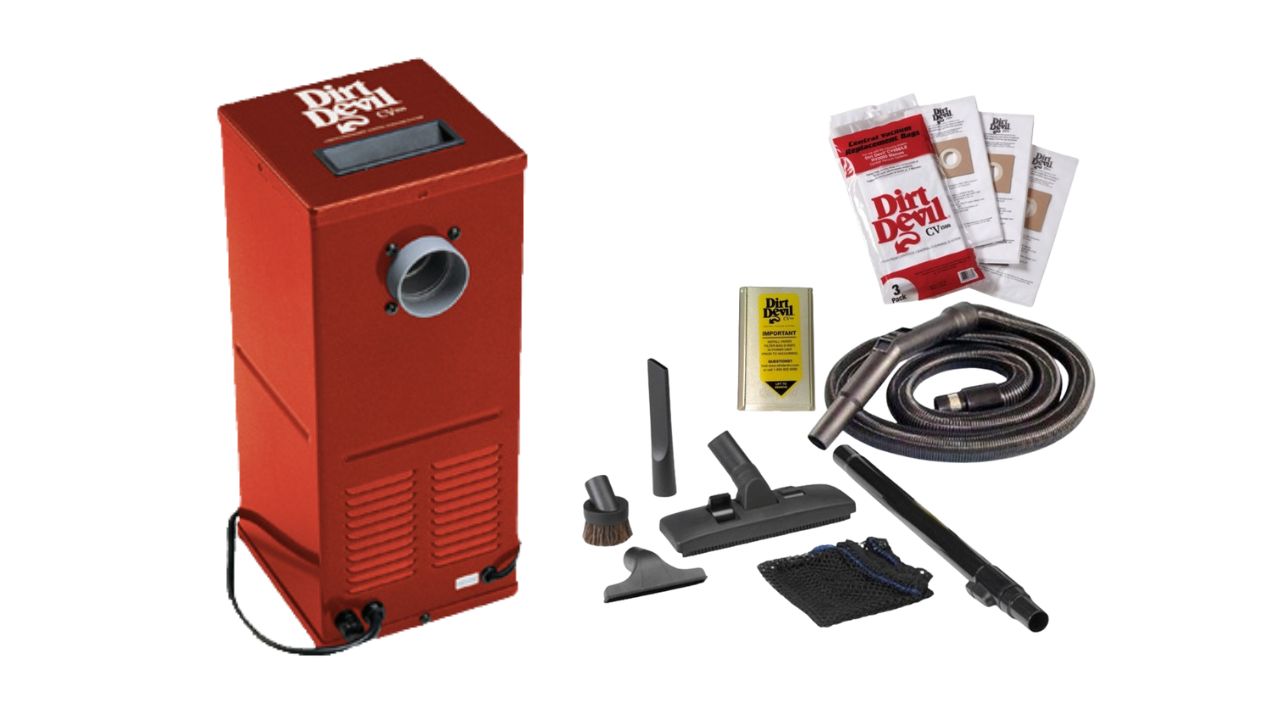
Browse Dirt Devil’s full built-in vacuum lineup and you’ll see the CV950 anchors a product family designed for coach installation from the ground up. The dealer who called it a throwaway appliance is wrong.
The real numbers no sell sheet leads with
Four specs decide whether any built-in power unit earns its compartment space.
The CV950 delivers 450 air watts, which predicts cleaning performance at the brush head, not the watts the motor draws from the wall. CFM lands at 120, water lift at 105 inches, and it draws 11.3 amps on 120-volt AC. A standard 15-amp coach branch runs it without a dedicated line. All four figures come directly from the H-P Products CV950 spec sheet.
Why it lives in your basement bay
Basement mounting keeps motor noise, exhaust, and debris out of the living space. But seal it inside an unvented compartment and you starve the motor of intake air. H-P’s installation documentation requires airflow in and a clear exhaust path out. A tight, closed bay kills motors faster than anything else a certified installer sees.
The Numbers That Decide Real Suction
Air watts versus water lift, explained simply
Water lift is the narrowest straw you’ve ever tried to drink through: how hard the unit pulls against a complete blockage. Air watts is the firehose, pressure and volume combined to lift debris and carry it through 20 feet of PVC. The CV950’s balance of 450 air watts against 105 inches is what made it work in production coach installations for over a decade.
How your 7-foot hose stretches to nearly 30
The Maxumizer hose collapses to 7 feet and stretches close to 30 feet. In a 35-foot motorhome, one inlet placed mid-coach covers the full living area front to back. That reach is why coach builders trusted a single-inlet layout in most production floor plans.
Where suction quietly dies in the pipe run
Suction drops with every 10-foot pipe run extension and every elbow added beyond the manufacturer’s maximum. Owners in larger coaches blame the motor when the real fault is three elbows and a long basement run between the power unit and the valve. Count the elbows before you count the air watts.
The compact size that sells RV owners
14 pounds. Roughly 6 by 7 by 14 inches. The entire kit stores in a single kitchen drawer, unlike a canister vacuum that needs closet space, a cord spot, and two hands to carry up coach steps. That footprint is why Tiffin, Newmar, and Winnebago spec’d this unit.
The CV950 Signature Weak Spot
Why owners tap the case to wake it up
You’ve seen it in the forums: open the bay, lift the inlet lid, hear nothing, walk back to the canister, smack the side. Motor fires. That’s not a quirk. It’s a failing relay telling you exactly what it is.
No click when the inlet opens means the relay never fired. A loud click with zero suction means the relay fired but the motor didn’t, pointing at a cracked impeller or tripped thermal protector. These are not the same repair.
The 24-volt transformer that keeps failing
Multiple threads across the Tiffin RV Network trace dead CV950 units to one weak link: the undersized 24-volt transformer on the relay circuit board, rated low enough in milliamp output that normal use pushed it past its limits after a few seasons.
One owner traced two successive board failures to this transformer, wired an external higher-rated 24-volt unit to bypass the original, and reported no recurrence over three additional seasons of full-time use. That bypass costs under $20. The relay assembly, H-P part number 7090, replaces the whole board for about $65.
Is the relay board worth replacing?
A failed relay on an otherwise sound unit is a $65 fix with the 7090 relay assembly. A motor replacement with part number 8404 lists near $89. H-P has sold out-of-warranty owners discounted full units in the $175 to $200 range when a repair wasn’t viable.
That math changes when the motor and relay both fail on a coach with corroded tubing you can’t reach without cutting cabinetry. At that threshold, the higher-powered CV1500 model, rated at 550 air watts with a 5-year warranty and a direct plug-and-play fit in the same mounting footprint, becomes the rational call.
When intermittent power means corroded contacts
Not every dead-unit report is a relay board failure. Some CV950s fire only when the inlet lid is held at a specific angle, which is contact corrosion, not board failure. The auto-start circuit closes when the hose’s metal band bridges two spring-loaded pins inside the collar. Those pins corrode in a damp bay. A light pass with emery cloth takes five minutes and costs nothing. Check this before ordering parts.
It Runs But Will Not Suck
Why does my Dirt Devil RV Central Vacuum CV950 lose suction?
A spinning motor with zero floor pickup is almost never a dead motor. It’s a broken airflow path somewhere between the brush head and the canister. Start at the canister lid: a gap of even a few millimeters between lid and body bleeds enough bypass air to cut suction in half. Press the lid firmly before you open any pipe joints.
The friction-fit flex pipe clog everyone misses
The flex tube connecting the in-wall 2-inch PVC to the canister is seated by friction in most coach installations, no adhesive. Pull it apart and feel full suction return at the open end: the clog lives upstream in the rigid tubing. Snake from the inlet valve before touching anything else. A decade of compressed pet hair frees in minutes with a single pass.
Bag and lid mistakes that strangle airflow
The paper filter bag, part number 7767, reaches capacity faster than it looks in a coach environment. Suction drops noticeably at roughly two-thirds full, well before the bag appears stuffed. Change it at two-thirds. Seat the canister lid with both hands before every use: a cover sitting even slightly off square bypasses the gasket and bleeds enough airflow to make a near-empty bag feel like the unit is dying.
Bags, Filters, And The Filtration Truth
Why this is a bagged-only system
The CV950 captures debris in a disposable 1-gallon paper bag, part number 7767. A washable secondary foam filter, part number 4929, sits between the bag chamber and the motor. That filter must be fully dry before reinstallation. No cyclone option and no bagless conversion exist for this unit. Budget for bags.
Bag and filter parts at a glance
| Part | Number | Approximate Cost |
|---|---|---|
| Replacement bags (3-pack) | 7767 | $9 to $14 |
| Secondary foam filter | 4929 | $8 to $12 |
| Maxumizer hose | 7833 | ~$58 |
| Full tool kit | varies | ~$177 |
| Relay assembly | 7090 | ~$65 |
| Replacement motor | 8404 | ~$89 |
Call H-P directly for current pricing on parts that move.
What “no recirculation” really means in an RV
A residential Vacuflo, also built by H-P Products, vents exhaust through the exterior wall. Your CV950 vents into the basement bay. Debris doesn’t recirculate into the living space, so the claim holds. But exhaust air stays in the bay compartment. The official Dirt Devil CV950 power-unit manual carries no HEPA certification for this unit. Aftermarket bags marketed with HEPA labels need a cited ASTM F558 test result before you trust them.
Parts, Hoses, And Keeping A Legacy Unit Alive
Finding a hose the previous owner took
Buying a used coach with a CV950 and no hose is the most common scenario in every RV forum covering this unit. Generic shop vac hoses won’t work: the auto-start circuit closes when the hose’s metal activation band bridges the contact pins inside the inlet valve, and a standard shop hose has no such band. Get the Maxumizer hose, part number 7833, before concluding the unit is dead.
The two inlet types that confuse buyers
Lid-switch valves power on the instant the inlet cover lifts. Pin-contact valves close the circuit only when the hose band bridges the two spring-loaded pins inside the collar. A lid-switch inlet with no hose runs the motor but connects nothing. A pin-contact inlet with corroded pins leaves the unit silent and the owner convinced the board is blown. Identify which valve your coach has, and most “it won’t turn on” scenarios resolve in under 60 seconds.
What H-P Products will still sell you
H-P Products has built central vacuums from Ohio for more than 75 years. Owners who call the parts line report staff who know the CV950 by part number and sub-week shipping on stocked items. The 7090 board, the 8404 motor, the 7767 bags, and discounted replacement units are all available directly. That institutional depth is the strongest argument for keeping a functional CV950 running.
One limitation worth naming: H-P’s authorized service network concentrates in the Midwest and Northeast. Owners in the southern US needing in-person warranty service on a CV1500 upgrade sometimes face a long drive, though H-P handles most repairs by mail.
The RugRat turbine brush love or hate question
Owner sentiment on the RugRat air-driven turbine brush splits nearly in half. Half call it useless on low-pile carpet, snagging at every seam edge. The other half swear by it for pet hair on hard floors. The common thread among the harshest critics: a worn original head, not a design flaw. A fresh replacement head runs around $39 from H-P and draws far fewer complaints than the decade-old unit that came with the coach.
Repair It Or Rip It Out
When the CV950 is worth saving
A functioning unit with a failed relay is almost always worth the $65 fix. Two full component replacements across five years still undercut a new unit, and the motor alone at $89 rarely makes the decision hard.
A basement-mounted central vac cleans the whole coach from one quiet, fixed point with no cord, no stairs, no motor noise inside. Owners who want quick bay cleanups without running the full system have added a retractable garage hose alternative at the bay door, leaving the CV950 for the interior work it dominates.
When a portable finally wins
A motor that fails twice in 18 months plus clogged tubing buried under floor panels you can’t reach without cutting cabinets shifts the math. At that point you’re not buying a $65 part. You’re buying a plumbing job and a repair job at the same time. A quality cordless stick vacuum and an honest acceptance that the built-in is done is a reasonable outcome.
Conclusion
You walked in worried the red canister in your bay was a dead-end badge product. You leave knowing it’s an H-P Products central vacuum with a $65 weak point and a parts supplier that’s answered the phone for 75 years.
Tonight, pull the inlet valve plate, bridge the two low-voltage contact wires with a short jumper, and listen. A click with no suction is the motor. Silence is the relay. That test tells you exactly what the next step costs.
A healthy dirt devil rv central vacuum cv950 cleans the entire rig from one canister in the basement bay. No cord, no stairs, no motor noise inside. No upright ever gave you that.
Frequently Asked Questions
What is the Dirt Devil CV950, and which RVs came with it?
The CV950 is a built-in power unit manufactured by H-P Products under a Dirt Devil license. Tiffin, Newmar, and Winnebago are the most common OEM installers, fitting it across dozens of motorhome floor plans from the late 1990s through the mid-2000s.
What are the Dirt Devil CV950 specs: air watts, CFM, and water lift?
450 air watts, 120 CFM, 105 inches water lift, 11.3-amp draw, 120-volt AC, 14 pounds, 1-gallon canister. A standard 15-amp coach branch circuit runs it.
What replacement bags and filters does the CV950 use?
Part number 7767 for the paper bag, part number 4929 for the washable secondary foam filter. Change the bag at two-thirds capacity; let the foam filter dry completely before reinstalling.
Why won’t my Dirt Devil CV950 turn on?
Check the GFCI breaker first. It’s the most common false “dead unit” on RV appliances under NEC Article 551 and resets in seconds. No click at the inlet points to the relay assembly, part 7090. A click with no suction points to the motor, part 8404. Corroded inlet contact pins are a third option and the easiest fix. See NFPA 1192 Standard on Recreational Vehicles and RVIA’s overview of RV electrical and NEC Article 551 compliance for the branch circuit standards that govern this appliance.
Is the Dirt Devil CV950 still made, and what replaces it?
The CV950 is discontinued, but H-P Products still supplies parts. The CV1500 is the direct replacement: 550 air watts, a 5-year warranty versus the CV950’s 3-year limited coverage, same mounting footprint, same inlet valve wiring, no structural modification required.
How much does it cost to repair a CV950 versus replace it?
Relay board: ~$65. Motor: ~$89. CV1500 at retail: ~$400, though H-P has sold out-of-warranty owners discounted units at $175 to $200. Two relay repairs across five years undercut a full replacement.
Will a Dirt Devil CV1500 fit where my CV950 was mounted?
Yes. The CV1500 is a plug-and-play replacement. The mounting footprint, 120-volt AC connection, and low-voltage inlet valve wiring carry over without new wiring or structural changes.