You found “MD” stamped on a dusty wall unit, or a dealer handed you a quote for an md central vac and want to know who actually makes this before you say yes. Most of what ranks online about the brand is stale, dealer-sourced, and missing one critical 2025 update.
MD sells four overlapping lines with similar air watt figures, and the flagship hides a wiring catch nobody mentions at the showroom. By the end you will know which line fits your home, which spec to trust, and what the 2025 ownership change means for your parts and warranty.
MD Manufacturing
MD Manufacturing, now a subsidiary of Hide-A-Hose, Inc. following a 2025 acquisition, builds bagged central vacuum power units sold exclusively through authorized dealers across North America. Four active lines cover homes from 1,500 to over 10,000 square feet on steel construction and Ametek bypass motor technology dating to the brand’s founding in 1961.Who Actually Makes MD Central Vacuums
What Does MD Manufacturing Actually Make Today
M.D. Manufacturing, Inc., now operating under parent company Hide-A-Hose, Inc. after the 2025 acquisition, produces central vacuum power units, replacement motors, hose sets, and the Hide-A-Hose retractable inwall hose system. One thing to clear up first: search “MD Manufacturing” and you will pull results for an Ohio and Texas metal-fabrication firm that makes electrical ground straps. That company has nothing to do with central vacuums. The brand you are researching is the California central vacuum maker, and the distinction matters when you are ordering parts.
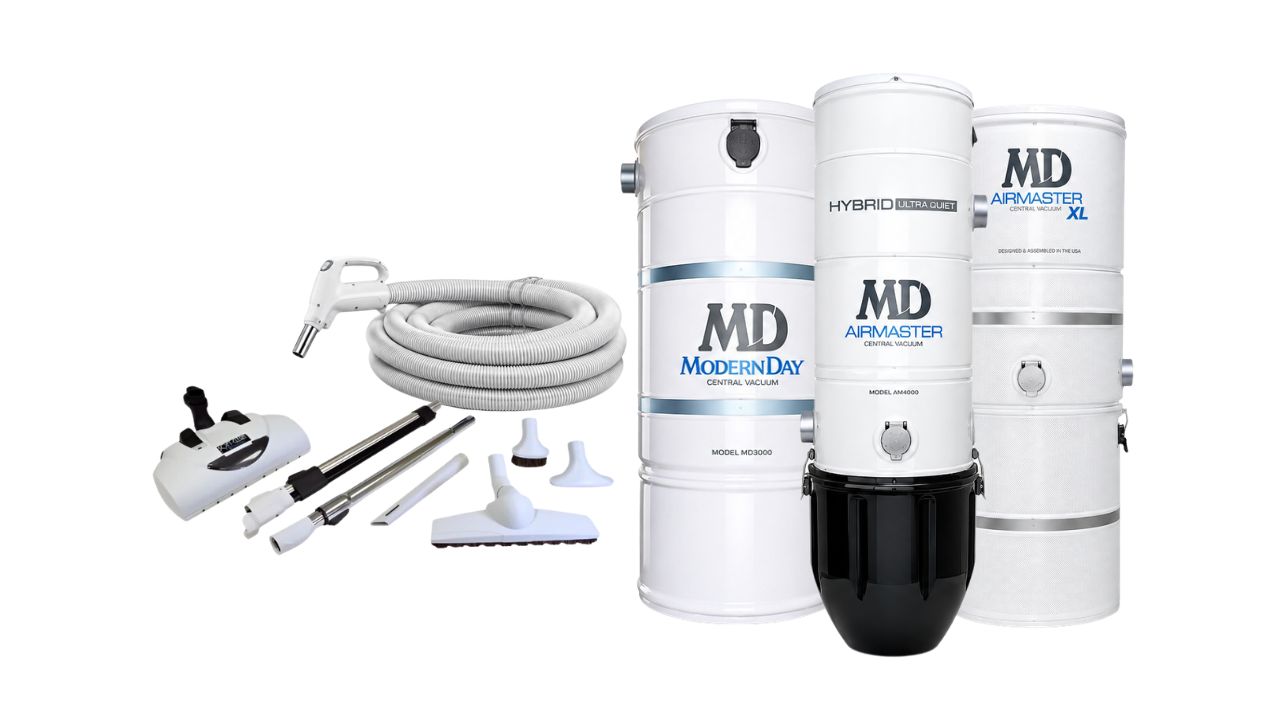
Their central vacuum power units span four active lines from contractor-grade single-motor units to dual-motor flagship systems rated above 900 air watts. Every unit ships exclusively through an authorized dealer. No Amazon listing, no Home Depot SKU.
From A Garage To A Bakersfield Factory
Charles Emdy started M.D. Manufacturing in a North Hollywood garage in 1961 with twelve Ametek motors and a metalworking background. His son Wayne bought the company in 1971 and built the dealer network. A fire in 1983 destroyed all the tooling. That kind of loss either kills a company or defines it. MD rebuilt and kept running.
Units are designed and assembled in Bakersfield, California. The signature has always been a sound-dampened steel body with powder coating inside and out, which is why 30-year-old MD units still run in basements across the country.
Why The Name Confuses Every Web Search
“MD Manufacturing” is a common business name. The central vacuum maker’s legal name is M.D. Manufacturing, Inc., now also marketed as Hide-A-Hose MD under the 2025 parent. Operations remain in Bakersfield. The parent company sits in Monroe, Washington, with distribution in Louisville, Kentucky. Knowing the exact name keeps your parts search from landing on the wrong company and the wrong order.
The Four Power Unit Lines Decoded
MD sells four active lines:
| Line | Motor Type | Warranty | Best For |
|---|---|---|---|
| SilentMaster | Dual 5.7″ tangential bypass | 12 years, transferable | Large homes, premier installs |
| ModernDay | Single or dual metal up to 8.4″ | 10 years | Mid-size homes, retrofit |
| Flo-Master | Single thru-flow | 3 years | Contractor, value builds |
| AirMaster | Thru-flow, bottom-empty | Varies | Budget, bagless hybrid |
SilentMaster Is The Dual Motor Flagship
The SilentMaster is MD’s top line, ranging from roughly 495 to 905 air watts with a 12-year transferable warranty. “Transferable” means the remaining warranty follows the house to the next buyer, which reads as a tangible asset on a real estate disclosure.
Both motors are tangential bypass units. Bypass means the cooling air and the suction air move on separate paths through the motor. The fan that cools the motor never touches the debris stream. In a thru-flow motor, suction air crosses the windings directly, carrying fine particles across them on every run. Bypass runs cooler, endures longer, and motor technicians consistently report extended service life on bypass designs.
Dual motors run at lower RPM than a single motor straining to match the same output. Lower RPM means less mechanical stress on brushes and bearings. Owners feel it as a quieter startup and, over a decade of daily use, as a motor that keeps going.
ModernDay Is The Original Workhorse
The ModernDay line built the brand’s reputation. A family in Sacramento ran a ModernDay in a 2,400 square foot ranch for 22 years and replaced only the motor, not the canister. Metal motors up to 8.4 inches characterize the upper ModernDay models. A larger fan diameter moves more air per revolution, reaching higher CFM at moderate RPM rather than spinning hard to compensate for a smaller fan.
The unit ran in blue powder coat until around 2010, then switched to gray. Filtration is the same 8-gallon, 5-ply Tru-Seal closed bag as the SilentMaster range. The honest limitation: the dealer network thins in rural markets, and warranty service can mean longer turnaround when the nearest authorized shop is two hours away.
Value Lines For Tighter Budgets
The Flo-Master targets builders and cost-sensitive remodels. Single thru-flow motors keep the price down. A veteran Pacific Northwest dealer once said Flo-Master is the line he quotes when a builder refuses to add another dollar to a spec, and the line that same homeowner calls him about three years later when suction drops.
Their popular Airmaster line opens at the bottom for emptying rather than requiring bag removal, offered in bagged and bagless configurations. Thru-flow motors pull suction air directly across the windings to cool them. They cost less to manufacture but the debris and particulates crossing the windings over time wear them faster than a bypass design. Budget for earlier motor replacement in a high-use household on either thru-flow line.
Which Line Fits Your Floor Plan
Match air watts to your longest pipe run, not your total square footage. The installer rule: one inlet per 600 to 800 square feet per floor, with the power unit placed to minimize distance to the single farthest inlet. Ask your dealer for that pipe run measurement before they recommend a model. That number, not the square footage headline, decides whether you need the mid-range or the flagship.
The Air Watt Number Nobody Explains Honestly
Why 905 Air Watts Hides A Wiring Catch
The top SilentMaster lists 905 air watts and draws 27.8 amps on a 120-volt circuit. A standard 20-amp dedicated circuit cannot legally carry 27.8 continuous amps. The National Electrical Code caps continuous loads at 80 percent of rated circuit capacity, which puts the safe limit on a 20-amp circuit at 16 amps.
The 240-volt version of the same unit lists 866 air watts at roughly half the amp draw. Most dealers quote the 120-volt figure on the brochure. Ask for the 240-volt specs and circuit requirements before the rough-in wire goes into the wall, because moving that wire later costs real money.
Max CFM Times Max Waterlift Is A Trap
Air watts, per ASTM F558, equal CFM multiplied by water lift divided by 8.5. Both measurements must come from the same point on the motor’s performance curve. Peak airflow and peak water lift never occur simultaneously on any motor.
Peak CFM happens at zero restriction, with no hose or pipe attached. Peak water lift happens at full restriction, with the inlet completely sealed. Multiply both listed maximums and you produce a number the unit never delivers in use. This applies to every central vacuum brand, not just MD. Any guide that adds dual-motor air watt ratings together is giving you a figure that does not exist in the real world.
What Air Watts Mean At The Cleaning Head
The spec sheet number is bench tested with no pipe, no hose, and no fittings. A forum owner in Colorado running a SilentMaster in a 3,100 square foot two-story home measured a 22 percent drop in CFM at the farthest second-floor inlet versus the bare-motor spec, using a standard anemometer after a 55-foot pipe run from the basement unit.
Suction drops with every 10-foot pipe run extension and every 90-degree elbow added beyond the manufacturer’s specified maximum. A sweep elbow loses less pressure than a sharp 90-degree fitting. Choose your unit on installed performance at the farthest inlet, not the label.
Filtration Claims Versus Certified Standards
| Claim | What It Means | What It Does Not Mean |
|---|---|---|
| “Captures to 0.3 microns” | Particle size tested | No capture efficiency percentage stated |
| “True HEPA certified” | 99.97% capture at 0.3 microns under DOE standard | Only valid when DOE certification exists |
| “5-ply closed bag” | Multi-layer bag construction | Not interchangeable with a HEPA cert |
What Removes Particles To 0.3 Microns Leaves Out
MD’s Tru-Seal filtration captures particles as small as 0.3 microns through a 5-ply closed-bag design with 8-gallon capacity. That is a meaningful claim, but it is not the same as certified True HEPA. The US Department of Energy’s HEPA standard requires 99.97 percent particle capture at exactly 0.3 microns under a defined testing protocol. The EPA’s page on what a true HEPA filter actually certifies is the cleanest primary source on that distinction.
MD does not publish a DOE HEPA certification for the Tru-Seal bag on current specification sheets. Treat the two phrases as different claims. The bag design is strong and venting all exhaust through the canister rather than recirculating it through the living space puts any central vacuum ahead of most portable units for allergy households. The absence of a HEPA cert does not make MD’s filtration bad. It means one marketing phrase is not the other.
Does The Allergy Study Actually Hold Up
Vendors quoting 40 to 61 percent reductions in allergy symptoms are referencing a 2001 University of California, Davis study that followed 25 patients with house dust allergic rhinitis, published in a peer-reviewed journal. The range comes from different symptom categories within the same study, not multiple research projects.
Twenty-five patients is a small sample for a study cited as broadly as this one. The finding is real and peer-reviewed, but it is not a large-scale clinical trial. Use it as directional evidence that venting exhaust outside the living space reduces airborne allergen recirculation, which is the core central vacuum advantage over a portable, not as a guaranteed percentage improvement.
What Real Owners Say After Years Of Use
The Motor Failures Owners Keep Reporting
The most consistent criticism in MD owner forums targets single-motor failures on lower SilentMaster models and the thru-flow entry lines. One Phoenix forum owner documented three motor replacements in three years on a mid-range SilentMaster before tracing the failure pattern to carbon brush wear that no one had told him to track.
Carbon brushes are wear parts that press against the commutator and conduct electricity to the spinning armature. As they wear down, they lose contact, generate arcing, and kill the motor prematurely. Brush inspection costs far less than a motor replacement. Most homeowners and some dealers never mention brush service intervals as routine maintenance.
A veteran forum contributor was blunt: he would not choose a single-motor MD or an entry-tier SilentMaster. His threshold is the dual-motor SilentMaster or a different brand entirely.
Why Fans Pick The M715h On 120 Volt
The M715h is the model name that comes up repeatedly among MD loyalists who want strong performance without a 240-volt circuit. Multiple owners across different forums report zero clogging and consistent suction over years of heavy use in homes with pets and hardwood floors under 2,600 square feet. It lands on a standard dedicated 20-amp circuit with bypass motor construction and the same Tru-Seal bag filtration as the flagship line above it.
This is the sweet spot before the wiring catch kicks in. Monitor the carbon brushes on a schedule rather than waiting for a motor failure to flag the problem.
The Bag Design That Keeps Suction Steady
The Tru-Seal bag tapers as it fills, keeping the whole bag surface actively filtering instead of packing debris against one wall and choking the rest. A bag that collapses against the canister walls loses effective filtration area, pushing more load onto the motor pre-filter and dropping suction before the bag is full.
MD owners report less power fade between bag changes than competing bagged units where the bag sits loosely in a round canister. The 8-gallon capacity also reduces change frequency on normal household use. That is a design difference with a real daily-use result.
Installation Choices That Make Or Break It
Inlet Placement And Suction Loss Over Distance
Suction drops with every foot of pipe between the power unit and a wall inlet, and with every 90-degree elbow added beyond the manufacturer’s specified maximum. Standard installer math places one inlet per 25 to 30 feet of hose coverage so the hose reaches the center of each zone from the nearest valve.
Place the sharpest 90-degree elbows directly behind each inlet valve, where debris is moving slowly before it accelerates into the pipe. Downstream in high-velocity sections, use a sweep elbow instead. For a two-story 2,400 square foot home with the power unit in the garage, that typically means four to six inlets total. Place the power unit as close to the network center as the installation allows. Moving the unit ten feet closer to the midpoint recovers more suction than upgrading one line tier.
Should You Add A Retractable Hose System
The Hide-A-Hose system, now MD’s directly related product under the same parent, stores 30 to 50 feet of hose inside the wall cavity behind each inlet. The hose extends on demand and retracts when suction releases. One inlet covers a much larger area and you never coil a hose on the floor again.
The catch: the power unit must pull enough air to retract a loaded hose reliably. A marginal unit struggling to clean will not retract a 50-foot hose with confidence. Confirm the retraction force requirement with your installer, especially when matching a Hide-A-Hose inlet to an older existing power unit. Install cost runs higher than standard inlets, but families who retrofit the system say it changes how often they actually vacuum.
Bagged Versus Bagless The Honest Tradeoff
| Factor | Bagged | Bagless |
|---|---|---|
| Filtration on empty | Sealed until bag is removed | Debris exposed during canister empty |
| Motor protection | Bag captures before motor intake | Clogged foam filter is a motor risk |
| Ongoing cost | Bag 5-packs, price varies by dealer | Filter cleaning and periodic replacement |
| Mess on empty | Bag goes to trash | 8 gallons of airborne dust |
MD owners with pets and allergies overwhelmingly prefer bagged. The sealed bag goes to the trash without releasing debris. Bagless emptying means opening an 8-gallon canister in your utility room. A clogged foam pre-filter is a documented motor killer on cyclonic units because reduced airflow raises motor operating temperature. Bagged MD units protect the motor because debris never reaches the intake under normal use.
What The 2025 Ownership Change Means For Buyers
New Ownership Now Controls MD
In 2025, Hide-A-Hose, Inc. acquired a controlling interest in M.D. Manufacturing, Inc. Nearly every page currently ranking for this brand still calls MD an independent family-owned California company, which stopped being the complete picture when that acquisition closed. Hide-A-Hose, Inc., headquartered in Monroe, Washington, invented the retractable inwall hose system and built it into a recognized specialty brand. The combined entity now markets itself as Hide-A-Hose MD, with assembly remaining in Bakersfield, California.
The acquisition logic is straightforward: the retractable hose inventor now owns one of North America’s most respected power unit brands, and they were already deeply connected in the market before the papers were signed.
Warranty And Parts Questions To Ask
Warranty length varies by line: 3 years on Flo-Master, 10 years on ModernDay, 12 years on SilentMaster. Ask your dealer for the current written warranty document for your specific model, not the brochure summary. Historical sources reference different warranty terms for some lines, which suggests the terms have changed. The document that ships with your unit governs your claim.
An owner in a 2023 forum thread spent three weeks waiting on a backordered bypass motor during a period of constrained supply. With any ownership transition, inventory priorities can shift. Confirm motor part availability for your specific model before committing, particularly for less common 8.4-inch metal motor variants. Parts remain available only through the authorized dealer network, so no emergency overnight order through a third-party retailer.
Is MD Still The Safe Long Term Bet
An owner on a Pacific Northwest forum documented three consecutive homes with MD units starting in 1981, running through two floor renovations and a kitchen gut, with the third unit still running at the time of posting. That kind of loyalty does not accumulate without consistent product quality.
The honest asterisk is single-motor failures on the lower lines. The dual-motor SilentMaster and upper ModernDay models with metal motors do not carry the same failure frequency in owner forums. Entry lines and thru-flow motor units carry more risk over 15 years in a high-use home. A real dealer relationship, not just a purchase transaction, is the insurance policy here. An authorized dealer who services what they sell can source motors, check brushes, and diagnose suction loss before it becomes a full replacement.
Conclusion
You arrived with a stamped name and a dealer quote and you leave knowing what separates a SilentMaster from a Flo-Master, why the 905 air watt figure comes with a wiring catch, and why captures to 0.3 microns is not a certified HEPA claim. Tonight, pull the model sticker from the unit in your utility room or measure the run to the farthest inlet, then call an authorized MD dealer with that number in hand. A properly matched MD unit, backed by a dealer who services what they sell, outlasts any portable you have owned.
Frequently Asked Questions
Who owns MD Manufacturing central vacuums now?
Hide-A-Hose, Inc. acquired a controlling interest in M.D. Manufacturing in 2025. The brand now operates as Hide-A-Hose MD, with assembly remaining in Bakersfield, California and the parent company headquartered in Monroe, Washington.
Is MD Manufacturing still in business and made in the USA?
Yes. MD Manufacturing is active and assembles units in Bakersfield, California. The 2025 acquisition changed the ownership structure but not the production location.
What’s the difference between SilentMaster, ModernDay, and Flo-Master?
SilentMaster is the dual-motor bypass flagship with a 12-year transferable warranty. ModernDay is the original line with metal motors and a 10-year warranty. Flo-Master is the contractor-grade line with thru-flow motors and a 3-year warranty. For a long-term home installation, start at SilentMaster or upper ModernDay.
How many air watts do I need, and how powerful is an MD SilentMaster?
Match air watts to your longest pipe run, not your total square footage. SilentMaster spans roughly 495 to 905 air watts. For most homes under 4,000 square feet with standard pipe layouts, a mid-range SilentMaster in the 600 to 700 air watt range handles the job before you cross into 240-volt circuit territory.
Can I buy an MD central vacuum online or only through a dealer?
Dealer only. No model across any MD line is available through Amazon, Home Depot, or any online retailer. Contact an authorized dealer for a quote and installation estimate.
How long do MD central vacuum motors last and what does a replacement cost?
Motor lifespan depends on motor type and maintenance. Bypass motors on SilentMaster and upper ModernDay units outlast thru-flow motors on the entry lines. Carbon brush inspection is the most commonly skipped step and the most documented cause of early motor failure on MD units. Contact your dealer for current replacement pricing since no published retail price exists online.
What does the MD SilentMaster warranty actually cover?
The SilentMaster carries a 12-year warranty that transfers to a subsequent homeowner. ModernDay carries 10 years. Ask your dealer for the written warranty document for your exact model before purchase, since terms vary by line and have changed over the brand’s history. Confirm whether wear parts like carbon brushes fall inside or outside the coverage terms.