You searched “eureka central vacuum system” and hit a wall. Zuum models. Electrolux badges. Beam look-alikes. Prices scattered across storefronts that don’t explain a thing. Not one listing discloses that the manufacturer behind these units stopped operating in April 2024.
By the end of this guide, you’ll know what a Eureka central vacuum actually is, which three specs separate a capable unit from a decade of frustration, and whether buying, repairing, or replacing one makes financial sense for your home.
Eureka Central Vacuum System
Eureka’s central vacuum line shares its platform with Beam and Electrolux, but Midea Group owns the brand today. The Zuum Z-Series spans 550 to 640 air watts across five models with Triumph HEPA filtration built in. These systems suit allergy-sensitive households wanting whole-home convenience, though parts availability is tightening fast.What a Eureka central vacuum actually is
A Eureka central vacuum system puts the motor and canister in your garage, runs Schedule 40 PVC through the walls, and delivers suction at low-voltage inlet valves on every floor. The cleaning head moves through your living space while all the mess stays out of it.
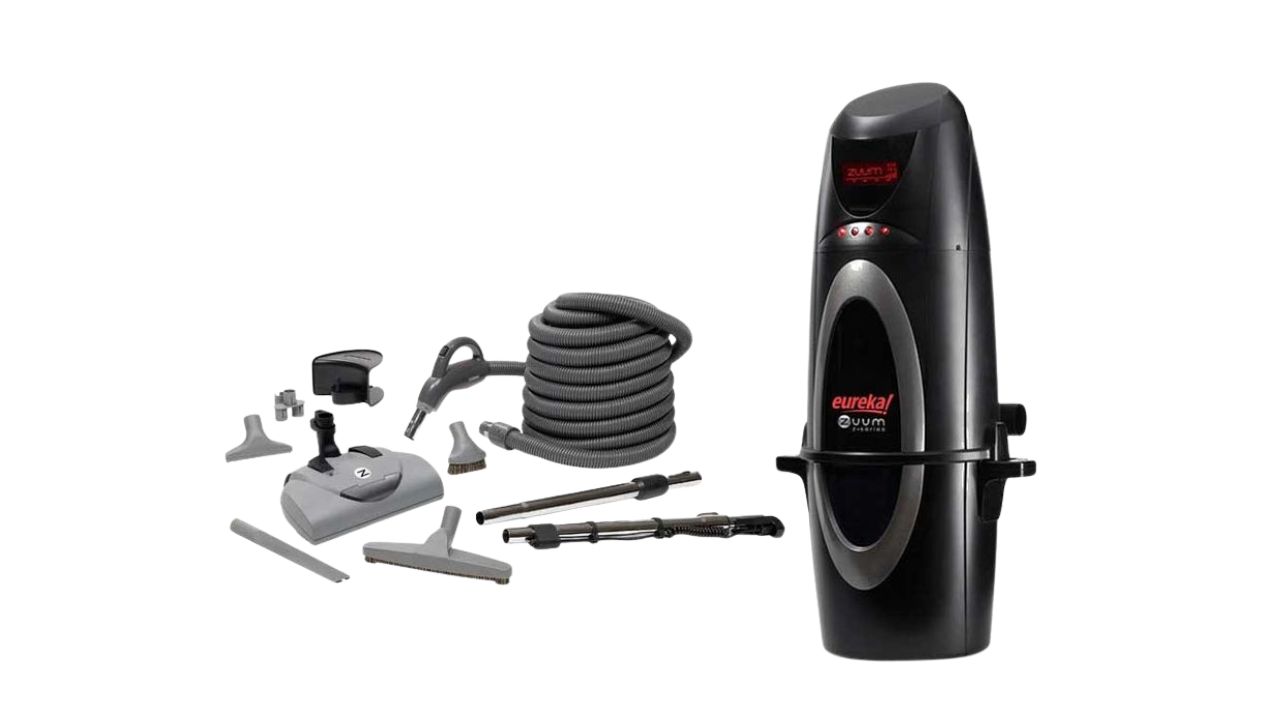
The whole-home system hiding in your walls
You carry a lightweight hose. You plug it into the nearest wall inlet. And you pull dirt through up to 50 feet of pipe to a canister you never have to lug up a staircase.
Dust doesn’t recirculate. Exhaust either vents directly outside or passes through a HEPA-rated canister before returning to the room. That’s the mechanical core of the system, and it’s why allergy households pay a premium for this setup over any portable. A standard installation uses inlet valves placed roughly every 700 to 800 square feet across the home’s footprint, which means a 30-foot crushproof hose reaches every corner without dragging a machine behind you.
The power unit does all the work. You just walk the hose.
Why people switch from a portable to central
The switch almost always starts with a health event or a renovation, not a casual upgrade decision.
Take a family of four with a golden retriever in a 2,600 sq ft split-level. They ran a bagged upright for six years and never got the embedded fur out of the bedroom carpet. Allergy season became a two-week ordeal twice a year, even with room air purifiers running. According to the US EPA’s guidance on indoor air quality, indoor pollutant levels in homes can run 2 to 5 times higher than outdoor air, and a portable vacuum that recirculates exhaust through the living space worsens that with every cleaning cycle.
After switching to a built-in system, exhaust left through the garage vent. Allergy symptoms dropped within the first month.
Researchers at UC Davis found clinical support for that experience. A peer-reviewed study on central vacuums and allergic rhinitis found that built-in central vacuum systems improved quality-of-life measures in patients with house-dust-associated rhinitis. One system swap can change how a household breathes year-round.
The ownership shuffle no dealer will mention
The Eureka central vacuum line has changed hands more than once, and where it stands today directly affects your warranty, parts supply, and long-term service options.
From Electrolux to Midea, who owns Eureka now?
Eureka, now owned by Midea Group, the Chinese appliance manufacturer that acquired the brand around 2016, built its central vacuum line on Electrolux’s Beam platform long before the ownership transfer. Electrolux produced Eureka central units on a shared platform alongside its own Beam line, which is why the internals look identical to any technician who has worked both brands.
Midea kept the Eureka name on floor care: uprights, cordless stick vacs, robot vacuums. The central vacuum line didn’t follow. Today, searching “Eureka” on any major retailer returns a page of corded uprights and budget robots, not a single Zuum power unit.
The Zuum central vacuum line passed through Nuera Air, a Laval, Quebec-based distributor that managed Eureka central vacuum products for the North American market. Nuera Air ceased manufacturing in April 2024. Trovac Industries, a Quebec-based central vacuum manufacturer and distributor, acquired the former Nuera brands in July 2024. That’s the timeline no dealer selling old Zuum stock bothers to disclose.
Are Eureka and Beam the same machine inside?
Yes, with meaningful caveats. Both the Eureka Zuum and the Beam central vacuum series, manufactured under the Electrolux Central Vacuum Systems umbrella, share a common platform, meaning shared motor architecture, compatible fittings, and overlapping service parts.
Owners on VacuumLand and central vacuum forums have documented this for years. The Eureka Sweep n Groom powerhead is the Beam Rugmaster re-labeled. Circuit board form factors, inlet valve dimensions, and hose connections follow the same specs. Beam replacement parts from Electrolux-authorized dealers often fit where OEM Eureka parts have gone discontinued.
Standard 2-inch central vacuum fittings are compatible with Beam, Drainvac, CycloVac, OVO, and most North American systems. Early Sears and Kenmore central vac installations used a non-standard bore that requires an adapter for modern hoses.
The Beam lineage isn’t just trivia. It’s your parts-hunting strategy when OEM Eureka components go scarce.
Is a Eureka central vacuum system still worth buying in 2026?
Buying a brand-new Eureka Zuum unit in 2026 carries real risk. You’re almost certainly purchasing old stock from a line whose manufacturer exited the market in April 2024.
The hardware is solid. Zuum motors ran on Ametek-platform internals with 7-year motor and electrical warranties on most models. But warranty claims on a discontinued line require locating a dealer still willing to honor the terms, and that search gets harder every year. For a Nilfisk central vacuum models reviewed alternative, Nilfisk maintains active dealer networks and a live warranty chain in 2026. Eureka can’t guarantee the same.
Own one already and it’s running clean? Keep it. The Beam-platform compatibility gives you a workable parts ecosystem. Walk into a new Zuum purchase with open eyes about what you’re actually buying.
The three specs that decide everything
Air watts, CFM, and water lift determine whether this system actually cleans your home or just looks impressive on a spec sheet. Every other number a dealer quotes is secondary until you have these three.
Air watts versus the motor wattage marketing trick
Air watts measure true suction delivered at the cleaning head, calculated from both airflow and suction working together under load, not just the motor’s electrical draw. Amps and peak horsepower tell you how hard a motor works, not how well it cleans.
Think of it like a straw: strong lungs behind a pinched straw lose pressure before the pull reaches the cup. Air watts account for both the pull and the restriction across the whole system.
The Eureka Zuum line runs from 550 air watts on the ECV5200 up to 640 air watts on the ECV5500 and ECV5600. Demand this number from any seller. Ignore amps until you have it.
Why CFM and water lift both matter
CFM, or cubic feet per minute, is the volume of air the unit moves each minute. Water lift, measured in inches of H₂O, is sealed suction strength, meaning the pull the motor generates against a completely blocked hose. You need both working together.
| Model | Air Watts | CFM | Amps | Canister Capacity |
|---|---|---|---|---|
| ECV5200 | 550 AW | — | — | — |
| ECV5300 | 575 AW | ~120 | 12.5 | — |
| ECV5400 | 600 AW | ~120 | 13.75 | 6.3 gal |
| ECV5500 | 640 AW | — | — | — |
| ECV5600 | 640 AW | — | — | — |
A unit heavy on water lift but thin on CFM chokes on large debris. High CFM with weak water lift slides over compacted pet hair in low-pile carpet. The ECV5400’s 120 CFM and 13.75-amp draw put it in solid mid-to-large home territory, and that 6.3-gallon canister means you’re not emptying it every other week.
The sizing claim that overpromises on paper
The 10,000 square foot coverage claim for the ECV5400 falls apart in real installations. That number assumes ideal conditions: short pipe runs, few elbows, a fresh filter, and a hose no longer than 30 feet.
Each 90-degree elbow in a central vacuum pipe run adds the resistance equivalent of roughly 5 to 7 additional linear feet of pipe. A home with 8 elbows between the power unit and the farthest inlet adds 40 to 56 feet of effective resistance before the hose even enters the equation. Match air watts to your real pipe-run length and elbow count, not the square footage number on the box.
The Zuum lineup, model by model
Five Zuum models cover small single-level homes to large multi-story builds, running from 550 to 640 air watts with a 6.3-gallon top-end canister and a shared Triumph HEPA filter across the range.
ECV5200 and 5300 for smaller homes
The ECV5200 delivers 550 air watts and suits single-level homes under 2,000 square feet with straightforward pipe runs. It’s the entry point of the Zuum line, built for light-to-moderate cleaning loads where pipe runs stay short and elbow count stays low.
The ECV5300 climbs to 575 air watts at roughly 120 CFM and a 12.5-amp motor draw. That bump matters in homes with carpet on multiple levels, where additional airflow keeps debris moving through longer runs without settling in the trunk line. Both models use the self-cleaning Triumph filter and accept the optional bag insert. Eureka recommends the bag upgrade for cleaner emptying and better motor protection long-term — fine particles that bypass the filter medium can damage motor carbon brushes over time.
ECV5400, 5500, and 5600 for bigger floors
The ECV5400 reaches 600 air watts with a 13.75-amp motor and a 6.3-gallon canister, making it a solid choice for homes between 3,000 and 5,000 square feet with moderate pipe complexity.
The ECV5500 and ECV5600 both hit 640 air watts, the top of the Zuum range. The ECV5500 offers dual inlets, which helps in retrofits where two pipe circuits converge at the power unit. At 640 air watts, these units sit below the output of top-tier quiet-rated systems. For context on another discontinued-but-still-serviced Beam-platform line, Hoover Hush central vacuum models reviewed on this site covers what to expect from similar heritage hardware before you decide.
What the warranty really covers
Warranty listings for the ECV5300 and ECV5400 show 7-year motor and electrical coverage. The ECV5500 listing claims a 10-year motor and electrical term.
Read the labor clause before assuming that coverage means free service. Most central vacuum warranties in this range cover parts for the stated period but cap labor at one year. After year one, you pay the technician even when the part itself is covered.
With Nuera Air out of operations since April 2024 and Trovac Industries now holding the brand assets, confirm in writing which entity stands behind warranty claims before you spend anything. A 10-year warranty from a company that no longer manufactures the product is only as good as the current asset holder’s willingness to honor it.
Filtration, allergies, and the HEPA fine print
Filtration quality determines whether a central vacuum system improves your home’s air or just relocates the problem. The Zuum’s Triumph filter makes a specific certified claim worth holding it to.
What HEPA Triumph filtration actually promises
HEPA filtration captures 99.97% of airborne particles at 0.3 microns in diameter, per the standard defined by the US Department of Energy and cited by the US EPA. That 0.3-micron threshold is where pet dander, dust mite debris, pollen, and fine particulate matter sit, the particles that trigger asthma and allergic rhinitis symptoms.
Eureka markets the Zuum with its Triumph self-cleaning filter, rated to HEPA efficiency. The self-cleaning mechanism shakes accumulated dust back into the canister rather than clogging the filter medium, which extends cleaning intervals compared to a static filter.
Hold any unit to that certified 99.97% number. “HEPA-style” and “HEPA-like” aren’t certifications. They’re marketing copy.
Bagged versus bagless, the honest tradeoff
Bagless works for most owners, but bagged filtration is the right choice for allergy-sensitive households and heavy pet hair loads.
| Feature | Bagged | Bagless |
|---|---|---|
| Emptying mess | Low | High |
| Running cost | $10–$15 per bag | Filter cost only |
| Filter longevity | Better | Shorter |
| Motor protection | Better | Moderate |
| Best for | Allergy households | Budget-focused owners |
The Zuum canister runs bagless by default but accepts a bag liner. Owners in central vacuum forums report the self-cleaning filter clogs faster than the marketing suggests, particularly in homes with two or more shedding pets. Eureka’s own documentation recommends bags to protect the motor and extend filter life. For allergy households, bags also mean a fully sealed disposal, no dust cloud when you empty.
Installation realities that protect your suction
Three decisions at installation carry more weight than any spec number: inlet count, power unit location, and pipe-run planning. Get these wrong and the best motor in the Zuum range won’t save your suction at the farthest inlet.
How many inlet valves you truly need
One inlet valve for every 700 to 800 square feet, per Eureka’s own installation manual. That means a 2,400 square foot home needs at least three inlets, placed so a 30-foot hose reaches every corner of each zone.
Some dealers push one inlet per floor and leave homeowners dragging a hose around doorframes to reach every room. Map your inlet placement by floor area and hose reach, not total square footage. A two-story home with 1,200 square feet per level needs at least two inlets per floor when walls and doorframes break up coverage zones. Placing an inlet at the top of each stairwell handles the hallway transition and gives you the most flexible coverage per inlet installed.
Where the power unit has to go
Mount the power unit at least 12 inches below the ceiling and at least 28 inches above the floor. That clearance prevents heat buildup around the motor housing and gives you room to service the canister without crouching.
The garage is the most practical location in the majority of North American homes: close to an exterior wall for easy exhaust routing, away from living areas for noise isolation, and accessible for filter cleaning without carrying debris through the house.
Never exhaust into a concealed space. Eureka’s installation manual prohibits it, and NFPA 70, the National Electrical Code, governs the dedicated 20-amp circuit the power unit requires. Run that 20-amp circuit for the power unit alone, not shared with the garage door opener or a workbench outlet. A shared circuit trips the breaker mid-cycle.
Does it really lose suction far from the unit?
Yes, suction drops with distance, and the drop is measurable. Think of it like pulling water through a long garden hose: the farther the outlet from the tap, the less pressure arrives at the end.
Every 10 feet of pipe adds flow resistance. Every 90-degree elbow adds the equivalent of 5 to 7 more feet. A 50-foot run with 6 elbows creates an effective resistance load of 80 to 90 feet on the motor. At the ECV5400’s rated output, that still leaves enough suction for carpet cleaning at the farthest inlet, but just barely. And the farthest inlet in a 3,500 square foot home is usually the carpeted bedroom where you need it most.
Place the power unit as close to the home’s geographic center as your layout allows. Every 10 feet you cut from the longest run keeps suction stronger where it counts.
What real owners complain about
Two failure patterns appear most often in long-term Eureka Zuum ownership: a control board that causes the unit to cycle on and off, and noise levels that surprise buyers who expected better sound insulation.
Why does my Eureka keep cutting on and off?
The most common Eureka central vacuum failure is a faulty control board. The unit starts, runs a few seconds, shuts off, then restarts, cycling at the inlet valve with no clear cause.
A family in a 2,200 sq ft ranch reported this exact failure on a seven-year-old ECV5300. The motor tested clean. The filter was fresh. The pipe run had no leaks. The culprit was a failed low-voltage control board, the component that receives the signal from the inlet valve and tells the motor when to run. A generic retrofit board compatible with Beam-platform units fixed the problem for around $60. Total downtime: one afternoon.
That repair worked because of the shared Beam platform. Without it, a seven-year-old Eureka would have been a parts-hunting dead end. The circuit board is the most common Eureka central vacuum replacement part worth sourcing before you need it.
The noise nobody warns you about
Some Eureka Zuum models run loud. Owners describe standing near the power unit during operation as genuinely uncomfortable without hearing protection, particularly older ECV5200 and ECV5300 units without an inline muffler on the exhaust port.
The garage mount solves most of this. Close a door between the unit and the living area and you won’t hear it above the television. Shared-wall installations, where the power unit backs against a finished bedroom or home office, need an inline muffler and vibration-isolation mounts to keep noise from transmitting through the structure.
The ECV5500 and ECV5600 run quieter than the lower models, but “quieter” here is relative to the Zuum range, not to a purpose-built quiet unit. A Beam Serenity with sound-insulated housing runs around 62 dB, quieter than a normal conversation in the next room. Keep that benchmark in mind when comparing options.
Buy new, buy used, or just repair?
Whether you buy, repair, or walk away depends on the unit’s current condition, your home’s existing pipe infrastructure, and the warranty reality in 2026.
When a fresh Eureka install makes sense
A new Eureka Zuum installation makes the most sense during new construction, when pipe runs go in before drywall closes. The labor cost of running PVC through an unfinished wall cavity is a fraction of a finished-wall retrofit.
During framing, a builder runs 2-inch Schedule 40 PVC trunk lines from a central location to inlet rough-ins on every planned floor for a few hundred dollars in materials. After drywall, that same installation can cost two to four times more in labor alone, especially in a two-story home with blown-in insulation and no attic access. Confirm Zuum stock exists before you spec it into a build. Your contractor needs a unit they can actually order, with a warranty chain they can service after the fact.
When to fix the system you already have
Repair beats replacement in almost every scenario where the motor still runs clean. A failing control board costs $50 to $100. A worn inlet valve costs $20 to $40. A clogged Triumph filter costs $30 to $60 to replace. Any one of those repairs is a fraction of a new power unit, and Beam-platform compatibility means you’re not hunting obsolete components.
Replace the filter every 2 to 3 years regardless of appearance. A partially clogged filter reduces air watts at the hose before you can feel the difference. Suction seems fine until you compare it side-by-side with a fresh filter on a clean unit.
A motor that smells like burning, or one that loses suction suddenly across all inlets at once, signals a deeper evaluation. Motor replacement on a Zuum unit runs $150 to $300 for the part plus labor. At that cost, the repair-versus-replace math gets serious, especially against the cost of a new unit from a brand with an active warranty chain.
Conclusion
You arrived thinking “eureka central vacuum system” was one clean product. Now you know it’s a Beam-platform unit owned by Midea, with the central vacuum line in Trovac’s hands after Nuera Air’s 2024 exit. Review all household central vacuum brand names before you commit.
Pull your model number tonight and check air watts against your actual pipe-run length. Done right, this system outlasts a decade of portables and moves exhaust out of your living air completely. Our full directory lets you find any central vac maker quickly when you’re ready to compare.
Frequently Asked Questions
Are Eureka central vacuum systems still manufactured?
No. Nuera Air, the company that manufactured and distributed Eureka central vacuum systems for North America, ceased operations in April 2024. Trovac Industries acquired the former Nuera brands in July 2024. New Zuum units still appear on retailer shelves, but they’re old inventory, not fresh production.
Who actually makes Eureka central vacuums, and are they the same as Beam?
Eureka central vacuums were built on the same platform as Beam, owned by Electrolux Central Vacuum Systems. Power unit internals, motor architecture, inlet valve dimensions, and hose fittings overlap significantly. Midea Group owns the Eureka brand today but does not manufacture central vacuum systems.
How many air watts does a Eureka Zuum central vacuum have?
Zuum models run from 550 air watts on the ECV5200 to 640 air watts on the ECV5500 and ECV5600. The ECV5300 delivers 575 air watts and the ECV5400 delivers 600 air watts. Demand this number from any seller before you consider price, amps, or horsepower claims.
Can I still get bags, filters, and parts for a Eureka central vacuum?
Yes, with some hunting required. Triumph filters and bag liners remain available through central vacuum parts dealers. The shared Beam platform means Electrolux-compatible parts often substitute for discontinued OEM Eureka components. Control boards and motor assemblies are where availability gets thin, so confirm compatibility before ordering.
Is a Eureka central vacuum worth buying or repairing today?
Repair an existing unit: yes. Buying new in 2026: only with confirmed stock and a clear warranty chain. The hardware is solid and Beam-platform compatibility extends service life, but you’re shopping a discontinued line. A repair on a running system beats the risk of warranty-orphan status on a new unit at any price.