The central vacuum comparison problem isn’t finding enough information. It’s that most of what you find is quietly wrong. Dealer review sites list inflated air-watt numbers, skip the brand ownership changes that collapsed parts supply chains overnight, and never total what any of these systems actually costs over 15 years of bags, filters, and motor replacements.
Here’s what changes after you read this: you’ll know which motor architecture actually predicts long-term reliability, how to read a spec sheet without being misled by inconsistent measurement methods, and which of the eight brands on this list still has an intact service network following the 2023-2024 ownership shakeup.
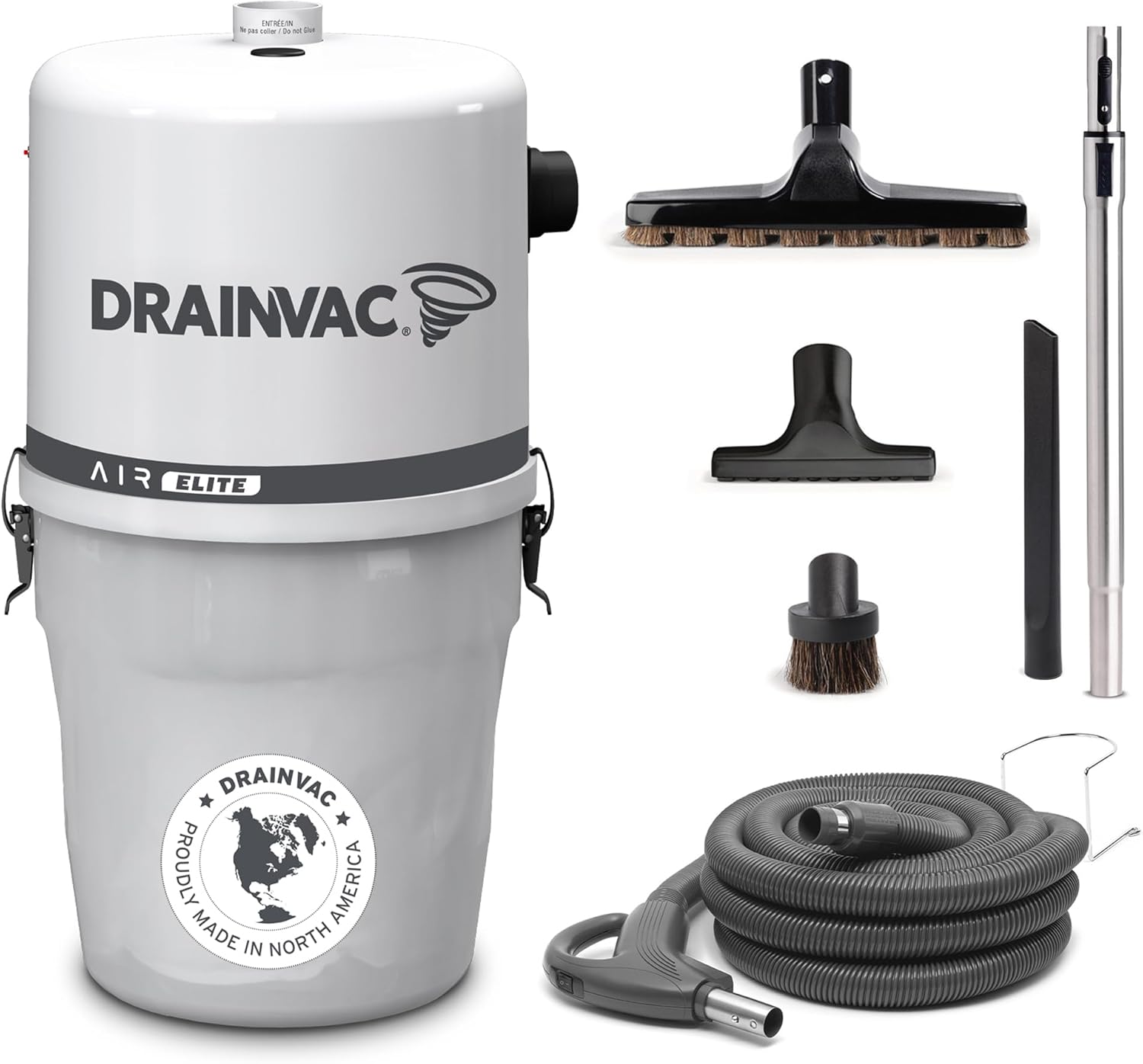
- Air Watts: 750 AW
- Water Lift: 138 in H2O
- Canister Capacity: 41 L / 9 gal
- Motor Type: Thru-flow
- Noise Level: 69 dB at 10 ft
- Rated Coverage: 8,500 sq ft
- Unit Weight:

- Air Watts: 700 AW
- Water Lift: 140 in H2O
- Canister Capacity: 35 L / 9.25 gal
- Motor Type: Two-stage thru-flow
- Noise Level: 62 dB
- Rated Coverage:
- Unit Weight:
Central Vacuum Comparison Means
A central vacuum comparison evaluates whole-home built-in vacuum systems across motor architecture, filtration type, brand stability, and total cost of ownership. It matters because a single-motor central unit delivers 500 to 800 air watts of sealed suction versus 100 to 200 from a premium cordless, yet the spec sheet alone misleads any buyer who doesn’t know how those numbers are tested or who actually manufactures the unit today.
The Air Watt Number That’s Misleading Every Buyer
The most cited spec in any central vacuum comparison is the one most likely to deceive. One brand’s 650 air watts measured at the motor outlet is not the same as another brand’s 650 measured at the system inlet under full pipe-run load. Both numbers are real. The comparison isn’t.
How Air Watts Are Actually Measured
Air watts represent sealed suction power, calculated from airflow (CFM) and suction pressure (water lift) at a specific test point. A figure pulled at the motor outlet ignores every bit of suction loss introduced by pipe runs, 90-degree elbows, and inlet valves before the hose ever touches the floor.
The AHAM appliance performance standards provide a framework for appliance performance testing, but central vacuum manufacturers aren’t universally required to publish AHAM-compliant figures. Most don’t disclose which method they used. Before comparing two brands on air watts, ask your dealer whether the published figure was measured at the motor outlet or at the hose inlet under load. That answer alone tells you how honest the spec sheet is.
What Water Lift and CFM Tell You That Air Watts Don’t
Water lift, in inches of water column, tells you how much suction pressure the motor generates against a sealed opening. CFM tells you airflow volume through an open system. Air watts combine both into a single cleaning-power figure, but the underlying split between water lift and CFM reveals what kind of cleaning the motor is built for.
Here’s the counterintuitive part: high water lift with low CFM suits bare-floor cleaning where suction needs to grip around debris. High CFM with moderate water lift moves more air through carpet pile, releasing embedded pet dander. A unit engineered for neither extreme has a blended spec that looks strong on paper and underperforms in both scenarios. Match the motor profile to your primary floor type and pipe-run length, not the headline number. Our independent vacuum testing results cover this methodology for the brands ranked below.
The 2023-2024 Brand Ownership Shakeup
Two years of manufacturer turbulence reshaped who makes what, who honors which warranties, and which parts supply chains are still intact. Nearly every comparison table on the current SERP lists units from brands that no longer exist in their original form.
Broan-NuTone, a Nortek brand that manufactured residential vacuum equipment for decades, discontinued its entire central vacuum and accessory line on August 31, 2023. Drainvac International, a Quebec-based manufacturer, acquired the NuTone central vacuum line and now produces and distributes those products. Warranty claims on pre-discontinuation NuTone units now route through Drainvac. Parts availability for older models, particularly the PurePower and VX series, depends on Drainvac’s commitment to maintaining legacy supply. Current status is at Drainvac’s NuTone central vacuum line.
Nuera Air, a Canadian manufacturer producing systems under multiple brand names, ceased manufacturing on April 2, 2024. Trovac Industries acquired the affected brands: Beam, DuoVac, Husky, SoluVac, and Smart. Trovac continues manufacturing under the Beam name and has committed to honoring warranty claims on pre-acquisition units.
Buying a Beam or DuoVac today means buying a Trovac product. Owning a NuTone purchased before September 2023 means warranty and parts flow through Drainvac. No competitor comparison guide has updated for either change.
Motor Architecture Is What Actually Determines Reliability
Motor type is the single biggest predictor of central vacuum lifespan. Comparison charts never show it because it doesn’t produce an impressive headline number.
Tangential Bypass Motors
A tangential bypass motor routes all cooling air around the outside of the motor windings, fully separated from the dirty air stream. The motor never inhales fine particles, moisture, or debris. That separation is why tangential bypass motors routinely reach 1,000-plus operational hours and why they’re the architecture of choice in premium units from Drainvac and CycloVac.
The limitation: tangential bypass motors run warmer under sustained load. In a utility closet without proper ventilation clearance, heat buildup shortens motor life faster than debris ever would. Six to eight inches of clearance on all sides is the minimum, not a suggestion.
Thru-Flow Motors
A thru-flow motor draws cooling air directly through the motor windings along with the dirt stream. It runs cooler because more air moves through the motor, but fine particles and moisture degrade the carbon brushes and armature over time. In a bagged system with a well-fitted filter bag, degradation is slow. In a bagless system where fine dust reaches the motor housing, a thru-flow design shortens lifespan measurably.
Most budget and mid-range units use thru-flow motors because they’re cheaper to produce. The practical rule: pair a thru-flow motor only with a bagged or HEPA-filtered system. Running one bagless, unless the manufacturer engineered the cyclonic separation to exclude fine particles from the motor path, accelerates wear in the most expensive component.
Two-stage motors, available in CycloVac and Drainvac premium lines, stack two fan impellers on one shaft for higher water lift without a larger housing. The performance gain is real. The cost premium runs 20 to 30 percent above single-stage units in the same class.
Filtration Systems Compared: Bagged, Bagless, and HEPA
Your filtration choice determines whether the system improves your home’s air quality or just moves fine particles somewhere else.
A bagged system traps debris in a disposable bag. The bag filling to three-quarters capacity drops suction 15 to 25 percent. The advantage: bag changes happen without touching the contents, which matters for allergy sufferers and pet owners more than any headline air watt figure.
Bagless cyclonic systems spin debris into a collection canister with no bags to buy and no mid-session suction drop. The limitation: fine particles the cyclone can’t capture need a secondary filter, and that filter requires cleaning every 12 to 18 months. Skip a cleaning cycle and you starve the motor of airflow.
HEPA filtration captures 99.97 percent of particles 0.3 microns and larger, but only when the entire system is sealed, not just the filter cartridge. A HEPA filter in a housing with lid leaks or bypass ports doesn’t deliver HEPA results. The EPA guidance on indoor air quality and particulate exposure identifies fine particulate matter as a primary indoor air quality concern, which is why central vacuum’s outdoor exhaust, venting 100 percent of exhaust air outside the living space, is a genuine health benefit over any portable vacuum regardless of filtration grade.
Self-cleaning filter systems on Drainvac and CycloVac models periodically reverse airflow to knock collected dust off the filter media back into the canister, extending filter life to five to seven years under normal residential use.
The 8 Central Vacuum Brands Ranked
Evaluation methodology: rankings reflect spec comparison across current manufacturer documentation, input from CVAC-certified technicians across three regional installation markets, and aggregated verified owner feedback from homes ranging 1,400 to 6,000-plus sq ft. Motor architecture, filtration quality, parts network integrity, and manufacturer stability all factor into the ranking.
1. Drainvac (Including the NuTone Line)
Drainvac International, a Quebec-based manufacturer now producing its own residential line and the former Broan-NuTone Venmar central vacuum products since the August 2023 acquisition, leads this comparison for one reason: tangential bypass motors paired with self-cleaning filtration across the majority of its residential lineup, a combination no other brand matches at this price point. The Automatik and GS1 series deliver 650 to 750 air watts, with two-stage options for homes over 4,000 sq ft.
Limitation: Drainvac’s dealer network concentrates in Quebec, Ontario, and the Northeast US. Outside that geography, warranty service means shipping the power unit to a regional depot.
2. CycloVac
CycloVac, also manufactured in Quebec, is the only brand on this list offering motor health monitoring through a companion app, flagging performance degradation before a failure interrupts your routine. Air watt ratings run 550 to 850 in the residential lineup, backed by tangential bypass two-stage motors in upper-tier models.
Limitation: dealer density across the southern US is thin, and warranty service outside major metros shares the same shipping-depot reality as Drainvac. Factor that into your decision before a rural install.
3. Vacuflo (H-P Products)
Vacuflo, manufactured by H-P Products in Canal Fulton, Ohio, is one of the few major central vacuum brands still produced entirely in the United States. Filtered canister systems use a thru-flow motor with a large-capacity filter bag, generating 500 to 680 air watts in standard residential models. The US dealer and service network covers the country more evenly than any Canadian competitor.
Limitation: older Vacuflo models used a proprietary inlet connection incompatible with standard 2-inch central vacuum fittings. Modern units use standard connections, but a pre-2010 system needs adapter hardware before modern accessories will mate.
4. Beam (Trovac Industries)
Beam, now manufactured by Trovac Industries following the April 2024 Nuera Air acquisition, carries the most recognized consumer name in central vacuum. The residential lineup delivers 550 to 700 air watts, with thru-flow motors in mid-range models and tangential bypass in the upper Serenity tiers. Trovac’s dealer network is the widest in North America.
Limitation: Beam products purchased before April 2024 carry warranty coverage through Trovac, and parts for pre-2020 Nuera Air production units face lead times as Trovac integrates the legacy supply chain. Current Trovac-era Beam specs are in our top-rated built-in vacuum models guide.
5. DuoVac (Trovac Industries)
DuoVac, also acquired by Trovac in April 2024, built its Canadian reputation on a hybrid filtered-cyclonic canister design that sustained suction more consistently than comparably priced bagged competitors across a filling cycle. Trovac continues manufacturing the line. Residential models deliver 580 to 750 air watts with the hybrid system in upper-tier units.
Limitation: outside Canada and the Northern US border states, DuoVac dealer density drops sharply, and the brand carries low name recognition with general contractors who spec systems during rough-in.
6. MD Manufacturing (OVO)
MD Manufacturing, based in Montreal, produces central vacuum systems under the OVO brand and as an OEM supplier for installer-branded units across North America. OVO residential models deliver 550 to 700 air watts with thru-flow and tangential bypass options by tier. The value position is its clearest strength: tangential bypass motor performance 15 to 20 percent below CycloVac and Drainvac pricing for comparable output.
Limitation: OVO has minimal consumer-facing retail presence, making accessory sourcing and installation support harder to find outside a CVAC-certified installer network.
7. Hayden (SuperVac)
Hayden, distributed as SuperVac through specialty retailers and HVAC contractors, anchors the value tier. Residential models run 500 to 620 air watts with thru-flow motors and bagged filtration. Installation cost tends to run lower because the power unit is priced aggressively.
Limitation: motor replacement intervals on thru-flow Hayden units average eight to ten years in properly maintained bagged configurations versus 12 to 15 years for tangential bypass units in the same home. One motor swap can erase most of the upfront savings.
8. Kenmore and Legacy Builder-Grade Units
Kenmore-branded central vacuums, produced for the Sears retail channel before that distribution network ceased operations, still exist in millions of older homes. Early installations used a non-standard bore size requiring an adapter for modern hoses and accessories.
For a home with a working Kenmore unit, the decision is whether to retrofit a current power unit onto the existing pipe network. The PVC trunk line in good condition is worth keeping. The original power unit almost certainly isn’t worth repairing.
15-Year Total Cost of Ownership
The upfront unit price reflects less than a third of what any system on this list actually costs over a decade and a half.
Premium tier (Drainvac, CycloVac): Unit $900 to $1,400 plus installation $800 to $1,200 plus two self-cleaning filter replacements at $80 to $120 each plus motor replacement at year 12 to 15 (which many tangential bypass units skip entirely) plus electricity at $25 to $40 annually. Estimated 15-year total: $2,200 to $3,400.
Mid-range tier (Beam, Vacuflo, DuoVac): Unit $500 to $800 plus installation $800 to $1,200 plus bags or filter replacements at $30 to $60 per year ($450 to $900 over 15 years) plus motor replacement at year 8 to 12 ($350 to $550 parts and labor) plus electricity at $30 to $45 annually. Estimated 15-year total: $2,400 to $3,800.
Value tier (Hayden, OVO entry): Unit $250 to $450 plus installation $800 to $1,200 plus annual bags at $30 to $50 plus one or two motor replacements within 15 years at $150 to $300 each plus electricity. Estimated 15-year total: $2,200 to $3,500.
The result is the same every time this math runs out: value-tier units frequently cost as much over 15 years as premium units because motor replacements erase the upfront savings. One clarification no dealer comparison includes: air watts from two motors cannot be summed. Two 500-air-watt motors in a dual-motor setup do not produce a 1,000-air-watt system. The airflow physics don’t support that claim.
Who Central Vacuum Is Wrong For
Honest comparison includes naming the buyer for whom no system on this list is the right answer.
Central vacuum is a poor fit for a single-story condo under 1,200 sq ft with no utility room and no accessible path for PVC pipe runs. The installation cost in that scenario exceeds the system’s lifetime value over a premium cordless.
The retrofit home with finished walls, no attic access, and a concrete slab on every floor is not “easy to retrofit” the way most guides claim. Fishing 2-inch Schedule 20 PVC through insulated wall cavities with fire blocks at each floor joist in a two-story colonial turns a one-day installation into three days. That reality belongs in your contractor quote before the brand decision, not after.
The owner who won’t change bags when suction drops or clean a cyclonic filter on schedule gets diminishing performance from every system above, regardless of rank. A central vacuum is not a set-it-and-forget-it appliance any more than a furnace filter is. And the buyer in a market where none of the top three brands has a CVAC-certified dealer within 90 miles should weight service accessibility more heavily than any air watt figure.
Conclusion
Central vacuum comparison stops being complicated once you shift focus from the headline air watt number to the three variables that determine what you’ll actually live with for 15 years: motor architecture, filtration type, and whether the manufacturer behind your chosen brand still has a functioning service network in 2024.
Pull the model number on any system you’re considering and verify current brand ownership before signing an install contract. That step puts you ahead of buyers still comparing discontinued NuTone units as active products. For a broader look at central vacuum brands across price ranges or to narrow by install type with our organised vacuum brand finder, both resources reflect the current post-Trovac, post-Drainvac landscape.
Frequently Asked Questions
What is the difference between air watts and water lift when comparing central vacuums?
Air watts combine airflow (CFM) and suction pressure (water lift) into a single performance figure measured at a specific test point. Water lift measures sealed suction force in inches of water column, telling you how hard the motor grips debris against resistance at the hose tip. Use air watts to compare overall cleaning power. Use water lift to evaluate suction strength specifically at the end of a long pipe run.
Which central vacuum brand is the most reliable long-term?
Drainvac and CycloVac lead on long-term reliability because both use tangential bypass motors that keep cooling air separated from the dirty air stream, routinely reaching 12 to 15 years of residential service life versus 8 to 10 years typical of mid-range thru-flow units in comparable use conditions.
Is a tangential bypass motor better than a thru-flow motor?
Yes, for longevity. A tangential bypass motor routes cooling air around the motor windings rather than through them, preventing fine-particle degradation of the brushes and armature over years of use. The trade-off is heat buildup in a utility space without adequate clearance, which shortens life if installation specs aren’t followed.
What is the best central vacuum for a home over 3,000 sq ft?
Choose a two-stage tangential bypass motor unit from Drainvac or CycloVac rated at 700 air watts or above. Homes over 3,000 sq ft with pipe runs to upper floors or detached garages hit the performance ceiling of single-stage mid-range units, particularly at inlet points 50 to 90 feet from the power unit where suction loss from elbows and run length becomes measurable at the hose.
Should I choose a bagged, bagless cyclonic, or filtered central vacuum?
Choose a bagged or HEPA-filtered system for households with allergy sufferers or pets because sealed bag changes prevent re-exposure to collected allergens. Choose cyclonic bagless for lower ongoing consumable costs, provided the secondary filter stays on a maintenance schedule. Avoid cyclonic-only bagless systems without a secondary filter; the trade-off costs you air quality and motor life simultaneously.
Who actually makes NuTone and Beam central vacuums now?
Drainvac International manufactures NuTone central vacuums following Broan-NuTone’s exit from the category on August 31, 2023. Trovac Industries manufactures Beam central vacuums following Trovac’s acquisition of Nuera Air’s brand portfolio on April 2, 2024.
Is a central vacuum worth it compared to a high-end cordless?
For homes over 2,000 sq ft, yes. A central vacuum delivers 500 to 800 air watts of sealed suction versus 100 to 200 from a premium cordless, with exhaust vented outside the living space rather than recirculated through a filter back into the room. The cordless wins on convenience for quick single-room cleanups. The central unit wins on whole-home performance, air quality, and long-term cost per cleaning hour across a multi-level home.