Central vacuum pipe Menards carries is Schedule 40 plumbing PVC, not the 2 inch OD vacuum tubing your inlets need, and that gap sends installers home with the wrong pipe more than any other search. Store staff point at the 2 inch pipe in the plumbing aisle and call it close enough. It isn’t, and the difference costs real airflow.
This guide settles what Menards stocks, why the “2 inch” label lies twice, and how to finish a complete central vacuum install kit clog-free. You’ll leave knowing what to buy, what to order instead, and which adapter bridges both.
Central Vacuum Pipe Menards
Central vacuum pipe Menards carries means Schedule 40 plumbing PVC, not the 2 inch OD vacuum tubing your fittings expect. Menards lists a Husky central vacuum unit online but stocks no dedicated vacuum tubing in store. DIY installers and retrofit buyers need to know the fitment gap before cutting pipe.Why Your Menards Trip Probably Ends in Frustration
Your Menards trip ends in frustration because the store simply does not sell central vacuum tubing, only plumbing and shop-vac products that look like substitutes. This guide is built from manufacturer install documentation, ASTM specification text, and cross-referenced installer forum threads, not a dealer’s inventory list, so the fitment answer below holds regardless of what a store associate tells you.
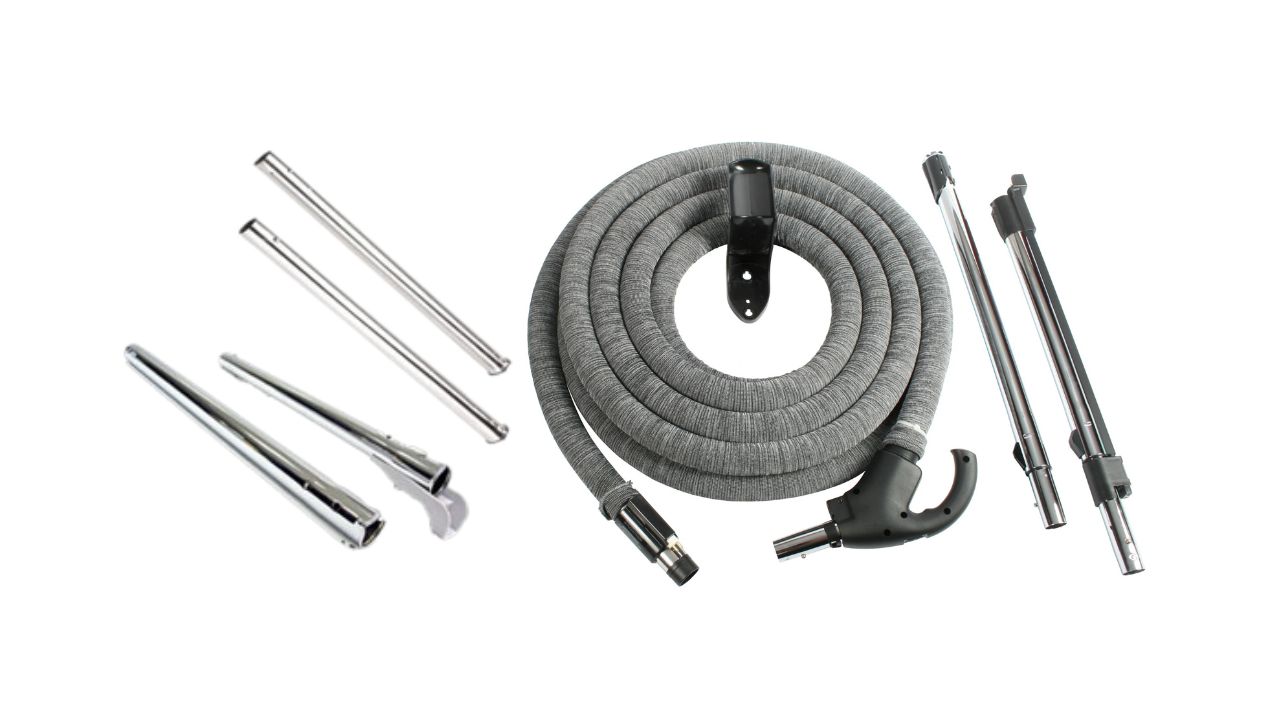
Can You Actually Buy Central Vacuum Pipe at Menards?
No. Menards sells one central vacuum product, a Husky central vacuum systems at Menards unit line, and nothing in the pipe aisle matches the tubing that unit needs. Husky, Menards’ house brand built by Trovac Industries, covers the power unit and canister, not the 2 inch OD tubing, sweep elbows, or inlet backing plates a working system requires.
That’s the limitation worth knowing before you buy the unit: you’ll still order every foot of pipe elsewhere. Home Depot runs a labeled central vacuum tubing category online. Menards runs none.
What Shows Up When You Search Their Site Instead
Search “central vacuum pipe” on menards.com and you get shop-vac hose, dust collection hose, and plumbing PVC, never vacuum-rated tubing. The exact keyword reroutes to wet/dry vacuum accessories. None of these meet the ASTM F2158 dimensional spec your fittings are built to.
Feels like the product should exist on that site. It doesn’t, not today.
The Employee Answer That Sends Buyers Down the Wrong Aisle
Ask a Menards associate for central vacuum pipe and most will walk you to Schedule 40 plumbing PVC. A DIY Chatroom thread on this exact confusion shows installers getting the same answer at multiple big-box chains, then discovering months later the pipe doesn’t seat right at the inlets. The employees aren’t wrong to point there. They’ve simply never stocked the thin-wall alternative.
Ever gotten confident store advice that turned out dead wrong? This is that, on a pipe run behind drywall.
The 2 Inch Lie: Same Number, Different Pipe
Both pipes carry a “2 inch” label, and neither measures the same thing, exactly why swapping them wrecks fitment. Getting the right pipe diameter matters more than any other spec here.
Why Vacuum Pipe Measures Outside and Plumbing Pipe Measures Inside
Central vacuum tubing runs a true 2 inch outer diameter (OD), measured across the outside wall of the pipe. Plumbing PVC measures 2 inches on the inside, pushing its actual outside diameter to roughly 2.375 inches. Think of two shoes marked size 10 from two different brands. Same number on the box. Different last, different fit, and one blisters your feet by mile three.
The Wall Thickness Difference Nobody Mentions at Checkout
Vacuum tubing walls run thin, close to 1/16 inch, sized to match the depth of a vacuum fitting’s hub so pipe and fitting sit flush inside. Schedule 40 walls run several times thicker, built for water pressure, not airflow.
| Pipe type | Outer diameter | Wall thickness | Weight (8 ft stick) |
|---|---|---|---|
| Central vacuum tube | 2.00 in | ~0.06 in | Light |
| Schedule 40 PVC | ~2.375 in | ~0.15 in | Heavy |
That thicker wall is why a Schedule 40 fitting never sits flush against a vacuum inlet’s backing plate.
What ASTM F2158 Certification Actually Guarantees You
ASTM F2158 is the standard governing residential central vacuum tube and fitting dimensions, wall tolerances, flattening resistance, and impact resistance. Broan-NuTone, whose central vacuum line DrainVac acquired in 2023 after Broan-NuTone exited the category, builds its fittings to this spec. Schedule 40 answers to a different standard meant for pressurized water, not airflow. No US central vacuum manufacturer recommends plumbing PVC for a full run, and this certification gap is exactly why.
What Menards Does Stock That Tempts You Anyway
Menards stocks three products that look like substitutes for vacuum tubing, and none pass the fitment test.
Schedule 40 PVC: Cheap, Everywhere, and Wrong for Vacuum Runs
Schedule 40, sold under labels like Charlotte Pipe, the country’s largest PVC pipe manufacturer, is cheap and sits on every Menards shelf. Its rough interior joints and mismatched fitting hubs create the exact catch points where debris snags. MD Manufacturing, an independent central vacuum parts manufacturer, lays out central vacuum pipe installation options compared by MD Manufacturing, ranking three choices, plumbing pipe, flexible hose, and true vacuum tubing, with plumbing pipe last for good reason. Use only large sweep elbows, never hard 90s, or debris stalls mid-run.
Thick walls also mean reaching for a full-size PVC saw and primer, steps thin-wall pipe skips entirely.
Sewer and Drain Pipe: The Thin Wall Workaround With a Catch
Some hardware stores carry thin-wall sewer and drain PVC that shares vacuum tubing’s lighter wall profile, and installer forums point to it as a workaround at competing chains. The catch: sewer and drain sizing serves drainage diameters, not the vacuum industry’s 2 inch OD spec, so fitment needs verifying against the stick in hand, not the label on the bin.
Dust Collection Hose Is Not Central Vacuum Tubing
Menards stocks 2.5 inch flexible dust collection hose built for shop cleanup, and it has no business running inside a finished wall. Builders tried flexible in-wall runs in the 1960s and dropped the approach fast once airflow losses showed up at every bend.
| Product | OD spec | Rigid? | In-wall rated? | Vacuum compatible? |
|---|---|---|---|---|
| Central vacuum tube | 2.00 in | Yes | Yes | Yes |
| Schedule 40 PVC | ~2.375 in | Yes | Needs adapter | Partial |
| Sewer/drain PVC | Varies | Yes | No | Rare |
| Dust collection hose | 2.5 in | No | No | No |
You want rigid PVC tubing alternatives here, not flex hose, full stop.
Where Installers Actually Buy Their Pipe
Installers skip Menards for pipe entirely, buying instead from Home Depot’s labeled category, an online vacuum specialist, or a local dealer.
Home Depot Carries a Central Vacuum Category That Menards Skips
Home Depot lists a dedicated central vacuum tubing category and stocks Broan-NuTone semi-rigid PVC in 8 and 10 foot sticks, something Menards has never carried. Check Home Depot’s central vac pipe options before assuming your local store has it on the shelf. Stock varies store to store, and listings often show zero units nearby, so call ahead before driving over.
Online Vacuum Specialists Beat Every Big Box on Selection
MD Manufacturing and similar specialists sell full stick bundles, fittings, wire, and cement together, and their 16 foot repair packs ship cut into shippable 4 foot sections to dodge oversized freight fees.
| Source | Cost per foot | What you get |
|---|---|---|
| Specialist bundle | Lower, bulk pricing | Pipe, fittings, wire, cement |
| Big box piecemeal | Higher, per-item markup | Pipe only, adapters extra |
The tradeoff is shipping time, not price. Budget a few extra days versus a same-day store run.
When a Local Vacuum Dealer Is Worth the Markup
A local vacuum dealer is worth the markup when you need pipe, sweep ells, and backing plates the same afternoon. You’ll pay more per stick, but skip freight on 8 foot lengths that never fit standard parcel boxes. Ask them to sell pipe alone. Most will. A few grumble.
Already Bought Schedule 40? Here’s Your Honest Options
Already bought Schedule 40 by mistake? You have two honest paths, adapt it at the ends or return it for real vacuum pipe. Which wins depends on how much of the run is already glued.
Adapter Kits That Bridge Plumbing Pipe to Vacuum Fittings
Dedicated 2×2 adapters, patented by Central Vacuum Stores owner Roger Ambrose, bridge Schedule 40’s 2 inch ID to vacuum pipe’s 2 inch OD at each end of a run. They’re compatible with Schedule 40 from any hardware store and standard vacuum inlets and power units. The exception: they don’t correct sewer/drain sizing or dust collection hose, and every adapter added is one more joint, one more failure point.
Use them at the inlet and power unit transitions only. Never mid-run:
- Cut Schedule 40 to length and dry-fit the run.
- Install a 2×2 adapter at the inlet backing plate.
- Install a matching adapter at the power unit intake.
- Glue transitions with standard PVC cement, no primer needed.
- Run the vacuum and check every joint before closing the wall.
The Clog Math on Mixed Diameter Systems
Mixed diameters create a ledge everywhere thick Schedule 40 meets a thin-wall vacuum fitting hub, exactly where a sock, a bobby pin, or a wad of pet fur stalls out. A hand-cut edge on Schedule 40 rarely matches a factory-beveled vacuum tube end, which makes the ledge worse. One buried clog can mean cutting open finished drywall to clear it later.
Worth the gamble on a hallway you’ll vacuum every week for the next twenty years?
When Returning It and Starting Over Costs Less
Price a 2,400 sq ft rough-in both ways before committing to adapters. Returning unopened Schedule 40 and ordering real vacuum tubing costs less than adapters plus labor once every transition point gets counted. The pipe inside your walls outlasts every power unit you’ll ever own, worth buying the pipe every manufacturer actually specifies.
The Static and Suction Myths Sold on Both Sides
Neither the static warnings nor the suction-loss claims about Schedule 40 hold up as either side tells them. The real risk is rough interior fit, not the plastic itself.
Does Schedule 40 Really Cause Dangerous Static Buildup?
No, not the way forum posts describe it. DIY Chatroom threads on this exact question show installers on both sides overstating their case, dealers warning of dangerous static buildup, DIYers dismissing it outright. Fit and interior smoothness at joints matter more to performance than static charge in a residential run.
The Suction Loss Claims Dealers Exaggerate and DIYers Dismiss
The real suction risk is turbulence at rough joints, not the pipe material draining airflow from the system. Manufacturer warnings center on clog risk and fitting fit, not Schedule 40 cutting raw suction numbers. Neither the dealer’s scare pitch nor the DIYer’s shrug survives a real read of the install manuals both sides claim to cite.
How Much Pipe Your Project Actually Needs
A typical multi-inlet home needs one inlet per 700 to 800 sq ft, plus 10 percent extra pipe for cuts and mistakes. Measure your longest run before ordering, from any source.
Estimating Sticks and Fittings for a Typical Two Story Home
A 2,400 sq ft two-story plan needs a trunk line from the power unit, branch lines to each floor, and an inlet drop roughly every 700 to 800 sq ft, meaning three to four inlets. Buy 10 percent more pipe than the tape measure says. Bad cuts and one redo eat sticks fast.
The Fittings List Menards Cannot Fill
Menards cannot fill the vacuum-specific fittings list no matter which pipe you land on, sweep elbows, 90 degree TYs, inlet backing plates, and stop couplings.
| Fitting | Purpose | Vacuum-only? |
|---|---|---|
| Sweep elbow | Wide-radius turn | Yes |
| 90° TY | Branch tie-in | Yes |
| Backing plate | Inlet mount | Yes |
| Stop coupling | Run termination | Yes |
Plumbing elbows turn too sharp for airflow, exactly why vacuum sweeps exist and why none of these show up in a Menards plumbing aisle.
Low Voltage Wire and Glue: The Two Things You Can Buy There
Standard 18 or 20 gauge low-voltage wire, the signal line telling the power unit an inlet is open, works fine from any hardware store, Menards included. Regular PVC cement bonds thin-wall vacuum tubing without a separate primer step. Grab both there and save the specialty order for pipe and fittings.
Check the power unit’s owner’s manual for its exact amperage draw first. Central vacuum motors run on a dedicated 15 or 20 amp circuit depending on the model, not a one-size rule.
Conclusion
You arrived thinking Menards forgot to stock an aisle. You’re leaving knowing central vacuum pipe is a specialty product built to its own ASTM standard, one no big-box plumbing shelf carries. Tonight, measure your longest run, count your inlets, and price a specialist bundle against the adapter route before buying a single stick. The pipe you choose now outlasts three power units, exactly why the right forty dollars of tubing beats the convenient kind.
Frequently Asked Questions
Does Menards sell dedicated central vacuum pipe and fittings, or only plumbing PVC?
Only plumbing PVC and shop-vac hose. Menards lists one Husky central vacuum unit online but stocks zero dedicated vacuum tubing or vacuum-specific fittings in any store.
What is the difference between central vacuum pipe and the 2 inch PVC at a hardware store?
Central vacuum pipe measures 2 inches outside; hardware store PVC measures 2 inches inside, closer to 2.375 inches outside. That mismatch is why the two won’t seat in the same fittings.
Can I use Schedule 40 plumbing PVC from Menards to install or repair a central vacuum?
Yes, but only with a 2×2 adapter at each inlet and power unit connection, and only using large sweep elbows, never hard 90-degree turns.
Why do central vacuum installers say plumbing PVC causes clogs?
Its thicker walls and rougher factory cuts leave interior ledges at every fitting transition, exactly where debris snags and stalls.
Is it cheaper to buy vacuum pipe online with shipping or use adapted PVC from a local store?
Adapted local PVC costs less for small repairs. A specialist bundle beats piecemeal big-box pricing plus adapters once every transition gets counted.