Standing in the plumbing aisle with a stick of 2 inch PVC, you’re about to make a central vacuum pvc tubings mistake that costs a weekend of drywall repair. The pipe looks right. It measures wrong, and most guides skip the number that matters: outside diameter, not the nominal size on the bin.
Finish this guide knowing the exact spec to demand, which fittings belong on your list, how many feet you need, and which “use Schedule 40” advice to skip. Getting your central vacuum setup package right starts with this pipe, not the power unit.
Central Vacuum PVC Tubings
Central vacuum PVC tubings are thin-wall plastic pipes sized by a 2 inch outside diameter and roughly a 1/16 inch wall, built to move air and debris, not water. Fittings hub onto that outer surface, not the inner bore. This guide draws on ASTM F2158 documentation, manufacturer pages, and installer forum consensus, not one dealer’s catalog.Why Your Hardware Store PVC Won’t Fit
Hardware store PVC won’t fit central vacuum fittings because plumbing pipe is sized by its inner bore while vacuum tubing is sized by its outer wall. That difference is the reason “PVC is PVC” is the most expensive myth in this hobby.
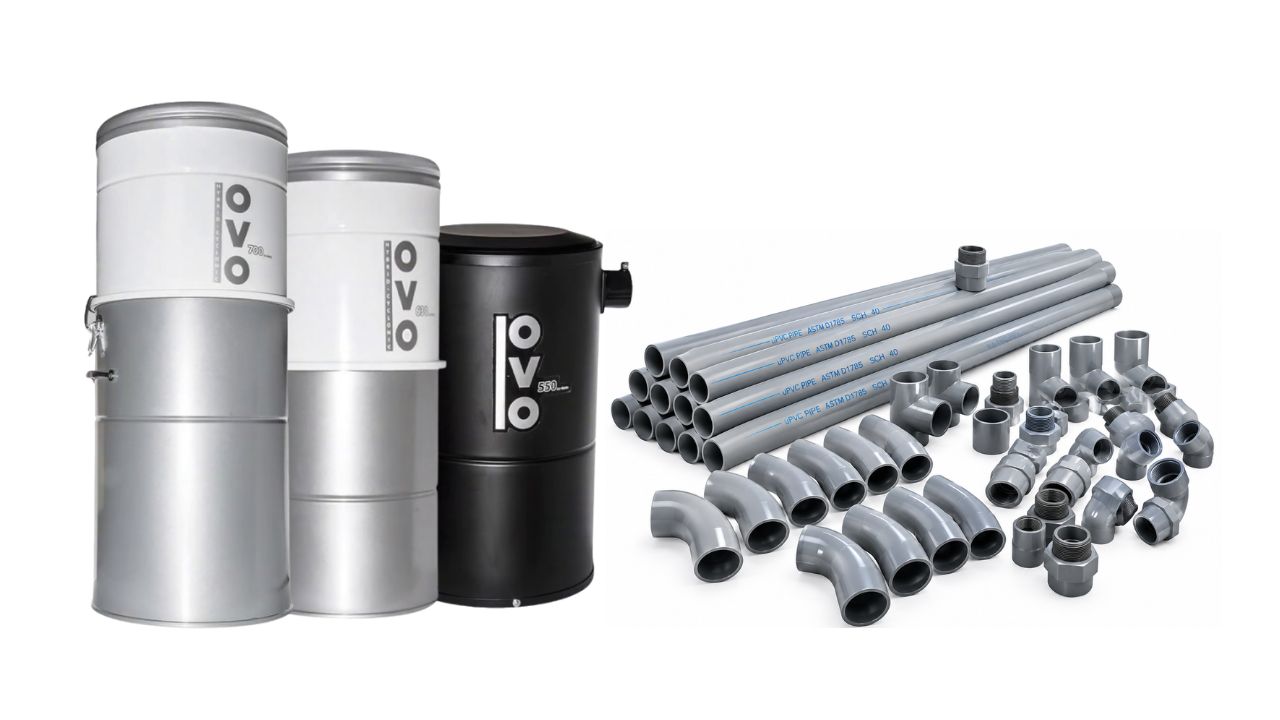
Two Pipes, Two Measuring Systems, One Expensive Mistake
Vacuum tubing measures 2 inches on the outside. Plumbing pipe measures 2 inches on the inside, pushing its outer diameter to roughly 2.375 inches. One DIYer learned this gluing Schedule 40 into an inlet backing plate, watching it seat loose and rock instead of locking flush.
Outside diameter is the true sizing spec for every vacuum fitting hub. Feel that mismatch once and dry-fitting before gluing anything stops being optional.
What Is Central Vacuum PVC Tubings and Why the Thin Wall Matters?
Central vacuum PVC tubing is a pressure-free pipe built to a tight outer tolerance, not a plumbing-grade schedule rating. Independent dimensioning of certified stock holds the tube at roughly 2.000 to 2.004 inches OD, with a wall around 1/16 inch thick. Compare suppliers against the full central vacuum pipe size standards before you order.
No schedule number appears on this pipe because it never carries pressurized water. Hide-A-Hose’s own 2-inch OD thin-wall central vacuum pipe specifications confirm the tube’s outer diameter, not an inner bore rating, is the spec that matters for fitting compatibility. Wall thickness matches the fitting hub, forming one smooth surface with no interior step.
Why does a step matter at all?
Air Moves Debris Differently Than Water Ever Will
Air carries debris worse than water carries anything, and that’s why vacuum pipe can’t borrow plumbing specs. Dense, moving water pushes an obstruction along regardless of a rough joint.
Vacuum air has no such muscle. A dry paperclip lodged against a burred edge parks there, and every interior ledge or glue ridge becomes a future clog anchor.
The ASTM F2158 Stamp and What It Certifies
ASTM F2158 is the central vacuum industry’s dimensional and performance standard, the stamp separating certified tubing from generic plastic pipe. ASTM International, the organization behind voluntary manufacturing standards across many industries, issued F2158 in the early 2000s and has kept it active through reapproval since.
The Tests Behind the Label on Certified Tubing
Tubing carrying the F2158 stamp has passed specific dimensional, flattening, and impact tests, not just a visual inspection. The standard governs materials, dimensions and tolerances, flattening resistance, and impact resistance for both tube and fittings.
The flattening test compresses a sample to 40 percent of its original outer diameter, and it must survive with no cracks. Certified tubing must also be homogeneous plastic, free of cracks, holes, or foreign inclusions.
Why Inspectors Can Fail an Uncertified Pipe Run
Building inspectors in jurisdictions that adopted F2158 through the Uniform Mechanical Code reject rough-ins lacking the stamp on both pipe and fittings. IAPMO, the International Association of Plumbing and Mechanical Officials, maintains the Uniform Mechanical Code many US municipalities reference for this requirement.
One installer’s rough-in was rejected outright for missing the F2158 marking. A failed inspection at that stage means opening finished walls to swap pipe already glued and strapped in place.
Virgin PVC Versus Regrind, the Quiet Quality Split
Virgin PVC means fresh, unrecycled resin through the pipe wall, a distinction most product pages never mention. Regrind pipe blends in reclaimed plastic scrap, and suppliers flag regrind stock for higher separation risk in temperature swings.
Ask the seller directly whether the tubing is virgin resin. The listing rarely volunteers this, and it’s a cheap question to ask before a purchase.
The Schedule 40 Debate Nobody Referees Honestly
The honest verdict on Schedule 40: it works with adapters, but every added joint raises clog risk, and the savings rarely survive one service call. Dealers on both sides have a product to sell, and neither says so out loud.
The Case Dealers Make Against Plumbing Pipe
Dealers selling dedicated tubing, including ThinkVacuums with its FlowMax Gold line, argue Schedule 40’s rougher finish and tight elbows invite clogs thin-wall tubing avoids. Cutting thick-walled plumbing pipe with a hacksaw instead of a tubing cutter leaves crooked, snag-ready edges at every joint.
No major US central vacuum manufacturer recommends plumbing pipe for a residential run. Not proof of a conspiracy, just a documented industry position.
The Contrarian Camp Says Schedule 40 Works Fine
Central Vacuum Stores, which sells a patented 2×2 adapter joining plumbing pipe to vacuum fittings, argues the opposite: buy cheap local Schedule 40, adapt every connection, and save on shipping. Their pitch leans on a claimed airflow benefit from the larger bore.
We flag that claim, cited as a 25 percent CFM boost, as single-source marketing with no independent lab data behind it. Commercial installs spec Schedule 40 for durability, but residential guidance points to F2158 tubing.
- Confirm the pipe carries an F2158 stamp before buying.
- Use a purpose-built adapter at every transition when substituting Schedule 40, not a field-cut sleeve.
- Budget for the adapter’s added labor time, not just its retail price.
Where We Land After Reading Both Sides
Adapters add joints, and every joint is a future clog candidate in a system that relies on airflow alone to move debris. Stepping down from a larger bore to a smaller one traps long debris like hair and floss right at the transition.
The few dollars saved on a local Schedule 40 stick rarely survive one blocked-line call.
Fittings Decide Whether Your System Clogs
Fitting choice, not pipe brand, decides whether your system clogs, because every turn either helps debris glide through or gives it a place to snag. Sweep geometry beats sharp geometry whenever air, not water, is doing the pushing.
Sweep 90s, Wyes, and the Banned Straight Tee
Sweep 90 elbows turn debris gradually along a wide arc instead of slamming it into a sharp corner. MD Manufacturing, behind the builtinvacuum.com installation resources, warns against straight tees on any branch connection and recommends wyes instead.
Wide-radius turns matter most where a branch line joins the trunk line, since that’s where two airstreams collide.
Here’s the corrected layout:
- Replace any straight tee at a branch junction with a sweep wye.
- Replace two stacked 90-degree elbows on an offset with two 45-degree elbows.
- Keep the inlet’s final turn as a short, tight sweep 90, not a hard-angle fitting.
The One Elbow You Never Glue
The short 90-degree elbow behind each wall inlet stays friction-fit, never cemented, because it’s your only service access once the wall closes. One owner cleared a lodged bobby pin in two minutes by pulling that unglued elbow free, no drywall involved.
Forum veterans call this the difference between a five-minute fix and a demolition project. Skip the glue there.
Glue Technique That Keeps the Interior Smooth
Solvent cement belongs on the male pipe end only, never inside the fitting hub, because excess glue hardens into a ridge that snags hair and floss for years. MD Manufacturing confirms primer isn’t necessary on this tubing, unlike some plumbing-grade PVC.
Deburr and ream every cut end before dry-fitting. That squeak of a properly reamed pipe sliding home is the sound of a joint that won’t clog in year three. Check couplings and central vac fittings for the full compatible parts list before you order.
How Much Tubing Your Home Actually Needs
Most residential installs need 80 to 150 feet of tubing, and the right number depends on floor plan shape, not raw square footage. A 120-foot run serves 1,500 to 2,000 square feet, while a larger 2,500 to 3,500 square foot home needs closer to 220 feet.
Planning Pipe Runs by Floor, Not Total Square Footage
Plan tubing floor by floor with a physical string test, not a calculator, since hallway turns and stacked levels eat pipe a flat number misses. One installer dragged a string line room to room simulating a 30-foot hose reach before drilling, catching two dead zones an estimate missed.
Reach into corners and past ceiling edges during that test, not just room centers. MD Manufacturing’s central vacuum pipe installation options compared page recommends one inlet per roughly 700 to 1,000 square feet with a standard 30-foot hose.
Stick Lengths, Freight Games, and the 5 Foot Lie
Industry “5 foot” sticks actually measure 4 feet 8.5 inches, a rounding quirk that throws off quick estimates. Longer 8-foot sticks mean fewer glue joints across a straight run, and fewer future clog points too.
Oversized freight charges cost more than the pipe itself on split orders, so plan one consolidated order instead of two. An 80-foot bundle retails around 140 dollars from national suppliers, before fittings.
Where Tubing Runs Get Homeowners in Trouble
Tubing runs get homeowners in trouble in spots nobody plans around: unconditioned attics, buried garage lines, fire barriers, and construction traffic. Each failure mode has a specific, fixable cause.
Attics, Crawl Spaces, and Condensation You Can’t See
Uninsulated attic pipe sweats in temperature swings, and damp dust inside the tube cakes into a paste that hardens like concrete. One cold-climate installer taped every fitting opening during a winter install to stop condensation forming inside the run before insulation went over it.
Suppliers warn regrind attic pipe cracks more readily under that same cycle. Wrap exposed runs, even in “just storage space.”
Burying Pipe to a Detached Garage
Burying rigid PVC to a detached garage risks freeze-thaw cracking, because ground temperature swings stress the pipe beyond its design tolerance. One VacuumLand forum member was warned that a shallow buried run could crack within a few winters.
Enthusiast consensus favors burying below the frost line or reconsidering power unit placement. A garage-mounted unit sounds convenient until the buried trench line clogs with no access panel to reach it.
Fire Codes, Water Heaters, and Metal Pipe Sections
Runs near a water heater flue or chimney require metal pipe instead of PVC, because plastic can’t sit that close to a heat source under most local codes. Fire barrier penetrations, like the wall between a garage and living space, need a steel plate or a listed firestop ring.
Check local code before the drywall crew closes anything up.
The Drywall Bump That Split a Thin Wall Pipe
A single drywall sheet cracked a run on one job site, witnessed by a builder writing for Fine Homebuilding, because thin-wall tubing trades toughness for a smooth interior finish. That trade works fine once strapped and protected, and fails the moment a crew leans a sheet against an unprotected run.
Strap pipe every few feet so nothing flexes at a glue joint during construction. That builder reported zero breaks across twenty installs once strapping became standard.
Repairs, Add Ons, and Matching Old Pipe
Repairing or extending an older system starts with measuring the existing pipe’s outside diameter, because older installs don’t always match today’s 2-inch standard. Guess the size and the fittings won’t seat.
Odd Diameters Hiding in Older Homes
Legacy Kenmore central vacuum systems used a 1 3/4 inch pipe, and Canplas Industries, maker of the Vaculine and Hayden tubing and fitting lines, sells step-down adapters bridging that older bore to modern 2-inch stock. Standard 2-inch fittings are compatible with pipe from MD Manufacturing, ThinkVacuums, VacuMaid, and Canplas. The exception: any pre-2-inch legacy run needs an adapter at the transition point.
Measure your existing pipe’s outer diameter before ordering a single fitting. The buried network in most homes outlasts every power unit connected to it, so a mid-network repair matters more than it looks.
Small Jobs Deserve Small Bundles
Small repairs and single-inlet relocations don’t need a full bundle order, since suppliers sell 16-foot and 40-foot packs for that scenario. One owner relocated an inlet with a 16-foot, four-stick pack in an afternoon.
Keep two spare couplings on hand for any repair job, since field cuts rarely land exactly where planned. In a tight retrofit corner where rigid pipe can’t bend, switching to flexible vac pipe at that one section, the approach behind Hide-A-Hose’s retractable systems, solves a problem rigid tubing can’t.
Buying Checklist Before You Order Tubing
Before ordering, confirm five things on the listing: the F2158 stamp, virgin PVC material, the 2-inch OD spec, real stick length, and freight terms. Skip one and risk a return shipment or a rejected inspection.
The Five Line Inspection for Any Pipe Listing
| Check | What to confirm |
|---|---|
| Certification | ASTM F2158 marking on pipe and fittings |
| Material | Virgin PVC resin, not regrind |
| Dimension | 2 inch OD, roughly 1/16 inch wall |
| Stick length | True length in inches, not the rounded “5 foot” label |
| Freight | Per-order shipping cost, since pipe rarely ships free outside full kits |
Read freight terms twice before checkout. Shipping surprises more first-time buyers than any spec on this list.
Fittings to Order With the Pipe, Not After
Order sweep 90s, 45s, wyes, couplings, and one unglued stop coupling per inlet with the pipe itself, not as a follow-up purchase. The regret on every installer forum: one missing fitting shipped from across the country, stalling the job for a week.
Order roughly 10 percent more fitting stock than the plan calls for. A partial-box return costs less than a stalled wall waiting on a two-dollar coupling.
Conclusion
You arrived thinking pipe is pipe. You’re leaving knowing the 2 inch outside diameter, thin wall spec is the whole game behind central vacuum pvc tubings, and F2158 certification separates a system that lasts decades from one that clogs in year two.
Tonight, measure the outside diameter of any pipe in your walls and walk your floor plan with a 30-foot string to map real hose reach. This buried network outlives every motor you’ll ever install, so getting the pipe right once beats replacing units every few years while still fighting clogs.
Frequently Asked Questions
What kind of PVC pipe is used for central vacuum systems?
Central vacuum systems use thin-wall PVC tubing with a 2 inch outside diameter and roughly a 1/16 inch wall, certified to ASTM F2158. It’s not the same product as plumbing-grade PVC sold by nominal inner diameter.
Can I use Schedule 40 PVC pipe to install a central vacuum?
Yes, with a purpose-built adapter at every connection, though it adds joints that raise clog risk over time. Certified thin-wall tubing avoids that trade-off for only slightly more up front.
How much tubing do I need to install a central vacuum in my home?
Most homes need 80 to 150 feet, with roughly 120 feet covering 1,500 to 2,000 square feet and 220 feet covering 2,500 to 3,500 square feet. Walk your floor plan with a 30-foot string before ordering to catch dead zones a square-footage estimate misses.
What fittings do I need for a central vacuum pipe run?
Stock sweep 90s, 45-degree elbows, sweep wyes for branch junctions, couplings, and one unglued stop coupling per inlet. Order them with the pipe, since a missing fitting can stall a job for a week waiting on shipping.
Will a building inspector fail a central vacuum installed with plumbing pipe?
Yes, in any jurisdiction that adopted ASTM F2158 through the Uniform Mechanical Code, an inspector can reject a run lacking the F2158 stamp on pipe and fittings. Check with your local building department before you glue a single joint.