Flexible central vac pipe looks like the fix when rigid PVC won’t clear a toe kick or joist bay. It is, for about three feet. Swap it in for the whole trunk and branch network, and suction dies at the farthest inlet before the motor quits.
Sellers list flex pipe, flex hose, and flex tubing under nearly identical names, never mentioning full-run flex sits outside ASTM F2158. Start with the right central vacuum kit, then use this guide to find where flex earns its spot, clamp or cement, and which rigid fitting fixes the corner flex gets blamed for.
Flexible Central Vac Pipe
Flexible central vac pipe is a short, corrugated connector for a VacPan, a power unit, or a tight framing obstacle, not a substitute pipe system. Every corrugation and bend steals air watts the system never wins back. Retrofit installers and VacPan buyers need it in short, deliberate lengths only.One Search Term, Three Completely Different Products
Three unrelated products share the same search term, and buying the wrong one wastes a trip back to the store. One slips over rigid tubing as a connector, one drags behind you as a cleaning hose, and one ships as a retrofit stub kit.
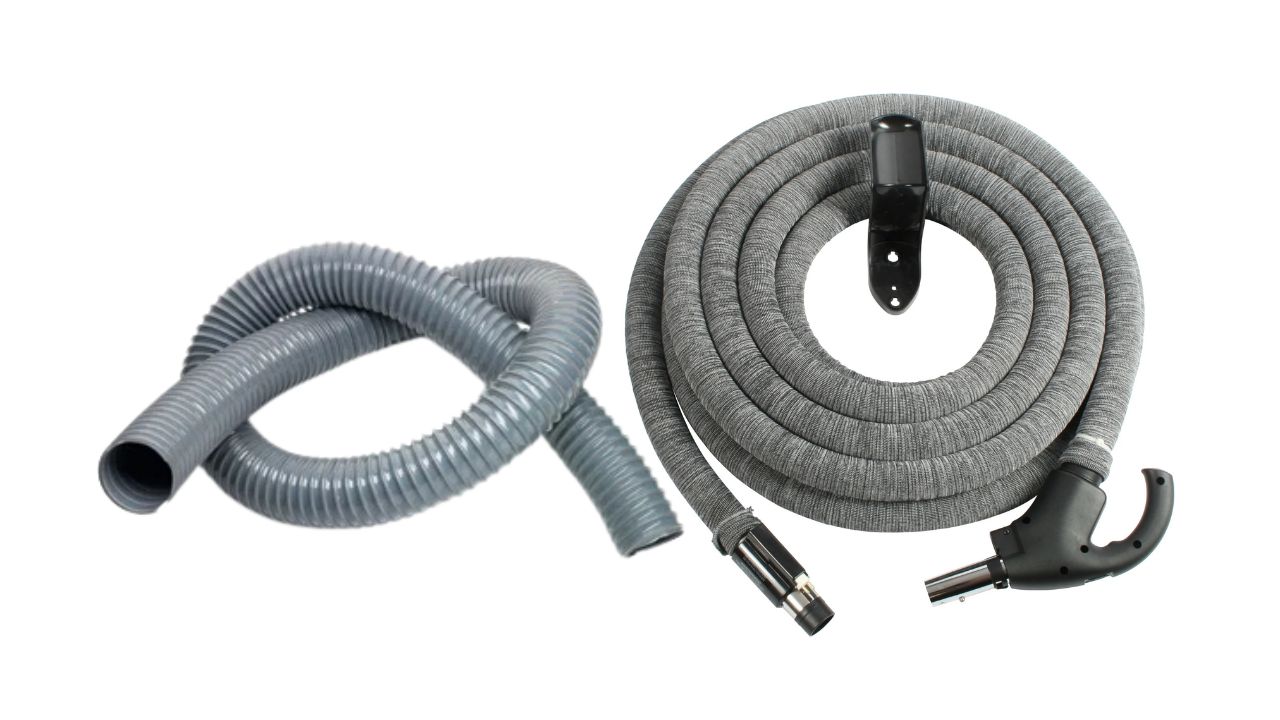
The install flex pipe that slips over rigid tubing
This is a connector sized in inches, not a plumbing system. The 2-inch inner diameter slips snugly over standard 2-inch outer diameter central vacuum pipe, the sizing used in roughly 99% of installations. Construction is a coated wire helix wrapped with polyester reinforcing yarns under an extruded cover, which is what lets it bend without kinking shut.
The cleaning hose you drag from inlet to inlet
This is the hose on the other end of your cleaning wand, not wall tubing, and mixing the two up sends installers to the wrong product page. Retailers list 30 to 40 foot flexible hoses under names nearly identical to install-grade flex pipe. Searched for wall tubing and landed on a handle attachment? That’s why.
The retrofit stub kits brands like OVO now sell
These kits connect a new power unit to an existing pipe network without tearing open walls. OVO Central Vacuum’s Easy Retrofit kit ships two 12-inch flexible pipes with stainless steel clamps and PVC connector pieces, built to fit standard 2-inch central vacuum pipe. The marketing line is universal compatibility, not permission to replace pipe runs with it. Need a longer gap covered? The included PVC pieces join two stubs together, but that joint stays a connection point, not a design feature.
The 1960s Flex Experiment That Installers Still Regret
Whole-house flex installations were tried decades ago and abandoned for good. Installers wanted to skip cutting and gluing fittings. Homeowners got clogs instead.
Why running whole systems in flex hose was abandoned as a disaster
Full-run flex hose replaced elbows and fittings across the entire pipe network, and it was abandoned as a disaster within years of the attempt. MD Manufacturing, which runs the builtinvacuum.com installation library and manufactures the Hide-A-Hose retractable system, documents the method in central vacuum pipe installation options compared: installers used two-inch flexible hose instead of standard fittings in the early 1960s to save labor. Air bounced against the corrugated ridges instead of gliding through, and short-radius turns became clog points. No known US manufacturer recommends flex for main line runs today. That’s not caution. That’s a lesson paid for in service calls.
What ASTM F2158 actually certifies and what it excludes
ASTM F2158 residential central-vacuum tube and fittings specification sets the dimensional tolerances, flattening resistance, and impact resistance rigid central vacuum tube must meet, and full-run corrugated flex was never built to pass those tests. Vacuflo, manufactured by H-P Products, is among the brands whose rigid tube meets that certified standard. The standard’s own scope excludes flex tubing at the power unit from its coverage, which tells you where flex belongs: short connection points, not load-bearing runs. Building departments in many US municipalities flag installs that skip certified tube for flex, and IAPMO plumbing and mechanical code standards back the same line. Ask your inspector before you assume flex passes.
Can I run my whole central vacuum system in flex pipe?
No. The limits are physical, not a sales tactic. Every corrugation adds friction, every rib is a place a toothpick or bobby pin can catch, and every added foot of flex is a foot the certified tube isn’t doing its job. Flex belongs in the last few feet. Nowhere else.
How Corrugated Ribs Quietly Steal Your Suction
Corrugated walls slow airflow at every ridge, and that friction loss adds up fast over distance. Smooth rigid tube, the kind covered under solid PVC tubing for central vacuums, doesn’t have this problem.
Friction loss explained like you’re talking to a 10 year old
Air moving through smooth rigid tube glides like a sled down a bobsled run. Push it through corrugated flex and it tumbles down a rocky staircase instead, catching on every ridge. That tumbling shows up as a real drop in air watts, the measurement of true suction power delivered at the cleaning head, not the inflated wattage number printed on the motor.
Why does my flex section keep clogging first?
Sharp debris lodges in the corrugations exactly where the pipe bends tightest, and that’s the most common flex-related service call installers see. The internal ledge where flex meets rigid pipe traps long objects like hair ties and paperclips permanently, since nothing smooth carries them past the joint. Suction drops hard at one inlet while every other inlet stays strong? Check the flex section first.
The tight radius trap nobody warns you about
Flex lets you make bends no rigid fitting can physically match, and that flexibility is exactly the danger. A long sweep 90-degree elbow keeps debris moving because the curve is gradual enough that nothing stalls. A pinched flex bend does the opposite: debris slows, catches, and builds a clog ledge one pass at a time. Needing flex to make a bend work is the signal to redesign the route instead.
Where Flex Pipe Genuinely Earns Its Place
Flex pipe has three legitimate jobs: VacPan hookups, power unit connections, and short retrofit stubs, and none of them involve more than a few feet of material. Outside those three, reach for rigid tube instead.
What is flexible central vac pipe used for, really?
The VacPan automatic dustpan connection is the single most common legitimate use, followed by the final link at the power unit and short retrofit stubs joining a new unit to an existing network. Each shares the same trait: a short run solving alignment, not a long run solving design.
The VacPan connection where flex is actually recommended
Install guides for the VacPan call for an unglued, clamped connection with a bit of vertical play built into the joint. Wire-reinforced 2-inch flex absorbs alignment error a rigid elbow can’t forgive, since a VacPan mounted under a cabinet toe kick rarely lines up perfectly with the pipe stub behind it. A single 30-inch length of flex covers the connection with room to spare.
Decoupling the power unit to cut transmitted noise
A short flex section between wall pipe and the power unit dampens vibration that would otherwise travel through the joists as a low hum. European suppliers market flex tubing specifically for this power unit connection, separate from any main-line use. Pair it with a rubber isolation pad under the mounting bracket for less noise.
Buying Flex Pipe Without Getting Burned
Two flex constructions dominate the market, and picking the wrong one means redoing the connection later. Know the sizing rule before you order, and skip listings that can’t tell you what you’re buying.
Vinyl wire helix versus rigid PVC style flex
| Material | Bend radius | Interior smoothness | Best use | Typical price per foot |
|---|---|---|---|---|
| Wire-reinforced vinyl | Tightest | Corrugated, ribbed | VacPan and retrofit stubs needing sharp bends | Lower cost per foot |
| Rigid PVC-style flex | Moderate | Smoother interior lining | Power unit connections, longer flex stubs | Higher cost per foot |
Both constructions share the same corrugation weakness past a few feet. Interior smoothness is the spec worth asking a supplier about: Plastiflex, a hose and tubing manufacturer supplying several central vacuum brands, sells a smooth-interior 30-inch flex length built for this exact niche.
Reading the ID and OD numbers before you order
Flex pipe slips over vacuum pipe, it doesn’t slot inside it, and mixing that up is the most common ordering mistake. Central vacuum pipe measures 2 inches on the outside diameter, unlike plumbing-grade PVC, which is sized differently. Match your flex pipe’s inner diameter to that outer number before ordering, a step covered in more depth in proper central vacuum pipe sizing.
Why the Amazon listings read like word salad
Marketplace listings borrow brand names loosely and promise fitment with sewage pipe and plumbing systems that have nothing to do with central vacuum tubing. Generic listings claim universal compatibility while leaving out diameter and construction details. Buy from a central vacuum specialty supplier like eVacuumStore instead, where a phone call gets a straight answer.
What a fair price actually looks like
Specialty retailers price rubber and vinyl flex tubing around the low 20-dollar range for a 30-inch precut length with clamps included. Buying by the foot from a parts house costs less for custom lengths but leaves clamp selection up to you. A complete kit costs more upfront and removes the guesswork.
Installing Flex the Way Careful Pros Do
Clamp every flex joint, never cement it, and keep the run short enough to service later. Those two habits separate a flex connection that lasts from one that fails behind drywall.
Hose clamps yes, glue never
Every major supplier gives the same instruction on flex: clamp it, don’t cement it. A worm gear clamp seated over the pipe hub, tightened evenly, is the standard connection method for wire-reinforced and PVC-style flex alike.
Install it the right way:
- Slide the flex fully onto the rigid pipe hub.
- Seat two worm gear clamps per joint, spaced apart, not stacked.
- Point the clamp screws in opposite directions so neither snags debris.
- Tighten until the flex seats evenly, then check for gaps by hand.
- Leave the joint accessible. A glued joint can’t be opened when it clogs.
Keeping the run under a few feet
Suppliers position flex as a connection material, not a replacement for rigid pipe, and every extra foot works against that purpose. The longer the flex run, the more air watts the system surrenders to friction. Measuring the flex portion of a job in feet, plural, is the sign the layout needs rigid fittings instead.
Leaving yourself a service path for future clogs
The rigid, in-wall network outlasts every power unit the house will own, but flex joints are the access points you’ll actually use for repairs. Clamped, unglued joints pop open in minutes when a clog hits, the entire reason not to cement them. Photograph every flex joint location before drywall closes them in for good.
When Flex Is a Symptom of a Routing Problem
A corner that seems to demand flex is a layout that needs two fittings instead of one improvised bend. Recognizing that difference before installation saves years of clogs at the same spot.
The corner that seems to demand flex usually doesn’t
Flex used to force a tight turn works like duct tape on a layout mistake: it holds, until it doesn’t. Two 45-degree fittings solve what one desperate flex bend attempts, spreading the turn across a wider radius air can move through. Moving an inlet six inches to the side eliminates the tight radius altogether. Fittings cost a few dollars each. A chronic clog point costs years of annoyance.
Questions to ask a dealer who suggests long flex runs
A dealer proposing long flex runs to save labor is quoting convenience, not quality, and two questions expose the difference fast. Ask whether the material carries the ASTM F2158 stamp. Ask exactly how a clog buried inside a long flex section gets cleared once the wall closes. A dealer who shrugs at either question is telling you how the job will fail later.
The shop vac crossover trap from woodworking forums
Woodworkers routinely try 2-inch central vacuum flex for garage dust collection and hit airflow walls fast. Fine sawdust needs cubic feet per minute of volume that narrow, corrugated runs strangle before it reaches the collector. Central vacuum flex solves alignment and vibration problems, not air volume.
Conclusion
The corner that once seemed impossible without flex has a rigid-pipe answer now, and flex keeps a narrow job: a few feet at the VacPan, the power unit, or a retrofit stub. Measure the distance between your dustpan or power unit and the nearest rigid pipe tonight, then order only that length plus clamps, alongside central vacuum materials you will need for the rest of the run. Rigid pipe with smart, short flex connections is why a central vacuum outlives five portables: the walls don’t have to be good enough, they have to be right.
Frequently Asked Questions
Can I run my whole central vacuum system in flexible pipe instead of PVC?
No, the reasons are physical, not a sales pitch. Every corrugation adds friction and every short-radius bend becomes a clog point, which is why full-run flex was abandoned decades ago and never meets ASTM F2158 as a main-line material.
Do you glue or clamp flexible central vacuum pipe?
Clamp it, always. Two worm gear clamps seated over the rigid pipe hub hold the joint securely and, unlike a cemented joint, open again the moment a clog needs clearing.
What size is flexible central vac pipe and does it fit standard 2-inch tubing?
Yes, standard flex pipe carries a 2-inch inner diameter built to slip over 2-inch outer diameter pipe, the sizing used in roughly 99% of North American installations. Confirm your pipe’s outer diameter before ordering, since older or off-brand systems occasionally deviate.
Does flexible pipe reduce central vacuum suction?
Yes, every foot of it. Corrugated ridges create turbulence and friction loss smooth rigid tube doesn’t have, which is why flex stays limited to short connections instead of full pipe networks.
How do I connect flexible pipe to a VacPan automatic dustpan?
Use a short length of wire-reinforced flex, clamped rather than glued, between the VacPan body and the nearest pipe stub. The unglued connection leaves the vertical play a toe-kick install needs to line up, and a single 30-inch section covers the job.