You typed “vroom vacuum” expecting a machine to plug in and push. Most Vroom units have no motor and need a working central vacuum behind them. One retailer listing won’t tell you that.
This guide tells you which Vroom fits your setup, what it costs across multiple rooms, and when a standard hose beats it. Read the full central vacuum buying guide first if you haven’t settled on built-in vacuum yet.
Vroom Vacuum
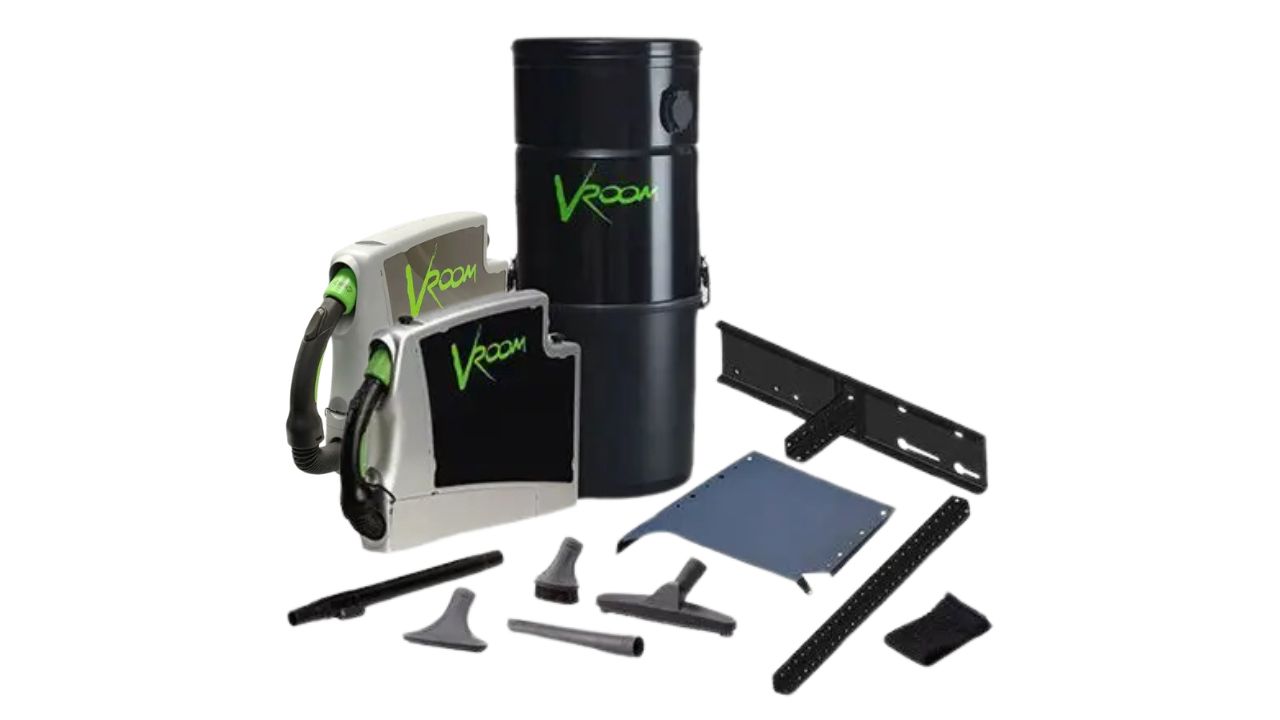
A Vroom is a retractable hose accessory that borrows suction from a central vacuum you already own. Pull, clean, let go, and the hose retracts itself. H-P Products, Inc. makes the full lineup, and one garage version includes its own small motor for homes without existing ductwork.Why Vroom Confuses Almost Every First Time Searcher
A used-car marketplace, a short manufacturer spec page, and a wall of thin retailer listings all fight for the same search term. None answer the real question.
Is a Vroom Vacuum a Real Standalone Vacuum?
No. The indoor Vroom is a hose retraction unit, not a vacuum. It connects to the central vacuum piped through your walls and borrows suction from your existing power unit. Pull the hose, clean the mess, release the handle, and an internal spring mechanism winds the hose back into the cabinet housing.
One exception: the Vroom Retract Vac all-in-one garage unit includes its own motor. That distinction changes every conversation about price and whether you can use one at all.
The Car Company Eating Your Search Results
Type “vroom” and Vroom.com, a used-car marketplace, floods the top results. You’re looking for the Vroom retractable hose system made by H-P Products, Inc. Search “Vroom retractable central vacuum hose” or go directly to VACUFLO’s official Vroom specifications. VACUFLO is H-P Products’ flagship central vacuum brand, and the Vroom product page lives there.
What You Pictured Versus What Actually Ships
You imagined a canister with a power cord. What ships is a hose reel roughly the size of a wine box that hides inside a standard kitchen cabinet. A small face plate sits on the cabinet wall. Pull the hose, clean the spill, release. The debris travels through your existing central vacuum tubing to a power unit you never see.
The Three Vroom Products People Mix Up
H-P Products builds three distinct units under the Vroom name. Miss the difference and you order something that won’t work in your space.
| Unit | Motor Included | Where It Installs | Primary Use |
|---|---|---|---|
| Vroom 18 / Vroom 24 (indoor) | No | Inside kitchen cabinet | Counter and floor spills |
| Vroom Retract Vac (garage, add-on) | No | Surface mount on garage wall | Cars, workbenches, garage floors |
| Vroom Retract Vac All-in-One | Yes | Surface mount, standalone | Garage use without existing central vac |
The Kitchen Cabinet Vroom for Fast Spills
The indoor units come in two sizes: Vroom 18 at 3 inches wide by 17.75 inches deep by 15.5 inches tall, and Vroom 24 at 3 inches wide by 21.75 inches deep by 15.5 inches tall. The Vroom 24 delivers up to 24 feet of hose — enough to cover a kitchen and adjacent dining area from one fixed point. Friction-fit attachments snap onto the hose end with no wand adapter, and the automatic on/off trips the power unit the moment you pull and cuts it when you release.
The Garage Retract Vac With Longer Reach
The garage version surface-mounts to the wall on four screws with no drywall cutting required. Standard hose length is 30 feet, customizable to 50 feet for larger bays. That reach covers a two-car garage floor, a vehicle interior, and a workbench on the opposite wall from one fixed mount. See an independent hands-on look at the Vroom Retract Vac for a field assessment of the retraction mechanism in a working shop environment.
The All-in-One With Its Own Motor
| Feature | Add-On Vroom | All-in-One Retract Vac |
|---|---|---|
| Motor | None — uses your central vac | Built-in Ametek/Lamb-sourced unit |
| Central vacuum required | Yes | No |
| Install type | Pipe tie-in by a technician | Surface mount plus outlet |
| Filtration | Your main unit’s system | 1-gallon dry bag, dry only |
This is the only Vroom that runs without existing ductwork. Buy it when your garage is isolated from the home’s pipe network. The add-on is useless without a nearby pipe connection point — a fact no product listing volunteers.
Who Really Builds Your Vroom Vacuum
H-P Products, Inc., based in Canton and Louisville, Ohio, manufactures every unit that ships under the Vroom name and has been building central vacuum equipment since 1945.
H-P Products and the Vacuflo Family Tree
The H-P Products portfolio includes VACUFLO for mid-range and commercial power units, Element for value-tier whole-home systems, Chameleon for color-customizable decorative inlets, Spot for compact wall-mount quick-clean fixtures, and Dirt Devil central vacuum products under license. Vroom is one quick-clean accessory line inside that catalog — backed by a manufacturer that supplies the North American dealer network, not just a product page.
Why the Maker Matters for Parts Later
The 3-year warranty runs through H-P Products’ authorized dealer network, not big-box retail or online marketplaces. Buy from an unauthorized listing and a warranty claim may require shipping the housing to Ohio — expensive for a unit tied into your wall piping. Authorized dealers handle the claim locally.
The Specs Dealers Skip On Vroom
Most Vroom listings publish the model name and hose reach and stop there. These three specs determine whether the unit actually fits your situation.
Where Does the Dirt Actually End Up?
The add-on Vroom sends debris through your existing central vacuum tubing to whatever canister or bag your power unit uses. Vroom has no filter of its own: a HEPA-filtered main unit gives you HEPA capture; a basic bag unit gives you basic filtration. Pet owners and allergy households need to evaluate the main unit’s exhaust path before the Vroom enters the conversation — the accessory inherits all of it. The all-in-one uses a 1-gallon dry bag only.
The 400 Air Watt Number on Garage Units
The all-in-one Retract Vac lists 400 air watts. Air watts measure actual suction at the cleaning head, calculated as CFM multiplied by water lift divided by 8.5 under ASTM F558. That is enough for car interiors, bare garage floors, and workbench debris. A whole-home central vacuum sized for 3,000 square feet delivers 600 to 700 air watts. The garage all-in-one is a targeted tool, not a whole-home replacement.
The Water Lift Figure Two Retailers Disagree On
H-P Products’ official specification lists 100 inches of water lift for the all-in-one unit. Water lift measures the sealed suction force a motor generates under ASTM F2609 conditions — how hard the unit pulls against a clog. One dealer page quotes 110 inches instead. Confirm it from VACUFLO’s official Vroom specifications before any comparison.
Add On Or All In One, Which Fits
| Factor | Add-On Indoor Vroom | All-in-One Garage Unit |
|---|---|---|
| Requires existing central vac | Yes | No |
| Approximate unit price | ~$249 (dated anchor) | ~$349 (dated anchor) |
| Install type | Cabinet cut-in and pipe tie-in | Four-screw wall mount plus outlet |
| Filtration path | Your main unit’s system | 1-gallon dry bag |
| Best for | Active central vac owners | Standalone garage coverage |
When the Cheaper Add-On Makes Sense
You own a working central vacuum with airflow to spare. The add-on borrows that suction, adds a cabinet access point, and removes the daily friction of pulling a 30-foot hose from a closet every time the dog knocks something over. Roughly $249 plus installation labor is a reasonable exchange for a high-traffic kitchen.
When You Need the All-in-One Motor
No central vacuum means the add-on is useless. The all-in-one stands alone and covers jobs the indoor system won’t reach: car interiors, workshop sawdust, the driveway edge. Compare Dirt Devil’s RV-ready CV950 unit if you’re weighing a compact self-contained central vacuum against the Vroom all-in-one on reach and price.
The Price Gap Nobody Quotes Upfront
Older dealer pricing placed the indoor add-on near $249 and the all-in-one near $349 — get a live quote from an authorized dealer. Professional labor for the pipe tie-in adds $100 to $200 per point, and a three-location setup can push past $1,100 before parts. That math is absent from every product listing in the current Top 10.
Installation Truths Before You Cut Drywall
Professional installation is worth the cost — not because the install is complex, but because a bad seal bleeds suction from every inlet on the branch.
The 35 Foot Rule That Quietly Kills Suction
Suction drops with every foot of pipe between the Vroom inlet and your power unit, and drops further with every 90-degree elbow added beyond the manufacturer’s specified maximum run. A Vroom 24 at 60 feet with three elbows in the line delivers noticeably weaker airflow than the same unit at 25 feet on a straight run. Plan the cabinet location around your existing pipe network, not around where the counter looks tidy.
Surface Mount Garage Units Skip the Wall Cutting
The Retract Vac bolts to the wall in under an hour: four screws, an outlet for the all-in-one version, an optional pipe tie-in for the add-on. No drywall opening, no patching. That’s why it shows up in retrofit jobs years after the original build.
Why a Pro Should Tie Into Your Pipes
The indoor add-on requires a clean cut into your central vacuum’s 2-inch PVC tubing and a sealed glue fitting at the junction. A bad seal bleeds suction from every inlet on that branch, and a miscut inside a wall cavity means opening drywall to fix it.
Standard 2-inch fittings are compatible with most North American systems — Beam, owned by Electrolux Group; Drainvac; CycloVac; OVO; and VACUFLO. Exceptions: older Sears/Kenmore installations used a non-standard bore needing a conversion adapter, and select older VACUFLO models with proprietary low-voltage wiring need an adapter before a Vroom fitting seats. A CVAC-certified technician on install day is cheaper than the repair bill.
Methodology: This guide draws on H-P Products and VACUFLO manufacturer documentation, an independent assessment from Pro Tool Reviews, and verified purchaser feedback from central vacuum enthusiast forums including VacuumLand.
What Real Owners Say About Vroom
Owner feedback divides into two clear camps.
The Kitchen Quick Clean Fans on VacuumLand
Central vacuum owners on VacuumLand consistently describe the kitchen Vroom as the most-used fixture in the house. Counter crumbs and floor debris during cooking are the dominant use case. Many pair it with a Spot wall-mount for the laundry room and a VacPan baseboard inlet at the toe kick — a full main-floor quick-clean network, no standard hose required.
The Retractable Hose Skeptics and Their Reasons
Some experienced central vac owners argue a lightweight modern hose in an organized closet offers comparable convenience for a fraction of the cost. Their second concern: verified purchasers on eBay model 9220 listings report the stretch hose requires real effort to pull to full reach and sometimes won’t fully retract without a manual push — the exact friction the Vroom promises to eliminate. No dealer page in the Top 10 discloses this before you buy.
The Convenience Setup Owners Swear By
Cereal hits the floor. The handle is under the cabinet. Two seconds and the hose is back inside its housing.
That three-second reset is what the price buys. Repeat Vroom buyers are the ones who clean that way every day.
Is The Vroom Vacuum Worth Your Money
Yes for one buyer. No for two others.
The Honest Case for Adding One
The add-on Vroom is a yes for a current central vacuum owner with daily kitchen traffic and cabinet space for the Vroom 24. Roughly $249 plus installation is a meaningful upgrade. H-P Products has built these systems since 1945, the parts pipeline is domestic, and the 3-year warranty runs through authorized dealers. The mechanism is a spring-loaded reel — there’s not much to go wrong.
The Honest Case Against Bothering
No central vacuum means the all-in-one is your only path, and at roughly $349 before installation it competes against shop vacs at $80 and lightweight canisters at $150 to $300. The Vroom’s advantage is convenience, not suction or price.
Buyers without wall piping who are comparing how an in-the-wall retractable hose system differs should know that Hide-A-Hose requires central vacuum piping already in the walls from the start. The Vroom’s cabinet-mount design sidesteps that for the standalone garage version, but 400 air watts and a 1-gallon bag make it a targeted tool, not a whole-home answer.
Rarely vacuum spots on the fly? You won’t miss a Vroom.
Conclusion
You arrived expecting a plug-in vacuum. You’re leaving knowing a Vroom works only as well as the system behind it. Pull the model number off your central vacuum power unit tonight and measure the pipe run to the cabinet you’re considering. That measurement tells you whether the add-on Vroom delivers or disappoints. Check the Central Vacuum Lab CV1500 review if you’re also comparing Dirt Devil power units. Unlike any portable, a working Vroom turns cleanup into something you reach for the way you’d reach for a faucet.
Frequently Asked Questions
What is a Vroom retractable hose and how does it work?
A Vroom is a spring-loaded hose reel that hides inside a kitchen cabinet or surface-mounts in a garage. Pull the hose, vacuum the mess, release, and an internal mechanism retracts it. The indoor add-on draws suction from your existing central vacuum; the all-in-one garage version runs its own motor.
Does the Vroom work with any central vacuum system?
Yes. H-P Products states the Vroom connects to any central vacuum using a standard 2-inch inlet fitting. Exceptions: older Sears/Kenmore installations with a non-standard bore need a conversion adapter, and select older VACUFLO models with proprietary low-voltage wiring require an adapter before a Vroom fitting seats correctly.
What is the difference between the Vroom and Hide-A-Hose?
The Vroom stores its hose in a cabinet housing beside an inlet. Hide-A-Hose retracts the hose directly into the central vacuum wall piping, so the hose lives inside the pipe between uses. The Vroom works with any existing central vacuum; Hide-A-Hose requires the pipe layout to be engineered for in-pipe retraction from the original install.
How much does a Vroom retractable hose cost to buy and install?
Older dealer pricing placed the indoor add-on near $249 and the all-in-one near $349 — request a current quote from an authorized dealer. Installation labor for the pipe tie-in adds $100 to $200 per location, and a multi-room setup can exceed $1,100 before parts.
Do you need professional installation and electrical wiring for a Vroom?
The garage all-in-one needs only a standard wall outlet. The indoor add-on requires cutting into existing central vacuum PVC tubing and gluing a sealed fitting — work a CVAC-certified technician handles correctly. A bad seal bleeds suction from every inlet on the branch and voids the 3-year warranty.
What is the difference between the Vroom 18, Vroom 24, Spot, and Vroom Retract Vac?
Vroom 18 fits a cabinet 17.75 inches deep; Vroom 24 fits a deeper 21.75-inch cabinet and delivers up to 24 feet of reach. Spot is a compact wall-mount quick-clean for secondary rooms. The Retract Vac is the garage version, available as an add-on requiring existing central vac piping or as an all-in-one with its own motor.
Is the Vroom worth it, and when is a standard hose the better choice?
The Vroom is worth it for a current central vacuum owner with a high-traffic kitchen and the right cabinet space. Choose a standard hose when you don’t own a central vacuum and are comparing the all-in-one against a shop vac on price, or when spot-cleaning is infrequent enough that a closet hose already meets your needs.