You push the hose into the nutone central vacuum wall outlet and wait for the familiar pull of suction. Nothing happens. NuTone stopped building central vacuum systems on August 31, 2023, when Broan-NuTone LLC exited the category and DrainVac International took over the product line, so it’s easy to assume every spare part vanished with the announcement. It didn’t.
This guide covers the full central vacuum outlet breakdown as it applies to NuTone systems specifically: how to identify your outlet, confirm the fit before you buy, and choose between a five-minute swap and a job that needs an electrician.
NuTone Central Vacuum Wall Outlet
A NuTone central vacuum wall outlet, called an inlet valve in the industry, is the wall port where a hose plugs in to start suction. Most use a universal 1.5-inch opening. Electrified versions add a 120-volt circuit for power brushes.Your Wall Outlet Died, Not Your Whole System
One dead outlet almost never means a failing power unit. It means one worn part behind a small plastic door, and that part costs less than a takeout dinner.
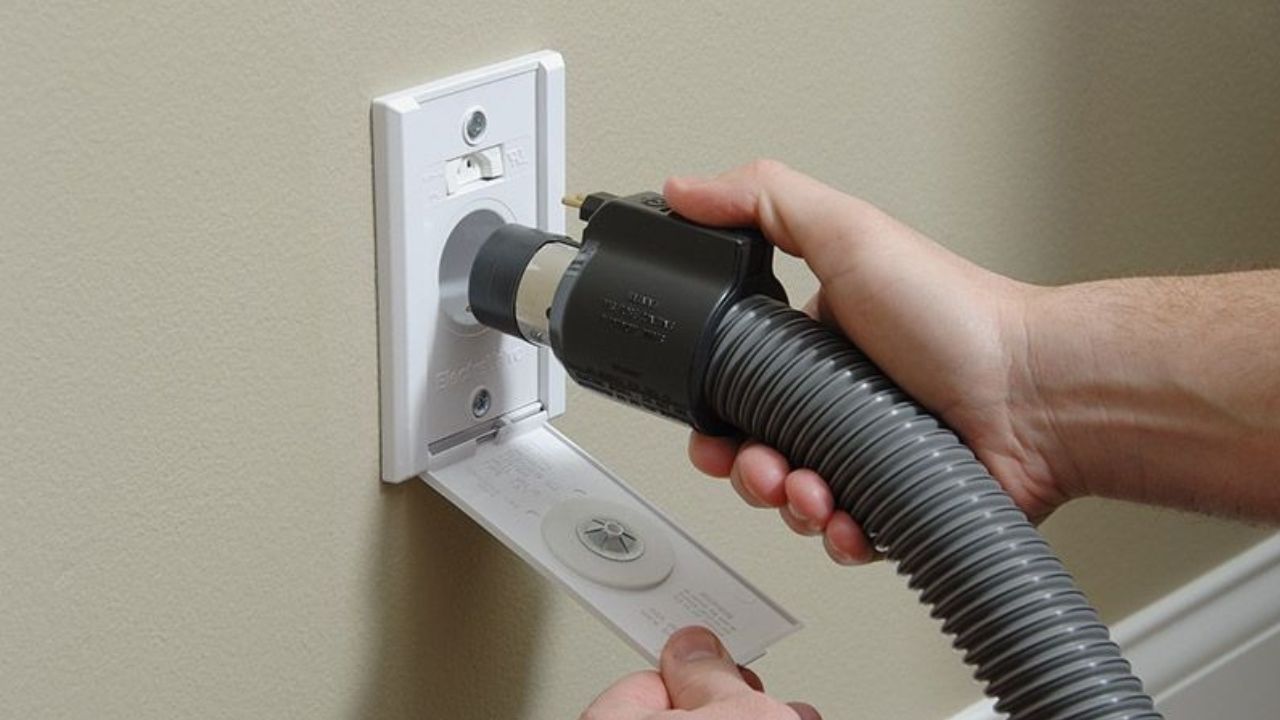
Why one dead outlet rarely means an expensive repair
A dead inlet points to a fifteen-dollar part, not a system failure. NuTone wires its outlets in parallel along the low-voltage signal line, so one bad contact leaves every other outlet in the house working normally. A VacuumLand forum member traced a dead hallway outlet to a corroded contact, swapped the valve for about fifteen dollars, and had suction back in ten minutes.
The spoon test that tells you everything in five seconds
Touch the back of a metal spoon across both contacts inside the outlet hole to isolate the fault in seconds. Suction kicks on: the outlet itself works fine and your hose end or its contact band is the problem. Nothing happens: the outlet, its wiring, or the low-voltage transformer is the suspect. MD Manufacturing’s troubleshooting guidance uses this exact test before recommending any part purchase.
What actually wears out inside these little doors
Spring-loaded contacts oxidize, door gaskets flatten, and return springs go missing after years of hose insertions. NuTone never sold these internals separately. The whole valve gets replaced as one sealed unit, and that’s actually good news for your wallet.
Worn parts inside a dead outlet, in order of likelihood:
- Oxidized or bent low-voltage contacts that no longer complete the circuit
- A flattened door gasket that lets suction leak instead of seal
- A broken or missing door spring that stops the flap from closing fully
What Is a NuTone Central Vacuum Wall Outlet?
A NuTone central vacuum wall outlet is the fixed wall port, formally called an inlet valve, where a vacuum hose connects to trigger suction from a remote power unit. It combines a low-voltage switch and an airtight door in one housing mounted flush to the wall.
Which NuTone central vacuum wall outlet fits your hose?
Match the outlet model to the hose type before you order anything, because a low-voltage hose won’t power an electric brush through a low-voltage-only inlet. The 330 series is the basic manual inlet. The 360 series is the standard automatic inlet and pairs with CH515 or CH230L hoses through a CF361 or CF361F bracket, detailed on NuTone’s 360W standard wall inlet specifications page. The CI358 SuperValve and CI390/CI399 Electra-Valve are electrified inlets built for direct-connect power hoses.
| Model | Type | Compatible Hose | Powers a Brush Directly |
|---|---|---|---|
| 330 series | Basic manual | CH515, CH230L | No |
| 360 series | Standard automatic | CH515, CH230L | No |
| CI358 SuperValve | Electrified | CH615, CH620 | Yes |
| CI390 / CI399 Electra-Valve | Electrified | CH615, CH620 | Yes |
Outlet, inlet, valve, port: four names, one part
Buyers search for “wall outlet.” The industry calls the same part an inlet valve. Think of it as a doorbell wired to open a highway: pressing the button (inserting the hose) doesn’t move any air itself, it just closes a low-voltage circuit that tells the power unit to start pulling. The metal contact band near the hose end is what actually completes that circuit.
The 24 volt handshake hiding behind the faceplate
A 24-volt low-voltage circuit, not house current, is what wakes up the power unit when you insert the hose. Two contacts sit inside the opening, wired in a daisy chain back to a central transformer. Insert the hose, the contact band shorts the two contacts, the transformer signals a relay, and the motor starts. Pull the hose out and the spring-loaded door reseals the pipe, so the rest of the system stays under vacuum.
Still not sure why one room feels weaker than the rest? The next section covers the one measurement that solves most of it.
The Universal Secret Dealers Never Lead With
Nearly every NuTone inlet from the last three decades shares one physical footprint, and that single fact saves most owners from paying brand-name prices for a generic part.
One footprint replaces almost every outlet on your wall
A 1.5-inch opening with mounting screws spaced 4 inches apart fits into a 1-5/8-inch hole in the bracket, and that combination covers the vast majority of NuTone-era inlets. MD Manufacturing, a parts supplier that documents this standard and is not affiliated with NuTone Vacuum, a trademark held by Nortek, states that rectangle valves built to this spec replace close to 99 percent of older inlets. You are not locked into a NuTone-branded part sold at a NuTone-branded price.
The exceptions that will waste your money
Some older and proprietary inlets break the universal rule completely, and buying the wrong replacement wastes both money and a return shipment. Skip a universal valve for any of these:
- Button-activated or copper-strip inlets from early installations
- Inlets with a 1-1/4-inch opening instead of the standard 1-1/2-inch hole
- Vacuflo, Budd, or Sears/Kenmore inlets built on proprietary bracket designs
Full face, square door, round door: does style matter?
Door style changes appearance and durability, not electrical function. A full-face inlet covers old paint scuffs and stray screw holes left by a previous outlet, and it holds up better over years of hose insertions than the standard door. Mount the door hinge up or down; both orientations work the same electrically. Homeowners weighing a different mounting style entirely sometimes switch to low-profile baseboard inlets instead of a standard wall box.
Basic or Electrified? Get This Wrong and Nothing Works
Confirm whether your system is basic or electrified before ordering, because the two inlet families are not interchangeable at the wall. Basic inlets carry only a 24-volt signal. Electrified inlets carry both the signal and 120 volts of house current.
Two small holes above the port change everything
Two extra holes spaced 3/8 inch apart, sitting just above the hose port, mean the inlet is electrified and carries house current. Those holes feed 120 volts to a direct-connect power brush through the hose itself, eliminating the need for a separate extension cord across the floor. Never insert anything into those two holes. That circuit runs live household voltage, not the gentle 24-volt signal the rest of the outlet uses.
The SuperValve and Electra Valve, decoded without dealer fog
The CI358 SuperValve and the CI390/CI399 Electra-Valve both power a brush directly, but they differ in wiring requirements and installation complexity. The CI358, manufactured by Hayden/Canplas, the contract manufacturer behind the part, pairs with CH615 and CH620 direct-connect hoses, carries UL listing and CSA approval, and includes a reversible flange so it mounts on either side of a wall stud. The CI390/CI399 needs a CI395RK rough-in kit installed behind the wall before the inlet itself goes in.
| Feature | CI358 SuperValve | CI390 / CI399 Electra-Valve |
|---|---|---|
| Compatible hose | CH615, CH620 | CH615, CH620 |
| Rough-in kit required | No | Yes, CI395RK |
| Flange | Reversible | Fixed |
| Certification | UL listed, CSA approved | UL listed |
When you should actually call an electrician
A basic low-voltage inlet swap is a two-screw, two-wire job any homeowner can finish in minutes. Electrified inlets carry 120 volts of house wiring behind that faceplate, and retailers who sell these parts recommend electrician installation for exactly that reason. The hesitation here is reasonable. Respect the high-voltage side of an electrified outlet the same way you would any live circuit.
Downgrading to a low voltage hose as the smart escape
A low-voltage hose with a built-in handle switch works on every NuTone inlet, basic or electrified, and sidesteps the wiring question entirely. Skip the electrified complexity if your cleaning routine is mostly hard floors and light carpet. One hose upgrade removes the walk back to the wall to flip a switch, permanently.
NuTone Is Gone, So Where Do Parts Come From Now?
Parts did not disappear when NuTone exited the central vacuum business. DrainVac now owns the product line, still fills parts orders, and keeps the same inlet standard that made NuTone systems easy to service in the first place.
Broan NuTone exited central vacuums on August 31, 2023
Production of Broan-NuTone central vacuum systems and accessories ended on August 31, 2023, and DrainVac International, through its Metal MP Inc. facility in Quebec, took over the entire product line. Existing pipe networks and outlets did not become orphaned overnight. Broan-NuTone now refers all central vacuum parts and product questions directly to DrainVac’s official NuTone central vacuum product line, which still lists inlets, hoses, and power units under the NuTone name.
Because Broan and NuTone share the same parent company history, owners comparing options across the two brands check the Broan inlet counterparts before assuming a part is NuTone-exclusive.
Why VacuumLand owners are hoarding new old stock outlets
Some longtime enthusiasts on VacuumLand have started buying spare new-old-stock NuTone outlets, worried DrainVac won’t keep producing the traditional inlet styles indefinitely. That worry is mostly unnecessary. The universal footprint shared across NuTone, MD Manufacturing, and other compatible brands means a generic replacement will fit the same bracket for decades after the last NuTone-branded box leaves a warehouse.
Three reliable sources for compatible outlets today
MD Manufacturing, ThinkVacuums, and Amazon all stock inlets built to the universal NuTone footprint right now. Third-party valves from Hayden and Canplas fit the same 4-inch screw spacing and 1-5/8-inch bracket hole as the original parts. Compatibility with your existing bracket matters more than brand loyalty to a company that no longer makes new systems.
Replace a Wall Outlet in Ten Minutes Flat
Swapping a low-voltage inlet takes about ten minutes, no electrician required for the basic outlet type.
Unplug the power unit first, every single time
Cut power at the power unit before touching any inlet wiring, no exceptions. The low-voltage side is gentle enough to touch safely, but MD Manufacturing’s installation guidance still calls for cutting power before any wiring work.
Two screws, two wires, one satisfying click
Correct outlet replacement, step by step:
- Remove the two mounting screws holding the old inlet to its bracket
- Pull the valve forward and disconnect the two low-voltage wires from its terminals
- Connect those same two wires to the new valve’s terminals
- Seat the new valve into the bracket and reinstall the two screws
- Restore power and test with a hose insertion
Expect the hose to fit a little stiff on the first few uses. It loosens as the door mechanism breaks in.
The trim plate trick for ugly wall scars
An old inlet leaves paint ghosting and stray screw holes when it comes off. A trim plate covers the damage without a repaint, and full-face replacement doors hide most of it on their own.
Hidden Outlet Problems That Steal Your Suction
A single cracked or open outlet anywhere in the house drains suction from every other inlet on the line, even ones nowhere near the leak.
The broken door in the guest room you forgot exists
Walk the house with the power unit running and listen for a hiss at every outlet, including ones behind furniture or inside closets you rarely open. A cracked door or missing gasket at even one unused inlet leaks air continuously and weakens performance system-wide. Guest rooms, storage closets, and inlets behind large furniture are the usual culprits nobody checks.
Why the farthest outlets fail first on old wiring
A RedFlagDeals forum owner found the outlets closest to the power unit still worked fine while the two farthest inlets in the house went completely dead. Corroded splices in the daisy-chained low-voltage wiring cut the signal before it reaches the far end of the run. A voltmeter reading across the contacts at each outlet settles the question faster than swapping parts blind.
Worn contacts versus a dead transformer: sorting the blame
Run the spoon test at every outlet before replacing anything, since the pattern of failures tells you what actually broke. One dead outlet among several working ones points to a bad valve. Every outlet dead at once points to the transformer or circuit board instead. Replace inlet valves before the board, since the cheaper part fails far more often than the electronics.
Should You Upgrade Outlets or Replace the Whole System?
Fresh outlets, a new hose, and new bags restore most of a NuTone system’s original performance for well under a hundred dollars, and that’s the right first move before considering a full replacement.
When fresh outlets buy your NuTone another decade
The pipe network buried in your walls outlasts every power unit and every inlet valve installed on it. A VacuumLand member still runs a sixteen-year-old NuTone power unit without issue on its original 1990s-era pipe infrastructure. New valves, a new hose, and fresh bags bring weak suction back to near-original levels for less than a hundred dollars in parts.
When the outlet is a symptom, not the disease
Weak suction at every single outlet, not just one, points past the inlet valves entirely and toward the power unit itself. NuTone’s older VX-series power units no longer have every internal part manufactured, since production ended in 2023. Weigh the cost of a full power unit swap against keeping the existing pipe network and adding a new unit built to fit it, rather than replacing outlets that were never actually the problem.
Conclusion
You arrived worried that a discontinued brand meant an orphaned system. It doesn’t. One universal footprint, a 1.5-inch opening with screws 4 inches apart, fits nearly every outlet NuTone ever installed, and DrainVac still supplies the parts that don’t. Tonight, open your outlet door, note whether it’s basic or electrified, measure the screw spacing, and order the match. No portable vacuum you’ve ever owned restores whole-home cleaning power for the price of one fifteen-dollar part.
Frequently Asked Questions
What is the wall outlet on a NuTone central vacuum actually called?
It’s called an inlet valve in the industry, even though most homeowners search for “wall outlet.” Both terms describe the same wall-mounted port where the hose plugs in to trigger suction.
Are central vacuum wall inlets universal, and will a generic inlet fit my NuTone system?
Yes, for the vast majority of NuTone installations. A 1.5-inch opening with mounting screws 4 inches apart covers roughly 99 percent of NuTone-era inlets, though button-activated, copper-contact, and 1-1/4-inch legacy inlets are exceptions that need a different part.
What is the difference between a low-voltage inlet and an electrified inlet?
A low-voltage inlet only carries the 24-volt signal that starts the motor, while an electrified inlet like the CI358 SuperValve also carries 120 volts to power an electric brush through the hose. Check for two extra holes near the port; their presence means the inlet is electrified.
Can I replace a NuTone wall inlet valve myself, or do I need an electrician?
Handle it yourself if the inlet is a basic low-voltage type, since it’s a two-screw, two-wire swap. Call an electrician for electrified inlets like the SuperValve or Electra-Valve, since those carry live 120-volt house wiring behind the faceplate.
Where do I buy NuTone inlet parts now that Broan-NuTone no longer makes central vacuums?
Order directly through DrainVac, which now owns the NuTone central vacuum line, or through MD Manufacturing, ThinkVacuums, and Amazon for universal-fit compatible valves. Broan-NuTone refers all parts inquiries to DrainVac since exiting the category in 2023.