You own a whole home vacuum, yet you still bend over a dustpan every night, chasing the dirt line across the kitchen tile. A central vac baseboard inlet fixes that, but the myth keeping buyers stuck is that any toe kick inlet works anywhere; placement and cabinet clearance decide whether you use it or ignore it.
By the end, you’ll know which of the three surviving inlet designs fits your kick space and which specs matter more than the brand. For inlets that handle your hose instead, our complete central vacuum outlet guide covers those separately.
Central Vac Baseboard Inlet
A central vac baseboard inlet is an automatic dustpan port tied into your existing 2 inch vacuum pipe, so you sweep debris into a toe kick instead of dragging a hose. It suits kitchens, mudrooms, and any daily-dirt spot. Clearance and placement decide whether it earns its keep, not the brand.Why You Still Sweep With a Whole Home Vacuum
You still reach for a broom because sweeping beats hauling a 30 foot hose for a spoonful of crumbs. A central vac baseboard inlet closes the gap between whole-home suction and the daily mess that never justifies the hose.
The nightly kitchen ritual a hose inlet never fixed
Coffee grounds by the counter. Cereal crumbs under the table. A third dustpan pass because the first two missed the line where tile meets cabinet toe kick.
That’s the routine a wall inlet alone never solves. Owners on Houzz admit they skip the hose entirely for daily kitchen dirt and grab a broom instead, since unclipping a hose for thirty seconds of sweeping feels like overkill. The dirt line along the baseboard is the friction point a sweep inlet erases: you sweep toward the kick plate instead of a dustpan you bend for, empty, and rinse.
What a flick of your toe actually replaces
Kick the lever, sweep the pile toward the opening, and suction pulls it away in one motion. No bending, no dustpan, no carrying dirt across the room to the trash can.
A household with two dogs shedding across a tile kitchen floor used to sweep fur into a dustpan and walk it to the garbage can daily. After a toe-kick inlet went into the cabinet under the sink, the fur pile disappears into the pipe network in one pass, and the vacuum unit doing the work sits in the garage, out of sight and mind.
What Sits Behind That Little Door in Your Kick Plate
That little door hides a flush mounted port wired into your home’s existing 2 inch central vacuum pipe, not a robot or a separate motor. Most buyers picture something self-contained; it’s actually a passive valve borrowing suction from the power unit installed elsewhere in the house.
What does a central vac baseboard inlet actually do?
It’s a flush-mounted port that connects to your existing 2 inch vacuum pipe and starts the power unit through a low voltage signal when you open the door. Opening it completes a 24 volt circuit, the power unit fires remotely, and suction pulls debris through the flex connection into the trunk line. Closing the door breaks the circuit and reseals the pipe.
Left closed, a baseboard inlet has zero effect on suction at any other inlet. A leaking or poorly seated door does the opposite, a failure mode covered later.
Toe kick, wall, or under the stairs: three homes for one device
A cabinet toe kick is the standard mounting spot, but a wall stud bay works just as well when there’s no cabinetry nearby. Wall installs require cutting the bottom 2×4 plate between two studs, more invasive than a toe kick retrofit but useful for rooms without base cabinets, like a mudroom bench or a closet under the stairs.
A mudroom bench install can outperform a kitchen island placement, because boot grit and dropped leaves pile up at the bench daily, while an island inlet only earns its keep if the family sweeps at that exact spot. Weighing a baseboard sweep port against a traditional central vacuum floor inlet for a mudroom, the baseboard version wins on daily-use convenience since there’s no lid to step on or hose to uncoil.
The flex pipe detail installers use and DIYers skip
Professional installers leave the elbow connection to the inlet unglued, and DIYers who glue it solid regret it the first time the unit needs service. Manufacturer instructions call for a short section of unglued flex pipe with roughly half an inch of vertical play built in.
That half inch lets you pull the inlet straight out of the wall or toe kick for a lever, gasket, or switch repair without cutting into finished cabinetry. Glue that elbow solid, and your next repair means opening drywall instead of sliding a replacement unit into place.
VacPan vs CanSweep vs VacPort: An Honest Scorecard
Three sweep inlet designs have survived in the market, and none is best for every home. VacPan wins on simplicity and in-wall ease, CanSweep wins on intake size, and VacPort wins on cabinet-hookup simplicity and visibility.
VacPan, the original that refuses to die
VacPan is manufactured by Plastiflex, and its toggle-switch design has stayed basically unchanged for decades because the mechanism rarely needs reinventing. The cutout is exact: a 6-3/4 inch long by 1-3/4 inch high slot in the wall or cabinet toe kick, with the pipe exiting upward from the rear.
That rear-upward exit makes VacPan noticeably easier to retrofit into an existing wall than a straight-back design, since the pipe can rise into the stud bay without extra elbows. Its known weak point is the plastic lever arm; it cracks after years of daily kicks, but a low-cost repair kit replaces the lever and gasket together in one visit.
CanSweep’s bigger mouth and the suction claim to question
CanSweep, manufactured in Canada by Canplas/Vaculine, uses a pivoting front lid instead of a toggle, so the whole face swings open when your toe finds it. The larger opening swallows bigger debris piles per pass than VacPan’s narrower toggle slot.
Some CanSweep listings claim “zero suction loss” compared to a standard inlet. That’s a manufacturer claim, not independently tested lab data, so treat it as marketing language until an installer confirms it for your specific pipe run.
| Feature | VacPan | CanSweep | VacPort |
|---|---|---|---|
| Intake style | Toggle switch, narrow slot | Full pivoting lid, wide mouth | Toggle switch with LED trim |
| Exit direction | Rear, upward | Rear, horizontal | Straight back, no elbow |
| Activation | Toe kick lever | Toe kick lid press | Toe kick lever |
| Repairability | Low-cost lever and gasket kit | Manufacturer replacement parts | Newer polycarbonate housing, fewer reported cracks |
VacPort adds LED lights, but do you need them?
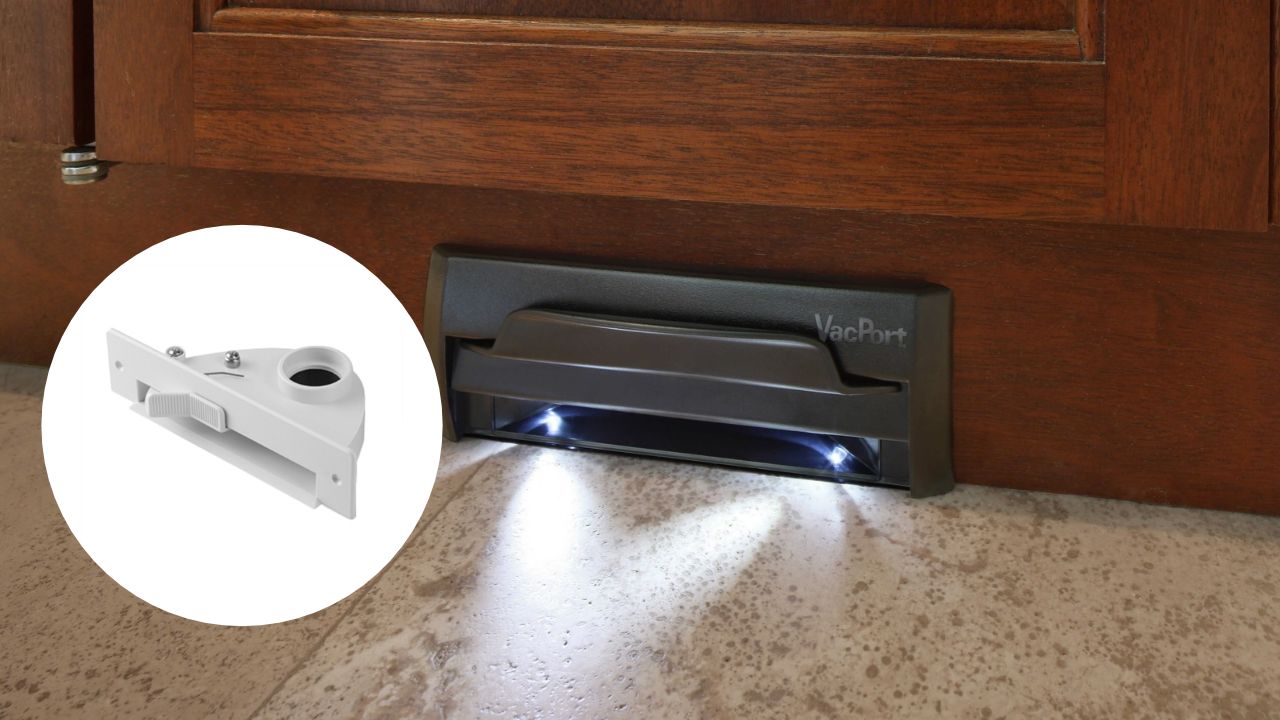
VacPort, sold by MD Manufacturing, runs LED lighting off the same low voltage wire that powers the switch, needing no separate circuit or transformer. Think of it as a porch light for your dirt pile: it makes the opening easier to see at night, nothing more.
Its polycarbonate housing targets the cracked-lever complaints that dog older toggle designs. The bigger practical win is the straight-back pipe connection, which skips the elbow VacPan and CanSweep both need and simplifies the hookup in shallow toe kicks where every inch of depth counts.
The discontinued VacuSweep and what replaces it now
VacuSweep is discontinued, and retailers now point buyers toward CanSweep as the direct swap since both come from Canplas/Vaculine. Old VacuSweep stock still turns up in marketplace listings with no repair-kit support, so buying one today means you’re on your own if the lever or gasket fails.
Before assuming any replacement fits your existing pipe run, check the exit direction against the old unit. A rear-horizontal VacuSweep swapped for a rear-upward VacPan can force a reroute of the flex connection inside a cabinet floor that wasn’t designed for it.
Placement Mistakes That Turn Inlets Into Wall Decorations
A poorly placed inlet becomes wall decoration fast, and the top complaint from owners is a spot that never matches where dirt actually collects. One Houzz owner described their island toe kick inlet as one they “hardly ever” use, because the location looked balanced on a floor plan but never matched real foot traffic.
Why island toe kicks frustrate real owners
A recessed island toe kick often forces you to sweep uphill under an overhang instead of straight into the opening. That same owner’s complaint centered on dirt trapped under the cabinet lip instead of sliding cleanly into the pan.
A flush wall mount gives the broom a straight, clean runway with no overhang to fight. Owner sentiment consistently favors inlets placed where dirt naturally collects, not wherever looks symmetrical on the kitchen elevation drawing.
The traffic map test before you cut anything
Watch where dirt actually piles up for a week before you cut a single slot. Doorways, the pantry edge, and the run in front of the sink beat a “centered” island spot almost every time, because that’s where shoes, spills, and crumbs really land.
Reset question: if you tracked your own sweeping for a week, would the pile end up near where the showroom diagram put the inlet?
One well placed inlet in a genuine traffic path outworks three scattered at convenient-looking spots. This is where vacuum-ready kitchen layouts planned during a remodel beat an afterthought retrofit, since the designer puts the inlet where the workflow already sends dirt.
How many sweep inlets does one house need?
Most homes land at one to three sweep inlets, with the kitchen claiming the first nearly every time. Each inlet needs its own tie into the nearest branch line rather than a shared run, which protects airflow at every other inlet in the house.
Pet households earn a second inlet at the mudroom or laundry door, the second-highest concentration of daily debris behind the kitchen. A third rarely pencils out unless the home has a genuinely high-traffic zone, like a workshop or finished basement entry.
The Install: Clearances, Cuts, and Retrofit Truth
Clearance numbers are where installs go wrong before the first cut is made. Manufacturer instructions and retailer guides disagree on the minimum toe kick height for a VacPan, and that gap trips up more DIY installs than any wiring question.
The toe kick height number retailers can’t agree on
Plastiflex’s own instructions list a 3-1/2 inch minimum toe kick height for VacPan, while some retailer guides publish figures as low as 2-1/4 inches for the same unit. The gap comes down to elbow clearance below the cabinet floor: the manufacturer number accounts for the pipe fitting, while shorter figures sometimes describe bare slot height only.
Measure your actual kick height and subfloor depth before trusting either number blind. Full details, including VacPan cutout dimensions and rough-in procedure, are worth reading before you pick up a saw.
Cutting the slot without wrecking your cabinets
The standard opening for VacPan and CanSweep is 6-3/4 inches long by 1-3/4 inches high, cut into the toe kick panel or baseboard. A trim plate forgives a rough or oversized cut and hides retrofit scars where the saw wandered.
For the access hole through the cabinet floor above the slot, a snap-on cover closes the gap once flex pipe is threaded through. A forgiving trim plate up front and a snap cover underneath is what separates a clean retrofit from one that shows every mistake.
Retrofitting from a basement or crawl space
Drill a small reference hole through the cabinet floor first, then locate it from below before committing to the final cutout. That reference point shows exactly where the trunk line runs relative to the inlet, so the flex connection doesn’t end up fighting a joist.
Flex pipe bridges the last awkward feet between the inlet and the trunk line, which is what makes basement and crawl space retrofits realistic in homes built decades before central vac was standard. New construction skips this step: the slot gets blocked out and the pipe stubbed in before flooring goes down.
The two wires that make it all work
The inlet’s terminals only take low voltage signal wire, 18 or 20 gauge stranded, not household line voltage, so no electrician or permit is required in most jurisdictions. That resolves the fear a lot of homeowners have before they start: this is a low-voltage hookup, not an electrical project.
For the pipe and wiring basics behind any install, including how the low voltage circuit ties to the power unit relay, see this central vacuum pipe and low-voltage rough-in basics reference. When activation gets flaky months later, a loose terminal screw at the inlet or relay is the first thing to check.
What It Won’t Swallow and When It Clogs
A sweep inlet handles dry household debris and nothing else, and ignoring that rule is how a clog ends up sealed behind finished drywall. Dealers rarely mention this before the sale, since it’s a limitation, not a selling point.
Dry debris only, and that rule has teeth
Crumbs, dust, pet hair, and coffee grounds pass through the pipe network cleanly at normal suction. Liquids, screws, coins, and other hard objects jam at elbows, and a clog behind a wall costs far more in labor than the inlet cost to buy.
One owner learned this the hard way when a stray screw swept into a kitchen inlet lodged in a pipe elbow behind finished drywall, turning a five-minute sweep into a repair call. Corrected use looks like this:
- Sweep only dry debris toward the inlet: dust, crumbs, hair, dry dirt.
- Hand-pick hard objects like screws, coins, and toys before sweeping.
- Wipe up liquid spills separately; never sweep wet debris toward the inlet.
- If something hard goes in by accident, stop using that inlet and call a technician first.
The seal question owners ask after year one
A worn gasket on the inlet door leaks suction from every other inlet in the house, not just the one with the bad seal. One Amazon reviewer described a faint whistling airflow noise traced back to a door that wasn’t seated flush in its slot, a symptom of exactly this problem.
Sloppy mounting during install is often the root cause: a door resting on a slightly uneven trim plate edge never seals fully, even when the gasket is fine. The VacPan repair kit swaps the lever and gasket together in one repair, fixing both the mechanical wear and the seal issue in a single part.
Buying Smart in a Market Full of Ghost Brands
Brand names on baseboard inlet boxes don’t always mean what they used to, and buying on badge alone leads to confusion at checkout. NuTone’s exit from the central vacuum category is the clearest example on the market today.
Why NuTone branded VacPans still fill Amazon listings
NuTone stepped away from the central vacuum business, yet NuTone-branded automatic dustpan listings still circulate on Amazon years later. The underlying hardware in most listings is the same Plastiflex VacPan design sold under a different label, not a separate NuTone engineering effort.
Buy on the physical design and cutout dimensions, not the badge on the trim plate. A VacPan is a VacPan regardless of which now-inactive brand sits on the box, and repair kits are sized to the mechanism, not the label.
Universal fit claims and the brands they actually cover
These sweep inlets connect to standard 2 inch OD central vacuum pipe, which is what makes cross-brand compatibility possible. Retailers explicitly list compatibility with Beam, VacuFlo, NuTone, and SilentMaster systems, since all share that same pipe standard.
| Inlet Model | Compatible System Brands | Exit Connection Type |
|---|---|---|
| VacPan | Beam, VacuFlo, NuTone, SilentMaster, most 2 inch OD systems | Rear, upward elbow |
| CanSweep | Beam, VacuFlo, NuTone, SilentMaster, most 2 inch OD systems | Rear, horizontal elbow |
| VacPort | Beam, VacuFlo, NuTone, SilentMaster, most 2 inch OD systems | Straight back, no elbow |
For full VacPan compatibility notes and step-by-step mounting instructions across brands, see VacPan cross-brand compatibility and installation instructions. Homes running an odd or proprietary pipe system, rather than standard 2 inch OD, deserve a phone call to the manufacturer before checkout.
No central vac? The standalone toe kick option exists
Sweepovac-style units pack a small standalone motor directly into the cabinet, working without any central vacuum system. Think of it as a window air conditioner next to a whole-home HVAC system: it cools one room well, but isn’t built for the whole job.
These standalone units handle light crumb duty fine, but can’t match the suction or capacity of a unit tied into a whole-home pipe network. If central vacuum pipe already runs under your floor, tying a real sweep inlet into that network wins easily over a separate standalone motor.
Conclusion
You arrived thinking a baseboard inlet was either a gimmick or a mystery box behind the kick plate. You’re leaving knowing it’s a placement decision wrapped around a simple, proven part with a documented failure point and a cheap fix.
Tonight, grab a tape measure and check your toe kick height and cabinet floor depth where your swept piles already land, not where a diagram says they should. A portable vacuum retires in about seven years; a well placed sweep inlet rides your existing pipe network for decades and earns its keep every single day.
Frequently Asked Questions
What is a central vacuum baseboard inlet and how does it work?
It’s a flush-mounted, toe-kick-activated port wired into your existing central vacuum pipe. Opening the door completes a low voltage circuit, starts the power unit, and suction carries swept debris into the pipe network until you close it again.
What is the difference between a VacPan, CanSweep, and VacuSweep?
VacPan uses a toggle lever and exits upward from the rear, CanSweep uses a pivoting lid with a wider intake and exits horizontally, and VacuSweep is a discontinued unit that CanSweep now replaces. All three connect to standard 2 inch central vacuum pipe.
Can I add a baseboard sweep inlet to my existing central vacuum system?
Yes, as long as your system uses standard 2 inch OD pipe, which covers most Beam, VacuFlo, NuTone, and SilentMaster installations. The main constraints are toe kick clearance and access to the nearest branch line for the pipe tie-in.
What size hole do I need to cut for a VacPan or CanSweep?
Cut a 6-3/4 inch long by 1-3/4 inch high slot in the wall, baseboard, or cabinet toe kick. A trim plate covers a slightly rough cut, so precision matters less than getting the depth and clearance right.
Do baseboard inlets work with any central vacuum brand?
Mostly yes, since VacPan, CanSweep, and VacPort all connect to standard 2 inch OD pipe used across Beam, VacuFlo, NuTone, and SilentMaster systems. Confirm your pipe diameter before ordering if your system is older or unusually configured.
Why won’t my VacPan or sweep inlet turn off?
A stuck-on inlet is almost always a lever or switch that isn’t returning to its resting position, or a relay at the power unit holding the circuit closed. Check the lever mechanism and terminal wiring first before assuming the power unit itself has failed.
Is a baseboard inlet worth it, or should I just use the hose?
Worth it if dirt piles up daily at one specific spot, like a kitchen or mudroom entry, where hauling a hose feels like overkill for a quick sweep. Skip it if your home has no consistent daily-mess zone, since the installation cost only pays off with regular use.