Central vacuum hoses and attachments are the part of the system you touch every week, and the part most buyers research last. You spent thousands on the power unit and pipe network, then a flimsy hose became the whole daily experience.
Finish this guide knowing which of the three hose types fits your inlets, what diameter and length actually matter, and which attachments earn a spot in your closet. Brand loyalty barely matters once you understand the standard your walls were built around.
Central Vacuum Hoses and Attachments
Central vacuum hoses and attachments are the tools that plug into wall inlets and move air and dirt into the pipe network. What matters is hose type, wire connection, diameter, and tool fitting, not the brand on the handle. First-time buyers avoid a wrong order; older-system owners learn what’s safe to mix.Start With Hose Type Before Anything Else
Three hose types exist, and picking the right one comes before length, diameter, or tools: basic hoses run on suction alone, low voltage hoses add a remote switch, and electric hoses add a powered brush.
This evaluation draws on manufacturer documentation from Cen-Tec Systems, H-P Products, and MD Manufacturing, plus recurring owner and installer forum patterns, not one dealer’s stock sheet. A quick way to identify your existing central vacuum hose type is checking the cuff for a switch and a wire channel first.
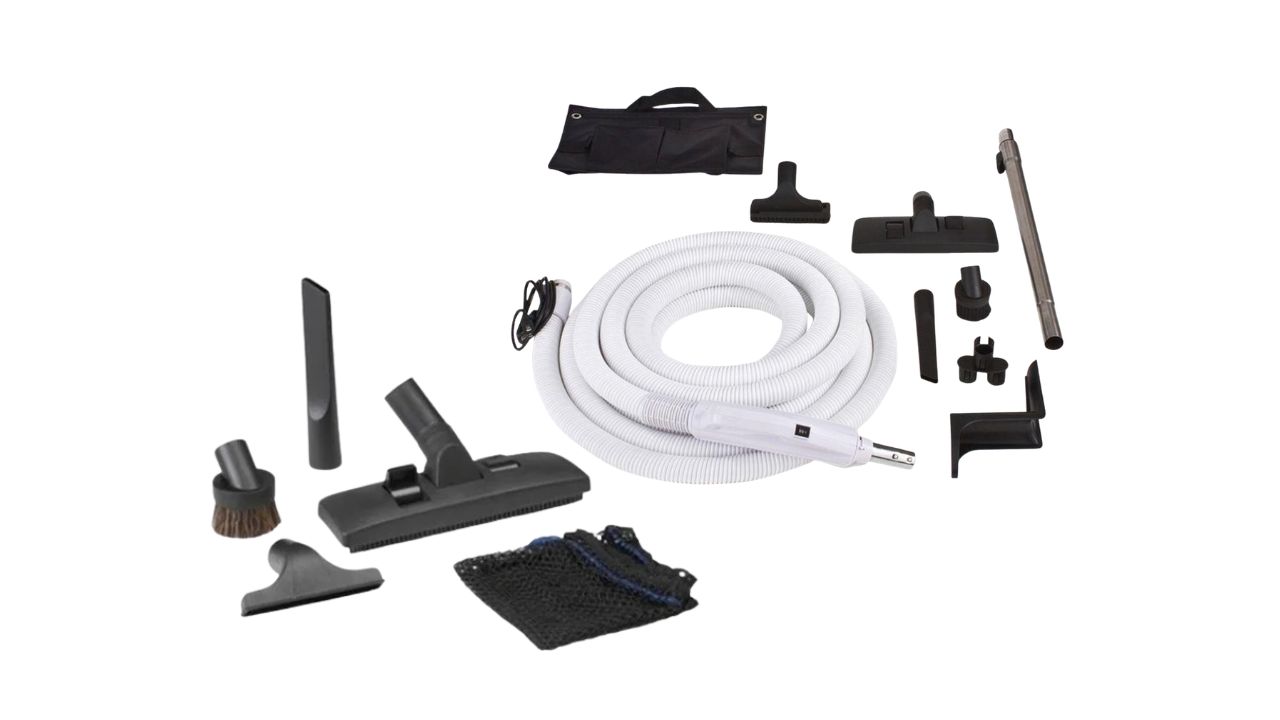
Basic Hoses Run the Moment You Plug In
A basic hose has no switch and no wiring. Suction starts the instant the cuff seats into the inlet valve, and stops the instant you pull it out.
That’s the entire mechanism, which also makes it the cheapest hose class and the least likely to develop an internal fault. A garage corner or workshop inlet used twice a month is the right home for one, though walking back to unplug it after every room wears thin fast as your only hose.
Low Voltage Hoses Put the Off Switch in Your Hand
A low voltage hose carries a thin signal wire under the jacket that completes a 24 volt circuit at the inlet, letting a rocker switch on the handle turn the power unit on and off remotely. Metal contact bands in the cuff close that loop against matching contacts in the inlet valve.
This is the most common hose sold for homes with mostly hard floors and area rugs. Cen-Tec Systems, the Bloomington, Illinois manufacturer of vacuum accessories, documents industry-standard pin-jack low-voltage hoses as compatible with Beam, Vacuflo, CycloVac, VacuMaid, and most standard North American inlets.
Not every switch survives a decade of daily seating, the one durability cost of adding electronics to a hose that would otherwise never fail.
Electric Hoses Exist for One Reason: Carpet
An electric hose adds full 120 volt wiring to run a motorized brush roll in a powerhead, since suction alone can’t dig embedded grit out of carpet pile. A three-way switch controls suction and brush motor separately.
Forum repair techs note that turbo brushes, which spin from suction alone, disappoint on anything thicker than low or medium pile because they lose spin speed exactly where you need it most. Electric hoses cost roughly double a low voltage hose, so buy one only for real carpet.
Which Hose Turns On by Itself and Why
A basic hose firing up the second it seats in the inlet is the design working correctly, not a defect. Buyers who inherit one from a previous owner often assume the power unit is broken.
Match the hose to your own patience, not to whatever a dealer had in stock. Does walking back to cut suction sound minor, or like a daily irritation?
Decide How Your Electric Hose Gets Its Power
Electric hoses draw their 120 volts one of two ways, and guessing wrong is the most common return reason in the category. Pigtail hoses borrow power from an outlet; direct connect hoses draw it through prongs in the inlet.
Pigtail Hoses Borrow Power From a Wall Outlet
A pigtail hose has a short external cord, usually six to eight feet, plugged into an ordinary outlet near the inlet, while the cuff seats into a standard low-voltage inlet valve for suction and switching. No electrician or rewired inlet required.
Installers increasingly steer first-time electric hose buyers toward pigtail models, since there’s no fragile inlet prong to snap during installation. A visible cord trailing to a receptacle is the one tradeoff.
Direct Connect Needs an Electrified Inlet Behind It
A direct connect hose draws its 120 volts through two prongs in the cuff that mate with an inlet valve already wired for it, so one motion plugs in both suction and power. That feels premium, right up until it meets an inlet never wired for direct current.
Forcing a direct connect cuff into a standard low-voltage inlet can snap the prongs, an expensive lesson learned after the damage is done. Photograph your inlet face first: an electrified inlet shows two metal prong sockets recessed into it, a standard inlet does not.
Can You Convert Between Pigtail and Direct Connect?
Yes, most electric hoses ship convertible between the two wall-end styles using an included adapter, a detail most listings bury below the fold. Confirm your inlet face first; the adapter is a convenience, not a guarantee every hose ships with one.
The Diameter Spec That Quietly Changes Everything
Interior hose diameter runs either 1.25 inch or 1.375 inch on most systems, and that quarter-inch difference changes measurable airflow at the tool end, the spec sellers most often leave off the page.
Why Enthusiasts Push the Wider 1.375 Inch Bore
A wider 1.375 inch smooth bore moves noticeably more air than the 1.25 inch legacy size, with one manufacturer’s own testing claiming up to 15 percent more airflow at a comparable pipe-run length. Owners running a Vacuflo Turbo Grip turbine powerhead report the brush roll spinning faster on the wider bore, since a turbine depends entirely on airflow volume to spin.
Interior diameter rarely appears in retail bullet points, so Beam vacuum hose sizing and fit documentation is worth checking before buying on length alone.
Crushproof Beat Wire Reinforced for a Reason
Modern crushproof hoses use a ribbed plastic construction that flexes and recovers after a chair leg or rolling suitcase crosses it. Older wire-reinforced hoses run heavier, and the internal coil roughens the interior enough to choke airflow over a long pipe run.
Think of a garden hose versus a corrugated dryer duct: one recovers its shape underfoot, the other holds the dent. A few collectors still defend wire-reinforced hoses for toughness; your airflow numbers disagree.
Get the Length Right or Regret Every Saturday
Standard hose lengths run 30 to 35 feet, with specialty hoses stretching to 50 feet. Length trades inlet swaps against drag weight, not bigger-is-better math.
The 30 Foot Sweet Spot and When to Break It
Thirty feet covers most single-story homes without forcing a walk to a second wall port mid-room. A two-story layout with widely spaced inlets is the case for stepping up to 35 or 40 feet, the way Vacuflo hose lengths and compatibility breaks out by floor plan size.
One two-story colonial owner found a 40-foot hose meant swapping inlets on roughly half as many rooms versus a 30-foot hose, though that saved time cost real coil weight on every stair carry.
Reddit and Forum Owners on Lugging the Long Hose
Hose-wrangling fatigue is the most repeated central vacuum complaint across owner forums, ahead of motor noise or filter changes. The coil snagging a chair leg mid-pull shows up in nearly every long-term ownership thread.
The fix isn’t always a longer hose. Shorter length paired with smarter inlet placement often beats one giant hose dragged room to room, which is why stretch and retractable systems exist.
Stretch and Extension Hoses Cover the Gaps
| Type | Reach | Best Job |
|---|---|---|
| Stretch hose | Roughly 7 to 24 feet | Quick spot cleanups near one inlet |
| Extension hose | Adds 3 to 15 feet | Stairs, high corners, one extra room |
| Full-length hose | Fixed 30 to 50 feet | Whole-room, primary cleaning |
Both sacrifice some airflow at full reach. Treat them as helpers, not a replacement for your primary hose.
Check Compatibility Before You Fall for a Hose
Compatibility, not brand preference, decides whether a hose and toolset work in your walls. Most recent systems share a common inlet standard, with a short list of proprietary exceptions worth checking first.
Are Central Vacuum Hoses and Attachments Universal Across Brands?
Yes, in the vast majority of homes. Beam, sold by Electrolux to Nuera Air in 2018 and now under Trovac Industries, Vacuflo, made by H-P Products of Canton, Ohio, CycloVac, family-owned in Quebec since 1960, and VacuMaid, made by Oklahoma’s Lindsay Manufacturing, all share the same 1.5 inch inlet opening and cuff standard.
A Beam power unit runs a CycloVac hose without complaint, and the reverse is true. The in-wall pipe network outlives every brand cycle.
The Proprietary Exceptions That Bite Buyers
A handful of systems break from the 1.5 inch standard. Vacuflo’s electrified 4940-series inlets use a proprietary prong pattern that won’t accept a generic direct connect cuff without confirming the exact inlet generation first.
Legacy Kenmore and Budd-era installations used a narrower 1.25 inch bore that needs a reducing cuff or adapter to accept a modern hose. Confirm your exact inlet style with a close-up photo first, especially on a pre-2000s system.
Friction Fit or Button Lock at the Tool End
Wands and tools attach to a hose handle two ways, and mixing styles is a second, quieter compatibility trap. Friction-fit relies on a snug press; button-lock clicks a spring-loaded pin into place, and the two don’t cross-connect.
Decide this once, at the handle, and buy every future wand, extension, and powerhead to match. Check which style your current handle uses before your next order.
Match the Floor Tool to Your Actual Floors
The right floor tool depends on carpet pile depth and pet hair load far more than brand. Selecting a built-in vacuum power head comes down to one question: does the brush spin from its own motor, or from suction alone, the same split MD Manufacturing draws across its electric vs. air-driven attachment kit designs.
Electric Powerheads Earn Their Price on Real Carpet
An electric powerhead runs its brush roll from its own motor, agitating carpet fiber open so airflow can reach dirt embedded deep in the pile, a different mechanism from a turbine that only spins as hard as the air moving through it. Repair techs rate electric powerheads above air-driven alternatives for medium and deep pile carpet, and a proper central vacuum carpet cleaner setup needs an electric hose behind it, with no wiring shortcut around that pairing.
A family running three cats through a 2,800 square foot ranch on a 20-year-old low-voltage system swapped in Beam’s electric central vacuum powerhead once the old turbine brush stopped spinning fast enough to lift embedded fur from the hallway runner.
Turbo Brushes Trade Power for Simplicity
A turbo brush spins purely from passing suction, with no independent motor, so cleaning power rises and falls with your power unit’s airflow. That’s fine on rugs and low pile paired with a strong power unit, and it’s the appeal of pairing Vacuflo’s compact Rug Rat attachment with an ordinary low-voltage hose, since no electric wiring is required.
The air-driven TurboCat powerhead, co-developed by H-P Products and Black & Decker in 1980, remains the benchmark air-driven design, though it loses real cleaning power at the far end of a long pipe run in a way an electric motor never would.
Battery Powerheads Solve the Retractable Hose Problem
A retractable hose system carries no wiring through its wall-stored hose, the exact gap battery-powered brush heads fill. Owners of retractable Hide-A-Hose central vacuum setups often add a cordless brush head for carpeted bedrooms the wired option can’t reach.
Hide-A-Hose, which acquired fellow manufacturer MD Manufacturing in 2025, builds the Hide-A-Hose Monroe retractable unit around this pairing. Runtime anxiety on longer sessions is the honest tradeoff, since a battery brush eventually needs a recharge mid-house.
The Small Attachments You Will Actually Use
A handful of small attachments cover nearly every job outside the main floor tool, and buying them individually beats a bundled kit.
| Tool | Best Job |
|---|---|
| Crevice tool | Baseboards, vents, tight edges |
| Dusting brush | Blinds, shelves, delicate surfaces |
| Upholstery tool | Furniture, mattresses, car interiors |
| Bare floor brush | Hardwood, tile, sealed floors |
| Pet hair tool | Stair treads, upholstery pet hair |
The Standard Kit Covers More Than You Expect
Crevice tools, dusting brushes, and upholstery tools share the same 1.25 inch small-tool fitting, so mixing brands rarely causes the compatibility problems hose ends do. The Cen-Tec CT20QD floor tool is built to that universal standard regardless of which power unit sits in the utility room.
A natural bristle bare floor brush protects hardwood better than any combination tool, since stiff synthetic bristles marketed as universal tend to scratch finished wood over time. Beam’s hard floor mop head exists for that reason.
Bundled kits front-load filler tools you’ll rarely touch. Buy the core five individually, checking Beam dusting and floor brush options against your rooms first.
Pet Owners Need Two Specific Tools, Not Ten
An air-driven stair and upholstery mini turbo tool earns its place in a pet household immediately, lifting embedded fur off stair treads in one pass. Electrolux-compatible vacuum head upgrades, a naming carried over from Beam’s Electrolux years, still show up widely in this category.
Skip gimmick attachments marketed at pet owners beyond that. Strong suction plus the correct brush type handles most pet messes without a drawer full of single-purpose tools.
Wands Are the Forgotten Half of Every Tool
Telescopic wands adjust reach and fold small for closet storage, easy to overlook while shopping for hoses and powerheads. Electric powerheads need wands with integrated wiring to the brush motor, a spec many buyers miss until the powerhead won’t turn on.
A quality metal wand simply outlasts several plastic ones over years of daily use.
Protect the Hose You Just Paid For
A hose sock and a few storage habits extend hose life more than any spec choice, and cost far less than a replacement hose.
A Hose Sock Saves Your Walls, Not Your Suction
A hose sock is a washable fabric sleeve fitted over the hose exterior, shielding stairwell corners, door trim, and furniture from scuffs. It has no measurable effect on suction, despite what some first-time buyers assume.
Storage Habits Decide How Long a Hose Lives
Central vacuum hoses take more physical abuse than any other component and fail first. Loose coils on a wide hanger outlast hoses stored in tight, kinked loops.
How long do central vacuum hoses last? Expect several years of regular service from a well-stored hose, far short of the 15 to 20 year lifespan typical of the power unit, which is normal.
Swivels and Bleeder Valves Are Comfort, Not Fluff
A 360 degree swivel handle lets the hose rotate freely instead of twisting against your wrist through a long session, preventing kinks from a hose fighting its own coil. An air bleeder valve releases trapped suction the moment an upholstery tool seals flat against a cushion.
Neither shows up on a spec sheet, but both change how a session feels twenty minutes in.
Repair or Replace When the Hose Acts Up
Most hose failures trace to one of two causes, and knowing which decides whether you’re buying a small part or a whole new hose.
Dead Switch? That Is Usually a Cheap Fix
A flimsy or intermittent handle switch is the most common hose failure reported across repair forums, often showing up as suction that only starts if you twist the hose in the inlet just right. A corroded contact ring frequently cleans up and restores function before any part gets replaced.
Replacement switch assemblies cost little and install with basic hand tools, and sourcing Hide-A-Hose replacement parts or equivalent parts for your brand is usually a same-week fix.
When the Wiring Inside Ends the Hose for Good
A break in an electric hose’s internal 120 volt wiring cannot be repaired; manufacturer documentation is consistent that the hose gets replaced once that wiring fails. There’s no splice that safely restores a broken conductor inside a sealed jacket.
Weigh that cost against the wider 1.375 inch bore upgrade you may already want. A forced replacement is at least a reasonable moment to size up.
Your Pre Purchase Checklist in Buying Order
Buying in the wrong order is how a correctly chosen hose ends up incompatible with the inlet behind it.
Seven Checks Before You Click Buy
- Photograph your inlet face and count any visible pins or prongs.
- Confirm whether your system uses a proprietary inlet, like Vacuflo’s 4940-series.
- Pick hose type: basic, low voltage, or electric, based on carpet and patience.
- Confirm interior diameter: 1.25 inch legacy versus 1.375 inch modern bore.
- Measure your pipe-run distance to choose 30, 35, or 40-plus feet.
- Match your handle’s friction-fit or button-lock style before ordering any tool.
- Pair powerhead choice to your hose’s wiring before buying either.
What Deliberately Did Not Make This List
Brand loyalty didn’t make the list, since the shared 1.5 inch standard makes it mostly irrelevant to a working match. Airflow claims with no interior diameter attached didn’t make it either; a number with nothing to anchor it isn’t a spec, it’s copy.
Conclusion
You arrived assuming central vacuum hoses and attachments were interchangeable afterthoughts, and you’re leaving knowing hose type, wire connection, diameter, and tool fitting decide how the system feels every week. Pull your hose out tonight, photograph the wall end and inlet face, and measure the interior bore before ordering anything new.
A portable vacuum wears out whole and gets replaced whole. A central vacuum lets you upgrade the one part you actually touch and leave the pipe network exactly alone.
Frequently Asked Questions
What are the different types of central vacuum hoses?
Three types cover nearly every home: basic hoses that run the moment they seat, low voltage hoses with a remote on-off switch, and electric hoses that power a motorized brush. Pick based on carpet amount and how much you mind walking back to shut suction off.
What length central vacuum hose should I buy, 30, 35, or 50 feet?
Thirty feet fits most single-story homes; step up to 35 or 40 feet for larger two-story layouts with widely spaced inlets. Measure your longest room-to-inlet distance before assuming bigger is automatically better.
Do I need an electric powerhead, or is an air-driven turbine brush enough for carpet?
An electric powerhead handles medium to deep pile carpet better, since its brush motor runs independently of airflow. A turbine brush is fine on low pile and rugs, but loses spin speed at the far end of a long run.
Why won’t my new wand or attachment lock onto my hose handle?
Your handle and the new tool likely use mismatched connection styles, friction-fit versus button-lock. Check which style your handle uses before ordering any wand, extension, or powerhead.
How long do central vacuum hoses last?
Expect several years of regular service from a well-stored hose, far short of the power unit’s 15 to 20 year lifespan. Loose, uncoiled storage on a wide hanger extends that life more than any other habit.