Your stick vacuum just died on a sandy floor mat, and three RV central vacuum systems promise whole coach coverage without saying how hard they pull. Dealers borrow house system math, but a 400 square foot coach never runs short on coverage. It runs short on amps and exhaust room. I checked every spec sheet, install manual, and forum thread on the three units actually sold on Amazon right now.
You’ll leave knowing which unit publishes real suction numbers and which coach length and hookup type fits each one. Only one of the three states its air watts at all.
Our Top Picks at a Glance
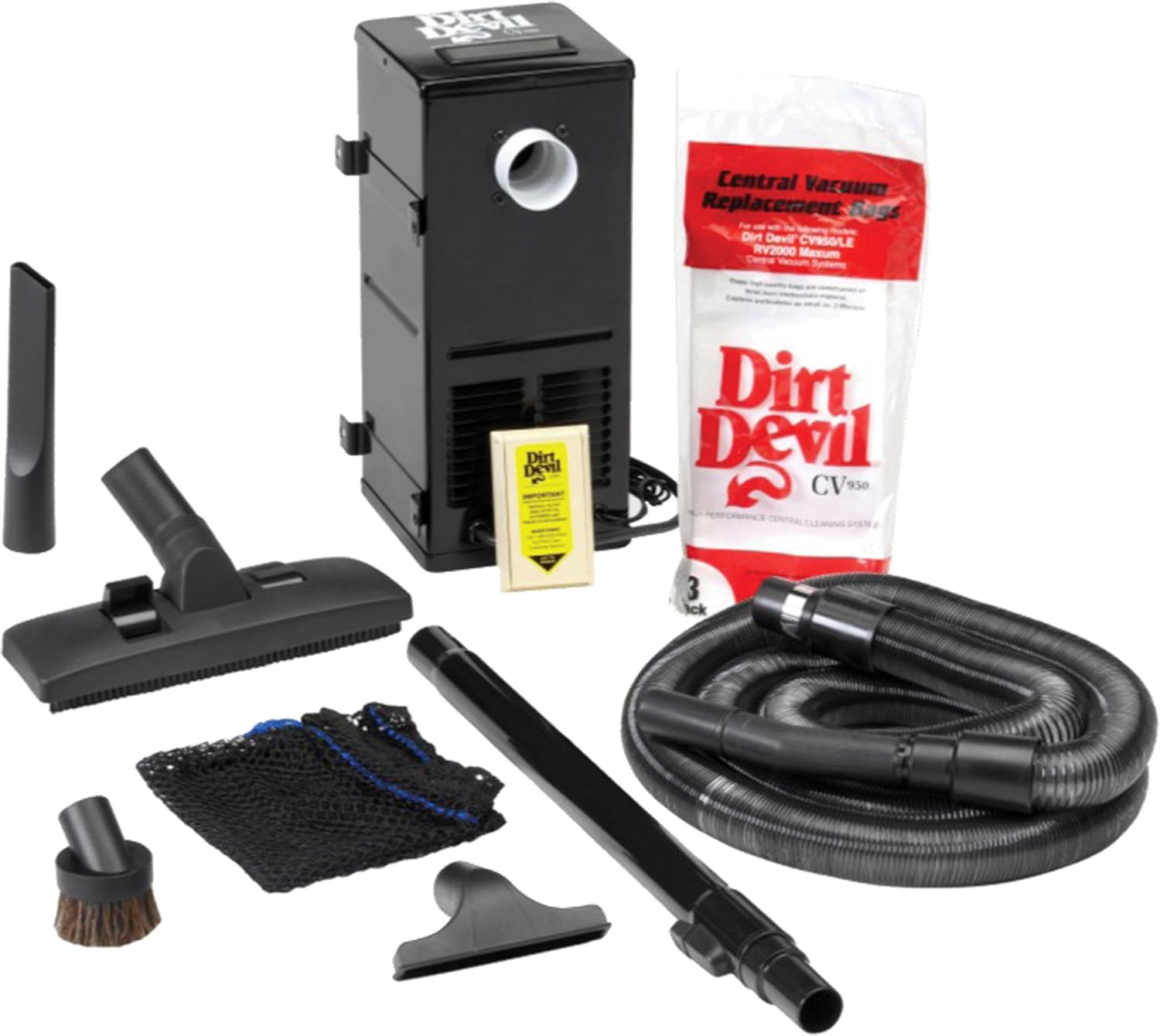
- Air Watts: 501 AW
- Airflow: 100 CFM
- Water Lift: 120 in
- Filtration: Certified HEPA, 0.3 micron
- Max Amp Draw: 11.7 A at 120V
- Warranty: 5 years

- Air Watts: 549 AW
- Airflow: 115 CFM
- Water Lift: 120 in
- Filtration: HEPA type, uncertified
- Max Amp Draw: 10 A per manual
- Warranty: 2 years
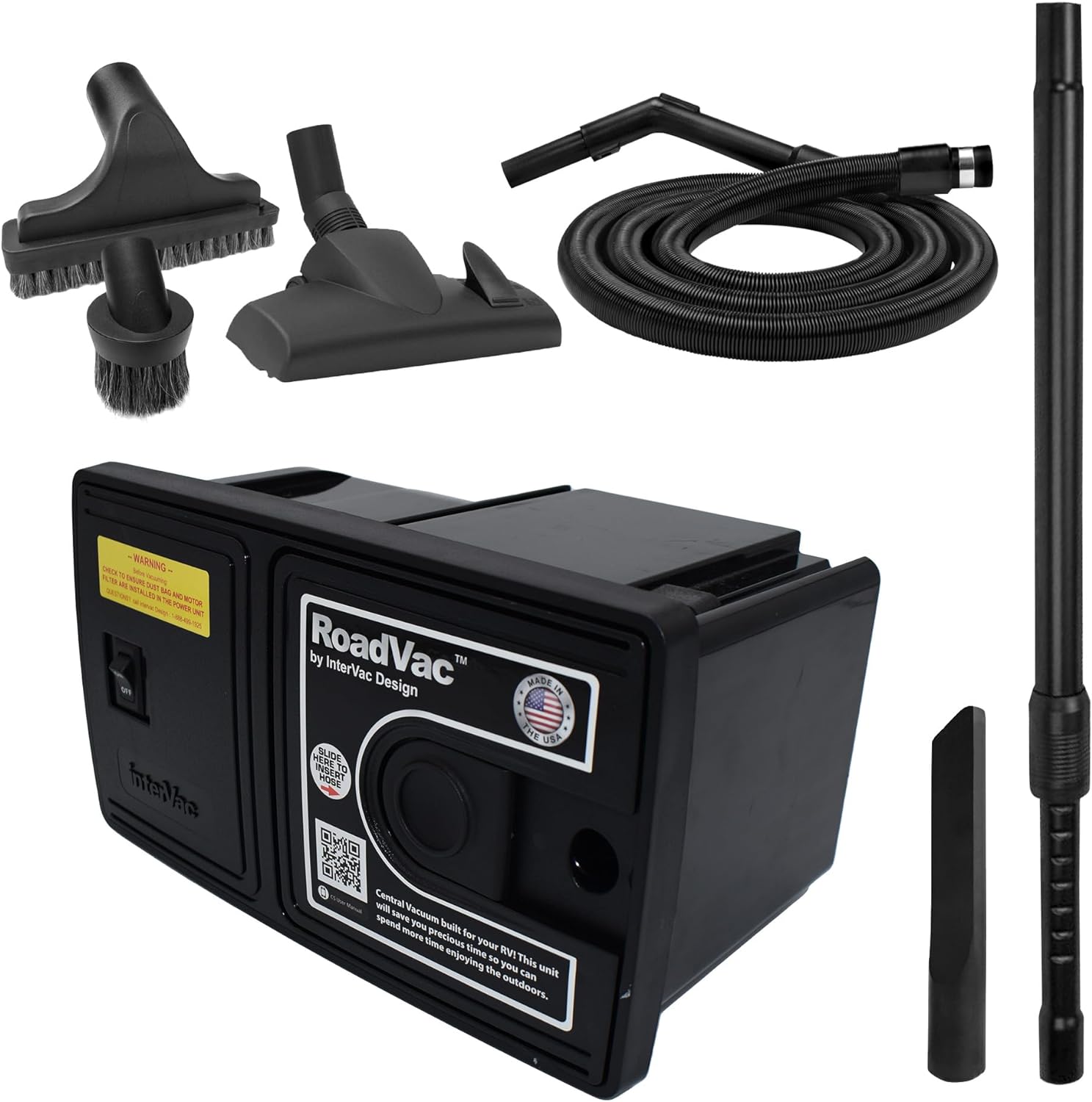
- Air Watts: 501 AW
- Airflow: 111 CFM
- Water Lift: 142 in
- Filtration: Standard bag, uncertified
- Max Amp Draw: 10 A vs 7A claim
- Warranty: 2 years
The Dirt Devil CV1500 leads this table for one reason: it’s the only unit publishing air watts, water lift, and CFM at all. That’s 501 AW, 120 inches of water lift, and 100 CFM, straight from H-P Products, no test standard cited but no hiding either.
1. Dirt Devil CV1500 Review
The Dirt Devil CV1500 is the only RV central vacuum in this test that tells you what it can actually do. H-P Products publishes 501 air watts, 120 inches of water lift, and 100 CFM, numbers InterVac won’t touch on either of its units. That transparency, plus a five year warranty, makes this the default pick for coaches over 30 feet.
- 501 air watts published by H-P Products
- All metal power unit, 14 pounds
- HEPA bags rated to 0.3 microns
- Optional remote mount, five feet away
- Five year warranty on the power unit
What We Love About the Dirt Devil CV1500
501 Air Watts Against a 35 Foot Stretch Hose
The CV1500’s 501 air watts is the only verified suction number in this whole category, and H-P Products backs it with 120 inches of water lift and 100 CFM. Air watts measure the working suction left after airflow and sealed lift combine, not just raw motor power.
H-P Products publishes these numbers on its own CV1500 power unit specification page, though no AHAM or IEC 62885 test condition is cited alongside them. Neither InterVac unit publishes any of these three figures. One Thor Tuscany owner running a 45 foot coach reported suction fade after upsizing from a 40 footer, a real reminder that hose length eats into these numbers fast.
Sand stuck to vinyl at full 35 foot stretch tells you more than any spec sheet ever will.
The Metal Body Built for Cargo Bay Vibration
The CV1500’s all metal housing weighs 14 pounds, nearly three times the InterVac units’ 5.5 pound composite shells. That weight is a real cost on a chassis already close to its GVWR, but it buys durability the plastic housings can’t match after years of road vibration on washboard gravel.
Durability you feel beats payload you save.
HEPA Bags Rated to 0.3 Microns for Allergy Travelers
The CV1500 ships with HEPA bags rated to capture 99.97% of particles down to 0.3 microns, the EPA and DOE threshold that defines the standard. InterVac markets its own bags as “HEPA type,” language that carries no certification requirement at all. A dealer claim of 98.3% capture at 0.03 microns for a competing unit isn’t a HEPA figure either, it’s a different measurement entirely.
The Five Year Warranty That Covered a Dead Board
H-P Products backs the CV1500 with a five year warranty on materials and workmanship, the longest term in this test by a wide margin.
A Forest River Forums owner reported a failed circuit board, and H-P shipped a replacement unit under that coverage. Compare that against InterVac’s own warranty and registration terms, which cap coverage at two years and void it entirely for aftermarket bags. One Fit RV commenter worried H-P might drop RV parts support down the line, the way some brands quietly do.
Register the unit the week you install it. That paperwork is the only thing standing between you and a $431 mistake.
Who the CV1500 Fits and Who Should Skip It
Buy It If You Run 30 Feet or More With Pets
Install the CV1500 in a Class A, fifth wheel, or any coach over 30 feet with carpet and shedding animals. Pet households and anyone managing asthma benefit most from a bag that actually carries a HEPA certification. This unit fits best with a vented exterior compartment and 120 volts within reach.
Skip It If Your Inverter Cannot Carry 11.7 Amps
Skip the CV1500 if your inverter caps out below 2,000 watts. Its 11.7 amp draw at 120 volts lands near 1,400 running watts, which wants a 2,000 watt pure sine inverter at minimum plus surge headroom.
RV branch circuits fall under NEC Article 551 and NFPA 1192, not the residential Article 210 dedicated 20 amp rule dealers keep repeating. Boondockers running a modest 1,000 watt inverter should look at the CS-8 instead, where the draw is meaningfully lighter.
Pros and Cons
- Pros: Only unit with published air watts, water lift, CFM
- Pros: Five year warranty, longest in this roundup
- Pros: Certified HEPA bags, 99.97% at 0.3 micron
- Pros: All metal housing built for cargo bay vibration
- Cons: Highest amp draw of the three, 11.7 A
- Cons: Two conflicting unit dimensions on H-P’s own site
- Cons: 1 gallon capacity forces frequent bag changes
2. InterVac RoadVac CS-RM Review
The InterVac RoadVac CS-RM is the only unit in this test built to run as a true piped system, with the power unit hidden away and the inlet surfacing wherever you need it. It ships with an inlet valve, a VacPort sweeper pan, and the wye fittings to add more inlets later. That architecture, not raw suction, is the whole pitch here, since InterVac won’t publish a single suction number for it.
InterVac also builds the hardware behind Dometic’s central RV vacuum system, so a buyer cross shopping the two badges is often comparing the same core motor and canister under different labels.
- Remote mounted power unit, hides out of sight
- Ships with VacPort sweeper inlet
- Two bag openings, not one
- Composite housing that won’t rust
- 11.75 by 6 by 6.75 inches
What We Love About the InterVac RoadVac CS-RM
The VacPort Lets You Sweep Debris Straight In
The VacPort sweeper pan lets you sweep crumbs straight into a toe kick inlet, no hose to unpack and no bending required. That beats reaching for a hose for a 20 second galley cleanup. The full CS-RM package ships the VacPort, the inlet valve, and the fittings needed to add it.
This is the only unit in the test you can use without unpacking anything.
Two Bag Openings Give It Airflow the CS-8 Lacks
InterVac’s own manual confirms the CS-RM runs a double collar Y11 bag with two openings, where the CS-8 and CS-6 use a single collar Y10 bag. A second opening cuts the pressure drop across a loading bag, which matters most once that bag sits half full rather than fresh.
InterVac still publishes no air watts to prove the gain, so take the airflow logic as sound engineering, not a verified number.
Remote Mounting Frees the Wall You Cannot Spare
Remote mounting lets the CS-RM hide in a basement bay or under a dinette, with only the inlet showing in the living space. InterVac’s manual places the inlet valve three to four feet from the power unit. A fully sealed compartment strangles airflow and cooks the motor, so the bay needs to breathe.
That composite shell isn’t just about weight. The same rust resistant material shows up in central vacuums built for marine environments, where humidity does to metal housings what road salt does to a truck frame.
This is a two evening install job for most owners, not the ten minute job the listings promise.
Who the CS-RM Fits and Who Should Skip It
Buy It If You Want an Inlet Where the Wall Is Full
Choose the CS-RM if your travel trailer or Class B build has no free interior wall panel left for a faceplate. Galley heavy cooks who’ll actually use the VacPort daily get the most value here. Owners fine trading published specs for install flexibility are the right buyer.
Skip It If You Need Numbers Before You Spend
Skip the CS-RM if you want verified suction numbers before you spend $390. InterVac publishes no air watts, no water lift, and no CFM anywhere we searched, and its own product page carries zero verified customer reviews. Spec driven buyers should take the CV1500 and its 501 AW figure instead.
Pros and Cons
- Pros: Only piped multi-inlet system, valve and VacPort included
- Pros: Lowest amp draw of the three, 10 A
- Pros: Composite housing resists rust in humid bays
- Pros: Sweep tee option for lower restriction runs
- Cons: Publishes zero suction data, no air watts or CFM
- Cons: Aftermarket bags void the warranty entirely
- Cons: Two year warranty, non-transferable, dated from manufacture
3. InterVac RoadVac CS-8 Review
The InterVac RoadVac CS-8 is the smallest and cheapest built in vacuum in this test, fitting an 11 by 6 by 6 inch cutout at just 5.5 pounds. There’s no inlet valve and no piping, the hose plugs straight into the unit itself. That simplicity is the entire pitch, right for a travel trailer or Class B van with no room to spare.
- Cheapest entry into a built in system
- One cutout, four screws, no tubing
- 5.5 pounds, 120 volts, 10 amps
- UL certified composite housing
- Y10 bags, not HEPA certified
What We Love About the InterVac RoadVac CS-8
One Cutout, Four Screws, and No Tubing at All
Installing the CS-8 means cutting one 11 by 6 inch opening, sliding the unit in cord first, and tightening four clamp screws behind the panel. There’s no pipe run, no wye fitting, and no low voltage wire to chase. Compare that against the CV1500’s separate canister and inlet plate work, which eats a whole afternoon.
This is the only unit here you can finish before lunch.
The Lowest Price Into a Built In RV Vacuum
The CS-8’s power unit runs $177.91 with cord, and the full kit sits at $295.80, well under the other two units. What the savings cost you: HEPA certified bags, published suction specs, and dirt capacity. A dealer sourced figure puts capacity at half a gallon against the CV1500’s 1 gallon. Shoppers comparing budget options should also check Eureka’s RV central vacuum lineup.
Cheapest is honest here, but call it cheapest, not best.
10 Amps Makes It the Friendliest Draw for Solar
Ten amps at 120 volts works out to roughly 1,200 running watts before surge, kinder to a modest inverter than the CV1500’s 11.7 amps. A dealer claim floating around puts the real draw at 7 amps, a number InterVac’s own manual doesn’t confirm. Clamp meter the unit before trusting either figure.
The CS-8 becomes the clear off grid pick, once that lower number gets verified against the manual.
Who the CS-8 Fits and Who Should Skip It
Buy It If You Camp Under 30 Feet Without Pets
Choose the CS-8 for a Class B van, teardrop, truck camper, or small travel trailer under 30 feet. Households with no allergy sufferers and no shedding animals get the most out of this unit’s limits. First time modders who want a quick win, not a weekend project, land here too.
Skip It If Anyone Aboard Has Asthma
Skip the CS-8 if anyone aboard manages asthma or serious allergies. Its Y10 bags carry no HEPA certification, unlike the CV1500’s bags rated to 0.3 microns. Half gallon capacity also means more frequent bag changes, and each change stirs dust back into the cabin air.
Allergy households should buy the CV1500 and accept its heavier amp draw instead.
Pros and Cons
- Pros: Smallest cutout and lightest unit, 5.5 pounds
- Pros: Lowest entry price in the category
- Pros: Cheapest genuine bags, about $4.94 each
- Pros: UL certified, mountable in wall or surface
- Cons: No inlet valve, hose plugs into the unit only
- Cons: No suction spec or bag capacity published
- Cons: Two year warranty voided by aftermarket bags
The Buyer’s Guide: Cutting Through the Hype
Do RV Central Vacuum Systems Beat a Cordless Stick Vac?
RV central vacuum systems beat a stick vac on sustained pull, but lose on grab and go convenience for a quick crumb sweep.
One Fit RV owner said his CV1500 “eats a Dyson for lunch,” then bought a separate carpet tool to finish the job. A Forest River Forums owner took the opposite path, skipping central vacuum and keeping a battery Dyson instead.
Water lift is the sealed pulling force that lets a machine hold debris up a hose instead of dropping it halfway. A built in system wins on long hauls through a 40 foot coach; a stick vac wins the two minute cleanup after breakfast.
The Three Specs That Actually Decide RV Suction
Air watts, water lift, and CFM decide RV suction, and one number alone tells you almost nothing.
Only the CV1500 publishes all three, and that transparency is itself a buying signal. A 35 foot stretch hose taxes airflow harder than an equal length of fixed hose, since a stretched hose narrows as it extends. InterVac’s own manual admits the stretch hose loses suction compared to a standard hose.
Check which units fit your RV before ranking any of them on suction numbers alone.
Price Tier Truth From 175 Dollars to 400 Dollars
Price in this category tracks warranty length and data transparency more than raw suction power. The entry tier, around $175 to $180, buys composite housing, one bag opening, and zero published specs. The mid tier, near $390 to $400, adds a remote mount, a VacPort, and a second bag opening. The top tier, at $432, buys metal construction, a certified HEPA bag, and five years of coverage.
Pay for warranty and honesty first, suction second. Only one brand here gives you suction numbers to pay for at all.
Red Flags Owners Only Discover After Installation
Dealers sell a ten minute install and skip what owners find out the hard way. Here’s what shows up after the cutout is already cut:
- A Keystone Forums owner found the unit too loud to mount inside living space, only in a bay or closet.
- A Fit RV owner discovered the CV1500 exhausts into its own mounting compartment, not outside the coach.
- A Grand Design owner posted a full install writeup, then flagged a wiring mistake that cost a second afternoon.
- InterVac’s manual warns that drywall dust and fine wood dust clog bags fast and can burn out the motor early.
Read the manual’s warning page before you cut anything, not after.
How We Tested and Where We Refused to Guess
This review leans on manufacturer documentation first, dealer listings second, and owner forum threads for the failure modes nobody puts in a spec sheet. Every unpublished number stays marked unpublished here, never estimated from a similar looking model. Three live conflicts run through this category: amp draw, warranty term, and filtration percentage, and none of them get averaged into a fake middle number.
InterVac declines to publish air watts across its entire RoadVac line, full stop, and that omission is reported here exactly as found.
Ownership and Maintenance on the Road
What Bags Really Cost You Over Five Years
Bag cost separates these three units more than sticker price does. InterVac’s Y10 and Y11 five packs run $24.69 and $28.89 direct from InterVac, roughly $4.94 and $5.78 per bag. The CV1500 ships three HEPA bags in the box, then refills run $12.19 each plus a $1.14 secondary filter per swap.
A two week a year camper burns through bags slowly. A full timer traveling with a dog burns a pack every month or two. The cheapest unit up front isn’t the cheapest system by year five.
The Motor Filter Everyone Forgets Until It Burns Out
InterVac’s manual says to rinse the secondary filter warm when it’s dirty, or replace it if it won’t come clean. A clogged bag starves the motor of airflow and cooks the windings from the inside, a failure nobody notices until the motor just stops. Check the secondary filter every fourth bag change, sooner after a dusty gravel lot.
Never run either brand without both a bag and a filter installed.
Stretch Hose Kinks and the 90 Degree Fix
A stretch hose pulled sideways from a flush wall inlet takes a permanent set within a season, choking airflow at exactly the spot you need it most. One RV Forum owner machined a 90 degree elbow so his hose stopped kinking at the inlet. Store the hose coiled loose in its mesh bag, never folded flat in a drawer.
Once the corrugation starts collapsing under load, replace the hose. Don’t tape it and hope.
Where the Exhaust Goes and Why It Matters Inside
The CV1500 vents straight into whatever compartment holds it, with no dedicated hose routing that air outside the coach. One RV Forum owner cut a 6 inch side wall vent just to move that exhaust out of the cabin. Exhaust placement matters more than bag rating for allergies, since a sealed compartment recirculates fine particles back into the living space.
Confirm the mounting compartment actually breathes. A sealed box cuts suction and heat soaks the motor at once.
Conclusion
You started this thinking more suction was the answer. It was mounting location, amp draw, and which brand actually tells you the truth on a spec sheet. Now you know the CV1500 publishes real numbers and a five year warranty, while both InterVac units ask you to trust install flexibility instead.
Open your bay door tonight, measure your cutout space, and check your inverter’s rated wattage before you request a single installation quote. No stick vac holds pull at 35 feet, and that’s the whole argument for building one in.
Frequently Asked Questions
Is a Central Vacuum Worth Installing in an RV?
Yes, if you run a coach over 30 feet with carpet, pets, or an allergy sufferer aboard. A built in system holds suction over a long hose pull in a way a stick vacuum can’t match. Skip it in a small van or teardrop, where a stick vacuum covers the whole footprint in one pass.
How Many Amps Does an RV Central Vacuum Draw on a 30 Amp Hookup?
The CV1500 draws 11.7 amps, about 39% of a 30 amp TT-30 shore service. Both InterVac units draw 10 amps per their manual, though a dealer claim of 7 amps hasn’t been confirmed. Clamp meter your unit before trusting either figure.
Do RV Central Vacuum Systems Need a Dedicated Circuit or GFCI Outlet?
No manufacturer here specifies a dedicated circuit. RV branch circuits fall under NEC Article 551 and NFPA 1192, not the residential Article 210 rule dealers often quote. CV1500 owners have reported GFCI nuisance trips on some 30 amp hookups.
How Much Wall Depth and Exhaust Clearance Does an RV Central Vacuum Need?
The CS-RM and CS-8 both need an 11 by 6 inch cutout with a wall between 3/8 and 1 inch thick. Every unit here needs real exhaust clearance too, a 3 inch louvered opening or an exhaust fitting, or the motor overheats and shuts down.
Can I Run Multiple Inlet Valves Off One RV Central Vacuum Power Unit?
Yes, but only the CS-RM ships built for it, with a wye fitting and sweep tee options included. The CV1500 supports a second inlet only through an optional Flex Connector Kit sold separately. The CS-8 has no inlet valve, so multiple inlets aren’t possible on that unit.