You typed “eureka rv central vacuum system” into Google and landed on a product page for a vacuum nobody sells anymore. Dealers push air watts because it sounds impressive, but in a coach, water lift decides whether your hose still pulls sand off the bathroom floor after 30 feet of tubing. We verified the CV140’s specs against dealer listings and the manufacturer’s manual, so choosing an RV central vacuum system starts here, not three tabs deep.
By the end, you’ll know which power unit fits your existing cutout, and where it falls short of the Yellow Jacket.
Our Top Picks at a Glance
Dirt Devil CV1500 RV Central Vacuum System (model 9880)
Features:
- Air Watts: 501
- Water Lift: 120 inches
- Max Amp Draw: 11.7 max, 8.7 continuous
- Dirt Capacity: 1 gallon
- Hose Reach: 7 feet stretching to 35
- Filtration: HEPA style bag, 99.97 percent claim
- Warranty: 5 years
The CV1500 is the only current RV power unit built to the Yellow Jacket’s 14.5-inch cabinet, and it beats the original on water lift, 120 inches against 86, the number that keeps suction alive at the far end of a 35-foot hose.
Dirt Devil CV1500 Review
The Dirt Devil CV1500, sold interchangeably as H-P Products model 9880, is the only current RV power unit built to slide into the Eureka CV140’s cabinet footprint without cutting a new hole. It ships as a complete kit, inlet valve, hose, wand, tools, and filter bags included, where most RV power units in this class sell the motor alone.
- 501 air watts, 120 inch water lift
- HEPA style bag, 99.97 percent claim
- Fourteen pounds, mounts any orientation
- Hose stretches 7 feet to 35
- Five year manufacturer warranty
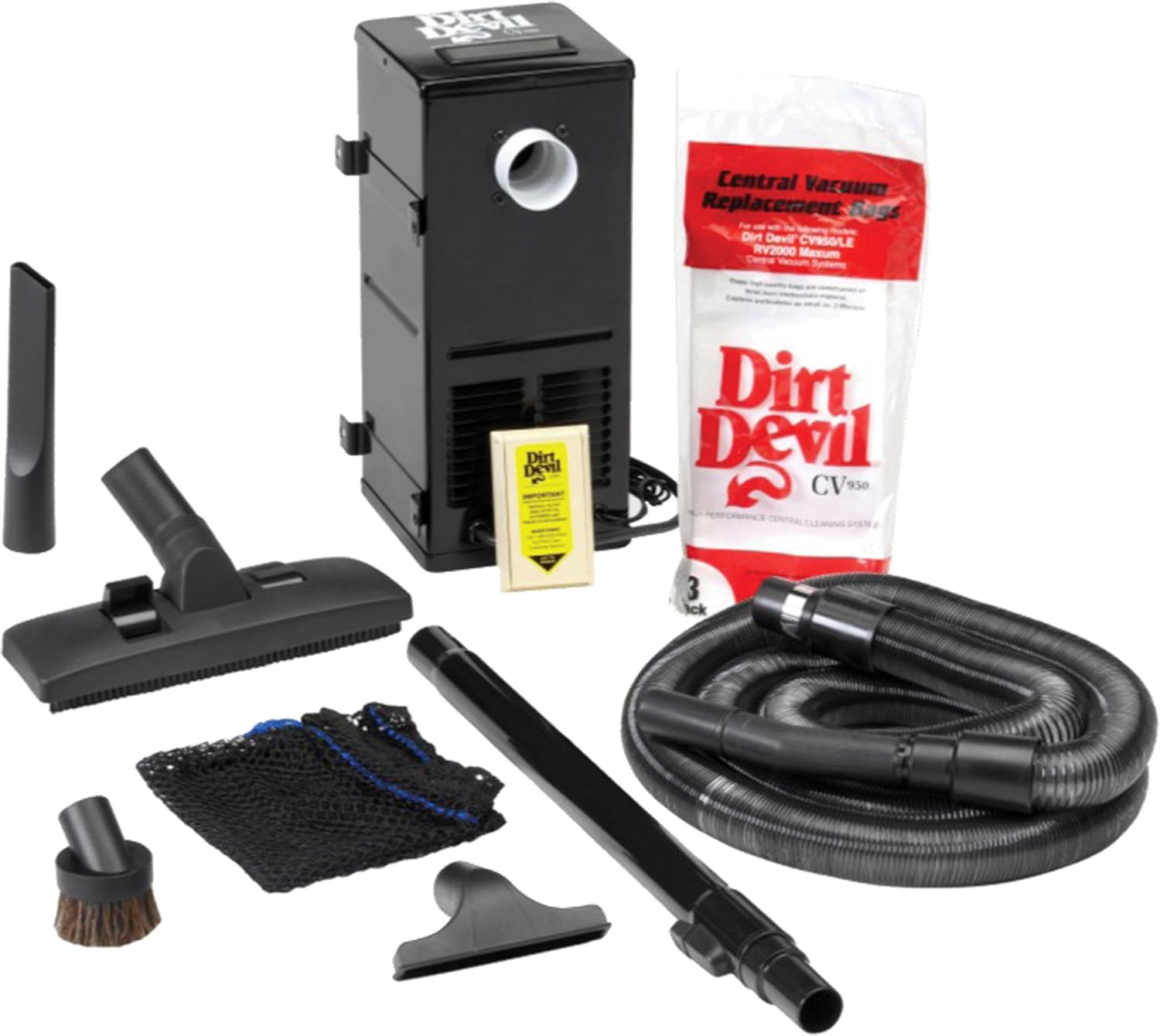
What We Love About the Dirt Devil CV1500
501 Air Watts Against Sand, Cat Litter, and Crumbs
Picture gravel rattling up 35 feet of hose without the motor bogging down. That’s what air watts (a measure of total suction power at the motor intake) buy you, and 501 of them paired with 120 inches of water lift keeps the CV1500 steady where weaker units fade. One RV owner reported pulling roughly a gallon of sharp cat litter through the system in a single pass without hose damage.
Against the Eureka CV140’s 400 air watts and 86-inch lift, this is a real jump, not a marginal one.
Fourteen Pounds That Disappear Under a Dinette Bench
Nobody wants to lose their one usable cabinet to an appliance. At 14 pounds and a footprint as small as 10 by 20 inches, the CV1500 mounts top or bottom, horizontal or vertical, using the same side brackets that held the original Eureka unit.
A flex connector kit lets the power unit sit up to 5 feet from the inlet valve, matching your only open cavity even when it isn’t directly behind the wall plate.
HEPA Bags That Keep Dust Out of Your Bunk
Dumping a bagless canister inside a 23-foot coach is not something most owners want to do. The CV1500’s HEPA (high-efficiency particulate air, rated to capture 99.97 percent of particles down to 0.3 microns) bags are built from three-layer electrostatic material and lift out sealed.
H-P Products doesn’t name an independent lab next to the claim, so call these bags HEPA style rather than lab-certified. The sealed bag still contains dust that a washable canister filter would release straight into your living space.
Eight Point Seven Continuous Amps on a 30 Amp Hookup
Run the vacuum while the air conditioner cycles on, and shore power gets tight fast. The CV1500 draws 11.7 amps at peak and 8.7 amps continuous, a spec H-P Products publishes but most dealer listings skip.
Owners running off a battery bank and inverter report the draw stays manageable. Shut off the air conditioner and microwave before you vacuum on a 30-amp pedestal, and you won’t trip the breaker.
Built for Full Timers With Shedding Pets and Sandy Steps
One owner reported running the same Dirt Devil platform unit for 18 years, a service life that beats most portable vacuums by a decade. Pair the power unit with a VacPan (an automatic dustpan inlet valve set into the toe kick) on hard flooring, and sweeping becomes a foot-tap instead of a dustpan chase.
Owners who left a canister vacuum behind describe the power gap in blunt terms: no more dragging a machine down the hallway. Miles logged beat months parked here.
Where the Dirt Devil CV1500 Falls Short
The 35 Foot Hose Owners Call an Anaconda
Multiple RV owners describe wrestling the fully extended hose as the exact reason they stopped using the system. The mesh tool caddy that ships with the kit eats a full storage cubby on its own.
Hard floor coaches report far less frustration than carpeted ones, since a smooth floor lets the hose glide instead of drag. You bought convenience, and in a fully carpeted rig, you inherited a workout.
Your Exhaust Vents Into the Storage Bay, Not Outside
The CV1500 vents through case slots into the mounting compartment, with no dedicated exhaust hose or outdoor-vent kit. Venting outdoors would mean mounting the entire unit outside the coach, unrealistic for most cabinet layouts.
Compare that to the Eureka Yellow Jacket’s own installation manual, which routes exhaust outside through a dedicated 2-inch hole. That gap matters more to allergy households than to weekend campers.
Suction Fades Once Your Coach Passes 40 Feet
One owner documented losing noticeable suction after moving from a 40-foot coach to a 45-foot coach running the same power unit. This is physics, not a defective unit: every extra foot of tubing and every non-sweep elbow costs a bit of water lift.
Test a smooth hose against the corrugated stock hose before blaming the motor.
The RugRat Carpet Tool Costs Another Fifty Dollars
Model 9880 ships with air-driven tools only, no motorized carpet brush included, confirmed across current dealer listings. The RugRat powered carpet tool sells separately for roughly $52.
Unboxing a carpet vacuum kit with no carpet tool stings a little. Carpeted coach owners should shop the bundled 9614 package instead, and confirm hose connections against the rv central vacuum compatibility chart first.
Pros and Cons Table
- Pros: Fits the Eureka CV140’s 14.5-inch cabinet, no rebuild
- Pros: 120-inch water lift beats the CV140’s 86-inch rating
- Pros: Complete kit at $255.99, hose and tools included
- Pros: Sealed HEPA bag contains dust during changes
- Pros: Five-year warranty from an operating US manufacturer
- Cons: Motor architecture and decibel rating undisclosed
- Cons: No electric power brush or carpet tool included
- Cons: No outdoor-vent kit, exhausts into the mounting bay
Who Should (and Shouldn’t) Buy This
Buy It If Your Coach Runs Long Trips and Hard Floors
This system earns its keep in coaches under 40 feet running tile, vinyl, or laminate floors. Pet owners, allergy households, and full-time travelers get the strongest return, since the sealed bag and stronger water lift solve problems a portable vacuum can’t touch.
Installing it requires an accessible bay or bench cavity and a standard 120-volt circuit, nothing more exotic than what most coaches already have wired. A built-in system also reads as a factory upgrade at resale.
Skip It If You Only Camp Six Weekends a Year
Weekend campers get more value from a quality stick vacuum than from a permanent install. Fully carpeted coaches also face the worst of the hose-handling complaints above, so weigh that trade-off before committing to a cutout.
Owners who switched away from occasional-use built-in systems moved to a cordless stick vacuum instead, citing storage simplicity over suction power. Consider Dometic’s RV vacuum models if a lower-capacity built-in still appeals for a smaller rig. Cutting a permanent hole for six weekends of use rarely pays for itself in resale value alone.
Why the Eureka RV Central Vacuum Search Leads Here
Every top result for this search is either a dealer page for a discontinued unit or a spec sheet with no context behind it. Here’s what actually happened, and what it means for the vacuum bolted into your cabinet right now.
Can You Still Buy a Eureka RV Central Vacuum System?
No. The Eureka CV140 Yellow Jacket is discontinued, and it has been for years. Electrolux owned Eureka from 1974 until it divested the Eureka brand to Midea Group in December 2016, keeping Beam as its own central vacuum brand and leaving the Yellow Jacket line with no factory home.
Two dealers still list the CV140 as though it ships today, but that’s a stale product page, not live inventory. Used units circulate around $150, most missing bags or a hose, with no factory parts pipeline behind them.
A discontinued unit with a healthy resale price is still a discontinued unit.
What the Yellow Jacket Gave You That the CV1500 Does Not
The Yellow Jacket moved more air, but the CV1500 pulls harder. Eureka’s CV140 rated 108 CFM (cubic feet per minute, a measure of raw airflow volume) against the CV1500’s 100 CFM, an 8-point edge in volume. Flip the water lift (a measure of suction strength against resistance, like a hose packed with sand) numbers and the CV1500 wins big: 120 inches against the Eureka’s 86, a 40 percent gain in suction recovery at the far end of a long hose.
The real loss is exhaust routing. The Eureka manual for the CV140 (P/N 460364) routes exhaust outside through a 2-inch hole, with two rules that carry over to any RV install: mount the unit with 2 inches of sidewall clearance, and never vent through the floor or into an enclosed space. The CV1500 has no dedicated vent hose or outdoor-vent kit, a gap that matters more to allergy households than weekend campers.
Your Old Eureka OX Bags Will Not Fit
Your Style OX bags are still on shelves, but they won’t fit the CV1500. The Eureka CV140 used Style OX bags, part 61230A, about $9.95 for a 4-pack and still in stock despite the power unit being gone. The CV1500 needs part 9597, a three-pack running roughly $18 to $21.
Budget that swap alongside the power unit cost, and watch for the cheaper standard CV1500 bag pack sold next to the HEPA version. They aren’t the same filtration grade.
The Buyer’s Guide: Cutting Through the Hype
Air Watts, Water Lift, and CFM in an RV
Air watts measure total suction power at the motor. Water lift measures how hard the motor pulls air through resistance, the way a hose packed with sand fights back. CFM measures raw airflow volume moving through the system.
Water lift wins in a coach because carpet fibers and a long hose create resistance, and 120 inches recovers suction that 100 CFM alone can’t guarantee. The Eureka-to-CV1500 comparison proves it: more CFM on the old unit didn’t mean more real-world suction once the hose stretched past 20 feet. Check water lift first on any RV vacuum spec sheet.
What Two Hundred to Four Hundred Dollars Actually Buys
A budget shop vacuum with 30 feet of hose runs around $100 but demands manual hauling and disposal after every use. The CV1500 sits at $255.99 to $270 across dealers and includes the inlet, hose, tools, and three HEPA bags in that price.
Competing RV power units push past $350 for the motor alone, then add an inlet kit and hose package separately, landing near $500 once the kit matches CV1500 completeness. Factor bags and tools over five years, and the mid-tier kit still comes out ahead.
Red Flags Owners Only Find After the Hole Is Cut
Circuit board failures show up in owner threads occasionally, and they’re covered under the five-year warranty when they happen. Published width dimensions vary between 6.25 and 7.5 inches across different retail listings for the same unit, a real problem when measuring a cutout.
Measure your cavity against the largest published figure, not the smallest, and confirm it against your coach’s actual bay before cutting anything. Long-term parts availability worries owners burned by discontinued Dirt Devil floor-care lines before, a fair concern given Eureka’s own exit. H-P Products remains an operating manufacturer, the strongest counterpoint against that worry today.
How We Tested and Verified Every Number Here
Every spec here traces back to H-P Products documentation, current dealer listings, owner forum reports on iRV2 and RV Forum, and the Allegro RV installation bulletin used as a category benchmark. Where a number couldn’t be verified against a manufacturer spec, we say so instead of repeating it as fact.
That’s why the 99.97 percent HEPA claim gets flagged rather than stated flat: no certifying lab is named next to it. You deserve to know what we don’t know as much as what we do.
Ownership and Maintenance Guides
The Half Full Rule and Your Five Year Bag Cost
Swap the bag once it reads half full, not when it’s packed solid, and suction stays consistent between cleanings. A three-pack of part 9597 bags runs roughly $18 to $21, and that cost scales with how often you’re on the road.
Weekend campers might replace bags twice a season, while full-time travelers should budget closer to a pack every month or two. Watch for the cheaper standard CV1500 bag pack sold alongside the HEPA version. They aren’t the same filtration grade, and mixing them up defeats the point of buying a HEPA system.
Keeping the Stretch Hose From Eating Your Storage Bay
Coil and hang the hose after every trip instead of stuffing it into the mesh caddy, and you’ll cut down on the kink points that form where the hose meets the inlet valve. Owners who adopt that habit report far fewer complaints about hose stiffness over time.
Give the hose a two-minute check after each trip: uncoil it fully, inspect the swivel handle connection, and re-coil loosely rather than tight. That small routine extends hose life more than any product you could buy to fix a kink after it sets in.
Inlet Valve Contacts and the Board That Actually Fails
Start troubleshooting a dead unit at the plunger switch inside the inlet door, the cheapest and most common point of failure and a five-minute check before you assume the motor is gone.
One owner traced a dead unit back to a failed control board and had it replaced under the five-year warranty at no cost. That warranty covers circuit board and motor defects but excludes damage from improper installation or unauthorized repair, so keep your receipt and installation notes on hand. A dead vacuum three states from home is a real headache. Knowing where to look first turns a panic into a five-minute fix.
Conclusion
You came here hunting a discontinued Eureka, and you’re leaving with the one replacement that actually fits. Tonight, measure your bench cavity against the largest published dimension, 7.5 inches wide, before you order anything. The CV1500 beats any portable vacuum you’ve hauled through a coach before for one honest reason: it’s built into the wall, so it’s ready the moment sand hits the carpet instead of waiting in a closet three rooms away.
Frequently Asked Questions
Does Eureka Still Make Central Vacuum Systems?
No. Electrolux divested the Eureka brand to Midea Group in December 2016 and kept Beam as its central vacuum brand. The Yellow Jacket line has no factory successor.
What Are the Actual Specs of the Eureka CV140 Yellow Jacket?
The CV140 rated 400 air watts, 86 inches of water lift, and 108 CFM in a 7 by 7 by 14.5 inch cabinet. It carried a $529.95 list price and a $429.95 street price before it was discontinued.
Why Do Two Dealers Still List the Eureka RV Central Vacuum as Available?
Those are stale product pages, not live inventory. Dealer sites don’t always pull discontinued models down the moment a manufacturer exits a category.
Can I Still Get Eureka Style OX Bags and the #38333 Motor Filter?
Yes, Style OX bags, part 61230A, remain in stock at vacuum specialists for about $9.95 per 4-pack. The #38333 washable motor filter is harder to source consistently, since no factory motor pipeline backs it anymore.
What RV Central Vacuum Fits the Same Cabinet Cutout as the Eureka CV140?
The Dirt Devil CV1500, also sold as H-P Products model 9880, is the only current unit built to that 14.5-inch cabinet envelope. It drops into the existing cutout without a rebuild.
Is 500 Air Watts Enough for a 35-Foot Motorhome?
Yes, for a single-inlet coach. Water lift matters more than air watts at that hose length, and the CV1500’s 120-inch rating handles the resistance a 35-foot run creates.
Can You Vent an RV Central Vacuum Exhaust Through the Floor of the Coach?
No. The Eureka CV140’s own installation manual prohibits venting through the floor or into any enclosed or sealed space, a rule that applies to any RV central vacuum install.