You bought a used fifth wheel and there’s a vacuum built into the pantry wall with no brand name you recognize. Or your Dometic vacuum died and every bag you buy is the wrong shape. Or you’re trying to figure out if the RoadVac under your dinette will fit the hole your last unit left behind.
This page exists because none of those questions have a single good answer anywhere else online. Our RV central vacuum systems guide covers how these systems work in general.
This page is the lookup tool. Every current and recently discontinued RV and marine central vacuum model, standardized side by side, with the exact bags, hoses, and inlet valves that fit each one.
A quick honest note before you dive in. RV central vacuum manufacturers do not publish specs the same way.
Some list air watts (a calculated measure of suction power at the hose end). Others lead with CFM (cubic feet per minute, how much air volume moves through the system). A few only give you water lift (how many inches a motor can pull water up a tube, a proxy for raw pulling force).
We pulled every number we could verify straight from manufacturer product pages, installation manuals, and dealer documentation. Anything we couldn’t confirm gets flagged as UNV (unverified) instead of a guess.
If you spot something wrong, tell us. We’ll fix it and credit you.
How to Identify the Central Vacuum in Your RV
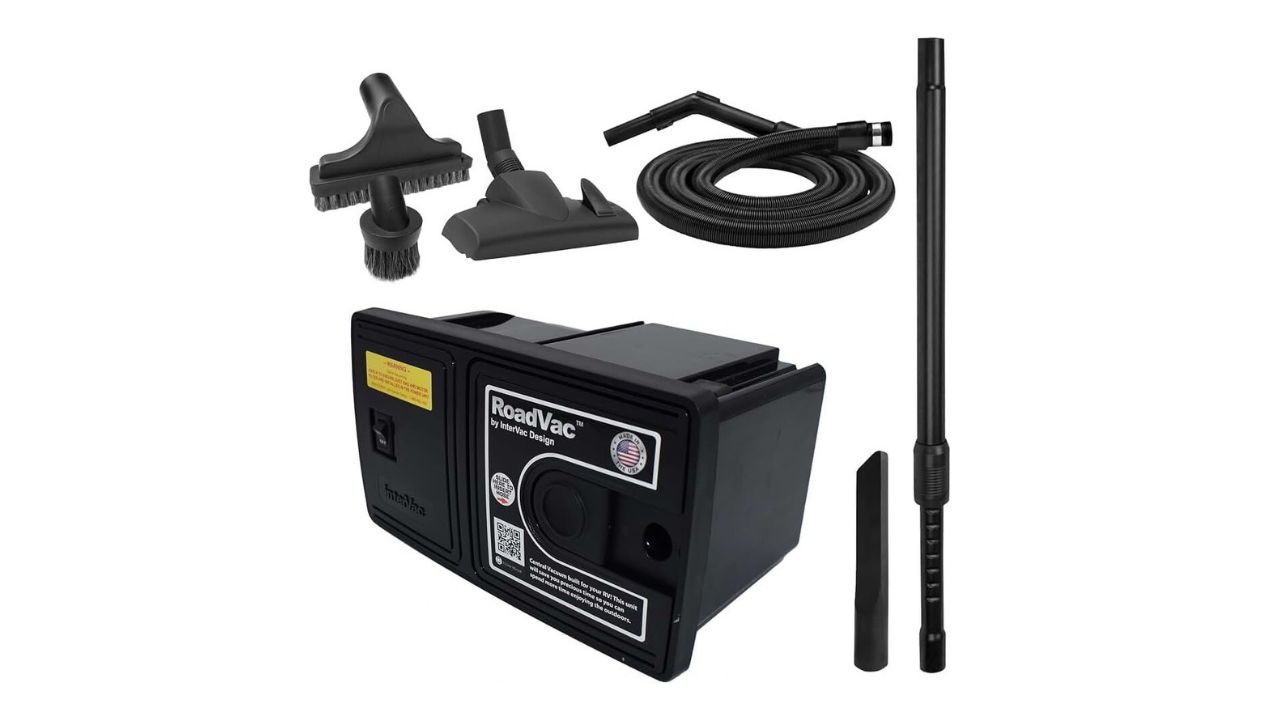
Start with the label inside the unit’s front panel. The label’s gone or the paint’s worn off on plenty of used rigs. When that happens, the cutout size and the badge shape tell you the family it belongs to.
The InterVac and Dometic Name Confusion
Three unrelated companies have used some version of the name “InterVac” over the years. Mixing them up is the single most common mistake owners make when shopping for parts.
The vacuum in your RV is almost certainly built by InterVac Design Corp, a Palm City, Florida manufacturer that makes the CS6, CS8, CSRM, RoadVac, and GarageVac lines sold specifically for RVs, boats, and garages. It is not related to the Canadian “InterVac” brand once made by Nuera Air and now owned by Trovac Industries. It’s also not the same as H-P Products’ unrelated “interVac” condo unit sold through the Vacuflo dealer network.
If you’re searching for parts and keep landing on results for whole-home installations in 2,500 to 12,000 square foot houses, you’ve wandered into one of the other two.
Dometic, the outdoor and RV accessories company, sold InterVac Design Corp’s units under its own brand name for a stretch of years. Owner forums confirm what InterVac’s own retailers will tell you directly: a Dometic RVAC and an InterVac CS8 are the same physical unit with a different badge.
Dometic eventually dropped the central vacuum line, and InterVac went back to selling under its own name to RV manufacturers and directly to owners.
Practically, that means if your unit says “Dometic” on the front, you can source replacement bags and parts under either name. Our Dometic central vacuum details page walks through that relationship in more depth.
Dometic’s current lineup runs the DI-CS8E (badged RVAC) and DI-CSRME (badged RVAC Plus), both InterVac hardware.
Dirt Devil and H-P Products
H-P Products of North Canton, Ohio, licenses the Dirt Devil name for its central vacuum line. That’s the second brand you’ll find factory installed across a wide range of towables and motorhomes.
Owner documentation credits the CV950 as the original equipment choice on older Tiffin Motorhomes. The CV950 and its close relative the RV2000 (sometimes labeled Maxum 2000) were H-P Products’ earlier RV power units.
Both are now superseded in the current catalog by the CV1500, the company’s current flagship. It carries a 5-year warranty, twice the length H-P Products backed the CV950 with.
We tracked down H-P Products’ own 2006 spec sheet for the CV950, and the comparison against the CV1500 isn’t as simple as “newer is stronger” across the board. The CV1500 pulls more air watts (501 versus 450) and more water lift (120 inches versus 105), but the older CV950 actually moves more raw air, 120 CFM against the CV1500’s 100. The CV1500 trades some airflow for concentrated suction, which matters more once the hose is stretched out to 35 feet and needs to hold pressure over that distance.
One thing worth correcting here: several retailers describe “RugRat” as if it were a separate power unit in the Dirt Devil lineage. It isn’t. RugRat is the name of a tool and accessory kit bundle sold with the CV1500, not a distinct vacuum model.
Eureka Yellow Jacket
The Eureka CV140 Yellow Jacket is a discontinued, bagged, wall mounted unit built by Beam during the years Beam operated under Electrolux ownership. Eureka never manufactured its own central vacuum motors. Beam built them.
Beam’s later ownership history explains why Yellow Jacket parts route through unexpected channels today. Beam was sold by Electrolux to Nuera Air in 2018, Nuera Air ceased all manufacturing in April 2024, and Trovac Industries acquired the Beam family of brands afterward.
Our Eureka RV vacuum breakdown covers where to find compatible parts now that the model is out of production.
The Whole-Home Brands Cross-Shopped for RVs
Allegro, Nadair, OVO, and Ecopure are not purpose-built RV products. They’re compact versions of whole-home central vacuum systems. Retailers market them to RV and boat owners because their canisters are small enough to fit in a large motorhome’s basement bay or a toy hauler’s garage.
Allegro Central Vacuum Systems Inc. has manufactured its own units in Oakville, Ontario since 1997, and its MU2100 is genuinely marketed for RVs, buses, and boats. Nadair Inc. and its consumer facing brand OVO build larger canister units (22 to 35 liters) that cover far more square footage than a typical RV needs. Ecopure is manufactured by Cana-Vac exclusively for the retailer CentralVacuumDirect.com.
If you’re comparing one of these against a purpose-built InterVac or Dirt Devil unit, know what you’re trading. You get more raw suction and a bigger dirt bin. You give up a heavier canister, a louder motor (Allegro’s MU2100 runs 75 decibels, notably louder than the compact RV-dedicated units), and amperage draw that can strain an RV’s shore power connection or inverter during boondocking.
Master Specification Comparison Table
Every RV and marine central vacuum model we could source verified specifications for, standardized to the same units. Dimensions are listed as height by width by depth in inches.
Where a manufacturer never published a number, or we found conflicting figures across sources we couldn’t reconcile, the cell reads UNV (unverified) rather than an invented figure. That’s not a placeholder. It’s an honest flag, and the Methodology section below explains exactly why each one is missing.
Power & Performance Specifications
| Brand and Model | Air Watts | CFM | Water Lift (in.) | Voltage | Max Amps | Status |
| InterVac CS8 | 520 | 111 | 113 | 120V | 10A | Active |
| InterVac CSRM | 520 | UNV | 114 | 120V (220V: 5A) | 10A | Active |
| InterVac RM (RoadVac) | UNV | UNV | UNV | 120V | 10A (CSRM hardware) | Active |
| InterVac RoadVac Z1-CS-8-CORD | 520 (CS8 hardware) | 111 (CS8 hardware) | 113 (CS8 hardware) | 120V | 10A (CS8 hardware) | Active |
| InterVac GarageVac GH120 | UNV (conflict: 400 to 512) | UNV (conflict: 100 to 121) | 110 | 120V | 10 to 10.7A | Active |
| InterVac F-120 / H-120 (marine) | 400 | UNV | 100 | 120V | 9A | Active |
| InterVac F-220 (marine, 220V) | UNV | UNV | UNV | 220V, 50/60Hz | UNV | Active |
| InterVac Pro (CondoVac/IVD660) | 660 | 121 | 122 | 120V | 12.7A | Active |
| Dometic RVAC (DI-CS8E) | 520 (CS8 hardware) | 111 (CS8 hardware) | 113 (CS8 hardware) | 120V | 10A (CS8 hardware) | Active |
| Dometic RVAC Plus (DI-CSRME) | UNV (CSRM hardware) | UNV (CSRM hardware) | UNV (CSRM hardware) | 120V | 10A (CSRM hardware) | Active |
| Dometic legacy flush mount (9093100) | UNV | UNV | UNV | 110V (spec lists 240VAC) | 11A | Discontinued |
| Dometic legacy external mount (9093200) | UNV | UNV | UNV | 110V (spec lists 240VAC) | 11A | Discontinued |
| Dirt Devil CV1500 | 501 | 100 | 120 | 120V | 11.7A | Active |
| Dirt Devil CV950 / CV950LE | 450 | 120 | 105 | 120V | 11.3A | Legacy |
| Dirt Devil RV2000 (Maxum 2000) | UNV | UNV | UNV | 120V | UNV | Legacy |
| Eureka CV140 Yellow Jacket | 400 | 108 | 86 | 120V | 10.2A | Discontinued |
| Allegro MU2100 | 525 | 121 | 125 | 110 to 120V | 13.8A | Active |
| Allegro MU4100 / MU4101 | 550 | 121 | 125 | 110 to 120V | 15.7A | Active |
| Ecopure 700ECPC | 700 (Cana-Vac family) | UNV | UNV | UNV | UNV | Active |
| Nadair CV 60018 | 600 | 127 | 140.9 | UNV | UNV | Active |
| Nadair 700AW-25L | 700 | 140.2 | 141.2 | UNV | 15A breaker | Active |
| OVO 700AW Heavy Duty | 700 | 140.2 | 140 | UNV | 13.8 to 15A | Active |
| RecPro RP-2110 VacPan | n/a (inlet accessory) | n/a | n/a | n/a | n/a | Active |
Physical Dimensions & Features
| Brand and Model | Weight (lbs) | Unit Dimensions H×W×D (in.) | Bag Capacity | Filtration | Hose & Accessories | Warranty |
| InterVac CS8 | 5.5 | 6.75 × 11.75 × 6 | 1 gal | HEPA-type bag | 5 ft cord; hose to 35 ft (kit) | 2 yr |
| InterVac CSRM | 5.6 | Cutout 6 × 11 × 6 | UNV | HEPA-type bag | 5 ft cord; 35 ft stretch hose | 2 yr |
| InterVac RM (RoadVac) | UNV | UNV (CSRM hardware) | UNV | HEPA-type bag | 35 ft stretch hose | 2 yr |
| InterVac RoadVac Z1-CS-8-CORD | 8 (shipped) | 4 × 9 × 19 (shipped) | 4 pt (0.5 gal) | 5-layer HEPA-type, 98.3% at 0.03 micron | 35 ft stretch hose | 2 yr |
| InterVac GarageVac GH120 | 9 | 29.5 × 9.5 × 4 | 7 lb / ~1 gal | Triple filtration to 0.3 micron | 5.5 to 8 ft cord; hose to 35-40 ft | 2 yr |
| InterVac F-120 / H-120 (marine) | 8 | 18.25 × 9.5 × 3.94 | 1 to 4 gal | HEPA-type | 40 ft stretch hose | 2 yr |
| InterVac F-220 (marine, 220V) | UNV | 18.25 × 9.5 × 5 | UNV | UNV | UNV | UNV |
| InterVac Pro (CondoVac/IVD660) | 14 | 19.4 × 10.5 × 7.6 (in-wall 3.9) | UNV | HEPA option available; 70 dB | UNV | UNV |
| Dometic RVAC (DI-CS8E) | 7 | matches CS8 cutout | 1 gal | HEPA-type bag | 5 ft cord; 40 ft hose (retracts 10 ft) | UNV |
| Dometic RVAC Plus (DI-CSRME) | UNV | matches CSRM cutout | UNV | HEPA-type bag | UNV | UNV |
| Dometic legacy flush mount (9093100) | 12 | cutout 7.75 × 15.875 (wall depth 3.875) | UNV | Steel powder-coat case | 8 to 30 ft | 3 yr parts, 2 yr labor |
| Dometic legacy external mount (9093200) | 12 | UNV cutout (surface mount) | UNV | Steel powder-coat case | 8 to 30 ft | 3 yr parts, 2 yr labor |
| Dirt Devil CV1500 | 14 | 14.5 × 7 × 6.25 | 1 gal | HEPA bag, 99.97% at 0.3 micron | 7 to 35 ft | 5 yr |
| Dirt Devil CV950 / CV950LE | 14 | 14.5 × 7 × 6.25 | 1 gal | HEPA-compatible bag | 7 to 30 ft (kit) | UNV |
| Dirt Devil RV2000 (Maxum 2000) | UNV | UNV | UNV | HEPA-compatible bag | UNV | UNV |
| Eureka CV140 Yellow Jacket | UNV | 14.5 × UNV × 7 | 1 gal (4 qt Style OX) | Bagged, standard | UNV | UNV |
| Allegro MU2100 | 15 (shipping) | 20 × 8.5 dia. | 0.5 gal | Washable cloth filter, bagless | Sold separately, 7.5 ft kit hose | UNV |
| Allegro MU4100 / MU4101 | 28 | 39 × 12 dia. | 5 gal | Hybrid, bag or bagless, to 99.97% | 30 ft (per kit) | UNV |
| Ecopure 700ECPC | UNV | ~12 dia. (Cana-Vac ref) | 4 gal (Cana-Vac ref) | Paper bag | UNV | UNV |
| Nadair CV 60018 | UNV | UNV | 18L / 4.75 gal | Top-fill disposable bag | UNV | UNV |
| Nadair 700AW-25L | UNV | UNV | 5.8 gal / 22L | Hybrid, bag or bagless; 63 dB | UNV | UNV |
| OVO 700AW Heavy Duty | UNV | UNV | 9.25 gal / 35L | Hybrid + washable filter | 30 ft (kit) | UNV |
| RecPro RP-2110 VacPan | UNV | cutout 6.75 × 1.75; 2 in. pipe conn. | n/a | n/a | n/a | UNV |
A note on that Allegro MU2100 washable cloth filter: it means no ongoing bag purchases, but the reader empties and washes it by hand, which is a real difference from the bag-swap habit CV1500 or CS8 owners are used to. And its 75 decibel operating volume is loud enough to hold a conversation over, closer to a shop vac than the compact RV units it sits beside on this list.
Cross-Brand Compatibility Matrix
Dometic RVAC (DI-CS8E) and InterVac CS8 are the identical unit. Same power unit, same cutout, same bags. The Dometic RVAC Plus (DI-CSRME) is the identical unit to the InterVac CSRM. If a dealer quotes you a “Dometic exclusive” part at a premium, you can buy the InterVac equivalent instead.
Dirt Devil CV950, RV2000, and CV1500 share the same replacement bag family, part numbers 7767-W and 9597, despite being three different generations of the product. That’s the opposite of the common assumption that a bag bought for one won’t fit another in this lineage.
It also means if you’re not sure whether your unit is a CV950 or an RV2000, buying either bag is a safe move. The guesswork only matters if you’re shopping for a replacement motor or power unit.
InterVac’s bag numbering splits by chassis family, not by marketing name. Bag Y10-5 fits the CS6, CS8, and CS8HW, and it doubles as the Dometic CV1003 bag under a different part number. Bag Y11-5 fits the CSRM, CS9, and CS10, doubling as the Dometic CV1004. Buy by chassis family, not by whether the front badge says InterVac or Dometic.
Eureka Yellow Jacket parts do not cross over to InterVac or Dirt Devil. Eureka’s Yellow Jacket uses a 4-quart Style OX bag, a completely different shape from the flat pouch bags InterVac and Dirt Devil use. Beam built the motor on its own architecture.
If your Yellow Jacket died and you’re looking at a straight swap, there isn’t a plug-and-play replacement bag or motor from another brand. The realistic path is replacing the whole power unit, and the InterVac CS8 or Dirt Devil CV1500 are the closest same-class options in current production.
Measure your existing cutout first. The Yellow Jacket’s 14.5 inch height doesn’t automatically match either replacement’s footprint.
RoadVac is a retail name InterVac Design Corp uses for its own CS8 and CSRM product family, not a separate manufacturer. If you see “RoadVac” and “InterVac” listed as if they’re competing brands, they’re the same company selling through different channels.
Allegro, Nadair, OVO, and Ecopure do not share parts with InterVac, Dometic, or Dirt Devil. Different motor architecture (Ametek/Lamb tangential bypass motors, versus the flow-through motors in the RV-dedicated units), different bag and filter shapes, and in Allegro’s case, no bag at all.
Treat these as their own compatibility island. Within that island, confirm exact bag part numbers before buying.
Nadair and OVO share a parent company and similar canister construction. We could not verify that their disposable bags are interchangeable model to model, so check the specific part number stamped inside your unit before ordering.
Inlet valve sizing is where retrofit installs go wrong most often. The general central vacuum industry standard hose end is 1.5 inches in diameter. Older Dirt Devil and H-P Products RV units, including the CV950 and RV2000, were built around a smaller 1-3/8 inch inlet valve specific to RVs.
Adapters exist to step between 1-3/8, 1.5, and 2 inch fittings. Don’t assume a hose from a home central vacuum system will plug straight into an RV-dedicated inlet without one.
Confirm your inlet valve size before ordering a replacement hose from a different brand.
Replacement Parts Cross-Reference
Bags
| Part Number | Fits | Notes |
|---|---|---|
| InterVac Y10-5 (5-pack, includes motor filter) | InterVac CS6, CS8, CS8HW; cross-branded as Dometic CV1003 | HEPA-type bag |
| InterVac Y11-5 (5-pack, includes motor filter) | InterVac CSRM, CS9, CS10; cross-branded as Dometic CV1004 | HEPA-type bag |
| InterVac Y08-5 | InterVac Pro models H, F, LH, GH, GF, RM, RMH, RMF | HEPA-type bag |
| InterVac Y09-5 | InterVac RMD models | HEPA-type bag |
| Dirt Devil / H-P Products 7767-W or 9597 (3-pack) | Dirt Devil CV950, CV950LE, CV1500, RV2000 / Maxum 2000 | HEPA bag, 99.97% at 0.3 micron; confirmed interchangeable across all four model names |
| Eureka Style OX (4 qt) | Eureka CV140 Yellow Jacket only | Not compatible with InterVac or Dirt Devil units |
Hoses
Standard RV central vacuum hoses ship as expandable, crush-resistant units that compress to a short length for storage and stretch out for cleaning. The InterVac CS8, CSRM, and RoadVac family ship with a hose that compresses to roughly 5 to 7 feet and stretches to 35 feet.
The Dirt Devil CV1500 ships with a 7-foot hose that expands to 35 feet as well. The two most common current RV units use the same working range, which matters if you’re deciding whether a longer aftermarket hose will reach every corner of your floor plan.
The Dometic RVAC’s published hose spec (40 feet extended, retracting to 10 feet) runs longer than the InterVac CS8 hardware it shares a chassis with. Confirm which hose actually shipped with your specific unit rather than assuming by brand name.
Cuff sizing follows the inlet valve standard noted above. Match 1-3/8 inch cuffs to older Dirt Devil units and 1.5 inch cuffs to current InterVac, Dometic, and CV1500 hardware.
Filters
Every current RV-dedicated unit on this list (InterVac’s full lineup, Dometic’s rebadged versions, and the Dirt Devil CV1500) ships with HEPA or HEPA-type bag filtration rated to capture particles down to 0.3 microns. That matters for pet owners and allergy sufferers running the vacuum in a closed-up rig.
HEPA, or High Efficiency Particulate Air filtration, means the filter traps at least 99.97 percent of particles at that size, the standard most manufacturers cite.
The Allegro MU2100 skips bags and filters entirely in favor of a washable cloth filter. That cuts your ongoing cost but means hand-cleaning a dust-caked filter instead of dropping in a fresh bag.
Replace bag-style filters when the bag reaches half to two-thirds full or feels firm when you press it, generally every three to four months of regular use.
Motor filters (the secondary filter behind the bag, protecting the motor itself) last the life of the unit and only need replacement if visibly clogged or torn.
Inlet Valves
InterVac’s current hardware uses the AS-40 inlet valve as standard equipment across its RV product line, paired with the VacPort fitting for baseboard dustpan installations.
Dirt Devil’s CV1500 supports both standard inlet valve mounting and an optional Flex Connector Kit. That kit lets you separate the power unit from the inlet valve by up to 5 feet, useful when the ideal wall cavity for the motor isn’t directly behind where you want the inlet.
Confirm mounting type (flush or surface) and cutout dimensions before ordering an inlet valve separately from a full kit. Flush-mount and surface-mount hardware are not interchangeable without additional trim parts.
Accessory Kits and Tools
InterVac’s TK-104 and TK-108B kits and Dirt Devil’s RugRat bundle cover the same functional ground: a telescoping wand, combination rug and floor tool, crevice tool, dusting brush, and upholstery brush, packaged with the stretch hose.
These tool heads use a standard friction-fit wand connection across both brands. A crevice tool from one kit will generally seat on a wand from the other, even though the manufacturers don’t market them as cross-compatible.
Allegro’s accessory kits are sold separately from the MU2100 power unit itself, a detail some retail listings bury. Budget for the ZAS210 hose and ZIK010 inlet kit on top of the base unit price if you’re buying new.
Installation Fit Reference
InterVac CS8, CSRM, and the Dometic-badged equivalents share the same footprint: an 11 inch wide by 6 inch high cutout, minimum 6 inch installation depth, and a wall thickness between 3/8 and 1 inch.
That’s a small enough cutout to fit inside most RV pantry cabinets, under a dinette seat, or in a closet. It explains why this is the family most commonly factory installed across Forest River, Grand Design, and Prime Time trailers, where owner documentation confirms units mounted in the pantry cabinet above the breaker panel.
Dirt Devil’s CV1500 measures 6.25 by 7 by 14.5 inches and can mount top or bottom, horizontally or vertically, which gives installers more flexibility in an odd-shaped compartment than the boxier InterVac units allow.
InterVac’s GarageVac GH120 is a tall, narrow unit at 29.5 by 9.5 by 4 inches, designed for wall mounting in a garage or basement storage bay rather than a cabinet cutout. It’s worth considering for large motorhomes with a walk-in storage bay, but it won’t fit the same compact cavity a CS8 does.
Marine installations run different voltage. InterVac’s F-220 is built for 220V, 50/60Hz power and needs a 16 inch high by 8-1/8 inch wide cutout, noticeably larger than the RV-dedicated 120V units.
Boat owners running 110V shore power or an inverter should confirm which voltage variant they’re buying. F-120 and F-220 are not interchangeable without a different electrical setup entirely.
All of the units in this chart plug into standard 110 to 120V household-style outlets except the marine 220V variants. That matters for boondocking. A compact InterVac CS8 or Dirt Devil CV1500 drawing 9.5 to 11.7 amps is a manageable inverter load for most RV battery systems running briefly.
The larger whole-home-style units cross-shopped for RVs, like the OVO 700AW or Ecopure 700ECPC, weren’t engineered with RV power budgets in mind. Their higher rated amperage and larger motor startup draw are worth checking against your inverter’s continuous and surge ratings before you commit to one as an upgrade.
Hose routing matters more in an RV than a house. The compact power units on this list are designed to sit close to a single inlet, most often with the hose stretching out from one central point rather than running long pipe networks to multiple inlets the way a house-sized system would.
If you’re adding a second inlet (a common upgrade for larger fifth wheels with a separate bedroom), confirm the manufacturer’s maximum supported hose run before you cut a second hole. Suction measurably drops the farther the inlet sits from the power unit.
Methodology and Corrections
We built this chart from manufacturer product pages and installation manuals: InterVac Design Corp, H-P Products/Dirt Devil, Allegro Central Vacuum Systems, Dometic, Nadair, and OVO. We backed that with retailer spec sheets from CentralVacuumDirect, ThinkVacuums, RV Upgrade Store, and Young Farts RV Parts, plus owner-confirmed compatibility threads on iRV2, Forest River Forums, and Montana Owners Club.
Every spec carries a source we can point back to.
Where manufacturers didn’t publish a number, or where we found conflicting figures across sources we couldn’t reconcile, we marked the field UNV rather than estimate. We tracked down an original 2006 H-P Products dealer spec sheet for the CV950 and CV950LE, so those numbers are now confirmed. The RV2000 (Maxum 2000) is the one that’s still genuinely thin. It’s discontinued long enough that H-P Products no longer lists full specs for it anywhere we could find.
The same goes for the Dometic legacy 9093100 and 9093200 series. We located the original Dometic AB installation manual, which confirmed cutout size, amp draw, weight, and warranty terms. That manual’s spec table lists 240VAC while its own install instructions reference a 110V outlet for the flush mount version, a contradiction in the source document itself that we couldn’t resolve, so we flagged voltage rather than guess which figure applies to which mount type.
Several of the whole-home-style brands (Ecopure, and the exact weight and dimensions for the larger Nadair and OVO units) still have gaps, since RV-specific performance data isn’t separately published from their general residential specs.
If you own one of the UNV models and can confirm a spec from your owner’s manual or a manufacturer support call, email us and we’ll update the chart with credit to you.
We’ll also revisit this page quarterly to catch new model releases, discontinuations, and pricing changes, and we’ll update the “last updated” date at the top each time we do.