The Beam Serenity Plus shows up on three dealer pages with three different air watt numbers, and none say which one is real. Dealers lean on the highest figure to justify a price tag built for a 6,000 square foot home, even when your closet barely fits the canister.
This guide pulls the SC3500’s verified specs from Beam’s own documentation, the ASTM test behind the air watt claim, and owner reports of the shutoffs that send people searching at midnight. You’ll leave knowing what to repair, what to skip, and which unit replaces it. Central Vacuum Lab’s Beam vacuum guide covers the full lineup.
Beam Serenity Plus
A discontinued dual-motor power unit, model SC3500, rated at a combined 1,045 air watts across two 240-volt motors. Trovac’s 2024 Beam acquisition now governs its parts and warranty. It fits large homes with long pipe runs, not starter installs. Confirm parts supply before buying or repairing one.Sorting Out What Serenity Plus Really Means
Serenity Plus is not one product, it’s a naming convention Beam reused across a power unit, a power head, and several bundled kits. Get the model number off the unit’s nameplate before you order parts or quote a repair, because the wrong order wastes a week of shipping.
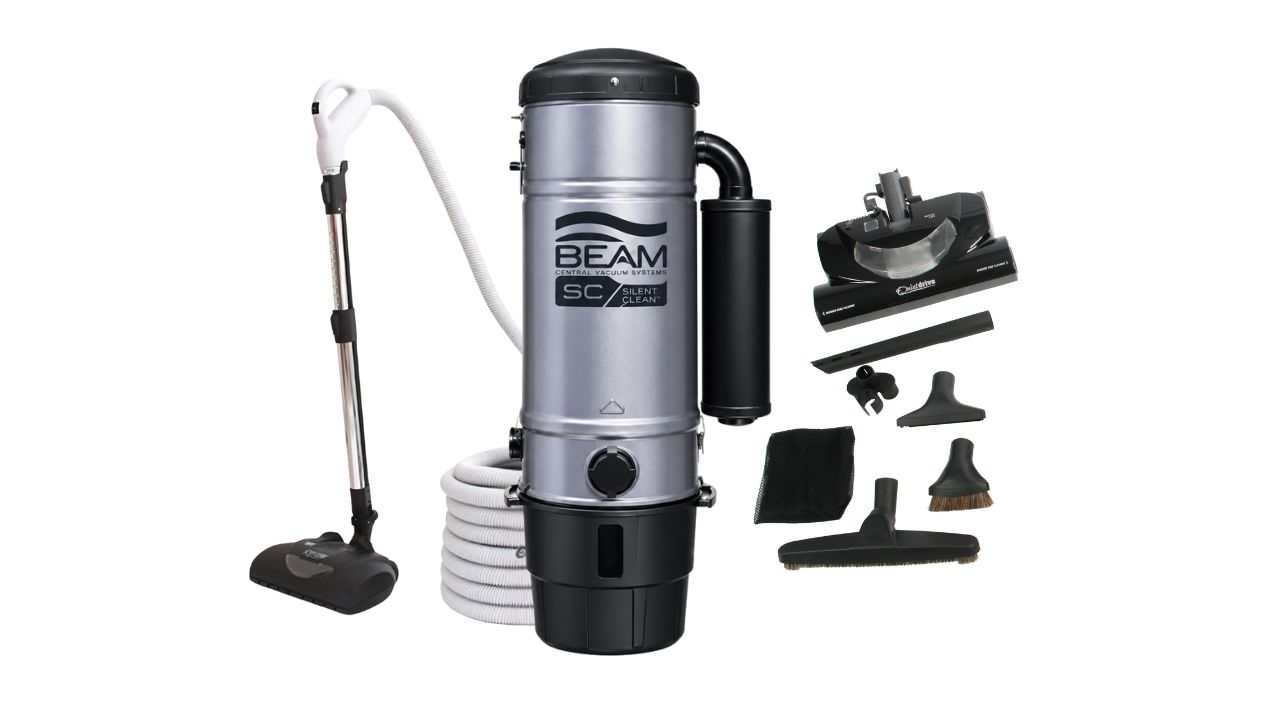
Is it a power unit, nozzle, or kit?
The Serenity Plus name covers a wall-mounted power unit, a separate power head attachment, and full installation kits sold together. Buyers and even some techs grab the wrong part because retailers slap “Serenity Plus” on all three without saying which one they mean.
Here’s the thing: a listing titled “Beam Serenity Plus Central Vacuum” might ship you just the canister, no hose, no power head, no inlets. Pull the model number, stamped 000328 on the SC3500, before calling anyone for parts.
- Photograph the nameplate on the power unit.
- Confirm whether you need the unit, the power head, or both.
- Match that model number to the part you’re quoting.
Got the right model? Good, now let’s see why the size dealers recommend rarely fits the home it’s going into.
Why dealers push a Serenity Plus 2875 model
Some reps quote the largest Serenity Plus available no matter the home’s size, because a bigger number sells easier than an honest fit. Owners in modest homes report being steered toward the most powerful unit in the line for a house a fraction of its rated coverage.
A 1,550 square foot semi-detached home rarely needs a flagship dual-motor unit. The pipe run is short, the elbow count is low, and a single-motor unit in the 400 to 600 air watt range moves plenty of air at the farthest inlet. Watch this pattern: the bigger the power claim on the brochure, the bigger the commission on the invoice.
The SC3500 dual motor behind the big name
The SC3500 runs two 240-volt, two-stage bypass motors instead of one. Bypass motors pull cooling air across the housing separately from the dirty airflow, so they run cooler and outlast the single-stage thru-flow motors in cheaper units.
Two motors also mean two sets of carbon brushes, two thermal overload protectors, and double the failure points. More power at the inlet means more hardware to maintain over the unit’s life.
Who Owns Beam Now And Why You Care
Beam belongs to Les Industries Trovac Ltd. as of June 2024, not Electrolux Group or Nuera Air, and that change decides whose warranty paperwork is worth anything today. Parts supply and service follow the brand, not the box in your basement.
From Electrolux to Nuera Air to Trovac
Beam launched in 1957, Electrolux Group bought the brand in 1987, and Nuera Air later took over manufacturing before halting production. Trovac acquired Beam in June 2024 after Nuera Air’s exit, picking up roughly a third of the world’s central vacuum output.
Each handoff reshuffled who answers the phone when a Serenity Plus motor dies. A warranty card printed under one owner doesn’t guarantee service from the next.
What the 2024 sale did to your warranty
Ownership changes strand warranties even when paperwork looks fine, and that’s exactly what happened to older Serenity Plus units. Beam’s current warranty page covers units manufactured as of September 2024 under Trovac, leaving earlier Serenity Plus units in a gray zone.
Call and get the coverage confirmed in writing. A two-year warranty printed on a box from the Nuera Air era means little once the company behind it no longer exists in that form.
Why the site still names two owners
Beam’s own website still shows seams from the 2024 sale, with some pages crediting Trovac and others carrying older Nuera Air language. That inconsistency on the manufacturer’s own site is a signal, not a typo.
Verify any dealer’s warranty or parts claim directly with Beam, not a sales page written before the acquisition closed.
The Air Watt Numbers That Don’t Add Up
The Serenity Plus SC3500 sells at 1,000, 1,045, and 1,100 air watts depending on the page, and only one of those numbers traces to an actual test. Air watts measure sealed suction power at the hose end under load, and a combined dual-motor figure doesn’t work the way a single-motor rating does.
Is the beam serenity plus really 1,045 air watts?
The SC3500’s documented rating is 1,045 air watts, the figure Beam’s own product page lists for the twin-motor unit, while other retailers round it to 1,000 or up to 1,100. Same model, different number, depending on which catalog copied which spec sheet first.
The figure is marketing copy, not a measurement, whenever nobody on the sales floor names ASTM F558. Ask which testing standard produced the number before you trust it.
Why 211 CFM and 124 inches mislead you
The SC3500’s 124 inches of water lift happens at zero airflow, and its 211 CFM peak happens at zero suction resistance. Those numbers never occur at the same moment, any more than a sprinter doubles as the strongest powerlifter on the same lap.
Real cleaning happens in the middle of that curve, at whatever resistance your pipe run, elbow count, and inlet create.
The air watt rating no dealer actually measures
Multiply the SC3500’s 211 CFM by its 124 inches of water lift and the math overshoots 1,045 by a wide margin, proof the headline numbers come from two separate test points, not one combined reading. the ASTM F558 air-performance test method defines air watts as one measurement taken at a single operating point, not multiplied from two separate peaks.
Trust an air watt figure measured at one operating point under that standard. Don’t trust one assembled after the fact from a spec sheet’s best individual numbers.
Filtration Claims Versus What The Filter Does
Beam calls the Serenity Plus filter hospital grade, but hospital grade is not a regulated term and the Gore filter inside it is not true HEPA. True HEPA has one legal definition, and the Serenity Plus filtration system doesn’t meet it.
Is hospital grade the same as true HEPA?
No, hospital grade is marketing language, while true HEPA is a specific, regulated capture rate the Serenity Plus filter doesn’t claim to hit. The Gore self-cleaning filter inside the SC3500 captures roughly 98% of particles at 0.3 microns. True HEPA, under the US Department of Energy standard most manufacturers reference, requires capturing 99.97% at that same size, the hardest particle to trap.
That gap matters for an allergy sufferer weighing filtration claims:
- True HEPA, certified to the DOE’s 99.97% standard.
- The Serenity Plus’s Gore media, rated near 98%, uncertified.
- Any filter marketed only as “hospital grade,” with no published percentage.
How the Gore self cleaning filter really performs
The Gore filter pulses itself clean every time you power the unit off, which is the real engineering behind the “maintenance free” claim, not a higher filtration grade. That self-pulse keeps airflow from choking down as dust builds, which matters more for sustained suction than for allergy protection.
An allergy sufferer needs the actual capture number, not the word permanent. Seals age, gaskets crack, and real-world dust escape climbs years after the factory rating.
Does the permanent filter ever need replacing?
Yes, despite “permanent” marketing language on North American pages, Beam’s own UK documentation recommends a filter change roughly every five years. One manufacturer, two answers, and that contradiction alone should make you double-check every other claim on the spec sheet too.
How Quiet Is This Vacuum Really
Beam markets the Serenity Plus as its quietest line, and the honest answer depends on which spec sheet you trust, since published figures range from the low 60s to over 80 decibels. That’s not a rounding error, it’s a different test method or motor configuration entirely.
62, 68, or 72 decibels which is honest?
The most consistent figure puts single-motor Beam units around 62 to 68 decibels, while a documented spec sheet for the dual-motor SC3500 lists 82.4. A ten-decibel gap sounds modest on paper but reads as roughly double the perceived loudness, so one quiet number says almost nothing about this twin-motor flagship.
Where you mount it changes the noise
Power unit location changes the experience of any decibel rating more than the spec sheet does. A garage, basement, or detached utility room install keeps motor noise away from bedrooms and living space, no matter the rated output.
Mount the SC3500 near a finished living area and most of its quiet engineering cancels out from simple proximity. Plan the location before the decibel number on the box sways the decision.
What Owners Say After Years Of Living With It
Long-term owners report three friction points: a proprietary hose connection, a canister button that pops mid-clean, and a kitchen sweep inlet most stop using within a year. None show up on a spec sheet.
The proprietary hose end nobody warns you about
The Serenity Plus uses a proprietary low-voltage hose connection, locking you out of swapping in another brand’s electric power nozzle without an adapter. Standard 2-inch tubing and inlet fittings stay compatible across Beam, Drainvac, CycloVac, OVO, and most North American systems. The exception is that hose end, which needs a Beam-specific adapter for any non-Beam electric hose.
That lock-in raises the long-term cost of accessories, since you’re shopping one brand’s catalog instead of the wider market.
Why the canister button pops and shuts off
Owners describe strong suction for ten to twenty minutes, then a small white button on the canister pops and the unit shuts down mid-room. That symptom traces to one of three things, checked in this order:
- A clogged filter or full dirt bin restricting airflow.
- Worn canister seals or gaskets letting pressure fluctuate.
- A tripped thermal overload protector on one motor.
Clear the filter and bin first, every time, before assuming a motor or switch has actually failed.
The vac pan owners quietly call a gimmick
The built-in kitchen sweep inlet sounds convenient in the brochure, and most owners use it for a few months before it becomes a vent catching crumbs nobody sweeps toward it. The honest owner consensus: rarely worth paying extra for.
Spend that budget on a longer hose or one more wall inlet instead. You’ll use either daily for years, unlike the pan.
Repair It Or Replace It For Good
The SC3500 sits in Beam’s own archive section, the manufacturer quietly telling you this platform is fading even while dealers still sell it at full price. Parts still exist. Whether to keep buying them depends on what’s actually broken.
Can you still buy Serenity Plus parts today?
Yes, motors, switches, gaskets, and dirt buckets for the SC3500 remain available through specialist dealers. The archive listing is a quiet warning sign for long-term support, not an immediate parts shortage.
Confirm the exact part number against your unit’s nameplate before paying for anything. Archived platforms are exactly where wrong-part orders become expensive mistakes.
When a 15 year old unit earns saving
A Serenity Plus with a sound motor and clear pipes is almost always cheaper to repair than replace, right up until the motor, circuit board, and seals fail together. At that point you’re paying for the same labor twice.
Your installed pipe network, the 2-inch PVC inside your walls, is the real asset, not the power unit hanging in the utility room. A new unit bolts onto that existing tubing in most retrofits, so replacing the can rarely means tearing into drywall again.
Smart replacements if you decide to upgrade
Weigh any replacement on motor type and parts availability first, and the air watt headline last, since that number caused the confusion that sent you researching the Serenity Plus.
Homes with long pipe runs and several upstairs inlets still benefit from real dual-motor headroom. Beam Premium for raw suction power covers that upper tier without the archived-parts question hanging over it.
A typical single or two-floor layout rarely needs twin motors at all. The compact Beam Pro alternative matches output to that footprint at a lower repair cost.
Smaller homes and tighter budgets don’t need flagship air watts to clean every room well. The entry-level Beam Easy Living earns its keep with a simpler, cheaper unit to service later.
| Replacement tier | Motor setup | Best fit |
|---|---|---|
| High-output | Dual motor | Large homes, long pipe runs, multiple floors |
| Mid-range | Single motor | Typical 2,000 to 3,500 sq ft homes |
| Entry-level | Single motor | Smaller homes, tighter budgets |
What to ask before paying for a repair
Get the exact failed part named and priced before you approve any labor on an aging, partly archived platform. A vague quote on an orphan unit is exactly where surprise bills happen.
- Name the specific failed part, not just “the motor” or “the board.”
- Ask whether they stock Serenity-specific switches and gaskets, or order them.
- Ask for a worst-case total upfront, including a second motor if one already failed.
Sizing It To Your Home Not The Brochure
Match inlet placement to your home’s layout, not the unit’s total rated coverage, because a powerful canister wired to badly placed inlets still leaves dead zones. Coverage numbers on the box describe a lab ceiling, not your hallway.
Match inlet count to square footage per floor
Plan inlet count and placement around each floor’s footprint, not the home’s total square footage as one number. Most homes need an inlet within roughly 30 feet of hose reach from every room, about one inlet per 600 to 700 square feet per floor.
Smart placement beats raw power for daily convenience. A 1,045 air watt unit feeding one badly placed inlet still means dragging a 50-foot hose through three rooms to reach the stairs.
The 35 foot rule that kills distant suction
Suction at the farthest inlet drops noticeably once the pipe run passes roughly 35 feet, no matter how the unit is rated on the box. A 15,000 square foot coverage claim ignores the friction, elbow count, and vertical rise your installation adds.
Treat any coverage claim as a lab ceiling, measured with minimal pipe and zero elbows. Your kitchen inlet, three floors and six elbows away, is a different physics problem entirely.
Conclusion
You came in trusting the highest air watt number and the words hospital grade on the box. You leave knowing those numbers come from two different tests, that Beam now answers to Trovac, and that a popping canister button points to a dirty filter, not a dead motor.
Tonight, find your unit’s model plate, photograph it, and call one dealer to ask about parts availability before you decide anything. A right-sized central vacuum, matched to your actual pipe run instead of a brochure ceiling, spares your back and your sinuses every day a portable never could.
Frequently Asked Questions
How many air watts does the Beam Serenity Plus actually have?
1,045 air watts is the documented figure from Beam’s own SC3500 page. Listings rounding to 1,000 or 1,100 are copying older or inflated spec sheets, not running a separate test.
Is the Beam Serenity Plus discontinued, and can I still get parts?
Yes, it’s discontinued and filed under Beam’s archives, but motors, switches, and gaskets remain available through specialist dealers. Confirm the part number against your nameplate first.
Why does my Beam Serenity Plus run for a few minutes and then shut off?
A clogged filter or full dirt bin is the most common cause, followed by worn canister seals and a tripped thermal overload protector. Clear the filter and bin before assuming a motor has failed.
Does the Beam Serenity Plus need a 240-volt or special circuit?
Yes, the SC3500 runs two 240-volt motors on a dedicated circuit, unlike single-motor Beam units built for standard household voltage. Check your panel before assuming a straight swap is possible.
What is the difference between the Serenity Plus and a single-motor Beam unit?
The Serenity Plus runs two 240-volt bypass motors for a combined 1,045 air watts, while single-motor units run one motor in the 400 to 700 air watt range and cost less to repair.
What can I replace a Beam Serenity Plus with without changing my pipes or inlets?
Any current power unit using standard 2-inch fittings bolts onto your existing PVC pipe and inlets in most homes. Match the motor type and air watt class to your square footage, not another flagship by default.
How long should the Serenity Plus motors last before they need replacing?
Bypass motors like the SC3500’s run for several thousand working hours before the carbon brushes wear down enough to need replacement. Daily use in a busy household reaches that point faster than occasional use in a smaller home.