A beam hoover system is not a Hoover product. It is a built-in vacuum made under the Beam name, and the “hoover” in your search is the British and Irish habit of using a brand as a verb, the same way some people say “hoover the lounge” no matter whose motor is spinning in the garage. That mix-up trips up a lot of buyers before they even get a quote.
Here is the misleading bit nobody fixes: dealers quote air watts like one number tells the whole story, when the same rating means different things on different pipe runs. Finish this guide and you will know which Beam unit fits your square footage, which specs to demand in writing, and which sales lines to ignore. You’ll also get Central Vacuum Lab’s central vacuum overview if you want the wider brand picture after this.
Beam Hoover System
A beam hoover system is a Beam-branded built-in vacuum, not a Hoover product, despite the search term. Beam, now manufactured by Trovac Industries after a 2024 ownership shift, sells central power units rated from roughly 550 to over 1,000 air watts. It suits homeowners specifying or replacing a ducted vacuum in a UK, Irish, or North American home. It is not for anyone hunting an actual Hoover-brand machine.The confusing name you typed into search
The phrase comes from habit, not confusion about the product itself. People type “hoover” because that’s the word their parents used for any vacuum, and Beam happens to be the dominant built-in brand where that habit runs strongest.
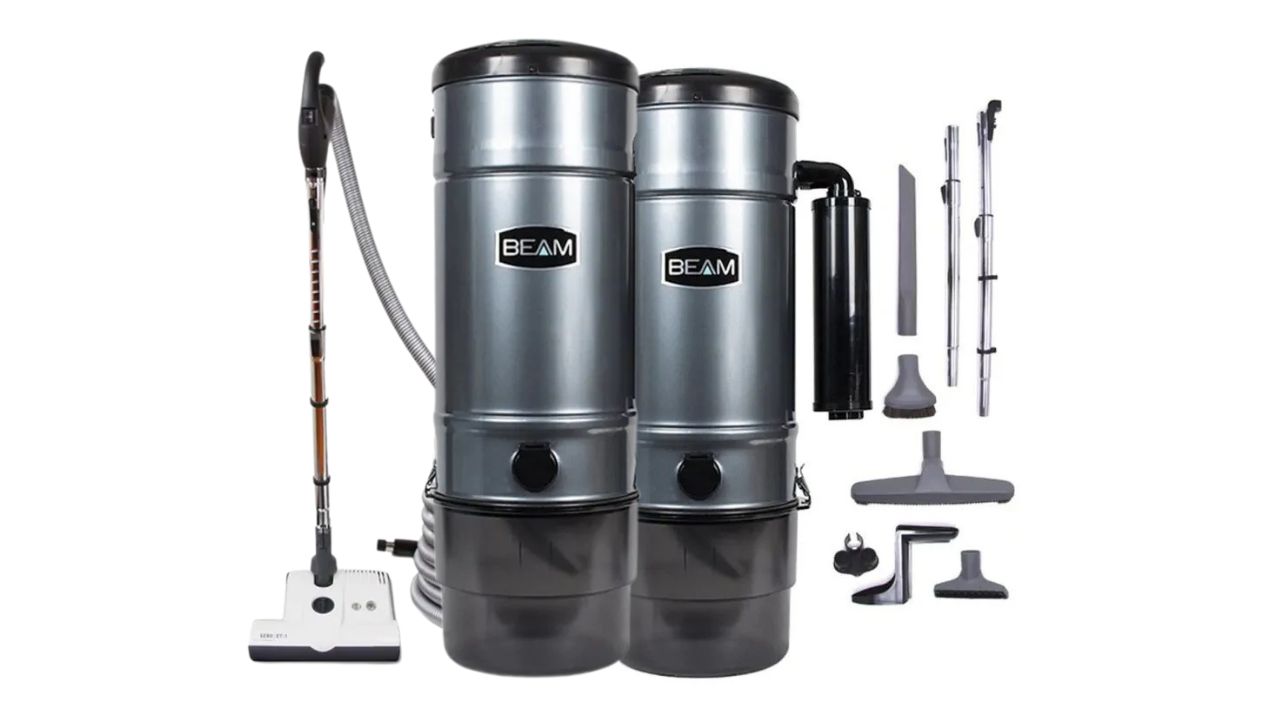
Why do people call it a beam hoover system?
Because “hoover” is a verb in everyday speech, not a brand reference. It stuck the same way “Sellotape” means any sticky tape in the UK.
- Many readers use “hoover” as a verb, meaning to vacuum, not the brand.
- Beam dominates Ireland and the UK, with BEAM Vacuum & Ventilation alone reporting over 80,000 installs since 1977.
- That regional habit fuses two separate names into one searched phrase, and Google has no way to untangle it for you.
Beam and Hoover never shared a factory
No, Beam and Hoover central vacuums were never built on the same line. They came from entirely separate manufacturers, parts catalogs, and engineering choices.
- Beam and Hoover central vacuums came from completely different manufacturers and parts lines.
- Treating them as identical leads buyers toward the wrong replacement unit entirely.
- Knowing the split saves you from ordering filters that will not fit your inlet.
Which brand is actually on your wall?
Check the power unit nameplate before you order anything. The badge on your wall inlet tells you almost nothing; the sticker on the power unit tells you everything.
- Check the inlet plate, power unit label, and any model sticker first.
- A Hoover badge and a Beam badge demand different parts catalogs completely.
- Photograph the model number now, so you stop guessing during every parts call.
Who actually builds these systems today
Beam is built by Trovac Industries, and Hoover’s old central vacuum line was built by a separate company called Cana-Vac. Knowing which one made your unit decides whether parts show up next week or never. This section pulls from manufacturer press releases, the acquiring company’s own site, and forum reports from owners and technicians, since neither beamvac.com nor any dealer page currently states the full chain in one place.
Beam belongs to Trovac since June 2024
Yes, Trovac Industries owns Beam as of June 2024, after the previous owner stopped making the brand entirely. That single fact decides whether your warranty means anything.
- Electrolux sold the Beam business to Nuera Air in 2018, closing out Electrolux’s divestiture of the Beam central vacuum business after a strategy shift toward its core appliance lines.
- Nuera Air’s halt in production was first reported on April 2, 2024, and it didn’t just affect Beam. It froze output for DuoVac and Husky too.
- Les Industries Trovac Ltd. acquired Beam, DuoVac, and Husky in June 2024 and resumed warranty support on units built since.
One catch worth flagging: beamvac.com’s own contact page still describes the brand as “wholly-owned by Nuera Air,” even though its footer credits Trovac Industries Inc. Treat that page as stale and trust the footer over the meta tag.
Hoover central units traced back to Cana Vac
No, Hoover never built its own central vacuums. A separate Canadian manufacturer, Cana-Vac, built them under license for more than two decades.
- Forum members on VacuumLand report Hoover centrals were built by Cana-Vac for roughly 25 years.
- Hoover’s central vacuum line has quietly exited the market, with no current production run.
- OEM, meaning the original equipment manufacturer, differs sharply between the two badges, and that’s the detail dealer pages skip.
Why the maker decides your parts future
The maker decides whether you can still buy a motor in five years. Skip this question and you’re gambling on a brand that might already be orphaned.
- An orphaned brand can leave you hunting motors and filters for years, sometimes importing them from overseas.
- A supported maker like Trovac keeps boards, hoses, and bins in stock through its dealer network.
- Ask who answers the phone before you trust any ten-year warranty promise on paper.
Who’s actually going to pick up when you call in year seven?
The spec that beats motor wattage
Air watts beat motor wattage as a performance gauge, full stop. Motor wattage tells you how much electricity the motor draws; air watts tell you how much of that draw turns into cleaning suction at the hose end.
Air watts versus the big box number
Air watts, the suction measured at the cleaning head, beat the motor wattage printed on the box. The math behind it follows the ASTM F558 air-watt measurement standard, which multiplies airflow by water lift and divides by 8.5.
- A Beam Serenity SC375 rates at 650 air watts, with 125 CFM of airflow and 116 inches of water lift on a 14.5-amp motor.
- That output covers homes up to roughly 8,000 square feet, according to Beam’s own spec sheet.
- Some sellers swap the divisor in the formula to inflate figures, so question any number that isn’t backed by a published test method.
Water lift is the spec dealers skip
Water lift, the suction strength that pulls debris uphill through pipe, almost never makes the glossy brochure. It matters more than the headline air-watt number once your pipe run gets long.
A Hoover SH80570 power unit lists 572 air watts and 128 inches of sealed suction, beating some higher-air-watt Beam units on raw lift alone.
Treat single-source spec sheets as claims to verify, not gospel to trust. Ask the dealer for the water lift number in writing, and walk away if they can’t produce it.
Suction you lose before you ever notice
You lose suction with distance, and you lose it before the vacuum ever feels weak in your hand. Every foot of pipe and every elbow takes a small bite out of the number on the box.
My Hoover barely reaches the parked car
A VacuumLand forum member described a basement Hoover unit that barely reached the garage, leaving the car’s interior half-cleaned on the farthest pull. That’s not a broken machine. That’s distance doing what distance does.
- Distance from the power unit drains suction long before you see dirt left behind on the carpet.
- Far inlets disappoint because nobody mapped the total run length before buying the unit.
- A 650 air watt rating at the motor is not 650 air watts at an inlet 60 feet away.
The 35 foot inlet rule nobody mentions
Coverage drops hard once an inlet sits beyond roughly 35 feet of pipe from the power unit. Most buying guides count square footage and stop there, which hides this exact problem.
- Real-world coverage drops once an inlet sits beyond roughly 35 feet of pipe.
- Counting inlets by total home size hides this slow suction loss completely.
- Place valves so no living space sits stranded at the pipe’s far extreme.
Long pipe runs quietly steal your power
Every elbow, every vertical climb, and every added foot of pipe shaves suction quietly, with no warning light to tell you it happened. Lab figures get tested on short, clean runs your actual hallway will never match.
Map your longest run on paper before you order a unit. Count the elbows. Add the vertical rise. Then ask the installer what the air watt figure looks like at that exact inlet, not at the motor.
Filtration claims that reach your lungs
Filtration claims need a certified number behind them, not a label that merely sounds certified. The words “HEPA style” and “HEPA type” carry no legal weight at all.
True HEPA versus HEPA style bags
HEPA, the filtration standard defined by the US Department of Energy, captures at least 99.97 percent of particles at 0.3 microns, the hardest particle size for any filter to trap, per the EPA’s HEPA filter standard. Anything labeled “HEPA style” or “HEPA type” has not been tested to that benchmark.
- True HEPA filtration captures 99.97 percent of particles at 0.3 microns, the recognized worst-case test point.
- Labels reading “HEPA style” or “HEPA type” meet no certified standard at all.
- Demand the certified rating in writing if anyone in the home has asthma or another respiratory condition.
Why allergy sufferers reach for central first
Central units exhaust dust outside the living space, instead of recirculating it back through the room you’re standing in. That single design difference is the whole reason allergy clinics keep recommending them over portables.
A parent running a ducted system through a dusty renovation noticed fewer morning flare-ups within weeks, simply because the fine particles left the house instead of resettling on the carpet. The payoff shows up in clearer mornings, not on any spec sheet.
Cyclonic, filtered, and self cleaning explained
Cyclonic separation, spinning debris into a bin by centrifugal force instead of trapping it in a bag, cuts down on filter clogging. Filtered and self-cleaning designs trade some of that convenience for a different upkeep routine.
| Type | How it works | Upkeep | Air quality |
|---|---|---|---|
| Cyclonic | Spins debris into a bin, no bag | Empty bin regularly, low filter strain | Good, depends on exhaust routing |
| Filtered | Air passes through a replaceable filter | Filter swaps on a schedule | Strong, if filter is true HEPA |
| Self-cleaning | Filter shakes clean on shutoff | Least manual cleaning | Strong, with Gore-type filters |
Beam’s Serenity range uses a Gore self-cleaning filter that resets itself every time you switch the unit off, a design built into its 4-gallon canister. For buyers who want hybrid filtration without redoing pipe, Beam also sells a standalone Beam Hybrid unit that pairs cyclonic separation with a secondary filter stage. The gap between these three types changes both your air quality and your yearly upkeep, so match the type to your patience, not to the model the dealer has in stock.
What the bag versus bin choice costs
Bagged units cost more over time but contain dust during emptying. Bagless bins save money on consumables and expose you to a dustier emptying routine instead.
| Choice | Filtration | Ongoing cost | Lifespan |
|---|---|---|---|
| Bagged | Bag traps fine dust before it hits the air | Recurring bag purchases | Filter media lasts longer |
| Bagless | Relies on cyclonic spin and a washable filter | Lower running cost | Filter needs regular rinsing |
Match the choice to your patience, not to the dealer’s preferred margin on consumables.
Repair the old unit or replace it
Repair an old unit when the motor still runs strong and parts are easy to find. Replace it when the brand is orphaned or the repair bill starts approaching the price of a new power unit.
When fixing the old unit makes sense
A sound motor and an available control board justify a low-cost repair over a full swap. Your existing pipe, inlets, and attachments stay exactly as they are either way.
- Confirm the motor still pulls full suction at the nearest inlet.
- Check that a board or brush set is actually in stock, not back-ordered for months.
- Compare the repair quote against half the cost of a new power unit before committing.
Keeping good bones beats tearing open finished walls without a real reason to.
When a new power unit costs less
A new power unit hangs onto your current pipe network, since most brands share the same 2-inch fitting standard. Repeated repairs on an orphaned brand can outrun the price of replacement within two or three callouts.
Buyers who want a fresh motor without a full retrofit step up to a dedicated Beam Pro power unit, which mates to existing Beam, Hoover, and most standard 2-inch pipe networks without new ducting. Newer units also add real filtration upgrades that older systems simply never had, including the self-cleaning filter stage. One limitation worth naming: a swap-in unit still inherits every undersized elbow and long run already hidden in your walls.
Goodbye and good riddance, or worth saving?
Owners split hard on this question, and both sides have a point. Verdict depends on which exact unit and motor generation sits in your utility room.
“The Domel single-stage motor in the late Alliance models is poor quality, and the plastic housing cracks at the screw posts,” one VacuumLand owner wrote, while another defended a decades-old Beam unit still running quiet and strong.
Judge your specific unit and motor type, not the brand’s reputation as a whole.
Installation truths your dealer skips
Installation carries small structural risk, and most quotes never mention it. Retrofitting pipe into a finished home means cutting into walls and crawling through attic space that wasn’t built with a vacuum in mind.
The hairline ceiling crack a retrofit caused
A VacuumLand homeowner watched a kitchen ceiling develop a hairline crack soon after a contractor routed pipe through the attic above it. Nothing broke loose. But the stress from the new run telegraphed straight down through the drywall seam.
- Retrofitting an existing home carries small structural risks that dealers rarely mention up front.
- Attic work near load-bearing joists can stress drywall seams below, even without visible damage that day.
- Ask exactly how pipe will route through your ceiling before anyone climbs into the attic.
What retrofitting an older home really costs
Retrofit costs run well past the supply-only number printed on the quote. Labor on an older home with tight wall cavities equals or exceeds the price of the power unit itself.
- Supply-only quotes hide labor, which frequently equals or exceeds the unit price on its own.
- Older homes with finished walls and no attic access drive both hours and surprises sharply higher.
- Get the full installed figure in writing, since the cheap headline number is the one that misleads.
Buying smart without the dealer spin
Buying smart means matching the unit to your home’s layout before you ever compare prices. Inlet count, pipe length, and water lift matter more than any single air-watt headline.
Match inlets to per floor square footage
Plan inlet count against each floor’s area, not the home’s total square footage. A two-story 2,400 square foot home lands near three inlets, roughly one per usable floor, placed so no room forces you to drag extra hose down a hallway.
Good placement means the farthest bedroom and the garage both stay inside that 35-foot rule from earlier, not stranded past it.
Questions to ask before you spend anything
Ask these three questions before any deposit changes hands, and write the answers down.
- Who manufactures the unit, and where do replacement parts actually ship from?
- What are the air watts and water lift figures, and which test method produced them?
- Which company honors the warranty today, not which company built the unit a decade ago?
Confirm the warranty term in writing, then check authorized Beam purchase locations to make sure your installer is actually on that list before you sign anything.
Why this beats every portable you owned
One quiet pass down the hallway lifts pet hair from the baseboard without you bending over once. The motor sits in the garage or basement, so the room you’re standing in stays calm while it works.
That daily ease, suction without the roar in your ear, is the payoff no upright or stick vacuum ever delivered.
Conclusion
You came in unsure whether Beam and Hoover were the same machine wearing two names. You leave knowing they never shared a factory, that Trovac now stands behind Beam’s warranty, and that the spec sheet only tells the truth once you check water lift and pipe length alongside it.
Tonight, photograph your power unit’s model sticker and look up who actually supports that brand right now. The real win isn’t the suction number on the box. It’s a motor that lives far from the air you breathe, doing its loudest work where you’ll never have to hear it.
Frequently Asked Questions
What is a Beam hoover system and how does it work?
It’s a Beam-branded, built-in vacuum, not a Hoover product. A power unit in the garage or basement pulls debris through wall inlets and 2-inch pipe back to a central canister, so the noisy motor never travels room to room with you.
Is “Beam hoover” the same as a Hoover-brand vacuum?
No, they’re unrelated machines. Beam and Hoover central vacuums came from separate manufacturers and parts catalogs, and Hoover’s own central vacuum line, built under license by Cana-Vac, has since left the market.
Who makes Beam central vacuums now?
Trovac Industries, as of June 2024. Trovac acquired the brand after Nuera Air, the prior owner since Electrolux’s 2018 divestiture, stopped manufacturing entirely.
Are Beam central vacuum parts and filters still available?
Yes, for units built under current ownership. Trovac resumed production and warranty support after June 2024, though parts for older Alliance-era units can take longer to source through some dealers.
Is a Beam central vacuum worth it, and who should avoid one?
Worth it for most multi-room homes with a clear attic or basement pipe route. Skip it if you own a small single-level flat with finished walls and no attic access, where a strong cordless unit will cost far less to own over time.