You searched for a dometic central rv vacuum system and landed on parts stamped InterVac instead. That’s not a mistake. Dometic doesn’t build its rv central vacuum systems; InterVac Design Corp does, and the bag part numbers prove it. Dealers quote suction like it’s settled, but nobody publishes air watts, water lift, or CFM, and your 30-amp pedestal still has to run the roof AC too.
I traced the InterVac manual, the H-P Products spec sheet, and four owner forums for what dealers skip: three conflicting warranty terms and a 7-amp versus 11.7-amp gap. You’ll know which unit fits your cabinet and your amp budget, and when to walk to the CV1500 instead.
Dometic Central RV Vacuum System: Our Top Picks at a Glance

- Air Watts: 414 AW
- Water Lift: 92 in
- Max Amps: 7 A at 120 V
- Unit Weight: 5.6 lb
- Dirt Capacity: Y11 double collar bag
- Warranty: 3 years, power unit
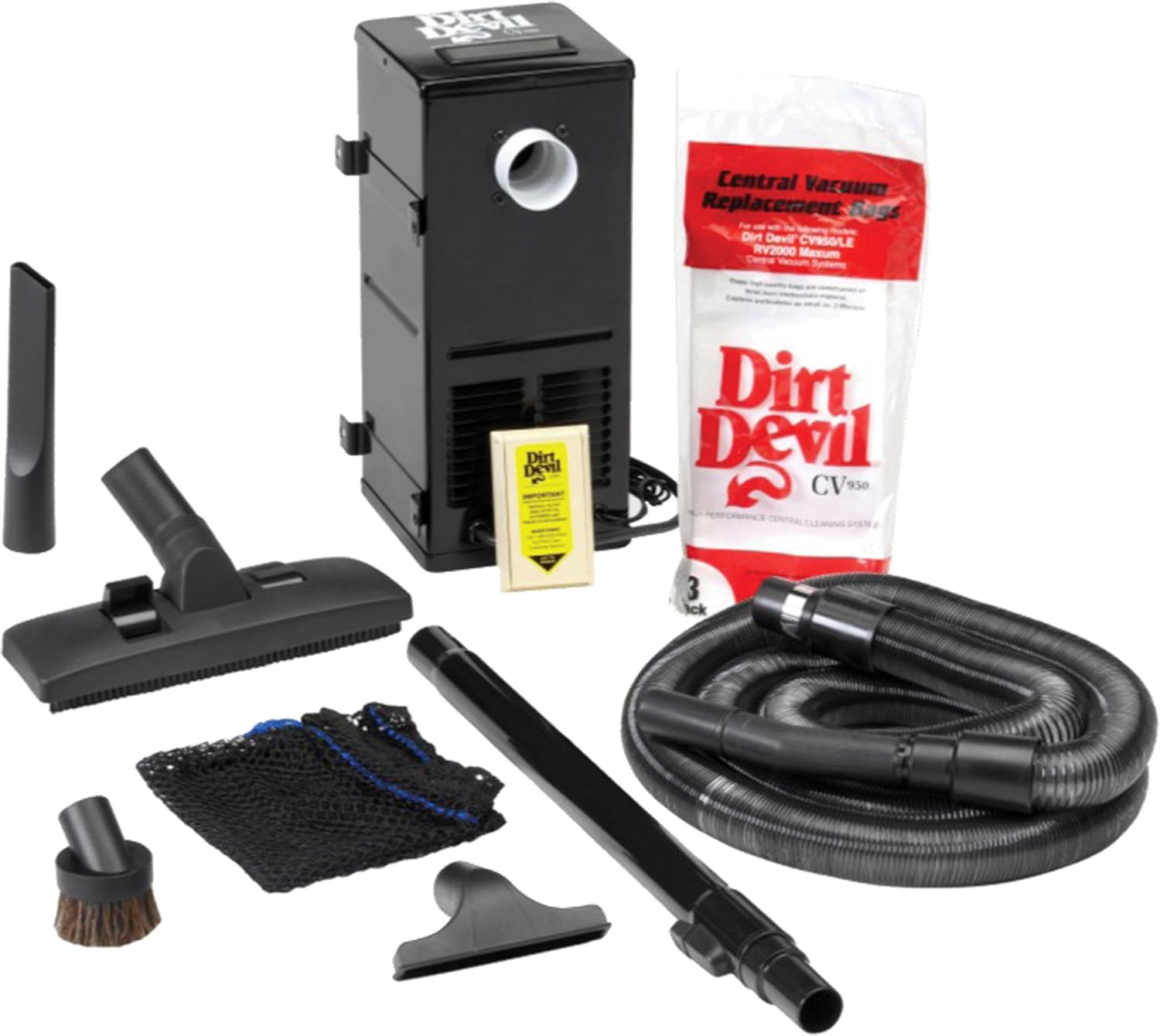
- Air Watts: 501 AW
- Water Lift: 120 in
- Max Amps: 11.7 A at 120 V
- Unit Weight: 14 lb
- Dirt Capacity: 1 gallon
- Warranty: 5 years
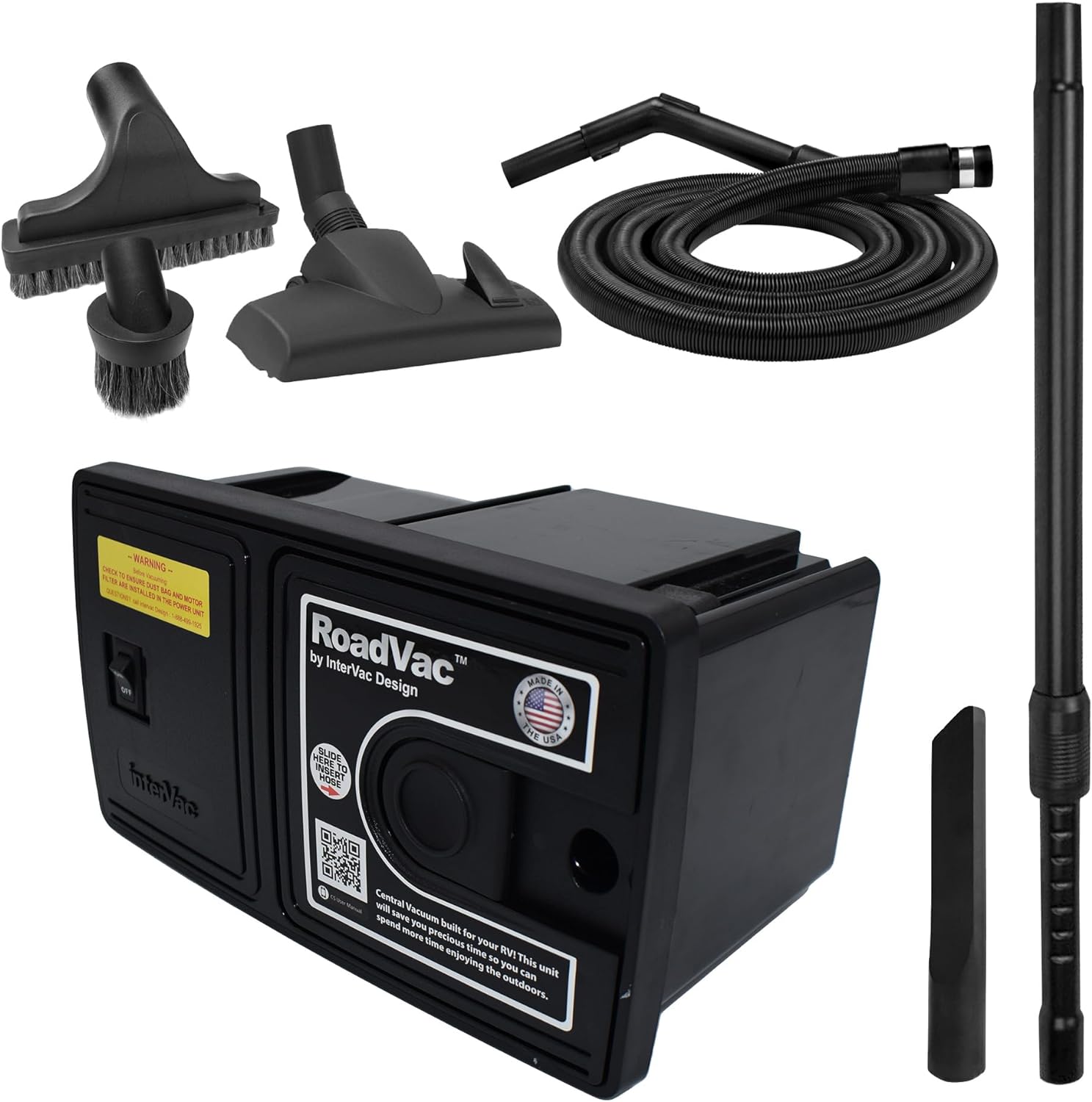
- Air Watts: 414 AW
- Water Lift: 92 in
- Max Amps: 7 A at 120 V
- Unit Weight: 5.5 lb
- Dirt Capacity: Y10 single collar bag
- Warranty: 3 years, power unit
The CS-RM earns the top spot for big rigs. It’s the only unit here that hides a 5.6 lb motor in a basement bay while still running a hose or VacPort inlet from the living space.
1. InterVac RoadVac CS-8 Review
The CS-8 is what Dometic actually sells you as the RVac CS8, built for one job: fit a 6-inch cabinet without tripping a 30-amp breaker. Across the InterVac manual and three RV-specific hands-on reviews, this unit wins on amp draw and body size, then loses ground everywhere InterVac stays quiet on paper.
- Draws only 7 amps
- Weighs 5.5 pounds installed
- 11 by 6 inch cutout
- Y10 five layer filtration bag
- Built in Palm City, Florida
What We Love About the RoadVac CS8
Seven Amps Means Your Breaker Survives Coffee and Cleaning
The CS-8 draws 7 amps at 120 volts, and that number is the whole story for anyone on 30-amp shore power. A tripped breaker mid-clean, coffee maker still running, air conditioner cycling in the background, is the exact scenario a 7-amp draw is built to avoid.
Run the math: a 30-amp pedestal gives you roughly 3,600 watts. A roof AC alone eats 1,300 to 1,800 watts, so the CS-8’s 840 watts (7 amps times 120 volts) still leaves room for a microwave. The CV1500 pulls nearly 1,400 watts at 11.7 amps, a much tighter squeeze on the same pedestal.
Five and a Half Pounds Changes Where It Mounts
At 5.5 pounds, the CS-8 mounts on four screws with no reinforced backing wall required, a real relief if you’ve ever budgeted an afternoon for blocking out a cabinet wall first. InterVac’s manual specifies a wall thickness between 3/8 inch and 1 inch, nothing more.
Compare that to the CV1500 at 14 pounds; that unit needs bracket support and a taller cavity, not four screws and a paper template.
Why the Y10 Bag Decides Your Real Filtration
The five layer fiber bag is the media doing the actual particle capture here, not the housing, not the motor. InterVac ships the Y10-5 bag, and it decides whether dust actually stays out of the cabin air.
Here’s the honest gap: dealer pages cite 98.3 percent capture while aftermarket listings cite 99.97 percent for the same bag, and InterVac names no certifying body behind either number. “HEPA-type” on a listing is marketing language, not the DOE HEPA threshold; verify the current spec directly with InterVac if anyone aboard has asthma.
The Cutout Is 11 by 6 by 6 and Permanent
The CS-8 needs an 11-inch by 6-inch wall cutout with a minimum of 6 inches of depth behind it, and once that saw cuts through finished paneling, there’s no undoing it. InterVac’s installation manual supplies a paper template for exactly this reason.
The full body measures 11 3/4 by 6 by 6 3/4 inches, and Dometic’s own RVac listing trims that to 10 7/8 by 5 7/8 by 6 inches. Measure both before you cut, since the 5-foot power cord must reach an outlet on its own; the manual prohibits extension cords.
Who Should (and Shouldn’t) Buy the CS8
Who a Dometic Central RV Vacuum System Actually Fits
This unit fits travel trailers and Class C coaches under 35 feet with mostly hard flooring. Boondockers running off an inverter, where every amp counts, benefit most from the 7-amp draw. Owners who want one inlet near the entry door, nothing more, get exactly that.
Skip It If Your Coach Is Fully Carpeted
Skip the CS-8 if your rig is fully carpeted; owners on iRV2 describe dragging the stretch hose across carpet as fighting an anaconda. InterVac’s own manual concedes the stretch hose loses suction compared to a traditional hose, and one owner reported it won’t lift carpet pile like a home system. Step up to the CV1500 instead; it publishes 120 inches of water lift, and this unit publishes none.
Pros and Cons Table
- Pros: Smallest installed footprint in this roundup
- Pros: 7-amp draw preserves shore power headroom
- Pros: Composite housing resists rust in damp bays
- Pros: UL certified with a documented thermal cutout
- Pros: Four-screw install with a supplied cutting template
- Cons: Sealed unit, motor failure means full replacement
- Cons: No inlet valve, one hose connection point only
2. RoadVac InterVac Design CS-RM Review
The CS-RM is the multiport architecture Dometic once sold as the RVac Plus, solving a problem the CS-8 can’t: getting the motor out of the living space entirely. Set against both InterVac units and the CV1500, this one earns its keep on noise isolation, not on suction numbers InterVac still won’t publish.
- Remote mount away from living space
- VacPort toe kick sweep compatible
- 24 volt low voltage inlet
- Y11 double collar bag required
- Same 7 amp draw as CS8
What We Love About the RoadVac CSRM
The VacPort Toe Kick Sweep Nobody Explains Honestly
Sweeping crumbs toward a kick board and watching them vanish is the VacPort’s whole appeal, and it’s real, but it hides a failure pattern nobody mentions upfront. InterVac lists two models for remote-mount units only, the A900 with an LED and the A910 without.
An Amazon owner logged the LED failing at roughly one year, then the door seal failing by year three, bleeding suction right at the hose connection. Budget for a replacement pan down the line, not just the install.
One Circuit Board Buys You a Remote Inlet
The real upgrade over the CS-8 isn’t suction, it’s placement. A motor running quietly in a basement bay beats one humming in the galley every time, and the CS-RM adds a circuit board and a 24-volt output the CS-8 simply doesn’t have.
Same motor tier, same 7-amp draw, just 5.6 pounds against 5.5. This is the only unit here you can hide behind a wall and still trigger remotely from across the coach.
Why the Y11 Double Collar Bag Matters
A double collar bag has two openings instead of one, sealing both intake paths inside the vacuum chamber at once. Y10 bags physically won’t fit this unit; only the Y11 fits the CSRM, CS9, CS10, and Dometic’s CV1004.
Picture the moment mid-trip when the wrong bag box is all you packed, and there’s no vacuum for the week. Photograph your bag’s part number tonight and save it to your phone.
Running 24 Volt Wire Through a Finished Wall
Fishing wire behind a wall you already paid to finish is the single most stressful part of this install, and it’s where most DIY attempts stall out. The manual specifies two 20-gauge yellow wires, UL AVLV2 rated, minimum 300 volts and 95°C, running alongside the flex hose and connecting outside the housing with butt connectors.
Budget an afternoon, or budget a tech; this step separates a weekend install from a call to a mobile RV installer.
Who Should (and Shouldn’t) Buy the CSRM
The Fifth Wheel Owner Who Wants Two Inlets
This unit fits fifth wheels and Class A coaches where one inlet can’t reach the bedroom. Owners doing a bench-seat or basement-bay install, with the hose piped up into the living space, get the most value here. A Grand Design owner wired the CS-RM into an existing outlet under bench seating and ran the hose forward.
Skip It If a Shedding Dog Rides Along
Skip the CS-RM if a heavy-shedding dog rides along full time; a Grand Design owner with an Australian Shepherd called the InterVac system seriously lacking for coat season. Neither InterVac unit publishes air watts, so there’s no spec to compare against a real pet-hair test. Choose the CV1500 instead; it publishes 501 air watts and holds a full gallon before a bag change.
Pros and Cons Table
- Pros: Motor hides in a basement bay, quietest option here
- Pros: VacPort dustpan inlet compatibility, unique in this roundup
- Pros: Washable Y22 motor filter cuts recurring cost
- Pros: Still only 7 amps despite the added hardware
- Pros: Actually in stock through the InterVac channel
- Cons: Flex-hose run stacks another suction-loss point onto the stretch hose
- Cons: VacPort has documented seal and LED failure reports
- Cons: Y11 bag misseats easily if installed backward
3. Dirt Devil CV1500 All-In-One Review
The CV1500 is the only unit here built by an established residential central vacuum manufacturer, H-P Products, under license from Royal Appliance. It’s also the only one that hands you real numbers instead of a shrug.
- Published 501 air watts
- 120 inches of water lift
- All metal power unit housing
- One gallon dirt capacity
- Five year manufacturer warranty
What We Love About the Dirt Devil CV1500
501 Air Watts Is the Only Verified Number Here
Air watts measure working suction by combining airflow and sealed suction into one figure at the motor. H-P Products publishes 501 air watts and 100 CFM for the CV1500; neither InterVac unit publishes either number anywhere.
A published spec isn’t an independent lab test, and that distinction matters. Still, this is the only unit here you can stack against a home central vacuum system on paper.
120 Inches of Water Lift on Wet Carpet
Water lift measures how many inches of water a sealed tube can pull the motor up, the same idea as pulling a milkshake through a straw instead of just moving air across an open floor. The CV1500 publishes 120 inches; neither InterVac model publishes a figure at all.
Think ground-in sand on a high-pile bedroom runner after a beach weekend, exactly the embedded debris this number answers for. Neither competing unit gives you anything to compare it against.
Metal Housing and a Five Year Warranty
A $400 power unit dying in year three behind a sealed wall is the fear driving this whole purchase, and the CV1500 answers it with an all-metal housing and a 5-year warranty. A Forest River owner had a failed circuit board replaced free under that same warranty.
Compare that to InterVac’s 3-year power unit coverage on a unit its own manual says can’t be opened for field service. One conflict, three sources; this one has none.
One Gallon Capacity Versus Bag Swaps Every Trip
Watching suction die mid-clean because the bag filled without warning is the exact moment this spec prevents. The CV1500 holds 1 gallon, shipped with a 3-pack of HEPA bags rated to 99.97 percent capture at 0.3 microns, double the roughly half-gallon capacity attributed to the CS-8. Full-timers and pet households get fewer bag swaps per season.
Who Should (and Shouldn’t) Buy the CV1500
The Full Timer With 50 Amp Service and Pets
This unit fits Class A coaches and large fifth wheels on 50-amp service with carpet and pets in the mix. It installs in a space as small as 10 by 20 inches, mounted vertically or horizontally, with the inlet reaching up to 5 feet away.
The 30 Amp Rig Owner Who Should Skip It
Skip the CV1500 if your rig runs 30-amp service; its 11.7-amp maximum draw eats over a third of that budget before the AC kicks on. Owners on iRV2 report the unit tripping a GFCI circuit after roughly two minutes of run time. Choose the CS-8 or CS-RM instead at 7 amps each, especially on inverter-fed power.
Readers who decide any built-in system is too much commitment still have an option: Eureka as an RV vacuum alternative skips the wall cutout entirely.
Pros and Cons Table
- Pros: Published air watts, water lift, and CFM, verifiable on paper
- Pros: True HEPA bag rated to 99.97 percent at 0.3 microns
- Pros: 1-gallon capacity, double the InterVac units
- Pros: Single consistent 5-year warranty term
- Pros: Built by an established central vacuum manufacturer
- Cons: 11.7-amp draw is a real constraint on 30-amp service
- Cons: 14-lb unit needs a 14.5-inch-tall cavity
- Cons: No variable suction control, no included carpet power brush
The Buyer’s Guide: Cutting Through the Hype
The Three Specs That Decide RV Vacuum Performance
Amp draw, not suction power, decides whether an RV central vacuum survives your electrical setup. Air watts measure working suction at the motor. Water lift measures how far the motor can pull air up a sealed tube. Max amps measures how much of your shore power budget the unit eats before the air conditioner even kicks on.
Home central vacuum guides never cover that third spec, because home systems don’t share a 30-amp pedestal with a rooftop AC. The 11.7-amp CV1500 versus the 7-amp InterVac units is the widest gap in this comparison. Match amps to your shore power before you shop on suction claims alone.
The Price Tier Truth From Power Unit to Full Kit
The sticker shock here isn’t the power unit, it’s realizing the tool kit costs more than the motor that runs it. The CS-8 power unit alone sells around $161, with the accessory kit priced separately on top.
| Configuration | What’s Included | Price Range |
|---|---|---|
| Power unit only | Motor and power cord | $161 to $207 |
| Power unit plus kit | Motor, 35-ft hose, tools | $296 to $390 |
| Plus remote inlet hardware | Adds valve, low-voltage wire, VacPort | Priced separately |
Check each listing for what’s bundled; some include the 35-foot stretch hose in the base price, others sell it as an add-on.
Red Flags Owners Only Find After the Install
Keystone owners describe the Dirt Devil unit as loud enough to need mounting outside the living space, not in a nearby closet. Hose kinking at the inlet pushed one owner to machine his own 90-degree elbow just to stop it.
One factory build shipped with a hose connection that separated behind the wall plate before first use; InterVac’s warranty saved that owner a return trip. And the honest one: multiple forum owners abandoned their system entirely for a cordless stick vacuum.
How We Tested and Where the Data Stops
This comparison draws on the InterVac manual W520, the H-P Products spec sheet, and four owner forums: iRV2, Forest River Forums, Grand Design Owners, and Keystone Forums. InterVac publishes no air watts, CFM, or water lift for either the CS-8 or CS-RM, full stop.
Two conflicts are worth flagging. InterVac lists a 35-foot stretched hose while Dometic’s page lists 40 feet for the same unit, and InterVac’s manual states 3 years on the power unit while some retail listings state 2. Verify both with the seller first.
Ownership & Maintenance Guides
Bag and Filter Costs Over Five Travel Seasons
Bags are the real ownership cost nobody shows you on the sticker price, and each unit locks you into a different one. The CS-8 uses Y10 bags with a washable Y22 motor filter, the CS-RM uses the Y11 double-collar bag, and the CV1500 uses its own HEPA bag sold in 3-packs.
The Y22 filter hand-washes in mild soap and reuses, cutting one line item from your yearly cost. Order a spare bag box before your next trip, not during it; InterVac’s support desk only runs weekdays.
Exhaust Venting Inside a Sealed Cabinet Kills Motors
A hot motor shutting itself off inside a closed bench seat is what happens when this step gets skipped, the single highest-value fix in this guide. InterVac’s manual requires either a 3-inch minimum louvered hole or the B560 exhaust fitting for any unit in a sealed cabinet.
The A612 kit supplies a funnel, 2.5 feet of X640 flex hose, and a flanged spigot to route that air out. Skip this step and the motor overheats mid-clean, shutting down until it cools.
Cleaning a Stretch Hose That Pets Have Clogged
Full suction at the unit and nothing through the wand usually means one thing: a clogged stretch hose, not a dying motor. InterVac’s manual gives a simple test, drop a quarter through the hose; if it sticks partway, the hose is blocked.
The wash needs two people, mild detergent, a garden hose, and a full 24 hours of hang drying. InterVac’s manual specifically warns pet households clog the stretch hose faster than any other owner group.
Inlet Valve and Low Voltage Checks Every Spring
A vacuum that won’t start on the first camping weekend is almost always a low-voltage problem, not a motor problem. Forum-verified failure points cluster around three spots: the circuit board, the door plunger switch, and the inlet wire connections. Check the VacPort door seal too, the exact failure one owner tracked worsening over three seasons, and run the unit for 60 seconds during de-winterizing before you need it.
Conclusion
You arrived thinking Dometic built these systems. Now you know InterVac does, and which bag number, Y10 or Y11, belongs to your unit. Drop the assumption that suction decides this purchase; amp draw does, on a shared 30-amp pedestal.
Tonight, check your shore power rating and measure your cabinet’s depth before you touch a saw, and cross-check your model against our RV vacuum compatibility chart first. Either system still beats the stick vacuum you keep tripping over, because it never needs finding, charging, or storing.
Frequently Asked Questions
Does Dometic actually make its own RV central vacuum system?
No. InterVac Design Corp manufactures the hardware Dometic sells as the RVac and RVac Plus, and the Y10 and Y11 bag part numbers cross-reference directly to InterVac’s own CS8 and CS-RM units.
What size wall cutout does a Dometic RVac need, and how much depth behind it?
Both units need an 11-inch by 6-inch cutout with 6 inches of depth behind the wall. Wall thickness at the mounting point must fall between 3/8 inch and 1 inch. Measure against InterVac’s paper template before cutting.
How many amps does an RV central vacuum draw on a 30-amp shore power hookup?
The InterVac units draw 7 amps; the Dirt Devil CV1500 draws up to 11.7 amps. On a 30-amp pedestal already running a roof air conditioner, the 7-amp units leave far more headroom.
Which replacement bags fit a Dometic CV1003 versus a Dometic CV1004?
The Y10-5 single-collar bag fits the CV1003, matching InterVac’s CS6, CS8, and CS8HW models. The Y11-5 double-collar bag fits the CV1004, matching InterVac’s CSRM, CS9, and CS10 models. They are not interchangeable.
Can you vent an RV central vacuum’s exhaust outside the coach instead of into the storage compartment?
Not without adding parts. InterVac’s B560 fitting with 2-inch flex hose routes exhaust out of a sealed cabinet, but neither system ships vent-ready by default. Skip that step in a sealed compartment, and the motor’s thermal cutout will shut it down from overheating.