A dealer quoted you the Vacuflo MaxAir, the biggest unit Vacuflo makes, and the invoice made you pause. Then you saw the brochure claim “removes 100% of dirt, dust, and allergens” next to three power figures that don’t agree with each other.
This guide reconciles those numbers and tells you whether the MaxAir fits your house, or whether you’re paying for power your square footage doesn’t need. For how it fits the brand’s full range, see our full Vacuflo central vac guide. By the end, you’ll know the specs worth demanding and what this system costs to own.
Vacuflo MaxAir
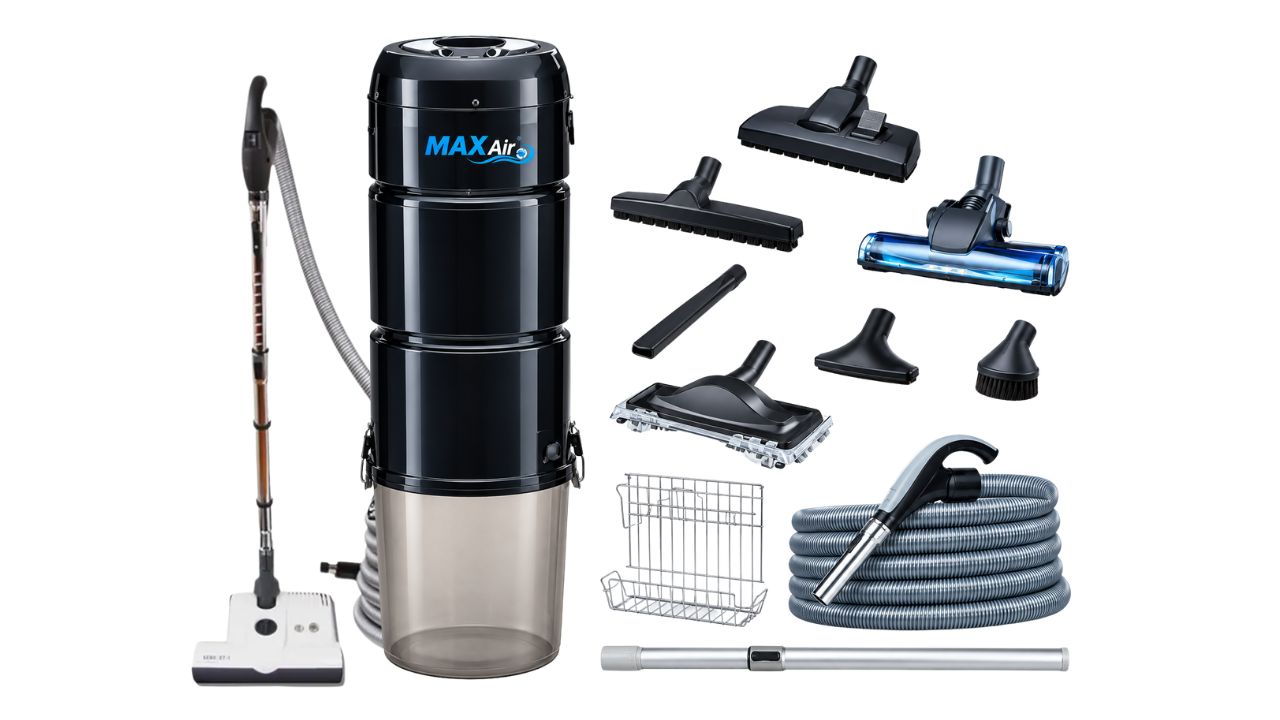
The MaxAir 9050 is a 240 volt, dual motor, true cyclonic power unit built for retractable hose runs and homes far larger than a typical house. It delivers 903 air watts and exhausts fine dust outside instead of bagging it. Builders with massive floor plans get real value here.What the MaxAir Really Is Under the Hood
The MaxAir is a true cyclonic power unit made by Vacuflo, a brand of H-P Products, Inc. out of Louisville, Ohio. It spins dirt out of the air with no bag, then sends leftover fine dust through a duct that must end outside your home.
A true cyclonic unit that vents outside
True cyclonic means dirt separates from the air on its own. No bag catches it.
- A spinning cyclone drops heavy debris into a six gallon canister.
- Fine dust that doesn’t settle exits through an exhaust line, vented outside.
- You empty the canister every few months instead of buying bags forever.
A bagged unit traps everything in one container you toss. True cyclonic needs somewhere for that exhaust to go, and it can’t be your garage.
Why it runs on a 240 volt circuit
The MaxAir needs a dedicated 240 volt circuit, not the standard 120 volt outlet most central vacs use. That changes your installation budget before you’ve priced the unit.
Most residential power units, including Vacuflo’s smaller models, run on 120 volts. The dual motor draws enough current to need its own 240 volt breaker, similar to an electric dryer circuit. Budget for that wiring before you fall for the spec sheet.
How dual motors share the workload
Two 5.7 inch motors run together here, not one oversized motor. That split is why the unit posts a peak of 903 air watts, a measure of sealed suction tested at the hose end under load.
That power fights suction loss across long pipe runs and the drag of a retractable hose system. A single motor loses steam past 50 to 60 feet of 2 inch pipe. Two motors together hold more suction, which matters most when the farthest inlet sits past where a standard unit fades.
The Three Power Numbers That Confuse Everyone
Three specs appear on every MaxAir listing, and they contradict each other under the math. The fix isn’t picking the biggest number. It’s knowing what each one measures.
Why CFM times water lift looks like a trick
You can’t multiply CFM by water lift and land near 903. That’s the short version.
The ASTM F558 air-power test method defines air watts as CFM times water lift, divided by 8.5. Plug in the MaxAir’s 122 CFM and 208 inch water lift and you land nowhere near 903, because the two figures are measured at different points on the motor’s curve. Peak airflow and peak suction don’t happen at once, so multiplying both invents a number the test never produced.
- Air watts is the calculated suction at one point on the curve, the figure brands use for marketing.
- Water lift is raw suction strength, measured in inches of water the motor pulls up a sealed tube.
- CFM is airflow volume, measured with zero resistance in the line.
None of the three predicts the others.
The one spec that survives a long pipe run
Water lift, not CFM, is what keeps a far inlet usable. Suction fades as air travels farther from the power unit, fighting friction in every foot of pipe and every elbow.
The MaxAir’s 208 inch water lift rating matters most once an inlet sits past 35 feet, where friction starts eating a typical unit’s reserve. CFM looks impressive but is measured with no resistance, a condition that vanishes once your hose and power brush are attached.
What air watts actually promise at the floor
The 903 air watt figure is the unit’s honest peak across its curve, not three specs added together. It’s the most useful number for comparing power units, dual motor or not.
No dealer brochure explains why CFM, water lift, and air watts can’t be summed, because the contradiction makes the sheet look unreliable. Use air watts to compare models, water lift to judge long pipe runs, and treat CFM as meaningless without its resistance figure.
Confused why three numbers never add up? You’re not alone there.
Where That 100 Percent Claim Falls Apart
The “removes 100% of dirt, dust, and allergens” line on the brochure isn’t accurate. Vacuflo’s own technical copy puts the real figure at 96 to 98 percent, with the rest leaving through the exhaust.
What the brand’s own fine print admits
Vacuflo’s own manufacturer documentation states true cyclonic separation captures 96 to 98 percent of debris in the canister, sitting below the headline marketing claim.
Less than 5 percent of fine dust, particles too light to spin out of the airflow, rides the exhaust line outside. That’s a strong capture rate. It isn’t 100 percent, and that gap is exactly the detail a dealer page won’t flag.
Should that exhaust ever vent into your garage?
No. A true cyclonic exhaust has to terminate in outside air, never into a garage, attic, or any space connected to the rooms you breathe in.
Owners on forums like VacuumLand describe a faint dust smell near the exhaust point, consistent with that uncaptured 2 to 4 percent. Vent into an attached garage and you push allergens toward a space your HVAC pulls from. Route it correctly:
- Run the duct through an exterior wall to true outside air, never into an enclosed attached structure.
- Keep the termination away from windows, dryer vents, and fresh air intakes.
- Have the crew pressure test the wall penetration, since a poor seal leaks dust into the cavity.
We checked this against H-P Products’ own installation literature and owner reports on what happens when installers cut corners on the vent run.
Who Actually Needs This Much Power
Most homes don’t need the MaxAir. That’s the answer a dealer earning commission on the flagship unit has no reason to give you.
Is the vacuflo maxair overkill for your home?
Yes, for most houses. The 22,000 square foot rating describes something closer to a small commercial building than a residence.
Halve any dealer’s coverage claim and size by floor plan, not total square footage. A 2,800 square foot two story home doesn’t need a 22,000 square foot rated unit any more than a sedan needs a diesel engine. The smaller true cyclonic 566Q handles most homes up to 8,000 square feet, at a fraction of the price.
When the MaxAir earns its keep with retractable hose
The MaxAir is the right call when a retractable hose system, like Hide-A-Hose, is part of the plan. That hose lives inside the pipe network and creates drag a smaller motor struggles against.
A retractable system pulls the hose back into the wall after every use, stealing suction a standard setup never fights. Installers steer those buyers toward dual motor units for this reason. Here, the bigger motor solves a real problem instead of inflating the invoice.
How to match inlets to square footage per floor
Count inlets by how much floor each one reaches, not by total square footage. That shift prevents most sizing mistakes.
Keep cleaning paths within 35 feet of any inlet, the distance where suction starts losing ground to friction. A poorly placed inlet wastes power you already paid for. Map each floor, mark the longest path, then size inlets to that distance.
Why bigger is not automatically better for you
Extra air watts you’ll never reach still cost real money, on the electric bill and the invoice. A freight engine doesn’t make a commuter train faster between two close stations. It just burns more fuel.
A right sized unit runs cooler and lasts longer, since it isn’t straining below its rated capacity. Power you never reach is power you never needed.
Still tempted by the biggest number on the shelf?
What the Spec Sheets Quietly Disagree On
Dealer spec sheets for the MaxAir contradict each other in ways that should slow any buyer down. We cross-checked listings across half a dozen authorized dealers plus the manufacturer’s own documentation to find where the numbers split.
The single versus dual motor contradiction
The MaxAir is a dual motor unit, full stop, even though one major dealer listing manages to call it both single and dual motor on the same page. Documentation across multiple retailers, plus the model’s own product code, confirms two 5.7 inch motors working together.
When a listing argues with itself, ask for the manufacturer spec sheet directly. The same confusion shows up with water lift, where some listings borrow the 135 inch figure that belongs to the smaller 566Q instead of the MaxAir’s correct 208 inch rating.
Why the model name keeps shifting around
MaxAir, model 9050, and “9000 series” describe the same dual motor unit, which is part of why listings get tangled. Vacuflo also sells a separate disposable bag unit, the DB9000, confused with the MaxAir purely because the numbers look similar.
The DB9000 isn’t true cyclonic and has nothing to do with outside exhausting. Confirm the exact model number, 9050, before signing anything, and ask to see it on manufacturer documentation rather than taking a salesperson’s word.
The Maintenance Nobody Mentions at the Showroom
Owning a MaxAir means opening a canister of compressed household dust every few months. That part rarely makes the sales pitch.
Why owners warn you to wear a mask
Yes, several owners specifically recommend a mask when emptying the canister. One HomeStars review describes the cleanup as messy enough to catch first-timers off guard.
Scraping the permanent filter screen clean releases a burst of fine dust. Wrapping a garbage bag around the canister opening before you start catches most of what would otherwise hang in the air around your face.
How often you really empty the canister
Vacuflo recommends emptying the canister and cleaning the filter screen every four to six months, not once a year. Skip that schedule and airflow drops while the motor works harder to compensate.
Six gallons sounds huge until a renovation’s worth of plaster dust fills it fast. Shorten that window during heavy construction or pet shedding season.
Why overfilling can destroy your motor
Overfilling the canister sends loose debris straight into the motor’s impeller, and that impact damage isn’t covered under warranty. H-P Products’ service documentation spells this out directly.
Construction debris and fireplace ash are the worst offenders, clogging the filter screen fast and letting larger particles through. A clogged screen forces the motor to strain against resistance it wasn’t built for, and that strain is how a solid motor fails years early.
What This System Truly Costs to Install
The power unit alone runs around $1,749, and that’s the smallest piece of your total bill. For a full breakdown across the lineup, check Vacuflo model pricing before committing to any single unit.
Why the power unit price is only the start
That $1,749 buys the motor box bolted to your wall, nothing more. The hose, wands, and power brush are purchased separately.
A dealer quoting “the MaxAir” without itemizing attachments is showing you roughly a third of the real number. Ask for an itemized quote before comparing dealers.
The exhaust kit and venting you cannot skip
The MaxAir requires outside exhausting, full stop, meaning an exhaust kit plus labor to run it through an exterior wall. This isn’t an optional upgrade.
Running that vent through a finished wall, especially in a retrofit, adds real labor on top of the kit. A true cyclonic unit installed without proper outside venting isn’t a cheaper version of the system. It’s one installed wrong.
What tubing, inlets, and wiring add on top
In-wall tubing, fittings, and inlet valves are their own line items, separate from the power unit and exhaust kit.
| Cost component | What it covers |
|---|---|
| Power unit (MaxAir 9050) | Motor and canister only, around $1,749 |
| Dedicated 240V circuit | Electrician labor for breaker and wiring |
| Exhaust kit and venting | Required outside termination, plus wall labor |
| In-wall tubing and fittings | Pipe network linking every inlet |
| Inlet valves | One per cleaning zone, priced individually |
| Hose, wands, power brush | Sold separately in nearly every case |
The installed total routinely runs several times the power unit’s sticker price. Compare that full number against any other system, not the headline price.
MaxAir Versus the Rest of the Vacuflo Lineup
The MaxAir sits at the top of Vacuflo’s true cyclonic line, but it isn’t the right fit for most buyers comparing models. Smaller true cyclonic units and a separate filtered cyclonic line cover the homes most people actually own.
True cyclonic versus filtered cyclonic in plain terms
True cyclonic units like the MaxAir vent fine dust outside and need a dedicated exhaust line. Filtered cyclonic units, Vacuflo’s FC series, trap that same dust indoors with a pleated cartridge filter instead.
| Factor | True Cyclonic (MaxAir) | Filtered Cyclonic (FC series) |
|---|---|---|
| Exhaust | Must vent outside | Vents indoors, no duct needed |
| Filter upkeep | None, just canister and screen | Cartridge replaced about once a year |
| Capture rate | 96 to 98% to canister, rest exhausted | 96 to 98% cyclonic, rest caught by cartridge |
| Best fit | Large homes, retractable hose | Homes without an outside wall to vent |
Owners running filtered units report fine dust slipping past the cartridge seal a little more as the filter ages, the tradeoff for skipping the outside vent. Neither approach is wrong. They solve different constraints.
Beam, a competing brand Electrolux Group divested to Nuera Air in 2017, has leaned harder into filtered and bagged systems than Vacuflo’s true cyclonic focus.
When the smaller 566Q beats the MaxAir
The 566Q beats the MaxAir for most homes under roughly 8,000 square feet, full stop. It’s still true cyclonic and skips bags, but runs on a standard 120 volt circuit instead of a dedicated 240 volt line.
Buyers without a Hide-A-Hose system or an oversized floor plan save real money on the unit and the wiring. For a smaller entry point, the smaller Vacuflo Edge units cover modest homes at a lower price still.
Anyone weighing the MaxAir against other flagship systems should also compare the flagship Vacuflo DB7000 rather than assume the biggest number wins. Choose the MaxAir only when retractable hose or a genuinely large home demands it. Everyone else is better served further down the lineup.
Conclusion
You walked in believing the biggest unit meant the best clean, and that “100 percent” line sealed the deal. Now you can read a spec sheet for what it says, spot the motor contradiction before a dealer glosses over it, and size a system by floor plan instead of hype.
Tonight, measure the longest run from your planned power unit to your farthest inlet, then decide whether retractable hose is something you need. A right sized Vacuflo outlasts every portable you’ve owned, because the motor lives in the basement doing the work, not in your hand on the stairs.
Frequently Asked Questions
What are the specs of the Vacuflo MaxAir 9050?
Dual 5.7 inch motors on a 240 volt circuit, 903 air watts, 122 CFM, and 208 inches of water lift, with a 6 gallon canister and 71.1 dBA sound level. It’s rated for homes up to 22,000 square feet, far beyond what most buyers own.
Does the Vacuflo MaxAir really have to be exhausted outside?
Yes, with no exceptions. True cyclonic units push 2 to 4 percent of fine dust through an exhaust line that must terminate in outside air, never into a garage, attic, or enclosed space connected to your living area.
Is the MaxAir single motor or dual motor?
Dual motor, despite one dealer listing that confusingly calls it both. Two 5.7 inch motors run together to produce the 903 air watt peak, which holds suction across long pipe runs and retractable hose systems.
What size home is the Vacuflo MaxAir made for, and is it overkill for a normal house?
Rated up to 22,000 square feet, and yes, that’s overkill for nearly everyone reading this. Most houses under 8,000 square feet are better served by the smaller 566Q, which costs less and runs on 120 volts.
What does a Vacuflo MaxAir cost installed?
Budget well beyond the $1,749 power unit price once you add the required 240 volt circuit, exhaust kit, venting labor, in-wall tubing, inlet valves, and a hose and power brush sold separately. Get an itemized quote, since the power unit price alone hides most of the real cost.