You already paid an installer to fish PVC tubing through your walls, and now one name keeps haunting the decision: vacuflo fc650. Dealers tout 8,000 square feet of coverage and a claim that it removes 100 percent of dust and allergens, with the fine print conveniently left out.
This guide goes deeper than our Vacuflo central vac roundup to break down this one unit alone. You’ll finish knowing the real air watt math, what the filter actually catches, and whether the FC650 fits your floor plan.
Vacuflo Fc650
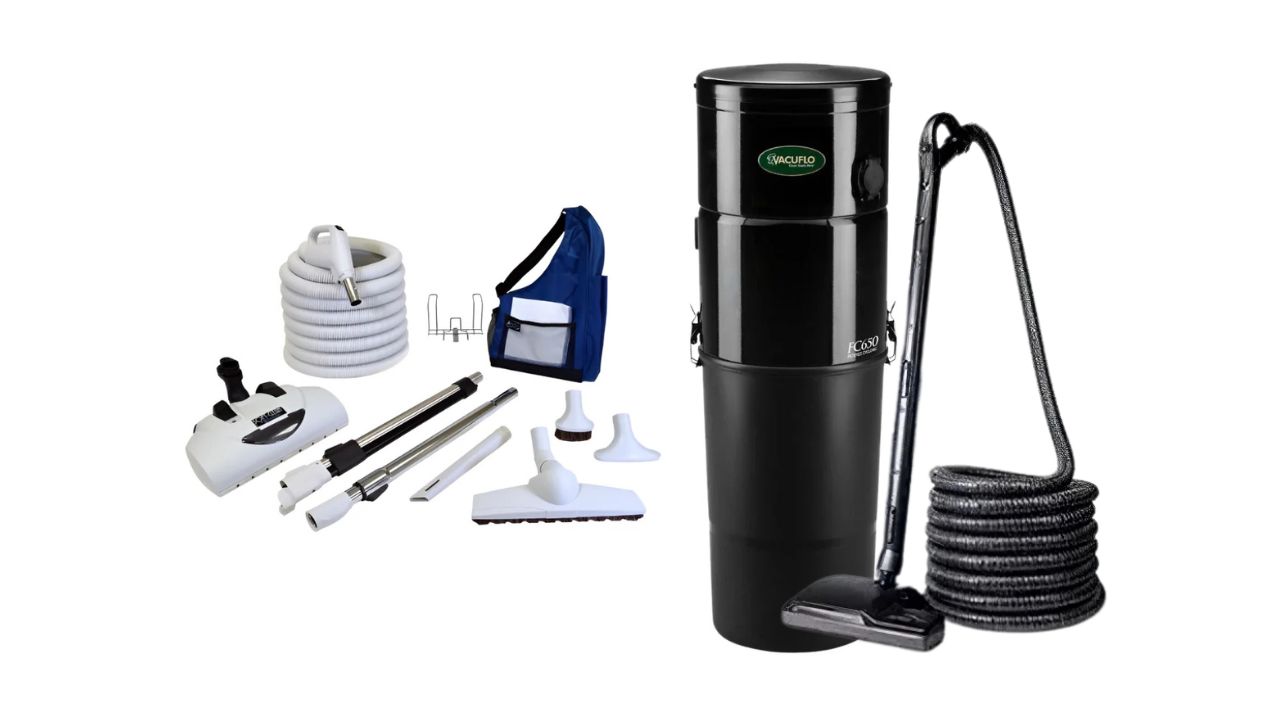
The Vacuflo FC650 is a single motor, filtered cyclonic power unit rated at 575 max air watts and 141 inches of water lift. Its cyclone catches 96 to 98 percent of debris before a pleated filter traps the rest. It fits large, single floor homes, not severe allergy households chasing HEPA.Meet the FC650 Before You Commit
The Vacuflo FC650 is a single motor, filtered cyclonic power unit built by H-P Products, the Ohio company that has owned and assembled Vacuflo since it created the category. This breakdown comes from cross-checking H-P Products’ spec sheets against dealer listings, installer forums, and the ASTM air watt formula, not one brochure. See Vacuflo’s official filtered cyclonic power unit lineup before comparing it to anything else here.
A Filtered Cyclonic Unit, Not a True Cyclone
The FC650 is filtered cyclonic: a spinning air column drops most dirt into the canister before a pleated cartridge filters whatever escapes. That two-stage design is why this unit can vent indoors at all.
Cyclonic separation spins air hard enough that heavy debris flings to the canister wall and drops, no bag, just centrifugal force sorting it. That spin handles 96 to 98 percent of incoming dirt. The pleated cartridge catches the last 2 to 4 percent, the fine stuff a true cyclone would send straight back into your living room.
Who VacuFlo Built This Unit For
VacuFlo built the FC650 for homeowners who want a dependable single motor unit, not dual motor headroom they’ll never use. The brand is also the oldest central vacuum maker still in production.
H-P Products has assembled these units in Ohio for decades, continuity that lets a 15-year-old unit still find parts. The motor comes from Ametek’s Lamb Electric division, the same supplier most of the industry uses. Trovac and Nuera went through ownership consolidation that scattered parts support. Vacuflo didn’t.
Know what you’re buying: a single motor, one company, one filtration design. Everything below tests whether that fits your house.
The Truth Behind 575 Air Watts
575 air watts is the FC650’s peak rating, a number you get only under lab conditions a real pipe network never matches. Vacuflo FC650 air watts only tell half the story without water lift and CFM beside them.
Air watts measure usable suction by combining airflow (CFM) and vacuum strength (water lift) into one number. A unit can hit a high peak and still feel weak at your farthest inlet, because real pipe runs eat into both halves of that equation.
Why Those Three Big Numbers Never Happen Together
The FC650’s 575 air watts, 124 CFM, and 141 inches of water lift each occur at a different point on the same performance curve, never simultaneously. Treat all three as outer edges of what this motor can do, not a combined performance you’ll feel at the hose.
Top speed and best fuel economy never happen on the same drive in a car either. Max air watts shows up at one airflow restriction, max CFM at another, max lift at full blockage.
How Dealers Can Inflate the Air Watt Math
The honest formula divides CFM by water lift using a divisor of 8.5, the ASTM-referenced standard. Some marketing sheets swap in 7.5 instead, inflating the number with no change to the motor.
Ask which divisor produced any air watt figure before comparing brands:
- Divide CFM times water lift by 8.5 for the ASTM-aligned figure.
- Divide by 7.5 only for a bigger-looking number, not an accurate one.
Water Lift Versus Air Watts in Plain Words
Water lift measures raw pulling strength. Air watts measure that strength combined with airflow speed. The FC650’s 141 inches of lift is the muscle number; 575 air watts blends that muscle with how much air moves.
Water lift is how high a kid could lift a bucket straight up. Air watts is that kid running across the yard with the bucket, strength and speed combined. A vacuum needs both: lift to pull debris from carpet pile, airflow to carry it back through the pipe.
That 8,000 Sq Ft Claim, Examined
The FC650’s 8,000 square foot coverage rating describes lab-ideal pipe runs, not your floor plan with elbows, risers, and a furnace room in the way. Cut that number in half, or rate each floor separately.
Why the Coverage Rating Rarely Matches Your House
Coverage jumps to 8,000 square feet on just a 55 air watt increase over the smaller FC550, too steep a jump for that modest power bump to support on suction alone. Treat the marketing number as a ceiling under perfect conditions, not a figure real pipe runs survive.
Rate your home floor by floor instead of as one total. A two-story home with one power unit in the basement is really two separate suction challenges stacked on each other.
The 35 Foot Inlet Rule Nobody Mentions
No inlet should sit more than 35 feet of hose-and-pipe distance from any point in the room it serves, a rule almost no dealer page states outright. Map inlets against this distance before the walls close up.
A 2,400 square foot two-story home needs four to six inlets placed so every corner falls inside that 35-foot reach. Skip a bedroom assuming the hose stretches that far, and you’ll regret dragging it through three doorways.
Why Pipe Distance Quietly Steals Your Suction
Every added foot of pipe between the inlet and the power unit shaves a measurable amount of suction off what reaches the hose end. A top-floor inlet 60 feet from a basement power unit feels noticeably weaker than one sitting 20 feet away on the same unit.
Lab ratings run on short, straight test pipe, nothing like the route through your walls. A few 90-degree elbows and a two-story climb drop the FC650’s real pull at that far inlet well below its rated peak.
Does the Vacuflo FC650 Actually Fit Your House?
Size the FC650 to your largest single floor, not your home’s total square footage. What size home for Vacuflo FC650 really means: a largest floor under roughly 3,000 to 3,500 square feet, inlets mapped to the 35-foot rule above.
A 2,400 square foot two-story home rarely needs an 8,000 square foot rated unit, that’s headroom you’re paying for and never using.
Filtered Cyclonic Versus True Cyclonic, Honestly
Filtered cyclonic units like the FC650 keep a cartridge filter so they can vent exhaust indoors, while true cyclonic units skip the filter and vent outdoors instead. That single design choice is the biggest tradeoff in this purchase.
What Forum Veterans Say About Filters Versus Venting
Long-time forum members insist true cyclonic systems vented outdoors remove fine dust more completely than any filtered design. The FC650’s filter is the convenience tradeoff for that small slice of indoor air quality.
Owners of both designs report that venting particulate straight outside, rather than trapping it in a filter inside your utility closet, removes a source of recirculated dust entirely. The FC650 can vent outside too, but doesn’t by default.
Why the FC650 Filter Can Cost Suction
A clogged pleated cartridge chokes airflow at the canister well before most owners notice weaker suction at the hose. Forum threads on the FC650 repeat the same complaint: power loss traced to a filter nobody checked in over a year.
True cyclonic models skip this failure point by design, no cartridge to clog. The FC650 trades that simplicity for indoor venting, a fair trade only when the filter gets maintained on schedule.
When Optional Outdoor Exhaust Is Worth Running
Run the FC650’s optional outdoor exhaust kit when you notice a faint dust smell near the power unit, or when anyone in the house has allergies. Indoor venting is the default, not the only option.
Allergy households should weigh the kit’s cost against the discomfort of recirculated fine dust, even at the small 2 to 4 percent the cartridge doesn’t catch.
Filtration, Allergies, and the HEPA Question
The FC650’s standard filter is not certified true HEPA, even though dealer pages routinely use HEPA-adjacent language. Is Vacuflo FC650 HEPA? No, not in its standard configuration, and that distinction matters for allergy households.
What the Standard Cartridge Really Filters
The standard pleated cartridge catches the 2 to 4 percent of fine dust the cyclone’s spin doesn’t separate out. It is not washable, and it must stay completely dry to keep working.
Tap it clean between replacements, never rinse it, and replace the cartridge (#8106-01) once a year. A wet or neglected cartridge restricts airflow and shortens motor life.
Is the FC650 Truly HEPA for Allergies?
No. The standard cartridge alone does not meet the federal HEPA standard, defined by the EPA as capturing 99.97 percent of particles at 0.3 microns. Ask about the optional HEPA cartridge when anyone in the home has asthma or severe allergies.
That 99.97 percent figure is a certified standard, not a marketing adjective. The FC650’s standard filtration was never tested against that benchmark.
Treat Hospital Grade Marketing With Healthy Doubt
Phrases like hospital grade and removes 100 percent of allergens carry no certified standard behind them, full stop. Ask which specific test or standard backs any filtration claim before trusting it.
A dealer who can’t name the standard has no claim worth trusting, treat it as a sales line and move on.
FC650 Versus Its FC550 and FC1550 Siblings
The FC650 sits in the middle of Vacuflo’s filtered cyclonic lineup, above the FC550, below the dual motor FC1550. Choosing between them comes down to pipe run and floor space.
| Spec | FC550 | FC650 | FC1550 |
|---|---|---|---|
| Motor | Single | Single | Dual |
| Max air watts | 520 | 575 | 1,010 |
| Water lift | 125″ | 141″ | Not published |
| Canister capacity | 6 gal | 6 gal | Not published |
| Noise (dBA) | Not published | 62.8 | Not published |
| Coverage rating | Not published | 8,000 sq ft (dealer rating) | Not published |
How Much More You Get Over the FC550
The FC650 adds 55 air watts and 16 inches of water lift over the FC550, while keeping the same 6-gallon canister and single motor body. Most of the extra cost buys reach on longer pipe runs, not raw cleaning muscle.
The FC550 likely cleans just as well for less money when your longest run sits well under 60 feet, worth checking against Vacuflo cost comparisons first.
For a full side-by-side across the catalog, our Vacuflo Edge side by side comparison shows how that model fits next to both of these.
When the Dual Motor FC1550 Makes Sense
The FC1550 nearly doubles the FC650’s suction at 1,010 max air watts, built for very large floor plans or unusually long pipe runs. Most average homes never need that headroom.
Reserve the FC1550 for houses well above 4,000 square feet on one floor. Anyone outgrowing this category should look at stepping up to the DB7000 first.
Living With the FC650 Every Day
Owning the FC650 means a once-a-year filter swap, an occasional canister dump, and little else once you stay ahead of maintenance. Skip that, and you’ll feel it in lost suction long before the motor fails.
The Yearly Filter Ritual You Cannot Skip
Empty the canister at about two-thirds full, not after it overflows, and replace the pleated cartridge once a year. Vacuflo FC650 filter replacement is cheap insurance against the motor strain a clogged cartridge causes.
- Empty the canister at roughly two-thirds capacity, never wait for full.
- Tap the cartridge clean between replacements, never rinse it with water.
- Swap in a fresh #8106-01 cartridge once every twelve months.
How a Clogged Filter Can Void Warranty
Owners on central vac forums warn that motor failure traced to a neglected, clogged filter may fall outside the FC650’s Limited Lifetime Warranty. Read the warranty paperwork for what counts as maintenance neglect before assuming everything is covered.
The Limited Lifetime Warranty protects components against manufacturing defects, not damage from a neglected filter swap.
Spot Cleaning Right at the Power Unit
The FC650 includes an on-board inlet valve for cleaning right next to the power unit, no hose-dragging required. That’s the inlet you’ll reach for most: the garage, the basement, or a quick car cleanup.
Pair the system with Vacuflo’s Chameleon retractable hose to skip hose storage entirely, a separate purchase from the power unit itself.
What Installation Actually Demands From Your Home
The FC650 needs 2-inch PVC tubing, low-voltage control wiring, and a dedicated 20-amp receptacle near the power unit. Vacuflo FC650 installation cost depends heavily on whether that circuit already exists.
Here’s a spec conflict worth flagging: some dealer sheets list the FC650’s draw at 14.3 max amps, others list 15.7 max and 12.4 average amps for the same unit. Have a licensed electrician confirm the figure against an H-P Products spec sheet and size the circuit per NEC Section 210.23. Keep the area above the unit clear, too, since blocked airflow shortens motor life.
Should You Buy the FC650 Now?
Buy the FC650 for a large single floor home that wants indoor venting with minimal fuss. Skip it for severe allergies or a smaller home that doesn’t need this much unit.
Who This Unit Genuinely Rewards
Renovators and large single-floor homeowners get the most from the FC650’s suction and indoor-vent convenience. One renovator mid plaster teardown reported the unit swallowing drywall dust all weekend without a single clog or power dip, the debris load a 6-gallon canister and real cyclone stage are built for.
Who Should Look at Another Model
Allergy-heavy households should look at true cyclonic models vented outdoors instead of the FC650’s standard filtered setup. Smaller homes can save real money stepping down to the FC550.
- Severe allergy or asthma homes: prioritize true cyclonic with outdoor venting, or the FC650 with the optional HEPA cartridge.
- Homes under 2,000 square feet on the largest floor: the FC550 likely covers every inlet for less.
- Condos or tight utility closets: the FC650-C’s 4-gallon body fits where the FC650’s 6-gallon body won’t.
Conclusion
You walked in afraid one wrong model number would cost you suction, money, or both. You’re leaving able to read air watts, water lift, and filtration claims like an owner, not a target for the next dealer pitch. Tonight, measure your largest floor and count how many inlets land within 35 feet of it, then weigh that against the FC650’s real numbers before any installer call. Get the sizing right, and this single motor unit ends the cord wrestling, the dragging canister, and the faint dust smell of every portable vacuum you’ve used for decades, quietly, for good.
Frequently Asked Questions
What size home is the Vacuflo FC650 rated for?
Size it to your largest single floor, under roughly 3,000 to 3,500 square feet, not your total square footage. Dealers advertise 8,000 square feet, but that assumes ideal, short pipe runs most homes don’t have.
Is the Vacuflo FC650 a HEPA central vacuum?
No, not in its standard configuration. The standard cartridge catches the 2 to 4 percent of fine dust the cyclone misses, but it has never been certified against the 99.97 percent HEPA standard.
What is the difference between the FC650 and the FC650-C?
The canister size is the real difference, 6 gallons on the FC650 versus 4 gallons on the FC650-C. The smaller FC650-C fits condos and tight utility closets where the standard body won’t.
Does the Vacuflo FC650 need a dedicated circuit?
Yes. It needs its own dedicated 20-amp receptacle, confirmed against current amp-draw figures by a licensed electrician since dealer sheets don’t always agree on the exact number.
How often do you replace the FC650 filter, and what does it cost?
Replace the pleated cartridge (#8106-01) once a year as routine maintenance. Skipping it risks the suction loss and motor strain that owners say isn’t always covered under warranty.