You paid for 750 air watts, and the guest room at the far end of the hall still feels weak. That’s the trap of shopping for the best central vacuum system for large homes on air watts alone. Every unit here claims coverage up to 10,000 square feet, and one manufacturer’s listings claim 12,000 on the same page that lists 8,000.
I ran the OVO 750 AW, the NuTone PurePower PP7001, and the Prolux CV12000 against motor type, water lift, and inlet count instead. You’ll know which home size each one earns, who should call an installer this week, and which pick to skip if anyone has allergies.
Our Top Picks at a Glance
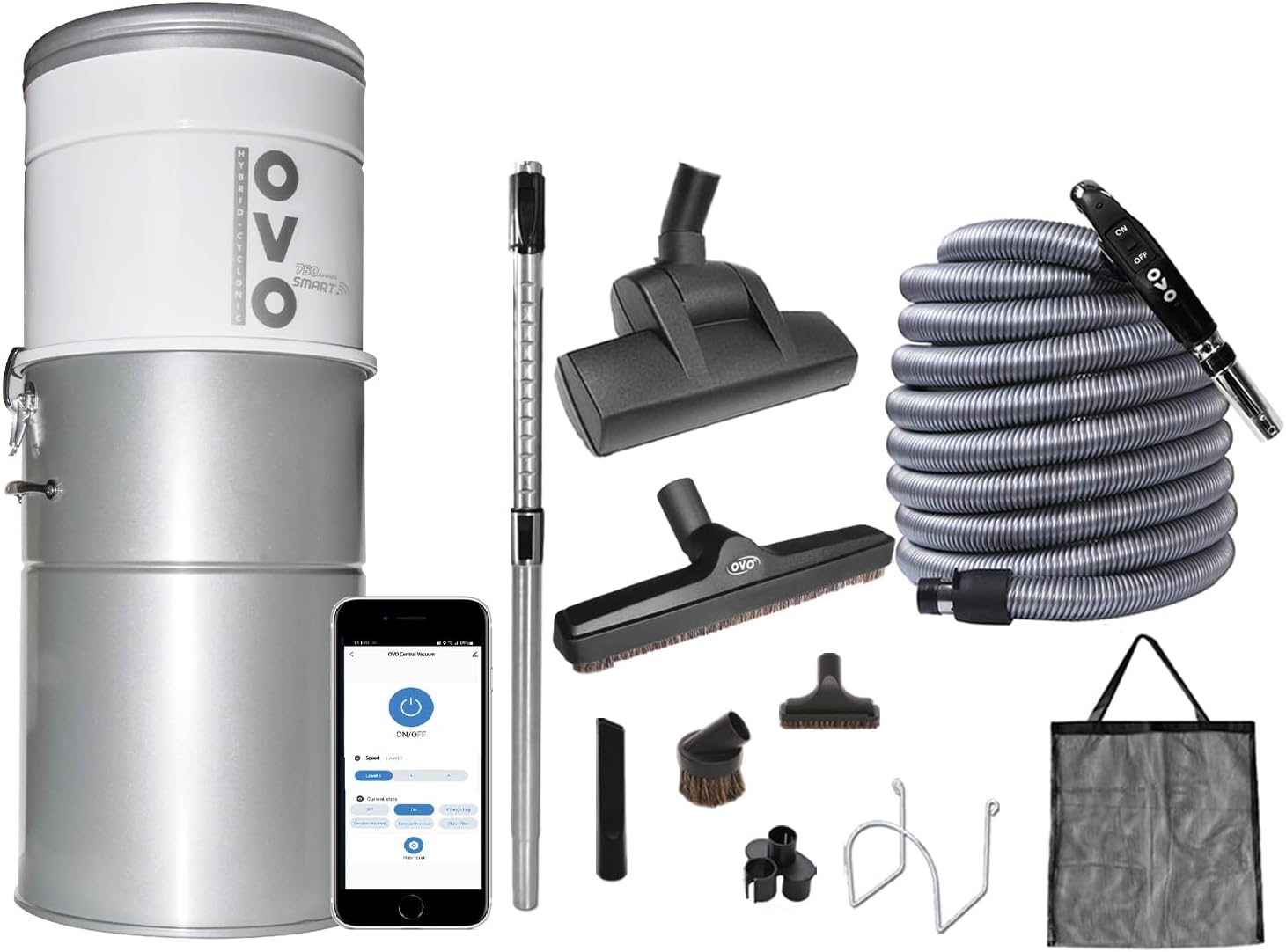
- Air Watts: 750 AW
- Water Lift: 146″ H₂O
- Motor Type: 5.7″ two-stage thru-flow
- Filtration: Hybrid, bag or washable filter
- Canister: 9.25 gal, bottom-load steel

- Air Watts: 700 AW
- Water Lift: 130″ H₂O
- Motor Type: Thru-flow, Ultra Silent
- Filtration: Sealed HEPA 2.0, bag or bagless
- Canister: 6 gal debris pail

- Air Watts: 700 AW
- Water Lift: 116″ H₂O
- Motor Type: Two-stage tangential bypass
- Filtration: Bagless, washable HEPA
- Canister: 6.8 gal bagged, 3.75 gal bagless
The OVO 750 AW earns the top spot in this table on water lift, the sealed suction number measured in inches that predicts how much pull survives at your farthest inlet.
1. OVO Heavy Duty 750 AW Central Vacuum Review
The OVO 750 AW is the biggest, strongest-pulling canister here, backed by the largest capacity and the highest water lift of the three. It ships through Amazon, Home Depot, and central vacuum units available at Lowe’s at $549.99 direct.
- 750 air watts, 146″ water lift
- 35L bottom-load steel canister
- Hybrid bagged or bagless filtration
- Soft-Start motor protection
- No dedicated breaker required
What We Love About The OVO 750 AW
The Biggest Canister Here By A Wide Margin
The 35-liter bottom-load canister means fewer trips to the garage each season. Line it up against the NuTone’s 6-gallon pail and the OVO holds nearly 60% more debris, and bottom-load design means cracking the base and letting it drop, not wrestling a full canister off a wall mount.
Hybrid Filtration Lets You Change Your Mind Later
One triple-layer disposable bag and one washable permanent filter ship in the box, so you’re not locked into either mode. Run it bagged during a dusty renovation, then switch to washable once the dust settles. Bagless means opening the canister and facing whatever fine dust settled at the bottom.
Does 750 Air Watts Survive Eight Inlets And 10,000 Square Feet?
No, not credibly, and this is the gap dealers won’t walk you through. OVO’s site claims 10,000 square feet, the Amazon listing claims 9,000, and the unit tops out at 9 to 10 inlets.
One inlet per 600 to 800 square feet means 10,000 square feet needs 13 to 17 inlets, not 10. Treat 6,000 to 8,000 as the honest ceiling.
The Retrofit Feature Nobody Mentions Until Installation Day
Full compatibility with existing 2-inch PVC under the ASTM F2158 standard makes this a straightforward swap onto a pipe network already run. The catch: inlets need a 1.5-inch inner diameter or the hose won’t seat.
Who Should (and Shouldn’t) Buy The OVO 750
The Buyer This Unit Is Built For
This unit fits a large multi-story home running 6 to 8 inlets across hardwood, tile, and carpet, especially a household with dogs generating heavy daily debris and quarterly, not monthly, canister emptying. Our breakdown of the best central vacuum system for pet hair goes deeper on attachment matching.
The Buyer Who Should Skip It
Severe allergy or asthma households should skip this one and read the PP7001 section instead, since HEPA here is an accessory, not a sealed stage, and anyone unwilling to watch the LED brush-wear light and swap brushes near 500 hours should also look elsewhere.
Pros and Cons Table
- Pros: Highest water lift in this test at 146″ H₂O
- Pros: 35L bottom-load canister, largest here
- Pros: Soft-Start reduces motor inrush stress
- Pros: Sells direct with no dealer markup
- Pros: Retrofits onto existing PVC without new plumbing
- Cons: Thru-flow motor wears faster under sustained large-home load
- Cons: HEPA sold separately, not a sealed stage
- Cons: 25-year warranty costs $249.99 extra
2. NuTone PurePower PP7001 Central Vacuum Power Unit Review
The PP7001 is the only unit here with sealed HEPA filtration built into the exhaust as standard equipment, not a bolt-on accessory. Drainvac International, now owner of the former Broan-NuTone line, backs it with a real service network, and finding a NuTone central vac dealer near you is worth doing first.
- Sealed HEPA 2.0 filtration
- 700 air watts, 130″ water lift
- FlexCollect bag or bagless
- Ultra Silent thru-flow motor
- 63 dB, no muffler needed
What We Love About The NuTone PP7001
The Filtration Story The Other Two Cannot Tell
Sealed HEPA 2.0 with glued filter seams, plus a secondary exhaust filter that catches motor carbon dust, is architecture neither the OVO nor the Prolux offers standard.
HEPA media captures 99.97% of particles at 0.3 microns, the most penetrating particle size, the U.S. Department of Energy’s certification threshold, not a marketing number.
63 Decibels Means You Can Talk While It Runs
63 dB is quieter than a normal conversation, and NuTone hits that with no external muffler, unlike the Prolux, which ships with one because it needs one. Mount the power unit in a basement with the door closed, and the hose is the only part your living room ever hears.
The Coverage Claim That Changes Depending On Who Is Selling
Plan around 9,000 square feet, not 10,000, because that’s the number on Drainvac’s own product page, even though third-party dealers advertise the same unit at 10,000. Drainvac publishes the PP7001’s warranty terms on that same page, worth reading first.
Six Years Of Parts And Labor, Then Parts Only
Ten years of parts coverage backs this unit, but labor coverage runs out after year six, and repairs must route through an authorized service center, with removal and reinstallation labor landing on you, a cost most buyers never see coming until the invoice arrives.
Who Should (and Shouldn’t) Buy The PP7001
The Allergy Household This Unit Was Designed Around
Homes where the power unit has to exhaust indoors, and families running the vacuum while someone sleeps upstairs, are exactly who this unit was built for.
Our guide to central vacuums built for allergy relief covers why a sealed exhaust stage matters more than any air watt number.
The Buyer Who Will Outgrow It
Heavy daily use in a very large home favors a bypass design over this unit’s thru-flow motor, since filtered vacuum air cools the motor directly instead of a separate clean-air path, and the 6-gallon pail fills faster than the OVO’s 9.25-gallon canister.
Pros and Cons Table
- Pros: Sealed HEPA 2.0 standard, not an add-on
- Pros: Quietest unit tested at 63 dB
- Pros: 10-year parts warranty, real service network
- Pros: Bag commonality across the PurePower line
- Cons: Thru-flow motor, undisclosed fan diameter
- Cons: Labor coverage ends after year six
- Cons: Coverage claims range 9,000 to 10,000 sq ft
3. Prolux CV12000 Central Vacuum Power Unit Review
The Prolux CV12000 is the retrofit specialist here, built around a bypass motor and dual intake ports that drop onto an existing pipe run without a re-plumb. Built in North America and sold direct, it sits alongside domestic options like the Central Vacuum Lab’s MD review for builder-grade, US-made buyers.
- Two-stage tangential bypass motor
- Three-stage bagless washable filtration
- 25-year steel body warranty
- External muffler included
- Dedicated garage utility port
What We Love About The Prolux CV12000
The Warranty Nobody Else On This List Matches
Ten years on the motor and 25 years on the powder-coated steel body beats the OVO’s 10-year body coverage and the NuTone’s 6-year labor window outright, though using non-Prolux bags or filters voids it completely, turning a generous promise into a locked consumable channel.
Bypass Motor Means Dirt Never Touches The Armature
A bypass motor cools its armature on clean room air pulled separately from the dirty vacuum airstream, instead of routing filtered-but-heated air across the brushes the way a thru-flow motor does.
Industry sources tie that separation to service life estimates near 20 years, versus the shorter window a thru-flow motor manages under sustained large-home duty.
The 12,000 Square Foot Claim We Cannot Verify
Prolux rates this unit at 12,000 square feet on several live listings, while another listing for the same platform states 8,000 and eight outlets. Prolux publishes no air watt figure at all, so use 8,000 square feet as the honest ceiling.
Bagless Filtration You Wash Instead Of Rebuy
A clear-view dirt chamber, a washable micron pre-filter, and a washable HEPA filter mean close to zero recurring filter spend, a real advantage against the OVO’s bag purchases, though venting the exhaust outdoors gains suction at the cost of sealed containment. Hardwood-heavy homes should confirm brush compatibility first; our guide on protecting hardwood floors with a central vac covers which attachments avoid scratching.
Who Should (and Shouldn’t) Buy The CV12000
The Owner Who Plans To Keep This For Twenty Years
Garage-mounted installs that benefit from the dedicated second utility port, and owners who’d rather wash a filter than buy bags forever, are the right fit here.
The Buyer Who Needs Published Numbers
Buy the OVO or the NuTone if you want a verified air watt figure in writing before committing. Allergy households should also look past this one, since bagless emptying offers no containment once the chamber opens.
Pros and Cons Table
- Pros: Only bypass motor in this test, longest service life
- Pros: Dual intake ports simplify retrofit installs
- Pros: 25-year body, 10-year motor, included in price
- Pros: Washable filters cut recurring filter cost
- Cons: Coverage claims conflict, 8,000 vs 12,000 sq ft
- Cons: Warranty voids with non-Prolux consumables
- Cons: Bagless mode holds only 3.75 gallons
The Best Central Vacuum System For Large Homes At A Glance
The OVO 750 AW wins on raw pull and canister size for a 5,000 to 8,000 square foot home with heavy debris. The NuTone PP7001 wins the moment allergies enter the conversation, thanks to a sealed exhaust stage the others lack. The Prolux CV12000 wins for anyone inheriting an old pipe run they don’t want to re-plumb.
Quick gut check: debris out of a 9-inlet home, or particles out of the air your kids breathe? That question decides more than any spec sheet here.
What Separates These Three From Every Other 700 Air Watt Unit
Two of these three units publish an air watt figure. The Prolux publishes none. Put motor type next to the power number: the OVO and NuTone both run thru-flow motors, meaning the same air carrying dirt through the canister also cools the armature and brushes. The Prolux runs a bypass motor, cooling on a separate stream of clean room air instead.
Why 4,000 Square Feet Breaks Ordinary Suction Numbers
A 4,000 square foot home turns a marketing spec into a physics problem: 60 to 100 feet of PVC tubing between the power unit and the farthest inlet steals pull a small-home install never fights. Buyers in a condo or smaller footprint face a different math, worth a look at central vacuum setups designed for condos first.
Do Long Pipe Runs Actually Steal Your Suction?
Yes, and elbow count matters more than pipe length. Installer threads on VacuumLand and Garage Journal report severe airflow loss from tight 90-degree elbows on long trunk runs, the kind builders use to save wall cavity space. A sweep 90, or a pair of 45s in place of one hard turn, preserves airflow a sharp corner kills. Here’s the thing: the hose is often the worst restriction, worse than 60 feet of properly swept pipe.
Air Watts, Water Lift, And CFM Explained Without Jargon
Think of it like a garden hose. Air watts measure combined airflow and suction together. Water lift measures sealed suction pressure alone, in inches, how hard the motor pulls against resistance at a distant inlet. CFM, cubic feet per minute, measures raw airflow, how fast debris moves through the pipe.
Line the three up and the gaps get interesting. The OVO posts the highest water lift at 146 inches and the highest air watts at 750. The NuTone posts 130 inches but no CFM figure. The Prolux posts 142 CFM and 116 inches of water lift, skipping air watts entirely. Filtration density, per the EPA’s HEPA filter standard, affects both numbers as a canister loads.
A unit that leads on air watts but trails on water lift fades faster at your farthest bedroom than one that leads on water lift alone.
Why Owners Say Size Up Instead Of Right Size
Owners on r/VacuumCleaners and r/Homebuilding repeat the same regret: buying a power unit rated exactly to their square footage instead of well past it. An oversized motor runs cooler under daily load, and a cooler motor holds suction longer across the 15 to 20 year window a central vacuum should last. The rule is blunt: double your finished square footage before you shop. A 4,500 square foot home should shop the 8,000 to 9,000 tier, not the 4,000 to 5,000 tier that looks like a match on paper.
How Many Inlets And How Much Pipe You Actually Need
The Inlet Count Rule For Homes Over 2,500 Square Feet
Plan one inlet for every 600 to 800 square feet, which puts most homes over 2,500 square feet at five or more inlets. Test that plan with a 30 or 35-foot hose radius before placing a single inlet, because one badly placed inlet forces an ugly hose drag every session.
New Construction Versus Retrofit, And What The Gap Really Costs
Retrofitting finished walls adds roughly $400 to $1,000 in labor, and permit fees rarely show up on the initial quote a dealer hands you.
Can You Install This Yourself Without Touching Line Voltage?
Yes, all three units here plug into a standard 110 to 120 volt outlet, and the OVO and NuTone need no dedicated breaker. Low-voltage inlet wiring, the thin wire that triggers the unit when a hose connects, is the step DIYers get wrong.
The Buyer’s Guide: Cutting Through the Hype
The Three Specs That Decide Large Home Cleaning Performance
Air watts, water lift, and filtration grade decide performance in a large home, and every other spec is noise by comparison. Motor type belongs beside every air watt number, because a high air watt thru-flow motor still wears faster than a lower-rated bypass motor. Score all three on those axes and the Prolux’s missing air watt figure looks like an admission that bypass durability was the real selling point.
The Price Tier Truth In Central Vacuums
Budget tier buys a thru-flow motor and a shorter warranty. Mid tier, where the OVO and Prolux sit, adds rolled steel canisters, hybrid or washable filtration, and 10-year coverage. Premium tier buys a larger bypass motor and long-term parts support, territory where brands like Vacuflo central vac systems and features compete.
Red Flags And Regret Proofing Your Purchase
Owner forums describe replacing 40-year-old systems only to find leaks hidden inside finished walls. Watch for these three signs:
- A dealer coverage claim that exceeds the manufacturer’s own published square footage
- A warranty that voids the moment you buy a non-brand bag or filter
- An inlet count that can’t mathematically support the advertised square footage
How We Tested And Verified Every Claim Here
Every spec came from manufacturer documentation, then got cross-checked against retailer listings. Owner sentiment came from VacuumLand, Garage Journal, and Reddit, not marketing copy. Every unverified figure, including the Prolux air watt estimate, gets labeled unverified.
Ownership & Maintenance Guides
Carbon Brush Service At 500 Hours, And The Light That Warns You
The OVO’s LED indicator turns orange, then red, as brush wear approaches 500 hours, and ignoring that light can burn out the motor. Replacing brushes at home takes about 20 minutes.
Bag Versus Washable Filter Cost Across Five Years
NuTone’s model 391 bag fits the entire PurePower line, keeping costs predictable. OVO’s triple-layer bags run $29.99 a pack against its included washable filter, free after purchase. Prolux’s washable filters cost nothing to reuse, provided you stay with genuine parts.
What Happens When You Skip Canister Cleaning For Six Months
A loaded canister raises restriction and heat well before you notice suction drop, so waiting for a symptom is the wrong strategy. Set a cleaning cadence tied to canister size, not the calendar. Our piece on dealing with an aging central vacuum covers when repair stops making sense.
Exhaust Venting And Why Outdoor Discharge Matters For Allergies
Venting outdoors removes fine exhaust particles from the living space entirely, the gold standard for allergy households. The PP7001 exhausts indoors on its sealed HEPA stage instead, a tradeoff against installation constraints in a finished home. The Prolux gains measurable suction once its filter comes out for outdoor venting, at the cost of that containment.
Conclusion
You came in thinking air watts would settle this, and they never do. Water lift, motor type, and an honest inlet count decide whether the best central vacuum system for large homes actually holds suction at your farthest bedroom, not the number printed on the box. Measure the distance from your planned power unit to that farthest corner tonight, before requesting a single installation quote. No portable you’ve owned pulls dirt out of the house instead of just moving it around the room, and that’s the whole point of doing this math first.
Frequently Asked Questions
How many air watts do I need for a central vacuum in a large home?
There’s no single number, because water lift and motor type matter more than air watts alone. Aim for a unit rated well past your actual square footage, and check water lift alongside any air watt figure published.
What is the difference between air watts and water lift, and which one matters over a long pipe run?
Water lift matters more over a long pipe run. Air watts combine airflow and suction into one number, while water lift isolates the sealed suction pressure that survives 60 to 100 feet of PVC to your farthest inlet.
Is a thru-flow or tangential bypass motor better for a large home?
A bypass motor holds up better under sustained large-home duty. It cools on clean air instead of the dirty air carrying debris through the system, which is why bypass designs carry longer service life estimates.
How many inlets does a 6,000 sq ft home need?
Plan for 8 to 10 inlets at one per 600 to 800 square feet. Test hose reach with a 30 to 35-foot radius first, so no room forces an awkward drag.
Does a central vacuum need a dedicated circuit?
Not always. The OVO and NuTone both run on a standard 15-amp non-dedicated circuit, but confirm the requirement with your local electrical authority before finalizing wiring.