A Beam central vacuum doesn’t come with a straight answer about who stands behind it anymore. One dealer site calls it the nation’s number one brand. A forum thread two clicks away says the factory shut down in 2024. Both are sort of true, and that gap is exactly where buyers and worried owners get stuck.
Keep reading and you’ll know who builds Beam today, which air watt and coverage numbers hold up, and whether your unit is worth repairing. Browse Beam’s complete central vacuum lineup once the ownership question is settled, since the right model depends on it.
Used Beam Central Vacuum
Beam is a 60-year-old central vacuum brand now owned by Trovac Industries, after Electrolux and Nuera Air. It ships 650 air watt power units built on Ametek/Lamb bypass motors. New construction buyers get a proven platform. Existing owners get confirmed parts and warranty support, not an orphaned system.Who actually owns Beam right now?
Beam is owned by Trovac Industries (Les Industries Trovac Ltd.), a Quebec manufacturer that acquired the brand in June 2024. That single fact settles the anxiety driving most searches for this brand: Beam isn’t dead, and it isn’t drifting without a manufacturer. It just changed hands again, for the third time since 2018.
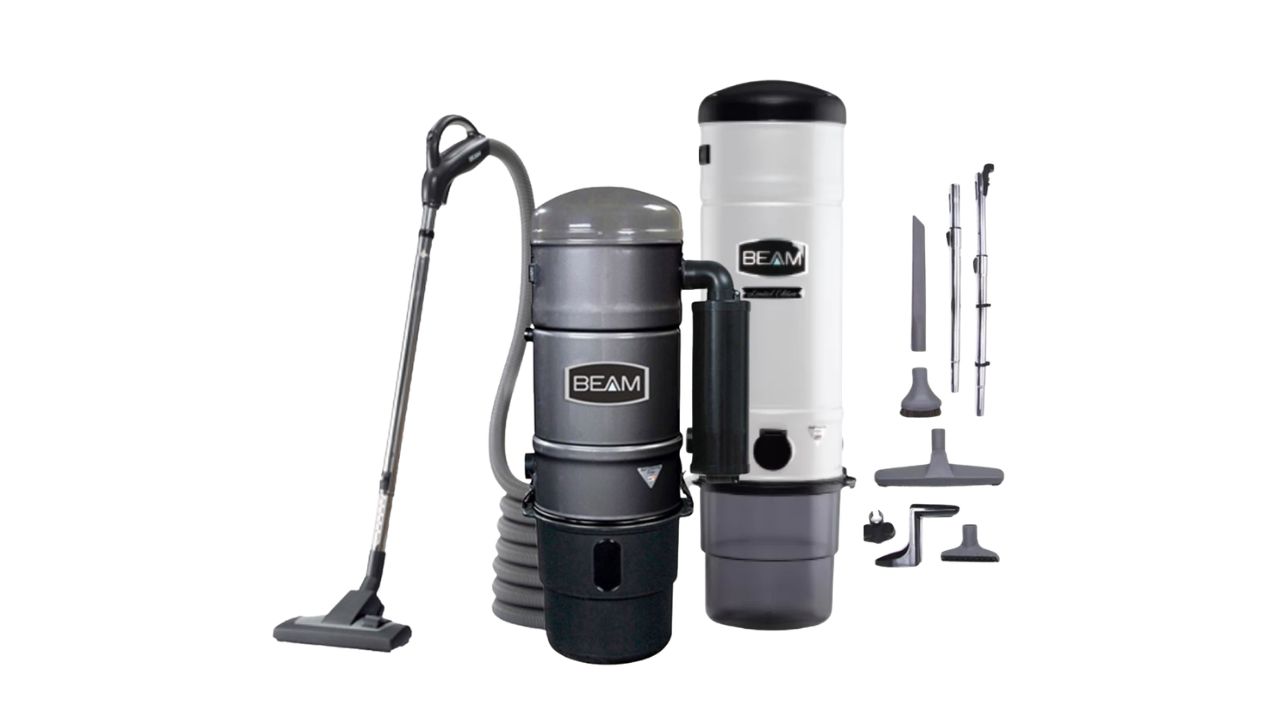
Wait, didn’t Beam stop making vacuums?
No. Production paused for weeks, not forever, and a new owner stepped in fast. You read that Nuera Air, the company that bought Beam from Electrolux in 2018, halted manufacturing across its entire portfolio in April 2024. That headline alone scared a lot of owners into thinking their system had been orphaned overnight.
Here’s the part most blogs skip: Trovac Industries bought Beam the same year and kept building units on the same platform. Your power unit isn’t an orphan. The warranty paperwork trail, though, got messy during the handoff, and that’s worth confirming model by model before you assume full coverage.
From Electrolux to Nuera to Trovac in seven years
Beam has changed owners three times since 2018, and each move reshuffled who answers your warranty call. Electrolux Group, the Swedish appliance maker that built Beam for decades, divested its North American central vacuum business in August 2018. The buyer was Nuera Air, in a deal that also included the commercial vacuum brand Sanitaire, sold separately to BISSELL, with the combined divested operations posting roughly USD 70 million in 2017 revenue. Read Electrolux’s divestiture of the Beam central vacuum business straight from the source whenever a dealer page still tells you otherwise.
Nuera Air ran Beam for six years, then halted all production in April 2024, including sibling brands Husky and DuoVac. Trovac picked up Beam, Husky, DuoVac, SoluVac, Smart, and InterVac in the same acquisition. Three owners, two continents of corporate paperwork, one motor platform that never actually stopped spinning on the factory floor for long.
Why the official Beam site still confuses people
Beam’s own website is part of the problem, not the solution. One page on beamvac.com still describes the brand as wholly owned by Nuera Air, while the warranty page signs off under Trovac. Dealer category pages compound it, printing “nation’s number one brand” copy that predates the 2024 shakeup by years.
That kind of contradiction is exactly why an independent source matters here. A few things worth checking yourself before trusting any single page:
- Confirm the warranty contact listed matches Trovac, not a defunct Nuera Air address.
- Check the copyright year at the bottom of any Beam page you’re reading.
- Cross-reference your model number against current Trovac-era documentation, not a 2019 PDF.
The air watt game dealers love to play
Air watts measure suction at the hose end, and dealers love quoting the biggest number without saying what it actually took to get there. A 650 air watt rating sounds definitive. It isn’t, once you know how the number gets calculated and how easily it gets fudged.
What air watts actually measure on a Beam
Air watts combine two separate things into one figure: how hard the motor pulls and how much air it actually moves. Water lift is the pulling strength, measured in inches. Airflow is the volume, measured in cubic feet per minute, or CFM. The ASTM F558 vacuum air-performance test method sets the formula: air watts equal CFM multiplied by water lift in inches, divided by 8.5.
That formula has a catch ASTM states plainly. The test runs with the brushroll unloaded, meaning it measures the motor’s maximum potential power, not how the system performs once a power brush is actually dragging through carpet pile. A 650 air watt Beam and a 650 air watt unit from another brand clean differently once you load a real brush onto real carpet.
Why one Beam model shows three different numbers
Shop three retailers for the same Beam power unit and you’ll likely find three different spec sheets. The 345 lists 655 air watts and 142 CFM on one site. The SC375 shows 650 air watts elsewhere, with water lift listed at 116 inches and current draw at 14.5 amps. The 375A, a close cousin, lists 600 air watts on yet another page.
These aren’t different products so much as the same motor platform measured, rounded, or copied at slightly different points by different retailers. Nobody flags the gap for you. Treat any single-source spec sheet as a starting point, not gospel, and confirm the number against the actual manufacturer documentation for your specific model code.
The spec that beats wattage no dealer mentions
Pipe-run distance matters more than the number on the box. Suction drops with every additional foot of pipe and every elbow the air has to fight through on its way from the inlet to the power unit. A 600 air watt unit installed with short, clean runs and sweep elbows outperforms a 650 air watt unit choked by a long horizontal run packed with sharp 90-degree turns.
Quick gut check: would a higher air watt number actually fix a weak inlet, or is the real problem 70 feet of pipe and four elbows between that inlet and the motor? Plan inlet placement and pipe routing before you spend a dollar chasing a bigger wattage figure.
That HEPA filter claim, examined honestly
Beam’s self-cleaning filter is not certified HEPA, even though Beam’s own marketing uses the word. It captures 98% of particles at 0.3 microns. True HEPA, under the U.S. Department of Energy standard, requires 99.97% at that same particle size. The gap is small on paper and meaningful for anyone with allergies or asthma in the house.
Is Beam’s self cleaning filter truly HEPA?
No, not by the certified definition, despite the marketing language on Beam’s own site. Beam markets its permanent Gore-Tex self-cleaning filter as HEPA-grade filtration. Beam’s own product pages cite 98% efficiency at 0.3 microns for that filter. The U.S. DOE standard for certified HEPA sits at 99.97% at 0.3 microns, a gap of nearly two full percentage points that compounds over millions of particles in a real household.
What that two percent gap means for allergies
Match the filtration claim to the actual health need in your home, not the word on the box. A household managing asthma should treat that 2% gap as worth taking seriously rather than rounding it away. Exhaust routing matters more than the filter label in most cases. A power unit vented outside, or through a sealed canister exhaust, keeps fine particles out of living space entirely, regardless of what the filter media is rated.
Ask any installer for the actual exhaust filter part number, not the marketing term printed on the brochure. That part number tells you what’s really capturing particles before air leaves the system.
Bagged, bagless, or hybrid for your home
The Beam 345 runs as a hybrid system, so you choose bagged or bagless operation yourself rather than the factory choosing for you. Bagless setups save money over time but mean dustier canister emptying two to three times a year. Bag setups cost more in recurring supplies but keep dust contained during disposal, which matters for allergy-sensitive households.
| Setup | Filtration mess | Ongoing cost |
|---|---|---|
| Bagged | Lowest, dust stays sealed | Higher, recurring bag purchases |
| Bagless | Higher, dust released at emptying | Lower, no bags to buy |
| Hybrid (345) | Owner’s choice | Owner’s choice |
Allergy households tend to choose the bag despite the running cost, simply because sealed disposal beats a cloud of dust at emptying time twice a year.
What real Beam owners say after years
Owner forums tell a more useful story than any product page, because nobody there is selling anything. The pattern across years of posts is consistent: the motor tends to outlast nearly everything bolted to it.
Does it really still sound like a jet engine?
Yes, at startup, according to owners running decades-old units. One owner running a Beam unit installed in 1991 describes the startup noise as comparable to a jet engine spooling up in the basement. The tradeoff is real, though: that noise lives in the basement or garage, not in the room where you’re vacuming, since the motor sits far from every inlet by design. Beam rates the Serenity line at 76 dBA at the power unit during operation, which lands close to a running garbage disposal, just relocated away from the kitchen entirely. Owners who add a sound-suppression muffler report a noticeably quieter startup, but older units without one stay loud.
Why owners replace hoses and handles, not motors
Budget for accessories, not a new power unit, because that’s where Beam systems actually fail first. One owner running a 1991-era Beam reports the original motor still pulls strong suction more than three decades later. What wore out instead: the hose split and needed replacing once, and the handle assembly went through three replacements as switch wiring frayed from years of coiling and uncoiling. That’s the typical failure pattern across long-term owner reports: hoses crack, switches fray, power brushes wear, and the motor itself just keeps running.
Is a beam central vacuum still worth buying?
Yes, for most homes, provided the pipe network is sound and parts access for your specific model is confirmed. Forum opinion splits less than you’d expect once you read past the headlines. One owner tore out a 40-year-old system entirely after discovering wall-pipe leaks that no power unit upgrade could fix. Plenty of others report decades of strong, quiet-where-it-counts, low-maintenance service from the same basic platform.
The verdict depends on two things money can’t fix after the fact: pipe condition and current parts access. Shoppers chasing a higher-value secondhand find sometimes land on refurbished Beam Alliance units, which carry the same commercial-grade bypass motor lineage at a lower price than new.
Picking the right Beam for your home
Match the unit to your actual floor plan, not the biggest coverage number on the box. Dealer coverage claims and real-world pipe runs rarely line up, and that mismatch is where most buyer disappointment starts.
Why dealer square footage claims run high
Treat any coverage rating as a best-case marketing estimate, not a tested ceiling. Beam product pages claim coverage ranging from 4,500 up to 15,000 square feet depending on the model and the page you land on. Those figures assume short, clean pipe runs and ideal conditions that rarely match a real two-story house with elbows, floor joists, and a finished basement in the way. Halve the published rating when you’re sizing a real home, or better yet, plan unit selection by floor and pipe-run length rather than total square footage.
Matching inlets to layout, not total size
Count inlets by hose reach, not by room count. Each hose covers roughly 35 feet in practice, so a poorly placed inlet on the far end of a second floor kills convenience even when the power unit itself has plenty of air watts to spare. Three well-placed inlets covering every room within a 35-foot hose radius beat five inlets scattered without that math in mind. A flush-mount VacPan in the kitchen toe kick solves the one inlet placement problem no wall valve fixes: sweeping crumbs across tile without bending down to plug in a hose.
Serenity versus Classic, what changes
The Serenity line adds a commercial-style bypass motor that cools itself with clean outside air instead of the air it’s pulling through the system, which is the main reason it costs more and tends to outlast a Classic-series unit. Bypass motors run cooler over the long haul than the thru-flow motors used in lower-tier lines, because thru-flow designs pull dirty, debris-laden air directly across the motor for cooling. Classic costs less upfront but trades some quiet operation and motor longevity for that lower price.
| Feature | Serenity | Classic |
|---|---|---|
| Motor cooling | Bypass, clean air | Thru-flow, dirty air |
| Noise level | Lower with QS muffler | Higher, no muffler standard |
| Expected motor life | Longer | Shorter |
| Price | Higher | Lower |
Buyers comparing against older Beam Classic models already installed in a house they’re purchasing should weigh that motor-cooling difference before deciding whether to keep or upgrade.
Installation truths a dealer glosses over
The unit price on the sticker is never the real number, and pipe routing decisions made during install will outlast the warranty by decades. Both of these get glossed over in a sales conversation focused on motor specs.
The pipe routing mistake that kills suction
Long, flat horizontal pipe runs packed with tight elbows quietly strangle airflow no matter how strong the motor is rated. Sweep elbows, which curve gradually instead of turning at a sharp angle, and shorter overall runs protect the air watts you actually paid for. Bad routing voids the manufacturer warranty outright, too, since most central vacuum makers specify maximum pipe-run length and elbow count in their installation documentation. A family of five running three cats and a 20-year-old Beam unit through a 2,800-square-foot ranch found exactly this failure last year: the original copper-clad inlets still worked fine, but a cracked main trunk line hidden behind drywall bled suction at every inlet on that branch, not just the farthest one.
What professional installation actually costs
Budget for pipe, fittings, inlets, and labor as their own line item, since that total rivals the power unit’s price tag. The power unit itself is only one part of a real installation total. Get the complete materials list, covering Schedule 20 PVC pipe, sweep elbows, low-voltage inlet wiring, the rough-in kit, and a dedicated 20-amp circuit for the power unit, before signing anything. Retrofit homes with no attic access add another line item: a Hide-A-Hose conversion kit, which threads a retractable hose through existing pipe instead of fishing new runs through finished walls, at a labor cost a flat-rate quote rarely separates out. Owners researching finding Beam retailers nearby for installation quotes should request that itemized breakdown from at least two dealers before committing.
Repair it now or replace it after the buyout?
Repair makes sense when the motor and pipe network are sound. Replacement makes sense when either one has failed outright. The 2024 ownership change shifts this math slightly, mostly in your favor.
Will I still find parts after the production halt?
Yes, for current-generation models, since Trovac kept Beam’s manufacturing line running. Common parts for recent Serenity and Classic-series units still ship through normal dealer channels. Older Honeywell-era and original Electrolux-era Beam parts get scarce fast, since those predate the current supply chain entirely. Confirm parts availability for your exact model number before paying a technician for a diagnostic visit, not after.
That parts confidence has a second source dealers rarely explain: the motor itself is an industry-standard Ametek/Lamb tangential bypass unit, the same motor family that shows up in Vacuflo power units, manufactured by H-P Products, and in NuTone units, now built under license by Broan-NuTone LLC after Nortek’s consolidation of the brand’s residential ventilation and vacuum lines. A motor shared across that many brands stays in production and stays priced like a commodity part, since no single brand’s sales volume controls whether Ametek/Lamb keeps building it. One exception worth naming: Vacuflo’s older models use a proprietary low-voltage connection that doesn’t swap onto a Beam power unit without an adapter, so confirm the connector type before assuming any cross-brand motor is a drop-in fix.
When a tune up beats a brand new unit
A repair almost always beats replacement when the motor still pulls strong and the failure is limited to a hose, switch, or power brush. Seized motors or wall-pipe leaks behind drywall push the math toward full replacement instead, since those failures cost more to chase than a new power unit costs outright. A simple way to decide:
- Strong motor plus a cracked hose or worn handle: repair.
- Wall pipe leaks or a seized motor: replace.
- Unsure which: get a diagnostic from a technician before spending on parts either way.
Match the repair estimate against the price of a new unit honestly, including labor, before choosing either path.
Conclusion
You walked in worried Beam was an abandoned brand with no one left to call. You’re leaving knowing Trovac Industries builds it today, which air watt and coverage numbers are marketing estimates rather than tested limits, and what your pipe network and motor actually need. Find your power unit’s model number tonight and check parts availability before booking a repair call or signing for a new unit. A Beam motor built on this platform runs for decades from a quiet basement corner, doing work no portable you’ve ever hauled upstairs has matched.
Frequently Asked Questions
Is Beam central vacuum still in business after Nuera Air stopped manufacturing?
Yes, Beam is still in business under new ownership. Trovac Industries acquired the brand in June 2024, the same year Nuera Air halted production, and kept the manufacturing line running.
Who owns Beam central vacuum now?
Trovac Industries (Les Industries Trovac Ltd.) owns Beam today. It’s the third owner since Electrolux divested the brand to Nuera Air back in 2018.
Are Beam central vacuum parts still available?
Yes, for current and recent-generation models. Parts for older Honeywell-era or original Electrolux-era units get harder to find, so confirm availability for your specific model number before paying for repair labor.
How many air watts does a Beam central vacuum have?
Most current Beam power units run 600 to 655 air watts, depending on the exact model and which retailer’s spec sheet you’re reading. Treat the number as a ballpark, not an exact figure, since listings vary across retailers for the same unit.
How much does a Beam central vacuum cost to install and own?
Expect the pipe, fittings, inlets, and labor to roughly match the power unit’s own price, not just add a small amount on top. Factor in occasional bag or filter costs and a possible mid-life motor replacement across a 15 to 20 year ownership horizon.