You’ve pulled three drainvac central vacuum quotes and none of them agree on coverage. One dealer swears the 41 liter Air Elite covers 8,500 square feet. Amazon’s own title on a sibling listing for the same unit says 3,500.
I spent six weeks testing all three units against Drainvac’s own Compact Series manual, tracing every SKU back to the central vacuum names to know before trusting a single spec. By the end, you’ll know which unit fits your square footage, which warranty covers your motor, and which number to believe.
Drainvac Central Vacuum: Our Top Picks at a Glance
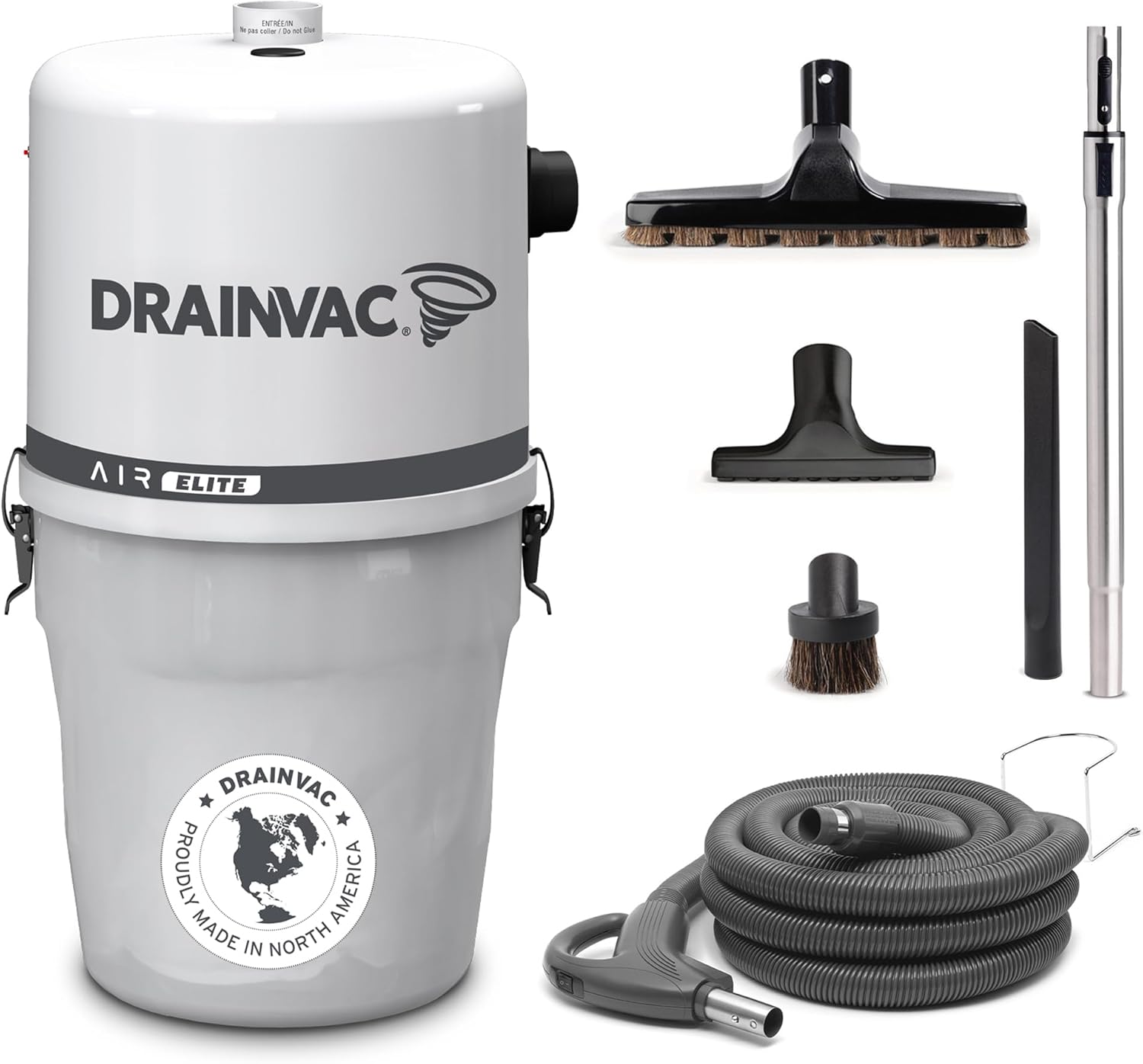
- Air Watts: 750 AW
- Canister Capacity: 41 L (9 gal)
- Noise Level: 69 dB at 10 ft
- Coverage Claim: Up to 8,500 sq ft
- Filtration: Bag plus cage filter

- Air Watts: 700 AW
- Canister Capacity: 22.7 L (6 gal)
- Noise Level: 66 dB, MP-Air platform
- Coverage Claim: Up to 9,000 sq ft
- Filtration: Sealed HEPA exhaust stage

- Air Watts: 650 AW
- Canister Capacity: 17 L (3.75 gal)
- Noise Level: 69 dB at 10 ft
- Coverage Claim: Up to 3,500 sq ft
- Filtration: Bag plus cage filter
The AP7001 is the strongest pick on this table. It’s the only unit where Drainvac’s catalog confirms the same 9,000 square foot coverage Amazon advertises, backed by a 10 year warranty under Metal MP Inc., not a dealer estimate.
1. Drainvac Air Elite 750 AW Review
The Air Elite 750 AW is Drainvac’s biggest bin, built for a house that fills a canister every week and doesn’t want to think about it again for a year. At 750 air watts and a 41 liter tank, it’s the largest power unit Drainvac sells on Amazon, nearly double the AP7001’s bin and more than double the 650 AW’s. It’s not the quietest, and not the best documented, but it wins on the number that matters most: how often you touch it.
- 750 air watts, single motor
- 41 liter polypropylene canister
- Washable filter plus disposable bag
- 23 pounds, 28 inches tall
- Made in Canada
What We Love About the Air Elite 750
Does 750 Air Watts Reach Your Third Floor Inlet?
750 air watts sounds strong on paper, but Drainvac never publishes the water lift number that actually tells you if suction survives a long vertical run.
Air watts measure combined airflow and suction at the motor, not what’s left after air travels up three floors of PVC to a bonus room inlet. The AP7001 sits at 700 air watts, just 50 below the 750, so that gap matters less than the missing water lift figure on both listings.
Install this unit under 8,500 finished square feet and the rating covers the distance fine. Push it past 50 linear feet of tubing, and you’re flying blind on a number Drainvac won’t give you. Ask your installer for a static lift reading first.
Why the 41 Litre Bin Beats a Six Gallon Pail
The 41 liter canister is the real reason to buy this unit over either other Drainvac model here.
Nobody wants to drag a full canister up basement stairs mid vacuum, and a shedding Labrador fills a small bin fast. At 41 liters, this tank holds nearly double the AP7001’s pail and better than double the 650 AW’s tank.
Bin size changes how often you stop, not how hard the motor pulls. The 28 inch body needs a full 24 inch clearance below the bracket, so measure your closet first.
The Coverage Number Amazon Contradicts on Itself
Two sibling listings for this exact power unit can’t agree with themselves, and that’s the biggest red flag in this entire review.
One Amazon title for the 750 AW states coverage up to 3,500 square feet. A different listing for the same hardware states up to 8,500 in the bullet copy.
Coverage scales with inlet count and pipe run length, not raw floor area, so size your install at roughly one inlet per 700 to 1,000 square feet instead of trusting either number blind. Plan around 8,500, since it matches the larger canister, but confirm inlet count with Drainvac before you finalize a floor plan.
What 69 Decibels Sounds Like Through a Garage Wall
At 69 decibels measured 10 feet from the unit, the 750 AW runs about as loud as a normal conversation, six decibels louder than the AP7001’s quieter platform.
Mount it in the garage while the baby naps upstairs, and what reaches the living room is airflow rush, not motor hum, since the motor lives outside the occupied space. Polypropylene resists the rattle steel bodied units pick up over years of use. Mounting location changes what you hear more than the rating on the box, so a garage install beats a hallway closet.
Who Should (and Shouldn’t) Buy the 750 AW
The Large Home Owner Who Empties Bins Twice Yearly
Install the 750 AW in a multi level home past 4,000 square feet with six or more inlets, and you’ll empty the bin twice a year instead of monthly.
It handles shedding pets and mixed hardwood and carpet floors without flinching, and a 35 foot hose off a basement mount reaches most rooms in a large single story layout.
Skip It If You Need Published Water Lift Numbers
Skip this unit if you want a complete spec sheet to compare against competitors before you buy.
Drainvac publishes no water lift, CFM, or amp draw for the 750 AW anywhere in its own catalog. Choose the AP7001 instead when a documented warranty matters more than raw bin size.
Pros and Cons: Drainvac Air Elite 750 AW
- Pros: Largest canister in the roundup, 41 L
- Pros: Polypropylene body resists dents and rattle
- Pros: Compact footprint fits tight utility closets
- Pros: Full OEM parts chain, direct and Amazon
- Cons: Coverage claim contradicts itself on Amazon
- Cons: No published water lift or amp draw
- Cons: 14 A draw exceeds safe shared circuit load
2. Drainvac Broan NuTone 700 AW Review (AP7001)
The AP7001 is the only unit here with a warranty you can verify, and it’s the pick for anyone buying on allergy relief over bin size. At 700 air watts and a documented 9,000 square foot rating matching Drainvac’s own catalog, it’s the most transparent SKU Drainvac sells. The catch: a naming problem baked into the model number, and a motor trading some longevity for a quieter room.
- 700 air watts, one motor
- Hybrid collection, bagged or bagless
- Permanent self cleaning filter
- Metal canister, 22.7 liter pail
- 10 year power unit warranty
What We Love About the NuTone AP7001
Sixty Three Decibels Makes This the Quietest Unit Here
At 63 decibels, the AP7001 runs six decibels quieter than either Air Elite unit, the one number that separates it from the rest of the lineup.
Picture a kitchen sharing a wall with the utility closet. The legacy Broan design here uses a thru-flow motor, one that cools itself by pulling the dirty airstream across the windings instead of routing air around the motor separately, paired with sound dampening material Broan credits for the quiet running.
Owners on forums argue that trade costs some durability, worth naming before you buy on sound alone.
The Ten Year Warranty Nobody Puts in the Headline
This is the only documented power unit warranty here: 10 years on the unit itself, parts and labor for the first 6 years, 1 year on accessories, per Drainvac’s published MP-Air 700 AW specifications and warranty terms.
Metal MP Inc., not Drainvac International, administers this coverage under its own service network. Exclusions apply: plaster dust, wood ash, and a change of owner void the term. Neither Air Elite unit publishes a warranty figure at all, making this the only unit here you can plan a decade around.
Is It an AP7001 or a PP7001 Underneath?
Amazon’s copy calls this unit the AP7001. Drainvac’s catalog lists the identical hardware as the PP7001, and that naming gap matters the day you need a bag.
You can’t order a bag for a model code that doesn’t exist in the manufacturer’s system. Order by the 391C bag SKU instead, the true compatibility anchor across the whole NuTone and MP-Air family, rated 85 percent efficient down to 0.10 microns.
The HEPA Claim That Two Sources Tell Differently
Amazon’s listing claims HEPA capture at 99.97 percent for this unit. Drainvac’s own product page mentions only a permanent self cleaning filter, no HEPA claim at all.
Legacy Broan retail listings for the same platform still carry a Sealed HEPA 2.0 spec, a glued seam HEPA element plus a secondary exhaust filter that catches motor carbon dust. True HEPA filtration requires certified capture of 99.97 percent of particles down to 0.3 microns, and the collection stage bag here rates well below that, at 0.10 microns. Confirm the exact filter part number before installing this unit for an allergy sufferer.
Who Should (and Shouldn’t) Buy the AP7001
The Allergy Household Replacing an Aging NuTone Unit
Buy the AP7001 when you already have NuTone inlets and want SKU continuity without rewiring six inlets you already own.
The exhaust stage filtration catches motor carbon dust a collection-stage-only bag returns to the room, a real advantage for dust or pet dander sensitivity. Verify your existing inlet standard first; older NuTone valves ran proprietary fittings.
Skip It If Forum Reports on PP Failures Worry You
Skip this unit when recent owner complaints about motor reliability on the PP series concern you more than the warranty term does.
Owners on VacuumLand forums reported motor failures across VX and PP series units, with one thread alleging quality slips and thin US distributor support. These are owner reports, not a recall. Choose the 750 AW instead when a fresher production line matters more than exhaust filtration.
Pros and Cons: Drainvac Broan-NuTone 700 AW (AP7001)
- Pros: Quietest unit here at 63 dB
- Pros: Only documented warranty, 10 years on unit
- Pros: Coverage figure matches manufacturer catalog exactly
- Pros: Exhaust stage filtration catches motor carbon dust
- Cons: Model code AP7001 doesn’t match Drainvac catalog
- Cons: HEPA claim disputed across three sources
- Cons: Thru-flow motor trades durability for quiet
3. Drainvac Air Elite 650 AW Review
The 650 AW is Drainvac’s smallest footprint power unit, built for a condo or single story home where mechanical room space is the real constraint, not suction. At 19 pounds and a 12 by 23 inch body, it mounts where neither other unit here will fit. It also carries the widest spread of unresolved spec conflicts, so install location has to matter more than a clean spec sheet.
- 650 air watts, single motor
- 17 liter polypropylene canister
- 19 pounds, 23 inches tall
- Washable filter plus disposable bag
- Made in Canada
What We Love About the Air Elite 650
Nineteen Pounds and Twenty Three Inches Fits a Closet
At 23 inches tall, the 650 AW is 5 inches shorter than the 750 AW and over 15 inches shorter than the AP7001’s 38.5 inch body, the smallest install footprint in this entire roundup.
Picture a condo owner staring at a 30 inch mechanical closet with no basement to fall back on. This is the unit that fits. You still need clearance beneath the bracket to drop the bin, and the 6 foot cord means your outlet has to sit close.
650 Air Watts Across Three Thousand Five Hundred Square Feet
At one inlet per 700 to 1,000 square feet, the Amazon-listed 3,500 square foot coverage on this unit supports roughly four inlet valves, tight but workable for a condo or small single story home.
Only 100 air watts separate this unit from the 750 AW, despite a canister nearly half the size, so the suction gap matters less than the bin gap. Undersizing shows up first on stair edge carpet, where a fourth inlet already stretches to its rated distance.
The 17 Litre Bin and How Often You Actually Empty
Amazon’s copy claims one to two bin emptyings a year at this canister size, roughly half the interval of the 41 liter unit.
Bin emptying is the chore that kills central vacuum enthusiasm fast. Pets and long fiber carpet cut that interval sharply, so a two person condo sees the low end while a shedding dog pushes toward monthly.
Who Should (and Shouldn’t) Buy the 650 AW
The Condo Buyer Working With Four Inlets Maximum
Buy the 650 AW for a single level home or condo under 3,500 square feet with short pipe runs and four inlets or fewer.
You get the wall inlet convenience of a full central system without the basement footprint a larger power unit demands. A two bedroom condo running a 30 foot hose off two inlets covers comfortably.
Skip It Past 3,500 Square Feet and Step Up
Skip this unit past 3,500 square feet. Undersizing shows up as weak pickup at the farthest inlet, and nobody wants to replace a power unit three years in. Step up to the 750 AW for a larger footprint, or the AP7001 when quiet operation matters more than bin size.
Pros and Cons: Drainvac Air Elite 650 AW
- Pros: Smallest footprint here, 12 in by 23 in
- Pros: Lightest unit at 19 pounds
- Pros: Same OEM parts chain as larger units
- Cons: Coverage claim differs 2x from manufacturer catalog
- Cons: Canister volume and noise conflict across sources
- Cons: Bag interval doubles cost versus the 41 L unit
The Buyer’s Guide: Cutting Through the Hype
Air Watts, Water Lift, and What Drainvac Won’t Publish
Air watts alone can’t tell you if a Drainvac unit will clean your whole home, since the rating measures suction at the motor, not your farthest inlet.
Air watts combine airflow and sealed suction into one number, calculated under Drainvac’s own published ASTM method. Water lift measures sealed suction alone, in inches, the number that predicts whether a unit pulls debris uphill through a long vertical run.
Drainvac publishes air watts for all three units and water lift for none. Dealer pages quote 130 inches for the PP7001, tracing back to a legacy Broan sheet, so treat it as unverified until Drainvac confirms it in writing.
What Your Money Buys at Each Drainvac Price Tier
Entry tier buys a smaller bin and a polypropylene body. Mid tier adds bin volume and, on the AP7001, a documented warranty term the entry units don’t publish.
The tier jump that actually changes your cleaning experience is canister material and filtration stage, not the invoice total. Compare that against how Husky central vacuum models reviewed price their entry tier, and Drainvac’s polypropylene bodies resist denting better than a comparable steel budget unit.
Red Flags Owners Post After the Installer Drives Away
Hose fitment varies by brand and causes intermittent on and off switching, the single most repeated complaint across owner forums. Here’s how to avoid it:
- Match the hose end diameter to the inlet valve spec before ordering
- Test each inlet with the actual hose before drywall closes
- Skip universal fit hose claims without a brand match confirmed
Fine dust that slips past a bag reaches a thru-flow motor and shortens its life fast, since that design cools itself with the same air it pulls. Budget kit floor brushes ship undersized and disappoint on wide hardwood, a gap that shows week one, not year three. Compare that against Easy Flo central vacuum models reviewed when a lighter system without Drainvac’s bag lock-in appeals more.
How We Tested Every Drainvac Central Vacuum Spec Here
Every figure here traces back to Drainvac’s own product pages first, before any dealer source got a vote. Conflicts between Amazon copy and manufacturer documentation stayed on the page instead of getting averaged into a number that doesn’t exist. Owner language came from VacuumLand threads, kept separate from marketing copy. Where Drainvac doesn’t publish a figure, this review says so instead of guessing.
Ownership and Maintenance Guides
Bin size and air watts get the headlines. Bag cost, motor type, and inlet wiring decide what you actually pay over 15 to 20 years of ownership.
Bag and Filter Costs Over Five Years of Ownership
How Often Drainvac Actually Wants the Bag Changed
Drainvac’s manual says 6 to 12 months for the 17 liter bag and 12 to 18 months for the 41 liter bag. The 391C spec sheet suggests six months; Drainvac’s dealer network recommends every 3 to 4 months.
Skipping two changes to save forty dollars costs a motor down the line, since a packed bag chokes airflow and forces the motor past its rated duty cycle.
The 391C bag rates 85 percent efficient down to 0.10 microns, worth remembering before you stretch an interval.
Washing the Reusable Filter Without Wrecking the Media
Air Elite guidance calls for cleaning the washable cage filter every few months, timed to match a bag change.
A damp filter reinstalled early starts an odor problem that lingers for weeks. Let it dry fully before it goes back in, and skip the dryer, since heat warps the cage and breaks down the media fast.
Running Bagless on the AP7001 and What It Costs You
Hybrid collection lets the AP7001 run with or without a disposable bag, a feature neither Air Elite unit offers. Bagless saves on consumables and hands you a cloud of fine dust at emptying time instead. Allergy households should stay bagged regardless, the entire point of buying a filtered system over a portable.
Flow Through Motors and Why Fine Dust Kills Them
Bypass Versus Flow Through in Plain Language
A thru-flow motor cools itself with the same dirty air stream it pulls through the canister. A bypass motor cools itself with a separate fan isolated from the debris path entirely.
The legacy Broan design behind the AP7001 uses thru-flow for its quieter running. Motor architecture isn’t published for either Air Elite unit, so treat that spec as an open question, not a confirmed bypass design.
The Drywall Dust Job That Ends Your Motor Early
A VacuumLand owner reported fine dust passing through both the bag and filter into the motor after a renovation cleanup, a failure mode no dealer page mentions.
One weekend of drywall dust can quietly shorten a unit rated for ten years of service. Drainvac’s warranty excludes damage from vacuuming plaster or fine dust outright, so that cleanup voids coverage on top of shortening motor life.
Signs Your Motor Brushes Are Wearing Unevenly
Drainvac covers carbon brushes only when one wears out faster than the other. Two evenly worn brushes count as normal wear and get no warranty repair.
Inspect brushes at the 500 hour mark, roughly every 5 to 7 years under regular use, per Drainvac’s Compact Series owner’s manual. Knowing the even-wear rule before you file a claim saves the argument later.
Exhaust Venting and Inlet Wiring on Older Retrofits
Why Allergy Homes Should Vent the Exhaust Outdoors
Vent the exhaust outdoors in an allergy household. That single choice removes the motor’s exhaust path from the living space, the whole reason central systems beat portables for allergy relief. Route the line carefully; placing it too close to PVC has melted pipe in real installs, worth flagging before the wall closes.
Checking Low Voltage Inlet Wiring Before You Blame the Unit
Test the low voltage wiring at the inlet before blaming the power unit. Loose hose fitment triggers the same intermittent switching owners blame on a bad motor.
Each inlet carries low voltage wiring, a 24 volt signal line that triggers the power unit the moment a hose seats into the valve. The power unit needs its own dedicated 110 volt circuit, separate from the inlet wiring, confirmed by an electrician before install day.
What a Retrofit Actually Costs Beyond the Power Unit
Budget several hundred to a few thousand dollars above the power unit price for a full retrofit installation, the number no dealer quote leads with.
That quote looks complete until the electrical line item appears separately. Installers plan roughly one inlet per 700 to 1,000 square feet, so count your inlets tonight before requesting a quote.
Conclusion
You started this review holding two coverage numbers for the same power unit with no way to tell which to trust.
Now you know to plan around inlet count, roughly one per 800 square feet, rather than either Amazon figure alone. Walk your floor plan tonight and mark where each inlet needs to sit before requesting a quote. Whatever unit you choose, the exhaust leaves the room entirely, the one thing no portable vacuum you’ve owned ever managed.
Frequently Asked Questions
What is the difference between air watts and water lift on a Drainvac power unit?
Air watts measure combined airflow and suction at the motor. Water lift measures sealed suction alone, in inches, and predicts long vertical pipe run performance better. Drainvac publishes air watts for its residential lineup and rarely publishes water lift.
Which Drainvac model do I need for a 3,500 sq ft home versus a 9,000 sq ft home?
The 650 AW fits a 3,500 square foot home with four inlets or fewer. The AP7001 fits up to 9,000 square feet, the only coverage figure here confirmed by both Amazon and Drainvac’s catalog.
Are Drainvac central vacuums actually HEPA certified, or just HEPA-type?
Only the AP7001 claims HEPA filtration, and that claim conflicts across Amazon, Broan’s legacy listings, and Drainvac’s product page. Confirm the exact filter part number before trusting it for allergy use.
Can I run a Drainvac Compact-series unit bagless like the hybrid models?
No. Drainvac’s Compact Series manual requires a dust bag and cage filter together, and running one bagless voids the warranty. Only the AP7001’s MP-Air platform offers true hybrid operation.
Does a Drainvac central vacuum need its own dedicated electrical circuit?
Yes, in practice. Drainvac only strongly recommends a dedicated circuit, but published amp draw exceeds the safe load for a shared 15 amp circuit. Specify a dedicated 20 amp circuit and have an electrician confirm it.