A Vacuflo power unit is not one product. It is three different filtration designs wearing the same paint job, and picking the wrong one means weak suction in the farthest bedroom for the next twenty years. Dealers love to say their True Cyclonic model “eliminates 100% of dust and allergens.” It doesn’t. The canister catches most of it, and the rest leaves through a vent.
Finish this guide and you’ll know which filtration family fits your home and which spec to trust. For the full model lineup, start with the Central Vacuum Lab Vacuflo central vac guide.
Vacuflo Power Unit
A Vacuflo power unit is the motorized canister behind a built-in vacuum system, sold in three filtration families: True Cyclonic, Filtered Cyclonic, and Disposable Bag. That pick decides suction strength and air quality. Size it to square footage; allergy households need it to keep dust out of the air.Why This Purchase Keeps Tripping People Up
People get stuck because Vacuflo’s lineup looks like one product line with different numbers on the side. It’s actually three separate engineering decisions about where dust goes after it leaves your floor. This guide compares Vacuflo’s own spec sheets and manuals against independent retailer listings and owner reports from forums like VacuumLand, where dealer marketing doesn’t reach.
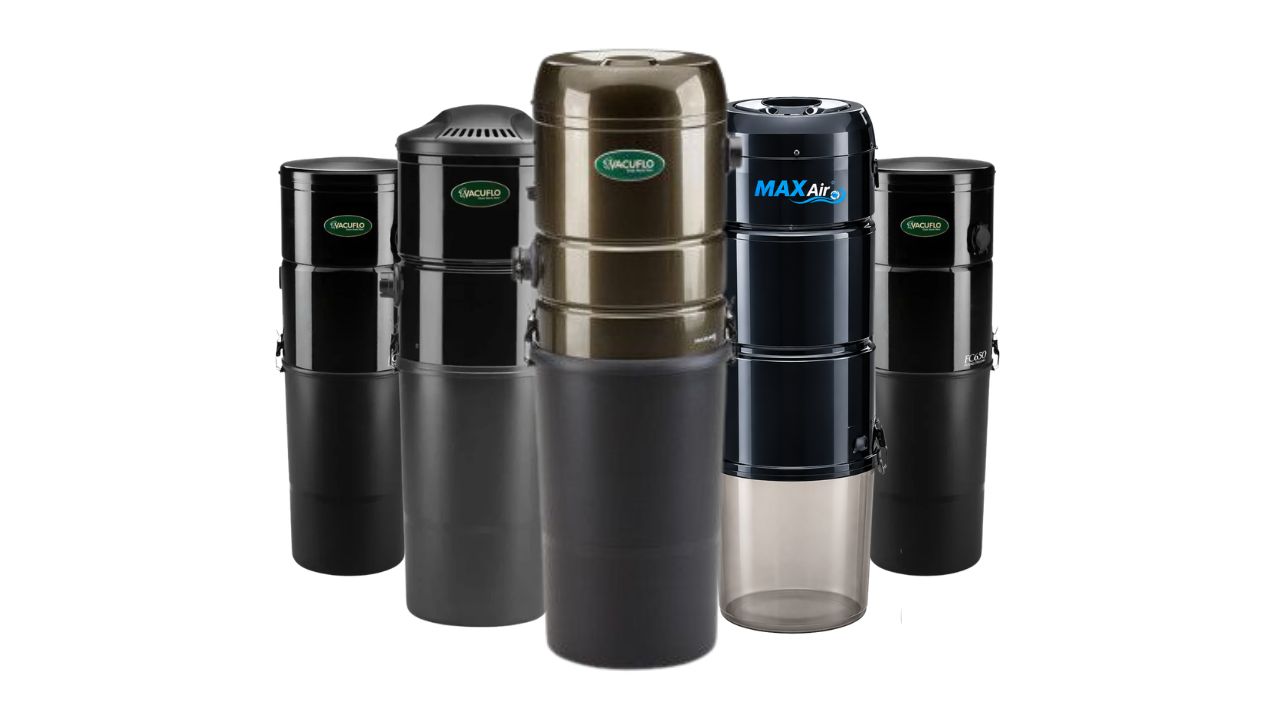
Are All These Vacuflo Models Really That Different?
Yes, and the model number tells you almost nothing about which one you need. A higher number usually signals more air watts within the same family, not a better overall vacuum for your house.
Here’s the trap. The 260, 466Q, and 566Q look like the same blue canister with a different label, and so do the FC550 and the DB7000 on a showroom shelf. But True Cyclonic units and the bagged Maxum line solve opposite problems: one skips consumables and vents fine dust outside, the other bags every particle and never vents anything. Pick by price alone, and you end up with a unit that blows dust into a garage with no exterior wall nearby.
Want to know how this plays out in a real living room? Keep reading.
What Dealers Emphasize Versus What You Feel
Dealers lead with power and warranty length because those numbers close a sale fast. You care about something quieter: whether you’ll touch dirt, whether the air stays clean, and whether the unit still pulls hard five years from now.
A shopper told a 760 “never loses suction” learned three weeks after install that the unit needs an exterior vent run and a 30-amp receptacle the builder never planned for. Nobody mentioned that during the pitch. The honest gap is convenience traded against filtration, and that rarely makes the sales sheet.
The Three Vacuflo Filtration Types, Explained Plainly
This is the whole decision. Get the filtration family right and the model number mostly sorts itself out by square footage.
True Cyclonic Units That Use No Bag or Filter
True Cyclonic means a bagless, filterless design that spins debris out of the airflow the way a tornado drops dirt out of moving air, venting a small share of exhaust outside. Vacuflo, built by H-P Products Inc. of Louisville, Ohio, cites cyclonic separation forcing roughly 96% to 98% of debris straight into the canister.
The remaining 2% to 4% of fine dust rides the airflow through the motor and out the exhaust vent. That’s the trade: no bags to buy, ever, but you need a clear path to an exterior wall.
Models in this family: the 260, 466Q, 566Q, 760, and MaxAir. The 760 is the flagship, built around a dual-motor design rather than a bigger single motor, which is why its air watt number jumps so far past the rest of the lineup. Full figures appear in Vacuflo’s published True Cyclonic specification sheet.
MaxAir sits at the top of that lineup for homes needing the most suction the True Cyclonic design can deliver, and the MaxAir high-suction models breakdown covers how it stacks up against the 760.
The limitation worth naming up front: True Cyclonic is the wrong call without a viable outdoor exhaust run, and it puts the buyer in direct contact with fine dust at every canister emptying.
Filtered Cyclonic Units With a Pleated Cartridge
Filtered Cyclonic adds a pleated cartridge after the cyclonic stage, so venting outside becomes optional instead of required. The same 96% to 98% of debris drops into the canister through cyclonic separation, and the cartridge then traps most of what would have escaped through the motor.
Dealers push this line hardest for retrofits and retractable hose setups, since skipping the outdoor vent run saves a full day of labor. VacuumLand owners flag a real catch: the cartridge’s pleats and seals let fine dust slip past after a few seasons without a swap, which is why Vacuflo calls for changing the 7-inch cartridge once a year.
Models include the FC300, FC550, FC650, and the dual-motor FC1550 for very large homes. The FC650 delivers 575 air watts at a 141-inch water lift, enough to hold suction across a 90-foot run to a distant second-floor inlet, where a weaker single-motor True Cyclonic unit would start to fade. The limitation: skip the annual cartridge change and you’re paying full price while breathing the same fine dust a True Cyclonic owner accepted for free.
Disposable Bag and Maxum Units for Allergy Homes
Disposable Bag systems trap debris inside a sealed three-layer bag, so the homeowner never makes physical contact with dirt, dust, or pet dander during emptying. That single difference is the deciding factor for a household built around allergies.
Vacuflo markets its CleanShield bags as capturing particles down to 0.3 microns. That figure matters because 0.3 microns is the threshold defining true HEPA filtration: the U.S. Department of Energy standard requires removing at least 99.97% of particles at that exact size, the hardest size for any filter to catch. Vacuflo cites the micron threshold without claiming certified HEPA performance, so an allergy-focused buyer should ask whether the bag was independently tested to the DOE standard or simply rated to the same micron size.
Models include the DB7000 and the Maxum line. The DB7000 lists 601 max air watts on a 20-amp dedicated circuit and a 158-inch water lift, the highest sealed suction of any single-motor Vacuflo unit, traded for the ongoing cost of replacement bags. The limitation: every bag swap is a small recurring expense the bagless True Cyclonic owner never pays.
Air Watts and the Specs That Actually Decide Power
The spec dealers print biggest on the box is usually motor wattage, and that’s the one number you should trust least.
Why Air Watts Beat the Wattage on the Box
Air watts measure real suction at the hose end under load, while motor wattage just measures how much electricity the motor draws. ASTM F558, the industry test standard, defines air watts as CFM multiplied by water lift, divided by 8.5.
Water lift is sealed suction, the force that pulls heavy debris up a long pipe run. CFM, cubic feet per minute, is the airflow that carries lighter dust and hair along the tube. A unit posts huge motor wattage and still delivers mediocre air watts when its fan design wastes that power as heat instead of suction.
How Many Air Watts Does a Vacuflo Power Unit Need?
Match the air watt number to your actual floor plan, never to the brochure’s maximum rated square footage. Here’s how the lineup breaks down:
| Model | Family | Max Air Watts | Max/Avg Amps | Rated Sq. Ft. | Capacity | Voltage |
|---|---|---|---|---|---|---|
| 260 | True Cyclonic | 443 | 14.2 / 10.5 | 3,000 | 5.5 gal | 120V |
| 466Q | True Cyclonic | 477 | 14.9 / 13.6 | 5,000 | 6 gal | 120V |
| 566Q | True Cyclonic | 535 | 15.6 / 12.0 | 8,000 | 6 gal | 120V |
| FC650 | Filtered Cyclonic | 575 | 15.7 / 12.4 | 8,000 | 6 gal | 120V |
| DB7000 | Disposable Bag | 601 | 14.8 / 12.1 | 8,000 | 6 gal | 120V |
| 760 | True Cyclonic (dual motor) | 886 | 28.4 / 21.0 | 12,000 | 6 gal | 120V |
| FC1550 | Filtered Cyclonic (dual motor) | 1,010 | 13.4 / 11.6 | 18,000 | 6 gal | 240V |
The 260 lists 443 air watts and the 466Q lists 477, a small jump that buys more rated coverage, not dramatically stronger suction. The 566Q lists 535, and the flagship 760 jumps to 886 by adding a second motor rather than a bigger single fan. Treat every rated square footage figure on this table as a ceiling, not a target, and size to your real pipe run instead.
One Amp Reading That Should Make You Pause
A higher amp draw does not mean stronger suction, and the 466Q proves it. It pulls roughly 13.6 average amps yet trails the 566Q’s 535 air watts, while the 566Q draws only 12.0 average amps and still pulls harder.
More current running through a motor means more heat and wear, not more clean. That’s a counter-intuitive result most buyers never check, because the amp rating sits right next to air watts on the spec sheet and people assume the two climb together.
Which Vacuflo Power Unit Actually Fits Your Home
Sizing comes down to honest square footage, inlet count, and floor type, not the number printed on the brochure.
Why the Rated Square Footage Is Almost Always Too Generous
Vacuflo’s rated coverage runs well past what most owners need from that model, and dealers rarely correct it. The 566Q carries an 8,000-square-foot rating, yet owners regularly run it on homes closer to 3,500 square feet with margin to spare.
A practical rule: cut the brochure rating roughly in half, or size per floor in a multi-story home instead of treating the house as one zone. The 760 exists for the other end of that scale, jumping to 886 air watts for homes in the 12,000-square-foot range where a single-motor unit runs out of headroom.
Counting Inlets the Way Installers Actually Do It
Installers place inlets so a single 30-foot hose reaches every corner without strain, and that rule matters more than total square footage. Real coverage starts dropping once an inlet sits past 35 feet from the power unit, since every added foot of pipe and every 90-degree elbow steals a measurable share of suction.
Plan inlet count per floor rather than for the house as a whole. A two-story home needs its own inlet math upstairs, where pipe runs back to a basement unit get longer and elbow count climbs.
Curious what that loss looks like at 90 feet versus 30? Keep reading.
Matching the Unit to Hard Floors or Carpet
A home with bare floors and a retractable hose setup leans more on water lift than raw CFM, since there’s no carpet pile to dig debris from. Heavy carpet does the opposite, demanding strong air watts plus a compatible powered brush to agitate embedded dirt before the pipe carries it away.
Pick the filtration family first, based on allergies and venting access, then choose the model inside that family based on floor type. A hardwood-heavy home on retractable hose performs well on a 566Q’s 535 air watts; thick carpet across three bedrooms wants the added headroom of an FC650 or DB7000.
What the No Filter Design Quietly Costs You
This is the trade-off forum veterans argue about more than any other spec on the sheet.
Does a Vacuflo True Cyclonic Motor Really Die Early?
It depends on maintenance habit, not on the True Cyclonic design itself. One VacuumLand owner running an original VacuFlo from 1978 has never replaced a motor, crediting it to emptying the canister every three months and cleaning the screen each time. Another owner’s 1984 unit still runs on its original motors decades later, needing just one carbon brush replacement.
Set against that, some repair shops report premature motor failure on units where owners skip canister maintenance. Fine dust rides through an unfiltered motor on every cycle, and Ametek/Lamb, the motor division supplying most of Vacuflo’s lineup, builds its tangential bypass motors to tolerate that dust load by cooling on a separate clean-air path rather than the dirty intake air.
What Actually Gets Blown Outside When You Vent?
Roughly 1% to 2% of the air pulled into a True Cyclonic unit exits through the exterior vent, carrying fine dust the cyclonic stage couldn’t separate. Manuals and technicians give the same answer: it’s dust, not debris, and small in volume but real.
- Aim the exhaust vent low and away from siding, windows, and parked cars.
- Keep the run short and straight, ideally under 8 feet, to avoid pressure loss.
- Never vent into an attic, soffit, or anywhere airflow can recirculate indoors.
The Overfilling Mistake That Wrecks the Impeller
Letting the canister run full pulls loose debris into the impeller blades, and that single habit causes motor damage Vacuflo’s warranty doesn’t cover. The fan spinning at full speed was never built to chew through debris instead of air.
Empty the canister before it looks full, and never run wood ash, plaster dust, or construction debris through the system. Any of it shortens a motor’s life regardless of filtration family.
Installing It Without Strangling Your Suction
The choices made on install day are the ones you can’t undo without tearing into a wall later.
The Electrical Detail Buyers Discover Too Late
Confirm your breaker and outlet before the installer mounts anything, since several Vacuflo models exceed a standard household circuit. The DB7000 needs a dedicated 20-amp receptacle, and the 760 averages 21 amps with bursts to 28.4, which is why H-P Products specifies a 30-amp dedicated receptacle for that model instead.
Builders quoting a basic central vacuum line item often price the wiring for a 20-amp circuit by default. Verify the model first, then the wiring, never the reverse.
Where to Mount a True Cyclonic Unit
A True Cyclonic unit needs a mounting spot near an exterior wall, since exhaust has to reach outside. Garages and basements with a nearby outside wall work well, keeping noise and any trace exhaust dust away from living space.
Keep that exhaust run short and straight. A long, elbow-heavy vent run fights the same airflow physics that rob suction inside the pipe network, just on the exhaust side instead of intake.
Keeping a Vacuflo Running for Two Decades
The owners getting twenty-plus years out of one motor aren’t lucky. They’re following a maintenance habit dealers rarely explain at the point of sale.
The Maintenance Rhythm Vacuflo Actually Recommends
Vacuflo’s documentation calls for emptying the canister and washing the screen every four to six months on True Cyclonic units. Filtered Cyclonic owners carry one extra task: swapping the 7-inch cartridge yearly to keep airflow from choking down as it clogs.
Skip either habit and suction fades while the motor works harder against a restricted path, the slow overheating pattern behind most premature failures owners report.
Bypass Motors and Why They Outlast Cheap Units
A bypass motor cools itself on a separate stream of clean air, the way a runner breathes fresh air rather than through a scarf clogged with dust. A flow-through motor cools on the same dirty air doing the cleaning work, which shortens its life.
Ametek/Lamb’s tangential bypass motors, including the 119792 built around a 7.2-inch fan and used across the 560, 566Q, and 960 power units, power most of the reliable units across the entire central vacuum industry, not just Vacuflo. That single design choice explains more about durability than any air watt figure on the sheet.
Repair or Replace Your Aging Vacuflo Unit
Standing over a dead power unit, most owners aren’t sure whether they’re looking at a quick fix or a sunk cost.
Is Your Old Vacuflo Worth a New Motor?
A failing motor on solid, undamaged in-wall pipe almost always favors repair over full replacement. Vacuflo motors and canisters, including the common Ametek/Lamb 119792, stay widely stocked by parts retailers years after a unit’s original sale, keeping repair costs predictable.
Weigh that repair cost against what a new unit buys: a fresh warranty, quieter operation, and on newer Filtered Cyclonic and DB models, better filtration than whatever shipped fifteen years ago. A motor swap on a unit with intact tubing is usually the cheaper, faster call, and that’s where Vacuflo pricing by model tier helps weigh repair against buying new.
The Private Label Twist Most Owners Never Knew
H-P Products Inc. builds the Vacuflo brand and also makes the central vacuum lines sold under the Dirt Devil and Element names, from the same Ohio facilities on shared platforms. Forum technicians report Royal-branded and central Dirt Devil-branded power units are frequently the same hardware as a Vacuflo unit wearing a different badge.
That central vacuum Dirt Devil is not the portable Dirt Devil sold at retail stores. The portable handheld and upright products belong to TTI Floor Care North America, a Techtronic Industries division, following its 2003 acquisition of Royal Appliance Manufacturing. Two different companies, one shared name, a detail that matters if a parts search turns up a suspiciously familiar Dirt Devil-branded canister.
For anyone designing a system from scratch rather than replacing one part, the custom Vacuflo system configurations page covers how power unit choice fits into a full pipe-and-inlet plan.
Conclusion
You came in worried about the wrong Vacuflo power unit and skeptical of the dealer line that True Cyclonic erases all dust and allergens. It doesn’t, but you now know which filtration family fits your home and which air watt figure to trust over a brochure ceiling.
Tonight, measure your largest floor and count how many inlets one 30-foot hose must reach, then size from that number. Unlike the portable you’ve dragged up the stairs for years, the right Vacuflo power unit pulls dirt completely out of your living space, and that keeps paying off for decades.
Frequently Asked Questions
What is a Vacuflo power unit, and what’s the difference between True Cyclonic, Filtered Cyclonic, and Disposable Bag?
It’s the motorized canister that powers a built-in vacuum system, and the three families differ in where dust ends up. True Cyclonic vents a small share of fine dust outside with no bag or filter, Filtered Cyclonic adds a cartridge so venting becomes optional, and Disposable Bag traps everything so you never touch dirt.
Who makes Vacuflo power units, and are Dirt Devil and Element the same unit?
H-P Products Inc. makes Vacuflo, and yes, its central vacuum Dirt Devil and Element lines share platforms with Vacuflo models. That central vacuum Dirt Devil has nothing to do with the portable Dirt Devil brand, owned by TTI Floor Care North America.
How many air watts do I actually need from a Vacuflo power unit?
Match air watts to your real floor plan, not the brochure’s maximum rating. A 3,500-square-foot single-story home with short runs does fine on a 535-air-watt 566Q, while a 12,000-square-foot home with long runs and multiple floors needs the dual-motor 760’s 886.
Does the Vacuflo lifetime warranty transfer to a new homeowner?
No, coverage stops the moment the original purchaser sells the home or removes the system. Vacuflo’s limited lifetime warranty applies only to the original purchaser at the site of original installation, and it excludes consumables like motor brushes, bags, and filter cartridges.
Can I replace a Vacuflo power unit’s motor myself?
Yes, on most models a motor swap is a straightforward DIY job if the canister and tubing stay intact. Genuine Ametek/Lamb replacement motors, including the 119792 used in the 566Q line, stay widely available through vacuum parts retailers, keeping a same-brand swap simple and affordable.