The aqua air central vac is not a smarter dry central vacuum. It is a built-in total cleaning system that also requires a dedicated water supply line and a drain connection at the power unit location. That detail alone reshapes the installation budget before one inch of PVC goes into the wall.
Browse the top central vacuum brands today and Aqua-Air stands apart from every dry system on that list. By the end of this guide, you will know which model fits your square footage, what your building needs before rough-in, and the two realities most dealers skip before the sale closes.
Aqua Air Central Vac
Aqua-Air central vac is a built-in total cleaning system that vacuums, mops, and auto-drains in a single continuous pass. It replaces bags and filters with cyclonic water filtration. It targets high-debris environments where a dry central vacuum stops short: kennels, grooming salons, auto shops, and pet-heavy homes with daily hard-floor washing demands.What Makes Aqua-Air Different From a Normal Central Vac
Aqua-Air is not an upgrade to a dry central vacuum. It is a separate category: a built-in system that handles dry debris, extracts wet spills, and scrubs hard floors, then drains soiled water directly into the sewer through a connection at the power unit. Standard central vacuums do none of those last three things.
It sweeps, mops, and drains in one pass
Think about what a kennel owner does after a bathing session. Wet fur on the floor, dirty rinse water spreading toward the drain, and a mop bucket already filthy after the second dog. The traditional cleanup is a portable shop vac for the debris, then a mop that spreads dirty water around more than it removes it.
Aqua-Air changes that sequence entirely. The stainless steel wand scrubs, squeegees, and lifts dirty water in one continuous motion, pulling it through the vacuum tubing and into the recovery tank where it flushes directly to the drain. The floor does not see recycled mop water. Hot water delivery to each inlet station is what makes that possible throughout the building.
Why it needs a drain, not just a canister
A standard central vacuum canister fills with dry debris and you empty it every few weeks. Aqua-Air’s recovery tank fills with dirty water, foam, and debris after every wet session. You cannot carry that across a utility room and pour it down a sink.
The self-flushing tank solves it. A drain connection at the power unit routes waste directly to a floor drain or utility drain at the end of each session. Think of it as a self-emptying dishwasher versus a bucket you haul by hand. The drain connection is not an optional upgrade. It is a hard requirement that must exist at the power unit location before installation begins.
No drain access means no Aqua-Air installation.
A short history that explains where Aqua-Air sits today
The first Aqua-Air system went into a residential home in Calgary, Canada in 1990. That is a real installation, not a trade-show prototype. The brand grew through Western Canada for nearly a decade, then Bridgepoint Systems acquired it in 1998 and moved manufacturing to Salt Lake City, Utah. Current production is in Ivins, Utah under new ownership.
That ownership chain matters for one practical reason: parts availability and warranty service depend on a live dealer network, not legacy brand recognition. Aqua-Air’s authorized dealer footprint is thinner than Beam, owned by Electrolux Group since its acquisition of the brand’s global central vacuum assets, but Aqua-Air dealers tend to specialize in commercial and specialty installations where the system is actually appropriate.
How the Cyclonic Water Filtration System Works
Aqua-Air replaces the mechanical filter entirely with a water-based cyclonic process. Dirt and debris spin out of the airstream into a water bath, drop into the recovery tank, and clean air exits through the exhaust. There is no filter to replace and no suction-clogging fiber mat to manage mid-session.
Cold water spray replaces your filter entirely
A conventional central vacuum’s filter is also its greatest weakness. As it loads with debris, it restricts airflow and suction drops steadily. Aqua-Air’s approach works more like a car-wash tunnel than a filter bag: a cold water spray hits the incoming airstream, dirt bonds to water droplets, and cyclonic spin throws the mixture against the tank wall. Gravity pulls it into the recovery reservoir below.
Cyclonic water filtration is the technical name for this process: a high-speed rotating airflow combined with a water injection stage that strips contaminants from the airstream without a filter medium in the path.
Because there is no mechanical filter surface to clog, the airstream stays open throughout the session. Suction is consistent from the first inlet to the last, whether the tank is empty or nearly full. No competing dry central vacuum can claim filter-free operation and consistent suction in the same breath.
What the debris screen actually does, and why it matters
A mesh debris screen sits inside the recovery tank and catches solid material before it reaches the drain line. Aqua-Air builds this in as standard. It is also one of the meaningful design differences between Aqua-Air, manufactured in Ivins, Utah, and Drainvac International, the other primary wet/dry central vacuum manufacturer on the North American market.
Forum users who have run both systems note that Drainvac uses a different cyclonic separation method without an equivalent debris screen. Reports of drain pipe clogging from solid debris appear more frequently in Drainvac discussions than in Aqua-Air threads across multiple enthusiast communities. That is community-sourced observation, not certified lab data, but the pattern is consistent across independent sources.
Clean or check the debris screen after every high-debris session. It is the one maintenance step Aqua-Air owners skip until they have a drain-line blockage that costs a half-day of downtime to clear.
What “no filter” actually means for allergy sufferers
No built-in filter sounds like straightforward good news for allergy sufferers. It is, with one condition. Aqua-Air’s cyclonic water wash captures dirt and allergens by binding them to water and routing them down the drain rather than exhausting particles into room air. That is a genuine advantage over any central vacuum that exhausts even trace amounts indoors.
The condition: confirm the exhaust air routing before installation. Outside exhaust is the safest configuration for anyone with severe asthma or dust sensitivity. A unit exhausting into an enclosed utility room moves air through that space, and any particle that escapes the water bath would recirculate there.
Use a filtered canister central vacuum with true HEPA filtration if the primary driver is allergen control and there is no hard-floor wet mopping requirement. Aqua-Air’s filtration approach is excellent for its category. Its category is built-in wet extraction, not clinical air purification.
Aqua-Air Models Side by Side
Aqua-Air offers six models across two form factors: single-canister (130, 150, 158) and dual-canister (230, 250, 258). The Aqua-Air Model 130 official specifications serve as the baseline for every residential installation comparison. Every spec in this section is drawn directly from Aqua-Air’s published product pages and authorized dealer listings.
Model 130 vs 150: what actually changes between them
| Spec | Model 130 | Model 150 |
|---|---|---|
| Motor diameter | 5.7 inch | 7.2 inch |
| Motor stages | 3-stage | 3-stage |
| Water lift | 137 in H₂O | 145 in H₂O |
| CFM | 101 | 102 |
| Amperage | 13.7 amp | 14 amp |
| Voltage | 120V | 120V |
| Coverage | Up to 4,000 sq ft | Up to 5,000 sq ft |
| CSA certified | No | Yes |
The Model 130 uses a 5.7-inch three-stage Ametek-Lamb extractor motor rated at 137 inches of water lift, the measurement of a motor’s pulling force against a sealed column of water, and 101 CFM. For a 2,800 square foot home with tile floors throughout the kitchen and bathrooms and two dogs generating daily mess, the 130 handles the load without being oversized.
The Model 150 steps to a 7.2-inch three-stage motor and 145 inches of water lift. The CFM difference is marginal at 102 versus 101, but the larger motor sustains peak performance longer under the frequency of commercial daily use. The 150 also carries CSA certification, which some commercial building codes and facility insurance policies require. Both run at 120 volts.
So which one do you actually need? Square footage wins the argument. Under 4,000 square feet, the 130 is sufficient. Between 4,000 and 5,000, take the 150 for the motor headroom and the certification.
Model 158 and the 8.4-inch motor upgrade
The Model 158 installs an 8.4-inch Ametek-Lamb two-stage extractor motor in the same single-canister housing as the 130 and 150. At 146 inches of water lift and 141 CFM, it moves more air volume per cycle than either three-stage model. In an auto detail shop where dried compound, grit, and wet debris mix in every session, that CFM advantage matters in a way it does not in a home kitchen.
Two-stage motors generate more airflow volume at the cost of some sealed suction efficiency relative to three-stage designs. For high-debris commercial settings where raw air movement is the priority over maximum sealed suction, the 158 is the right single-canister choice. For residential use, the three-stage models are the better match.
The installation footprint does not change: same 14 x 47-inch canister dimensions across all three single-canister models. Retrofitting a 158 into a mechanical room sized for the 130 requires no re-framing.
Dual-motor models for 5,000 to 10,000 square feet
Single-canister models cap at 5,000 square feet. For anything larger, the dual-canister configuration takes over.
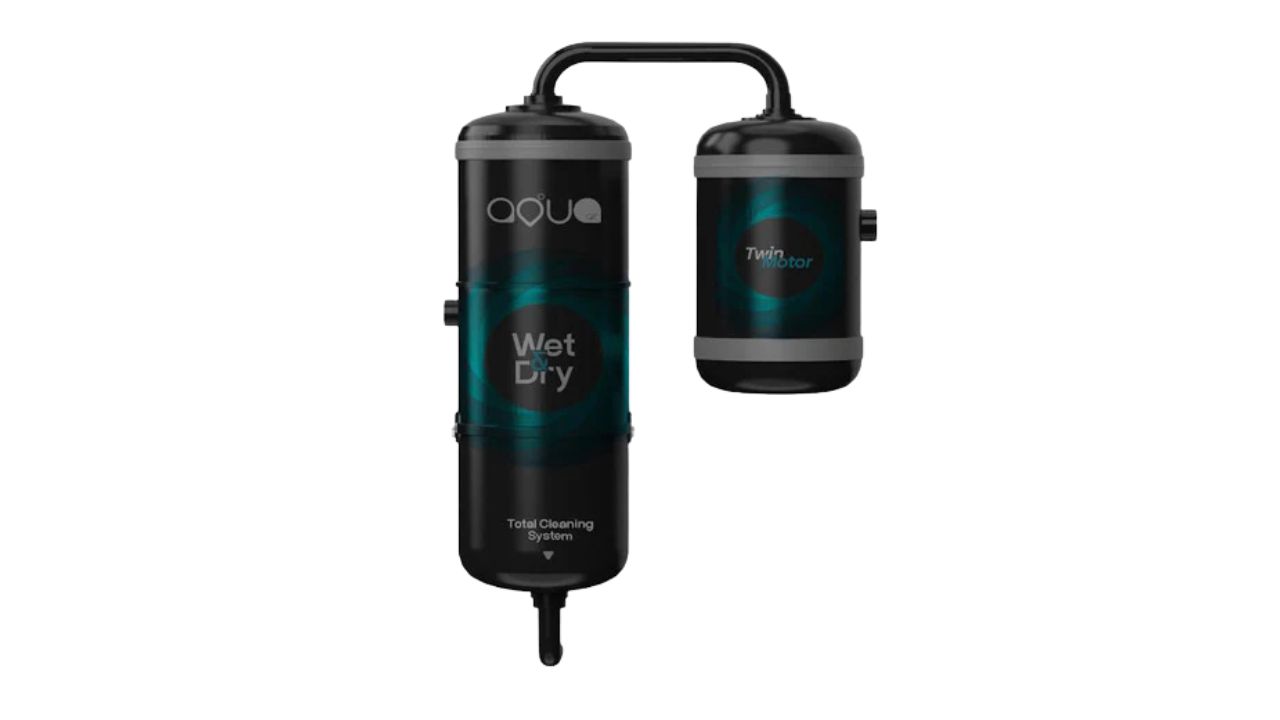
The Model 230, 250, and 258 pair a power unit with a separate debris separation tank, each motor rated independently. The 250 pairs two 7.2-inch three-stage motors at 145 inches of water lift each and covers up to 7,500 square feet. The 258 steps to two 8.4-inch motors at 14 amps each, rated for up to 10,000 square feet. It is the commercial benchmark before a custom multi-unit installation becomes the conversation.
The dual-canister design also allows mounting the power unit and separation tank at separate points within a tight utility room. That matters in older commercial buildings where mechanical room space is not generous.
Two operators can run two inlet stations simultaneously on any dual-motor model. In a commercial kennel with three bathing stations operating during peak morning hours, that simultaneous capability is not a luxury. It is the difference between a 15-minute cleanup and a 45-minute one.
What Installation Actually Requires
A full Aqua-Air wet/dry installation is a two-trade job. You need a vacuum contractor for the PVC tubing network and a licensed plumber for the parallel water supply and drain lines. No competing dry central vacuum requires both trades. That single difference is where most Aqua-Air installation budgets go sideways.
The two supply lines no dry central vac ever needs
A homeowner in a Phoenix suburb once priced a full Aqua-Air retrofit through their 3,200 square foot ranch. The vacuum contractor’s quote for 2-inch PVC tubing and four inlet stations came in around $1,800, consistent with a comparable dry system. Then the plumber’s quote arrived: an additional $2,400 to run 3/8-inch PEX water lines in parallel to each of the four inlet stations and connect a 2-inch DWV drain line from the utility room to the nearest sewer stack.
That doubled the installation cost before a single tool was selected.
Every Aqua-Air inlet station needs a vacuum line and a parallel water outlet line. Water outlets use 3/8-inch or 1/2-inch PEX or 3/8-inch copper tubing run alongside standard 2-inch PVC vacuum tubing throughout the building. Hot water up to 170 degrees Fahrenheit is required at the power unit connection for wet extraction to function. A cold water shutoff valve is also required at the unit. In a retrofit through finished walls, running those water lines is the single biggest cost driver in the entire project.
This is where Allegro central vacuum models reviewed and comparable dry systems look financially straightforward by contrast. A dry installation needs only 2-inch PVC, low-voltage wire, and a single dedicated electrical circuit. Aqua-Air needs all of that plus a parallel plumbing network and a drain tie-in. The additional investment is worth it in the right building, and the answer depends entirely on how you clean every day.
Where the power unit has to go
The power unit location is not a preference. It is an engineering constraint.
A wall stud or masonry anchor is required to support the unit’s weight plus a loaded recovery tank. The drain line pulls on the bottom of the canister, and a unit mounted to drywall alone will eventually fail that connection under load. Minimum clearances: 12 inches on each side and above, plus enough vertical space below the drain port for debris screen access and drain line routing.
Freezing is a real threat in northern climates. The water supply line running to and from the power unit will freeze when the utility room drops below 32 degrees Fahrenheit. An unheated garage wall in Minnesota is not a safe mounting location for a system with in-wall water lines. Flag this constraint at the rough-in stage, not after drywall closes.
The NEC dedicated 20-amp circuit requirement for central vacuum motor units applies to Aqua-Air as it does to any central vacuum motor rated at 14 amps or more. A dedicated circuit at the power unit location is code, not a recommendation.
Does your septic tank disqualify you from installing one?
Not automatically, but treat it as a serious question before committing. Aqua-Air’s waste flushing cycle sends water directly to the connected drain. Floor mopping sessions, wet extraction cycles, and the tank rinse all add water volume to your septic system. A residential septic tank has a daily hydraulic load limit, and an intensive floor-washing session adds volume at a rate a conventional toilet or sink does not approach.
Forum users on central vacuum enthusiast boards have flagged this concern specifically for Aqua-Air, noting the risk of hydraulic overload during heavy cleaning cycles. This is a documented community concern, not speculation.
Get your tank’s daily capacity rating from the installation records and bring that number to a licensed plumber before the sale closes. Do not rely on an Aqua-Air dealer to make that assessment.
Can you skip the water inlets and still get value?
Yes, with a clear trade-off you should understand upfront.
Installing the Aqua-Air power unit without running water lines to every inlet station is possible. You still get cyclonic filtration, filterless operation, the self-draining recovery tank, and the ability to handle wet spills using a wet-use hose connected at the power unit directly. What you lose is the ability to mop, scrub, or wet-extract from any wall inlet station. That in-room wet cleaning capability is the defining feature of the full system.
Forum consensus from experienced installers: skipping in-wall water lines makes sense for a garage or auto shop where the primary use is dry vacuuming with occasional wet pickup near the power unit. For whole-home wet mopping from any room, the water lines are not optional. You are not buying an Aqua-Air at that point. You are buying an expensive dry central vacuum with a self-draining tank.
The Settings Where Aqua-Air Genuinely Earns Its Price
Aqua-Air’s $2,700 to $6,700 price range is justified in high-frequency, hard-surface cleaning environments. The math shifts entirely when you are cleaning 400 square feet of tile twice a day versus vacuuming a carpeted living room twice a week.
Kennels, grooming salons, and veterinary facilities
A grooming salon owner described her pre-Aqua-Air morning routine: mop bucket for the first rinse, refill after three dogs, second bucket for the grooming room, shop vac near the drain area, squeegee for the lower walls. Forty-five minutes of cleanup before the first appointment.
After Aqua-Air, one pass with the stainless steel wand covers each room: scrub, squeegee, lift the water, done. The wand pulls dirty rinse water off the floor and into the recovery tank in one motion. The floor never sees recycled water.
Aqua-Air’s 3.5-inch hand tool attachment is designed for cleaning inside cages and bathing enclosures. The commercial brochure documents grooming areas, bathing cages, and veterinary examination rooms as primary target environments because the system was engineered around those use cases. Aqua-Air started in residential homes in 1990. Its primary commercial customer base is now kennel and salon operators.
Auto detail shops and residential garages
In a detail shop, two operators working simultaneously is the real performance test. One person vacuuming a vehicle interior while another wet-extracts floor mats on the shop floor means a dual-motor model earns its keep on any busy morning.
The optional detergent injection unit, accessory codes AA031 and AA033, automatically mixes cleaning solution with hot water at the inlet station. Consistent dilution ratios matter when running solvents through the same drain repeatedly.
The debris screen’s protection of the drain line is especially important in automotive settings where metal shavings, grit, and cleaning product residue share the same drain path. A clogged drain line in an active shop is a one-day shutdown. Check the debris screen after every high-grit session.
Is Aqua-Air right for a residential home?
It can be. The honest answer is that Aqua-Air’s value proposition peaks in high-volume hard-surface environments, and most residential buyers are not running one of those.
For a 2,000-square-foot carpet-primary home with no pets and no daily mopping routine, a conventional dry central vacuum outperforms Aqua-Air on every metric that matters: lower purchase price, simpler installation, lower maintenance overhead, and full compatibility with retractable hose systems that Aqua-Air cannot support. Buyers looking at the dry side of the built-in vacuum market will find that Imperium central vacuum models reviewed covers a system with strong residential motor warranty terms and proven filtration at a fraction of Aqua-Air’s installed cost.
The honest filter: do you fill and empty a mop bucket more than twice a week? If yes, Aqua-Air’s cost-of-ownership calculation changes significantly. If no, a dry central vacuum is the better investment.
What Forum Users Discovered After the Sale
Forum users who have run Aqua-Air across residential and commercial installations offer two consistent observations: the cleaning performance is real, and the total cost of ownership surprises almost every first-time buyer. Both deserve a direct look before the purchase decision closes.
“They are good but insanely expensive” — what users mean
The performance itself draws consistent praise. The cleaning result on hard floors with the squeegee attachment is described as genuinely impressive, particularly on tile kitchens and bathroom areas where standard vacuums leave residue. That feedback is consistent across multiple forum threads spanning years of owner experience.
The sticker shock does not come from the unit price alone. The Model 130 retails around $2,700 at current pricing; the Model 258 approaches $6,700. Add professional installation of vacuum tubing and parallel water lines in a residential retrofit, and total installed cost lands above $5,000 before accessories. In a commercial retrofit with four or more inlet stations, that number climbs toward $10,000 to $12,000 depending on building complexity.
That is not a price a household replaces a dry central vacuum with. That is a price a kennel owner or salon operator depreciates over five to seven years of daily commercial use.
You cannot use a Hide-A-Hose or a Wally Vac with this system
Hide-A-Hose is a retractable central vacuum hose that stores inside the wall cavity and extends when pulled from the inlet valve. It is compatible with most standard 2-inch inlet systems. It is not compatible with Aqua-Air.
The reason is physical. Aqua-Air wet-use operation requires a separate hose assembly with an integrated water line connector alongside the vacuum hose. A retractable hose stored in the wall cavity cannot route a parallel in-wall water supply line through the same retraction mechanism. The geometry does not work.
The Wally Vac, a wall-mounted suction tool for quick surface pickup, is also not recommended for Aqua-Air systems. This rules out two of the most commonly discussed central vacuum convenience upgrades. Buyers currently using a retractable hose system or planning to add one need this information before the sale.
The two-hose setup catches almost every first-time buyer off guard
For wet cleaning, an Aqua-Air inlet station accepts two connections simultaneously: a standard central vacuum hose for suction and a separate hose with an integrated water line connector for the wet supply. Both plug into the same inlet valve. Both need airtight connections throughout the cleaning pass.
Experienced installers describe getting both connections tight at the inlet valve as the most technically demanding part of the job. The PVC glue joints on both the vacuum line and the water line need to be fully cured before the first wet test cycle. Any moisture intrusion at a joint inside a finished wall means opening that wall to repair.
For dry vacuuming, the process is simpler: standard central vacuum hose connects at the inlet valve and the water connection stays capped. The two-hose complexity only activates in wet mode. Buyers expecting a plug-and-go experience similar to a standard central vacuum will hit a learning curve across the first few wet sessions.
Aqua-Air vs Drainvac: The Two Wet/Dry Systems
Aqua-Air, manufactured in Ivins, Utah, and Drainvac International, which also operates the NuTone central vacuum brand under its parent company structure, are the two primary wet/dry central vacuum manufacturers in the North American market. For any buyer evaluating built-in wet/dry cleaning, the comparison comes down to three specific differences.
The debris screen difference that changes drain reliability
Aqua-Air uses a mesh debris screen inside the recovery tank to catch solid material before it reaches the drain line. Drainvac uses a cyclonic separation method without an equivalent mechanical screen. Forum users with direct experience running both systems note that drain pipe clogging reports appear more frequently in Drainvac discussions than in comparable Aqua-Air threads.
That observation is sourced from wet/dry central vacuum installation trade-offs discussed by central vacuum technicians on VacuumLand, not manufacturer documentation. Neither brand publishes independent third-party drain clog rate data. The debris screen remains a measurable design difference: it either catches solid debris before the drain line or it does not.
Residential versus commercial warranty exposure
| Coverage | Aqua-Air Residential | Aqua-Air Commercial |
|---|---|---|
| Power unit | 5 years | 1 year or 1,000 hours |
| Dealer labor | First 90 days | First 90 days |
| Hoses and accessories | 90 days | 90 days |
The residential warranty covers the power unit for five years from purchase with dealer labor at no cost for the first 90 days. That is a reasonable warranty for a system in daily home use.
The commercial warranty drops to one year or 1,000 hours of use, whichever comes first. A kennel running Aqua-Air eight hours a day reaches 1,000 hours in roughly 125 days. That is a four-month commercial warranty on a $6,700 system, and it is a gap most commercial buyers do not see until they read the fine print after the check clears.
Hoses and accessories carry only a 90-day warranty on both versions. Replacement hoses and tools are recurring costs. In a commercial environment, they are not occasional ones.
Which system fits your building and which fits a facility
Buildings connected to a municipal sewer with utility room drain access are compatible with both systems. The debris screen design and warranty terms are the primary differentiators in that scenario, and both favor Aqua-Air for high-frequency commercial use.
Buildings on a septic system need a licensed plumbing assessment before committing to either wet/dry central vacuum. The hydraulic load concern applies to Drainvac equally. Neither system was engineered for residential septic compatibility as a default installation scenario.
For pure residential dry vacuuming with occasional wet spill pickup, a conventional dry central vacuum plus a portable wet-dry shop vac covers 90 percent of real-world needs at a fraction of either system’s installed cost. That is the honest comparison no dealer page will frame for you, and it is the correct frame for the majority of homeowners who will find this guide.
Conclusion
You arrived wondering whether Aqua-Air is a clever upgrade or a genuinely different category of cleaning system. It is the second one, but only if your building can support it and your cleaning frequency justifies it. The drain requirement, the parallel water lines, and the two-hose wet-mode setup are not surprises if you go in prepared. They are the design.
Tonight, walk to your utility room and find the floor drain or nearest sewer access point. Measure the distance from that point to where your first inlet station would be. That single measurement is where every honest Aqua-Air installation conversation starts. Get that number before you call a dealer, and you will already be ahead of most buyers.
The right owner for this system does not replace their mop once. They get rid of it for good.
Frequently Asked Questions
What makes an Aqua-Air central vacuum different from a standard central vacuum system?
Aqua-Air handles wet and dry cleaning in one built-in system, while standard central vacuums are dry-only. The key physical difference is a drain connection and a parallel water supply line at each inlet station, which allows Aqua-Air to scrub floors, extract wet spills, and flush soiled water directly to the sewer. A standard central vac requires none of that infrastructure.
Does an Aqua-Air wet/dry central vacuum require a water line at every inlet?
Yes, for full wet cleaning capability. Every inlet station needs a parallel 3/8-inch or 1/2-inch PEX or copper water supply line alongside the 2-inch PVC vacuum tubing. Skipping the water lines at an inlet means that station handles dry vacuuming only, which defeats the primary purpose of the system in most installations.
Can Aqua-Air central vacuum be connected to a septic tank instead of a sewer?
Not without a licensed assessment first. Aqua-Air’s waste flushing cycle adds significant water volume to the septic system during every wet cleaning session, which can push a residential tank beyond its daily hydraulic load limit. Get your tank’s rated daily capacity from installation records and review it with a licensed plumber before committing to the purchase.
Is Aqua-Air central vacuum compatible with Hide-A-Hose or retractable hose systems?
No. Hide-A-Hose and comparable retractable systems are not compatible with Aqua-Air. Wet-mode operation requires a separate hose assembly with an integrated water line connector, and a retractable hose stored inside the wall cavity cannot route that parallel water supply line through the same mechanism. If a retractable hose is part of your plan, Aqua-Air is not the right system.
How does Aqua-Air compare to Drainvac for residential wet/dry central vacuum use?
Both systems are viable for buildings connected to a municipal sewer. Aqua-Air includes a mesh debris screen that catches solid material before it reaches the drain line; Drainvac uses a different cyclonic separation method without an equivalent screen, and forum users report more frequent drain clogging complaints with that approach. Aqua-Air’s residential warranty covers the power unit for five years; confirm Drainvac’s current residential warranty terms directly with their dealer network before comparing final costs.