You stand in the showroom with fifteen hundred dollars set aside, and every brochure throws a different air watt number at you, but none of them explain the types of central vacuum systems hiding behind those numbers. The dealer wants you comparing brands, not filtration methods or motor architecture, and that’s exactly how buyers end up with a unit that loses suction in three years.
Finish this guide and you’ll name your filtration method, spot a motor built to die early, and know whether your hose should carry from the wall or retract into it. You’ll also know which type to skip, no matter what the dealer pushes that day.
Types Of Central Vacuum Systems
Central vacuum systems split into five real categories: filtered, true cyclonic, bagged, hybrid, and wet/dry, and each one differs again by motor design and inlet style. First-time buyers need this map before touching a price tag. Replacement shoppers need it to stop repeating a builder-grade mistake. Allergy households need it most of all, since the wrong exhaust path means breathing what you just vacuumed up.Why type matters more than brand name
Type decides your filtration, your maintenance routine, and your suction for the next twenty years, while the brand on the power unit mostly decides who answers the warranty phone. Two units can post the same air watt number on the box and behave nothing alike once one runs a thru-flow motor and the other runs a tangential bypass motor, or once one vents outside and the other recirculates through a filter.
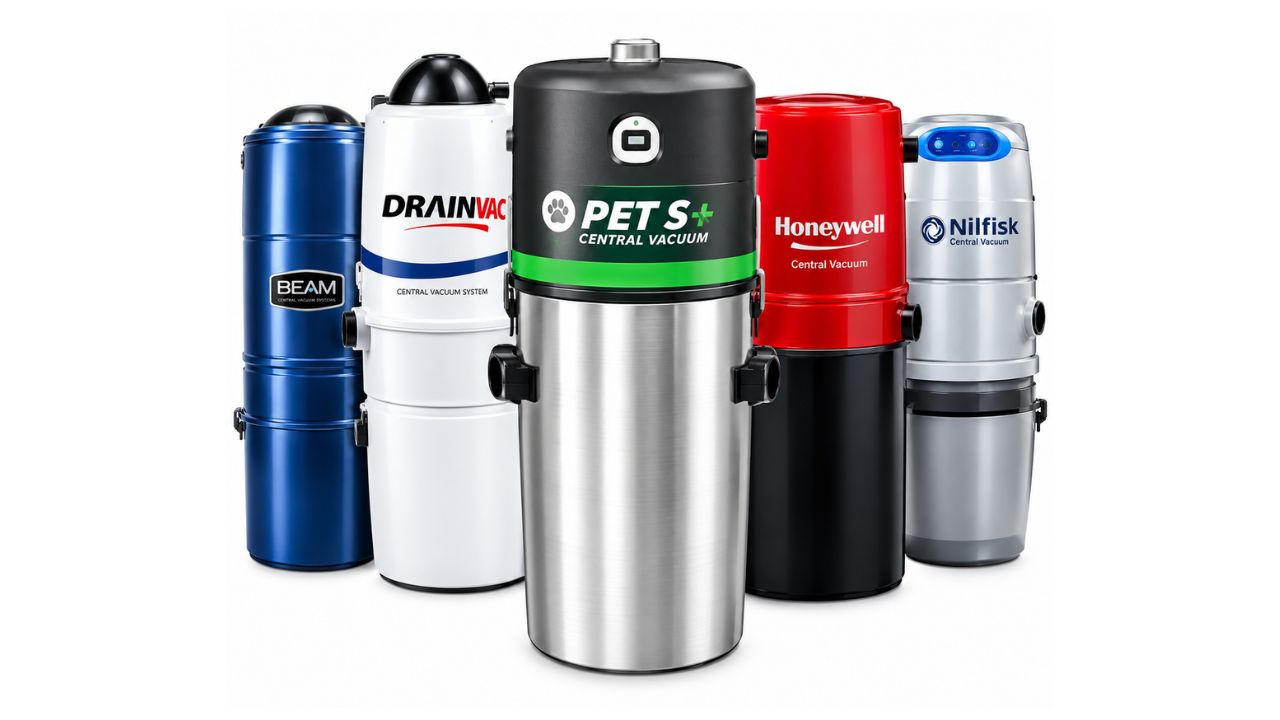
Beam, the brand most shoppers search for by name and now owned by Trovac Industries since its June 2024 acquisition following Nuera Air’s cessation that April, joins DuoVac and Hayden under that same parent company. Beam sells both filtered cyclonic and true cyclonic models, so the brand name alone never tells you which type sits behind the door.
This comparison draws on Ametek and Lamb motor spec sheets, NEC code language, and owner feedback pulled from central vacuum forums, not a single manufacturer’s brochure. For the full rundown on how built-in systems work room to room, see Central Vacuum Lab’s central vacuum overview.
Here’s the thing: nobody sells you on type first. They sell you on horsepower and a ten-year warranty sticker, and the type question never comes up until the filter clogs.
What does built in vacuuming actually feel like?
It feels like suction that doesn’t drop when you walk down the hall. One pass lifts embedded pet hair from low-pile carpet without you bending or dragging anything heavier than a hose.
- No cord trailing behind you and no canister hauled up the stairs.
- The wall inlet seals shut behind the hose, and the motor shuts itself off within seconds.
- A 60-foot pipe run to the farthest bedroom still pulls dander out of the pile, provided the type and motor were matched to the house.
Why most buyers pick the wrong type first
Most buyers pick by air watt number alone and ignore the filtration method they’ll live with every week. Air watts measure suction power at the hose end, not what happens to the dust after it leaves the floor.
A 700 air watt filtered cyclonic unit and a 700 air watt true cyclonic unit can deliver the same pull at the inlet, and still demand completely different maintenance for the next decade. One needs a filter rinsed or replaced every few weeks. The other vents outside and barely needs touching.
Picking filtration type before chasing a bigger number saves you from a mismatch you can’t undo once the unit is bolted to the wall.
Quick question: would you rather clean a filter monthly, or run one extra vent pipe through the wall once?
How systems separate dirt from your air
Systems separate dirt from air in one of four ways: a paper bag, a self-cleaning filter cartridge, a fixed filter inside a cyclonic chamber, or true cyclonic separation with no filter anywhere in the airflow path. Wikipedia’s overview of how cyclonic and filtered central vacuums separate dust covers the mechanics if you want the engineering version.
What types of central vacuum systems should I compare?
Compare paper bag, self-cleaning filter, filtered cyclonic, and true cyclonic side by side before you compare brands. Each method changes your venting needs, your maintenance schedule, and your monthly cost of ownership.
| Type | Filters fine dust with | Vents outside? | Maintenance |
|---|---|---|---|
| Paper bag | Sealed bag | No | Replace bag |
| Self-cleaning filter | Rinseable cartridge | No | Rinse cartridge |
| Filtered cyclonic | Fixed foam filter | Usually | Clean filter often |
| True cyclonic | No filter in airflow | Yes | Empty bin |
The four filtration methods explained without the sales spin
Paper bag systems trap fine dust inside a sealed bag and need no outside venting at all. Self-cleaning filter units swap the bag for a cartridge you rinse under a hose instead of buying replacements. Filtered cyclonic units spin out the big debris first, then push remaining air through a fixed foam filter you clean by hand on a schedule. True cyclonic units skip the filter entirely and exhaust outside.
What are the three main types of central vacuum systems, if someone forces you to pick only three? Bagged, cyclonic, and hybrid covers it, with filtered and true cyclonic as the two faces of the cyclonic category.
Why filtered cyclonic units earn the worst reviews
Filtered cyclonic units earn the worst owner reviews because suction falls as the canister and filter load up between cleanings. The motor pulls the same amount of air, but a clogging filter chokes that airflow before it ever reaches the hose end.
“It cleaned great for two weeks, then I had to baby it” is the blunt verdict you’ll find repeated across owner forums describing cartridge-style units. Trapped dust sitting against a damp filter can also grow odor, mold, and bacteria over months of normal use. This design vents outside in most installations, yet it still disappoints allergy households more often than true cyclonic or sealed bag types, because the cleaning interval is the part owners skip.
True cyclonic systems and the venting truth
True cyclonic systems exhaust nearly all of their airflow outside the home, and that detail changes who should buy one. No dealer mentions it on the showroom floor, but venting location is the difference between an allergy household breathing clean air and one breathing exhaust. Anyone weighing bagless central vacuum designs against a sealed-bag unit needs this trade-off in writing before signing anything.
How true cyclonic separation keeps suction steady
True cyclonic separation works like a tornado dropping debris while the wind keeps blowing past it. Heavier particles spin to the outside of the chamber and drop into a collection bin, while the airflow itself never slows down to push through a filter.
Up to 98 percent of dirt and debris drops directly into the bin before air reaches the motor or the exhaust port. That’s why suction on a true cyclonic unit barely changes between an empty bin and a nearly full one, compared to a filtered cyclonic unit that loses pull as the filter clogs.
Does bagless central vacuum really smell that bad?
Some owners notice a faint musty smell from bagless central vacuum exhaust, while others report none at all after a full season of use. Forum owners split hard on this complaint, and the difference often comes down to how often the bin gets emptied and how the exhaust pipe routes outside the structure.
Outdoor venting carries most of the odor away from living space, but it doesn’t eliminate the moment of emptying the bin indoors, when fine dust briefly escapes back into the room. Weigh that moment carefully, if anyone in the home has asthma.
Bagged and hybrid systems for allergy homes
Bagged systems seal dust inside a disposable bag from the moment it leaves the floor until the moment it hits the trash can outside. That single design choice makes emptying day painless for anyone who reacts to airborne dust or pet dander.
Why sealed bags win for asthma and allergies
Sealed bags keep collected dust contained, so emptying never means facing a cloud of debris at the canister. The bag itself also shields the motor and any exhaust filter from fine grit that would otherwise wear them down faster.
Allergy and asthma households consistently report the calmest emptying experience with bagged systems, since the bag goes straight into the trash sealed and never gets shaken out by hand.
How hybrid units let you switch bag or bin
Hybrid central vacuum systems run cyclonic separation for big debris first, then route fine particles into a bag for final capture. You get to choose bag mode for hygiene during allergy season, or bin mode the rest of the year to skip buying replacement bags.
| Mode | Best for | Trade-off |
|---|---|---|
| Bag mode | Allergy season, sealed disposal | Recurring bag cost |
| Bin mode | Lower running cost | More frequent hands-on emptying |
What HEPA really means versus HEPA style labels
Certified HEPA captures 99.97 percent of particles at 0.3 microns, a tested standard defined by the EPA definition of a true HEPA filter. “HEPA style” and “HEPA media” are marketing phrases that carry no tested capture guarantee at all.
Demand the certified percentage on a spec sheet, if allergies or asthma are driving the purchase, and walk away from any listing that only says “HEPA style.” NuTone, owned by Drainvac International since 2023, publishes certified HEPA ratings on its bagged units, which is the level of disclosure worth expecting from every brand you consider.
The motor type dealers hope you ignore
Motor architecture decides how long your power unit lasts and how much current it draws, and almost no dealer brings it up unprompted. A central vacuum that exceeds 7.5 amps needs its own dedicated 15-amp circuit, and one that exceeds 10 amps but stays under 16 needs a dedicated 20-amp circuit, per the NEC branch-circuit requirements for central vacuums. Motor type is what pushes that amperage number up or down.
Why air watts alone fool almost every buyer
Air watts equal CFM times water lift divided by 8.5, and brochures peak that number at a working orifice your home will never actually reach. Ametek measures real motor output near a 0.625-inch orifice under lab conditions, far narrower than any hose attachment you’ll run day to day.
A cheaper motor can post a higher peak air watt figure on the box than a larger, better-built motor, and still fail years sooner under daily use. Air watt rank alone tells you almost nothing about which motor architecture actually sits inside that shell.
Thru flow versus bypass motors in plain words
Thru-flow motors cool themselves with the same dirty air they pull through the system, while tangential bypass motors use a separate fan sealed away from the dust stream entirely. Cooling with dirty air wears down motor bearings faster, which is why thru-flow units tend to show shorter service life under heavy daily use.
The largest Ametek tangential bypass motor measures 8.4 inches across its fan housing, built for sustained run time rather than short bursts. Because the cooling fan runs independent of the suction air, two-stage and tangential bypass designs form the basis of continuous duty central vacuum models built for households that vacuum daily instead of weekly.
Are cheap Amazon central vacuum units worth avoiding?
Yes, budget units sold through marketplace listings under five hundred dollars are worth avoiding for anyone who wants a system to last past year three. Enthusiasts on central vacuum forums repeatedly warn first-time buyers that these imports often reuse older tank designs paired with weak thru-flow motors built for occasional use.
You get what you pay for here, and the repair calls start arriving faster than the warranty card promised.
Traditional inlets versus retractable hose systems
Traditional wall inlets need you to carry a hose from room to room, while retractable systems store the hose inside the pipe network itself. The choice changes your daily cleaning routine as much as it changes your installation cost.
Inlets themselves split into two wiring types: low-voltage inlets that just signal the power unit to switch on, and electric inlets that also carry power for a corded powerhead. Vacuflo, made by H-P Products in Ohio, built much of the low-voltage wiring standard still found in older installations, and matching a replacement inlet to that wiring type matters more than matching the brand name. MD Manufacturing’s VacPan automatic dustpan installs at kickplate height in a kitchen and switches on with a foot tap, letting you sweep crumbs into the wall without grabbing a hose at all.
How retractable hose systems hide inside your walls
A Hide-A-Hose retractable system stores its hose coiled inside the PVC piping and pulls back in automatically once you let go of the handle. You pull out only the length needed for the room you’re cleaning, and suction retracts the rest the moment you release it.
Standard 2-inch fittings and Schedule 20 PVC piping work with most retractable kits, with one exception: a Hide-A-Hose setup needs a dedicated single inlet built for that hose diameter, and it won’t retrofit onto an existing multi-inlet network without replacing that inlet valve. Fewer inlets can cover the same square footage this way, but the rough-in work runs trickier for an installer unfamiliar with the system.
Can you still use a powerhead with retractable hose?
No, most retractable hose systems can’t run a corded electric powerhead the way a traditional hose and inlet can. The retracting mechanism inside the hose blocks the extra electrical wire a powerhead needs to spin its brush roll.
Deep-pile carpet households should confirm powerhead compatibility in writing before committing to a retractable system. Traditional inlets still support the strongest electric powerhead options for households with heavy carpet and embedded pet hair.
Wet dry and compact systems for special needs
Wet dry and compact units exist for the two situations every other type handles badly: liquid spills and tight floor plans. Neither belongs in a typical single-family home, but both solve a real problem for the right buyer.
When a wet dry power unit earns its place
A wet dry power unit earns its place in garages, workshops, and basements where standard central vacuums would short out on contact with water. Brands building wet dry central vacuum systems use bypass motors specifically sealed and rated safe for liquid pickup, the same architecture that protects tangential bypass motors from dust.
A flooded garage handled this way skips the trip to buy a separate shop vac entirely. Most finished living spaces never need this capability, so don’t pay extra for it across the whole house.
Compact units built for condos apartments and RVs
Compact power units fit inside a tight closet, built for condos, apartments, and smaller square footage where a full-size canister has nowhere to go. They trade some raw suction and bin capacity for a smaller footprint and quieter operation.
Match the compact unit to your actual square footage rather than to a wish list of features you saw online. Anyone living somewhere too small to mount even a compact unit should look at portable central vacuum models instead, since those skip wall piping entirely.
Match the right type to your floor plan
Floor plan decides inlet count and power unit placement before brand or filtration type ever enters the conversation. Get this part wrong, and no motor or filtration choice fixes it later.
How square footage per floor drives inlet count
Plan inlet count by square footage on each floor, not by the total size of the home. A typical inlet covers roughly 700 square feet of reach with a 30-foot hose, so a single-story 2,000 square foot home usually needs three inlets placed to overlap their coverage.
Stretch a rope the length of your hose from each proposed inlet location to test every corner of every room before pipe goes in. Every missed corner becomes a daily annoyance you can’t fix once the walls close up.
Why distance from the power unit steals suction
Suction drops with every additional 10 feet of pipe run and every extra 90-degree elbow installed beyond the manufacturer’s stated maximum. A sweep elbow costs less suction than a sharp 90-degree fitting, since the wider turn radius keeps airflow moving instead of slamming it into a corner.
Keep pipe runs short, straight, and direct between the power unit and the farthest inlet, and place that power unit centrally near an exterior wall for the shortest possible exhaust run. The farthest inlet in a poorly engineered layout can lose 30 to 40 percent of its suction compared to the inlet closest to the power unit.
A simple way to shortlist your system type
Work through type decisions in this order, and the overwhelm disappears fast:
- Pick filtration method first, based on allergies and how much filter maintenance you’ll actually do.
- Pick motor architecture second, based on how many hours a week the unit will run.
- Pick hose style third, carried or retractable, based on whether powerheads matter for your carpet.
- Set your budget last, after the first three decisions, not before them.
Bring that ordered list to any dealer conversation, and watch how fast the upsell pitch changes.
Conclusion
Standing in that showroom now, you know your filtration method, you can spot a motor built to die early, and you know whether your hose should carry or retract. Tonight, walk your home and mark where each inlet would sit, then measure the longest run to a likely power unit location. Unlike any portable you’ve dragged up the stairs before, the right type holds its suction for decades instead of years, and it does it quietly enough that you forget it’s even running.
Frequently Asked Questions
What are the three main types of central vacuum systems?
Bagged, cyclonic, and hybrid are the three main types most buyers need to know. Cyclonic then splits further into filtered and true cyclonic, which is where most of the real performance differences actually live.
What is the difference between cyclonic and filtered central vacuum systems?
True cyclonic systems vent outside with no filter in the airflow path, while filtered cyclonic systems push air through a fixed foam filter before it exhausts. That filter is also why filtered cyclonic units lose suction between cleanings, something true cyclonic units rarely do.
Is a bagged or bagless central vacuum better for allergies?
Bagged systems are the better choice for most allergy and asthma households. The sealed bag never gets shaken out by hand, while bagless bin emptying briefly releases fine dust back into the room.
Do all central vacuum systems have to be vented outside?
No, only true cyclonic systems require outside venting to perform as designed. Bagged, self-cleaning filter, and most filtered cyclonic units can run without any outdoor vent at all.
What is the difference between a thru-flow and a tangential bypass motor?
Thru-flow motors cool with the same dirty air they pull through the system, while tangential bypass motors use a separate fan kept away from the dust stream. That separation is why tangential bypass motors tend to outlast thru-flow motors under daily, heavy use.