A built in vacuum in bathroom spaces sounds excessive until you’ve swept the same line of hair off the same six square feet of tile three times this week. Ask your dealer and you’ll hear one line: the hallway inlet already covers it. Nobody mentions sweep inlets, stretch hoses, or wet floors.
This guide covers every real option for installing a built-in vacuum system in a bathroom, whether you already own a central vacuum or you’re starting from bare wall. You’ll learn what a sweep inlet costs to add, why every system stays dry-only, and the placement mistake that kills suction house-wide.
Built In Vacuum In Bathroom
A built in vacuum in bathroom means a sweep inlet, stretch hose, or toe-kick unit that clears hair and dust out through the wall. It ties into an existing pipe network or its own receptacle. Standard systems handle dry debris only, never water. Existing owners gain the most; renters should skip it.Your Bathroom Fights Every Vacuum You Own
Every portable vacuum loses to a bathroom on physics, not marketing. Hair carries static, powder is too fine to sweep, and the room is too small for an upright.
Why hair, powder, and humidity beat portable vacuums
Static-charged hair clings to a cordless wand instead of lifting into it. That’s why guests still spot hair on tile you cleaned yesterday.
Makeup powder makes it worse. Wipe it and it smears; sweep it and it scatters into the grout instead of gathering into a pile. A portable’s exhaust just recirculates that same fine dust, and bathroom humidity glues what’s left to the baseboard and the wall behind the toilet.
The dustpan line problem in a five foot wide room
A dustpan leaves a line of debris on every pass, and a bathroom floor is too small to hide it. Push a broom toward a five foot wide pan and some of that pile skates past the lip. You sweep it again. Same line, same spot.
Tight floor plans leave nowhere to park an upright between the toilet and the tub. Cordless sticks end up living in a hall closet, so a thirty-second mess waits until laundry day.
Sound familiar? That’s the exact gap a built-in system closes.
What a Built In Vacuum Actually Does in a Bathroom
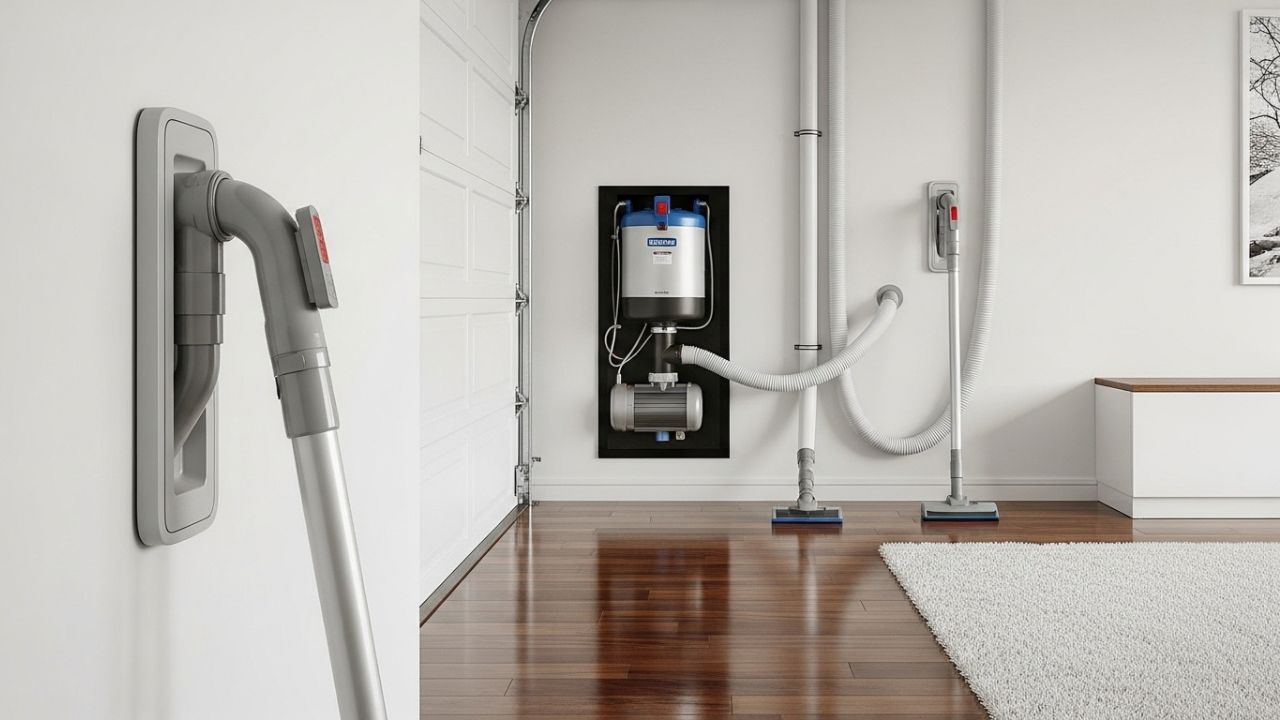
A built in vacuum in bathroom spaces sends hair and dust to a remote power unit through wall pipe, not back into the room you’re standing in. Most bathrooms already get coverage without a single inlet inside the room.
Why put a built in vacuum in bathroom spaces at all?
The suction motor lives elsewhere, so nothing exhausts back into your face while you clean. That’s the core advantage over anything portable.
Hair and powder leave the room permanently the moment they enter the pipe, headed for a canister in the basement instead of a bag under your sink. A five foot wide bathroom has zero spare inches for an upright, but plenty of room for a switch on the wall.
How bathrooms usually get served: the hallway inlet
Most bathrooms get vacuumed through a hallway inlet, not a dedicated one, because installers size coverage by radius, and one hallway location often reaches two or three rooms at once. A standard 30-foot hose easily makes it from that inlet, through the door, and across the floor.
The tradeoff shows up on the small stuff: dragging a 30-foot hose out of a closet for a thirty-second hair cleanup is its own kind of annoying, even once the suction’s strong.
Three dedicated bathroom options dealers rarely explain upfront
Three hardware paths put suction directly inside the bathroom instead of routing a hose in from the hall: a toe-kick sweep inlet, a wall-mounted stretch hose, or a standalone unit that skips central vacuum piping altogether.
| Option | Install effort | Best mess type |
|---|---|---|
| Toe-kick sweep inlet | Splices into existing pipe; cabinet cutout required | Hair and dust swept across the floor |
| Wall-mounted stretch hose | Mounts on a standard inlet backing plate | Counters, floors, vent grilles |
| Standalone toe-kick unit | No central vacuum needed; cutout plus receptacle | Same, for homes without a system |
The first two only make sense with an existing central vacuum spliced into a pipe network. The third exists for everyone else: a household with no central vacuum can still get a built-in bathroom vacuum through a standalone unit like Sweepovac, which skips piping and runs off its own receptacle.
Which of these three fits your bathroom’s layout?
The Toe Kick Sweep Inlet Under Your Vanity
A toe-kick sweep inlet turns your broom into the vacuum’s on-ramp: kick a switch, sweep the pile toward the faceplate, and it disappears into the wall. It’s the closest thing to hands-free cleanup a bathroom gets.
VacPan, CanSweep, and VacuSweep: same idea, different doors
VacPan, manufactured by Canplas under the Vaculine brand, is the original toe-kick sweep inlet: a 6-3/4 by 1-3/4 inch cutout in the cabinet base, activated by a toe switch on the faceplate. CanSweep, made by VacuMaid under the Lindsay Manufacturing name, uses a swing door instead of a fixed slot, which swallows larger debris like cotton balls more easily. VacuSweep works the same way as VacPan but connects straight out the back of the cabinet instead of down through the floor.
All three connect using standard 2-inch fittings, compatible with Beam, Drainvac, CycloVac, OVO, and most North American systems. Two exceptions: older Vacuflo installs sometimes use a proprietary low-voltage connection, and early Sears or Kenmore setups used a non-standard bore that needs an adapter. Check your hardware before you order a kit. VacuMaid’s sweep inlet installation guidance walks through the splice-in process.
Toe kick or flush wall mount? Owners disagree loudly
Mounting choice decides whether sweeping feels natural or awkward, and owners split hard on this one. A recessed toe kick tucks the inlet under the cabinet lip, which sounds tidy until you’re sweeping at an angle instead of straight in.
Owners on Houzz describe that exact frustration with a recessed island-style VacPan: sweeping debris in at an angle is harder than it looks in a showroom demo. A flush wall or baseboard mount removes the awkward under-cabinet reach, letting you sweep straight into the faceplate.
Decide the mounting surface before the inlet, not after.
The bowed lip defect one buyer hit twice
A bowed faceplate lip traps debris instead of swallowing it, and it’s the single most common defect owners report. One RedFlagDeals thread describes a returned VacPan where a slightly warped lip left a gap against the flooring, jamming hair right at the entrance instead of pulling it through.
- Check the faceplate sits flush against the floor before final screws go in.
- Test-sweep a small pile before closing up the cabinet panel.
- Return or exchange any unit with a visible bow in the lip, since it won’t self-correct with use.
This is owner sentiment, not lab data. Quality varies by production batch, and a five-minute check before final install catches it every time.
Stretch Hoses That Live in the Bathroom Wall
A stretch hose mounts on the wall like a garden hose reel, tucked beside a light switch until you pull it out for counters, floors, or the vent grille. It skips the cabinet cutout entirely.
WallyFlex: the little hose made by Trovac
WallyFlex, built by Trovac Industries, the manufacturer behind CycloVac and Beam accessories, mounts on a standard inlet backing plate at roughly light-switch height for quick counter and floor cleanups. One owner keeps it tucked inside a bathroom closet with a small set of attachments, pulling it out for makeup powder before it ever hits the floor.
Retailers list WallyFlex’s stretch reach at 14 or 15 feet depending on the listing, so confirm the actual length before you buy.
Wally, Vroom, and Spot: the countertop specialists
Three stretch-hose products compete for the same countertop cleanup job, and each hides differently when idle. VacuMaid markets the Wally for hair and makeup powder pickup at the vanity. Vroom, sold under the Vacuflo brand by H-P Products, stores inside a vanity cabinet with a hose extending up to 24 feet, in a 3-inch by 21.75-inch by 15.5-inch footprint, and turns on the moment you lift it; an 18-foot version fits shallower cabinets. Vacuflo’s Vroom retractable hose documentation has the full spec sheet. Spot mounts behind a wall plate for owners who want zero visible hardware.
That 21.75-inch depth is the catch with Vroom. A shallow vanity won’t fit it, so measure first.
The Water Problem Nobody Warns You About
A standard built in vacuum in bathroom spaces handles dry debris only, and that single fact gets left out of almost every dealer page selling one. Water and central vacuum pipe do not mix.
Standard central vacuums are dry only machines
Water pulled into wall pipe mixes with existing dust into a clogging sludge that doesn’t clear on its own. Moisture trapped in the pipe run and canister breeds mold, and that mold gets breathed in every time the system runs. Most manufacturers treat any liquid pickup as misuse that voids the warranty outright.
The one exception: wet capable units like DrainVac Automatik
DrainVac builds the Automatik specifically to pull up liquid safely, draining what it vacuums straight into the household sewer line instead of a canister. That makes a spilled glass of water or wet hair fair game for this one unit. Every other central vacuum on this list: towel first, vacuum second, no exceptions.
Talc, powder, and the fine dust that eats motors
Ultrafine powder slips past filtration and wears motor components the way sandpaper wears wood, grinding at brush contacts and bearings with every pass. Daily residual powder on the counter is fine. A spilled talc container is not.
- Wipe up a heavy powder spill with a damp cloth first.
- Vacuum only the light residue left behind after that wipe.
- Never run a full container’s worth of spilled powder through the inlet in one pass.
Where to mount an inlet in a wet room
Mount a bathroom inlet at standard outlet height, on a wall away from the tub or shower’s direct splash path, the same rule governing bathroom receptacle placement. Bathroom circuits run through GFCI protection, and a tripped GFCI on the vanity outlet can cut power to a low-voltage inlet switch on that same circuit, leaving a dead switch with no obvious cause. Mounting higher, clear of the spray radius, avoids both problems.
Ready for the retrofit question? That’s next, and it determines your cost.
Retrofit Reality: Getting Pipe Into an Existing Bathroom
Getting new pipe into a finished bathroom ranges from an afternoon job to a multi-day tile nightmare, and the difference comes down to what’s underneath the floor, not what’s on the wall.
The path through the sink plumbing chase
The floor under a vanity, near the drain, is usually the one untiled patch in the room, and it’s your easiest way into the wall cavity. Cut an access panel into the cabinet base along that chase, run flexible pipe through it, and patch the panel once set.
One RedFlagDeals DIYer put it bluntly: trying this route without flexible hose on hand will make the job miserable. Rigid pipe doesn’t bend around a drain trap the way a flex section does.
When tile stands between you and the pipe
Cutting through set tile risks a crack that costs more to fix than the inlet itself. A homeowner drilling slowly, checking for hairline cracks after every few passes, protects the floor at the cost of a slower afternoon.
Basements and crawlspaces below make this simpler, since pipe runs up through the subfloor instead of across it. Second-floor bathrooms often route through an adjacent closet or attic space instead, avoiding tile entirely.
What this adds to a standard install
A sweep inlet kit ships with the elbows and a Y-fitting needed to splice in, and that inlet counts toward your total when a system gets sized for square footage. Adding it during the original build, as part of your overall system design plan, skips every tile and access-panel question here, since pipe goes in before the floor does.
| Access type | What’s involved | Relative effort |
|---|---|---|
| Basement or crawlspace below | Pipe runs straight up through subfloor | Low, often a single afternoon |
| Untiled chase near the drain | Cabinet access panel, flexible pipe | Moderate |
| Set tile with no other access | Careful drilling, patch and re-grout | High |
Building new? Adding vacuum during home building is the cheapest version of this entire section, because none of it applies once drywall hasn’t gone up yet.
The Placement Math Dealers Round Up
Dealers quote 700 to 1,000 square feet of coverage per inlet with a 30-foot hose, and that number assumes an empty house with no furniture, no doors, and no hallway turns eating into your reach.
The 30 foot string test that never lies
One independent installer guide pegs real-world coverage in a furnished home closer to 500 square feet per inlet, less than half the showroom math. Walls, vanities, and closed doors eat hose length faster than a spec sheet accounts for.
- Tie a string at the exact spot your inlet is planned or already installed.
- Walk the string to every corner of the bathroom floor, including behind the door.
- A short string at any corner means that spot needs a dedicated inlet or a longer hose, not hope.
One inlet per floor is the floor, not the ceiling
Manufacturers advise at least one inlet per floor, and that’s a minimum, not a target. A hallway inlet near the bedrooms in a two-story layout often covers two bathrooms and three bedrooms at once, which is why builders stop at one per floor. Suction drops enough to notice past 40 feet of hose, so treat that as a practical ceiling.
Living With It: Hair, Clogs, and Honest Upkeep
An inlet works like a bouncer at the pipe’s front door: it’s built to jam on purpose before anything reaches the parts you can’t get to.
Why clogs jam at the inlet on purpose
Every inlet is engineered with a tighter bend than any elbow deeper in the wall, so an object that’s going to clog the system jams right where you can reach it with two fingers. Long hair almost never clogs the pipe. Bobby pins and floss picks do, jamming exactly where the design intends.
The suction leaks a bathroom setup can spring
A worn sweep inlet seal bleeds suction across the entire system, not just that one inlet, because central vacuum runs as one sealed loop. Only one inlet should ever sit open at a time; a second open door anywhere in the house pulls air from the one you’re using. Suction fading everywhere at once points to a failing gasket.
A two minute monthly habit that protects the system
Sweep a small test pile through the inlet monthly and listen for it disappearing cleanly. Wipe the door gasket so bathroom humidity doesn’t corrode the contacts. Pull visible hair off the inlet’s mouth before it mats and blocks the next pass.
Conclusion
You arrived thinking a bathroom vacuum meant another gadget crammed under the sink. A built in vacuum in bathroom spaces does the job through the pipe already in your walls, no extra appliance needed. Renters and anyone expecting standing-water pickup should skip it. Tonight, tie a string at your nearest inlet and walk it to every corner. A portable vacuum exhausts dust back into the room it just cleaned; this sends it out of the house for good, and the inlet outlasts a decade of stick vacuums.
Frequently Asked Questions
What is a built-in vacuum for a bathroom and how does it work?
It’s a sweep inlet, stretch hose, or standalone toe-kick unit that pulls hair and dust through wall pipe to a remote power unit or its own small motor. A toe switch or a lifted hose activates it, and debris never re-enters the room.
Can I add a sweep inlet to my bathroom if I already have a central vacuum system?
Yes, splice a VacPan, CanSweep, or VacuSweep into your existing trunk line using standard 2-inch fittings. Check for older Vacuflo or Sears/Kenmore hardware first, since both need an adapter.
What built-in vacuum options exist if I don’t have a central vacuum system?
A standalone toe-kick unit like Sweepovac, which needs only a cabinet cutout and a nearby receptacle, no piping required. It runs independently of any whole-house system.
Can a built-in bathroom vacuum pick up water or wet hair from the shower?
No, standard systems handle dry debris only and treat liquid pickup as warranty-voiding misuse. DrainVac’s Automatik is the one exception, built to drain vacuumed liquid straight into the sewer line.
How much does it cost to add a sweep inlet, WallyFlex, or toe-kick vacuum to a bathroom?
Cost tracks access, not hardware. A basement or crawlspace run under the bathroom is cheapest; a tiled floor with no other access costs the most. A standalone unit skips piping entirely but still needs a cutout and a receptacle.