You got a dealer quote for a vacu maid central vacuum system, three model numbers, and no explanation of what separates them. Then you found four different air-watt numbers for the same power unit: one dealer says 440, another says 740. That’s what a brand with zero independent review coverage looks like, every number tracing back to whoever is selling it.
We pulled every spec here from Lindsay Manufacturing’s 2024 catalog, not reseller copy. You’ll leave knowing which filtration fits your allergies, which unit needs an exterior wall, and whether the warranty transfers when you sell the house.
Our Top Picks at a Glance

- Max Air Watts: 760
- Airflow: 137 CFM
- Sealed Vacuum: 150 inches H2O
- Filtration Type: Inverted bag
- Dirt Capacity: 38 quarts
- Noise Level: 68 dB vented
- Coverage Area: 12,000 sq ft
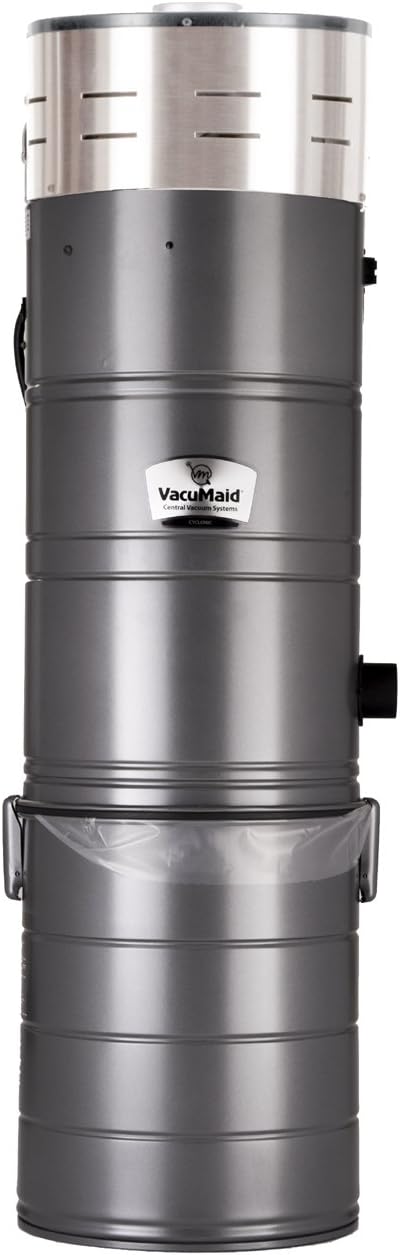
- Max Air Watts: 440
- Airflow: 115.8 CFM
- Sealed Vacuum: 124.6 inches H2O
- Filtration Type: Cyclonic, bagless
- Dirt Capacity: 27 quarts
- Noise Level: 75 dB vented
- Coverage Area: 9,000 sq ft

- Max Air Watts: 631
- Airflow: 121 CFM
- Sealed Vacuum: 142 inches H2O
- Filtration Type: Inverted bag
- Dirt Capacity: 38 quarts
- Noise Level: 65 dB vented
- Coverage Area: 10,000 sq ft
The SR60 takes the top spot. A 150-inch sealed vacuum is the highest figure VacuMaid publishes for any residential unit, and it’s the only one here carrying a manufacturer motor-life rating, which matters most once your tubing run passes 4,000 square feet.
1. VacuMaid P125P Review
The P125P is VacuMaid’s cyclonic power unit, and it exists for one job: swapping a dead VacuMaid or AstroVac pod without cutting into a single wall. It bolts onto the hanger bracket your old unit already used. That single design choice makes it the fastest replacement path in this roundup, even though the published suction numbers trail both of VacuMaid’s inverted bag units.
- True cyclonic separation, no bags
- Mounts on existing hanger bracket
- Ships with PVC changeover fittings
- Ametek Lamb 7.2-inch bypass motor
- Patented Air Channel liner support
What We Love About the VacuMaid P125P
Why 440 Air Watts Actually Moves Through 60 Feet of Pipe
Air watts measure sealed suction power by combining airflow and vacuum lift into one working number, the closest thing central vacuum shopping has to a single spec you can trust. The defensible trio for the P125P, tied to its named Ametek/Lamb motor part, is 440 air watts, 115.8 CFM, and 124.6 inches of sealed vacuum. That sits well below the SR60’s 760 air watts at a comparable house size.
Run the math on a 9,000-square-foot floor plan and the far inlet valve feels it first. Suction that starts strong at the power unit loses ground over 60 feet of 2-inch tubing, and a lower air-watt motor has less reserve to spend on distance. Homes stretching past 4,000 square feet should size up.
Where does your farthest planned inlet sit relative to the power unit closet?
The Retrofit Swap That Skips Cutting Into Finished Walls
The P125P mounts straight onto the hanger bracket your existing VacuMaid or AstroVac unit already used, which turns a replacement into a parts swap instead of a demolition project. The kit ships with a 90-degree sweep elbow, two stop couplers, two 14-inch PVC sections, and two 45-degree ells to reconnect the riser you already have.
- Unmount the old power unit from the bracket.
- Dry-fit the included sweep elbow and PVC sections to the existing riser.
- Cement the joints. PVC cement is not included, so buy it separately.
- Mount the new unit and reconnect the low-voltage wiring.
That’s a Saturday morning job, not a demolition weekend.
Why Bagless Here Means Outside Exhaust Is Mandatory
Cyclonic separation spins debris out of the airstream by centrifugal force instead of trapping it in a filter, and it has no secondary filtration stage to catch what the cyclone misses. That’s why the P125P has to vent outdoors, full stop. Owners on VacuumLand describe adding an exhaust run after the unit was already mounted, which means cutting a second hole in the wall.
Plan the exhaust route before you buy this unit, not after. Keep the run under 10 feet, low to the ground, away from windows and entrances.
No exterior wall access at the power unit location means this model is wrong for you.
The 75 dB Number Nobody Puts in the Product Photo
VacuMaid publishes 75 dB with vented exhaust for the P125P, the loudest figure in this entire roundup and 7 dB above the SR60’s 68 dB at the same measurement condition. That gap is not small. Every added 3 dB roughly doubles perceived loudness, so the P125P is running well above double the SR60 at the motor.
Picture a running garbage disposal two rooms away, muffled through a closed door. That’s roughly what a P125P sounds like through a shared garage wall. Fine for a detached garage or basement mechanical room, worth a second look if the power unit closet backs onto a bedroom.
The Electrostatic Filter Pet Owners Get Told About Too Late
Lindsay recommends the optional ES934 electrostatic lint screen for households with pets, and dealers rarely mention it until after the sale. Without it, shedding fur travels further into the canister and the motor housing than it should, which shortens service life on a unit that already carries no manufacturer motor-hour rating.
Treat the ES934 as a line item on the original quote, not an accessory you add later. Budget for the screen and its replacement cadence before you sign anything.
Who Should and Shouldn’t Buy the P125P
The Retrofit Owner Replacing a Dead VacuMaid Pod
This unit is for the homeowner with existing VacuMaid tubing, an existing hanger bracket, and inlets already roughed into the walls. Homes at or under 9,000 square feet with exterior wall access at the power unit location fit best. Owners who never want to buy a replacement bag for the next 15 years will appreciate the bagless design most.
You want the old system working again, not reinvented.
The Allergy Household That Should Take the SR60 Instead
Skip the P125P if anyone in the home has allergies or asthma. Cyclonic separation alone captures less fine dust than a filtered inverted bag, and no HEPA-rated media exists in this unit no matter what a dealer page claims. Point allergy and asthma buyers to the SR60, where a filtered bag stage actually traps what a cyclone lets pass.
Filtration grade matters more than bagless convenience for that household.
Pros and Cons Table
- Pros: Eliminates suction loss from clogging filters
- Pros: Rolled galvannealed steel, not molded plastic
- Pros: Fastest swap onto existing VacuMaid bracket
- Pros: Bypass motor keeps dirt out of cooling path
- Cons: Loudest published figure, 75 dB vented
- Cons: Mandatory outdoor exhaust rules out interior closets
- Cons: No manufacturer air-watt figure published
2. VacuMaid BL54 Black Label Review
The BL54 Black Label is VacuMaid’s retail-channel inverted bag unit, sold through Amazon and Home Depot rather than the dealer network Lindsay runs its catalog models through. It’s the strongest all-around pick for a 3,500 to 5,000-square-foot home that wants permanent filtered air and a front utility port for garage cleanup, and it’s the only unit here that publishes an actual maximum pipe run.
- Front mounted utility port for hoses
- Permanent inverted bag filtration
- Ametek Lamb 7.2-inch bypass motor
- Built-in noise reduction chamber
- Installation changeover kit included
What We Love About the BL54 Black Label
The Utility Port That Turns the Unit Into a Shop Vac
A hose plugs straight into the front of the power unit itself, no inlet valve required. That’s a real advantage in a garage bay where nobody roughed in a dedicated inlet, and it handles vehicle interiors without dragging a second vacuum out of the closet.
No more hauling a shop vac out for the car every weekend.
Why This Model Is Missing From Lindsay’s Dealer Catalog
Lindsay’s own inverted bag category lists the SR46, SR60, SR14, SR64, CS46, and SR62. The BL54 is not among them. It shows up at Home Depot and Amazon instead, which means it’s a retail-channel SKU built on shared catalog hardware rather than a full catalog model.
That matters for service. A retail purchase has a thinner dealer-side parts lookup than a catalog model, even when the motor and canister are identical hardware. Verify your service path before the box ships to your driveway.
The Warranty Clause That Big Box Buyers Trip Over
Lindsay’s warranty voids coverage the moment service comes from anyone other than an authorized VacuMaid dealer using genuine VacuMaid parts. That clause assumes a dealer relationship exists in the first place, and a Home Depot or Amazon purchase has no installer in that chain by default.
- Locate an authorized VacuMaid dealer near you before you need one.
- Register the unit with Lindsay directly, not just the retailer.
- Keep every receipt in case an install date dispute comes up later.
What 631 Air Watts Buys at This Price Tier
The retailer listing puts the BL54 at 631 air watts and 10,000 square feet of rated coverage, landing squarely between the P125P’s 440 and the SR60’s 760. CFM, sealed vacuum, canister capacity, and dB are all unpublished for this specific model, and that gap should stay a gap. Don’t let anyone fill those blanks with numbers borrowed from a sibling catalog motor.
Who Should and Shouldn’t Buy the BL54
The Budget Retrofit Buyer Who Wants Bagged Filtration
This unit fits homes near 10,000 square feet where the owner wants filtered air over bagless convenience, plus a bundled installation kit instead of sourcing parts separately. Owners who are comfortable handling their own service calls and parts orders get real value here.
Real filtration, without flagship pricing.
The Buyer Who Needs Documented Specs Before Committing
Skip the BL54 if you’re the type of buyer comparing dB ratings across brands, because there’s no published number to compare. New construction buyers sizing a system before drywall closes need airflow data that simply doesn’t exist for this model yet. Send that spec-driven buyer to the SR60, where every figure is on the record.
Missing data is a real cost, not a rounding error.
Pros and Cons Table
- Pros: Published 180-foot maximum pipe run
- Pros: Zero recurring bag cost, permanent filter
- Pros: Front utility port doubles as shop vac
- Pros: Sold through Amazon and Home Depot both
- Cons: Missing from Lindsay’s 2024 dealer catalog
- Cons: No published dB rating or amp draw
- Cons: Coverage claim conflicts with pipe-run limit
3. VacuMaid SR60 Review
The SR60 is VacuMaid’s largest residential inverted bag unit, built around an 8.4-inch two-stage bypass motor that delivers 150 inches of sealed vacuum, the highest figure in this roundup. It’s the correct call for homes above 5,000 square feet, multi-story installs where the unit sits on the lowest floor, and any system with a long vertical lift to fight.
- Ametek Lamb 8.4-inch two-stage bypass
- 38-quart dirt capacity
- Permanent Surf-Tex inverted bag
- Approximately 1,500-hour motor life rating
- 68 dB with vented exhaust
What We Love About the VacuMaid SR60
The 8.4-Inch Motor That Owners Call a Beast
The verified trio here is 760 air watts, 137 CFM, and 150 inches of sealed vacuum. Sealed vacuum is the lifting force a motor produces with the airway fully blocked, and 150 inches is the highest figure across VacuMaid’s entire residential line.
That number is what carries debris up a two-story riser and across a long trunk run without losing pull at the far end.
The far inlet on a long run still lifts embedded fibers out of high-pile carpet, not just surface dust.
How the Inverted Bag Beats Cyclonic on Fine Dust
An inverted bag is a permanent polyester filter coated in a slick acrylic latex finish that releases trapped particles when the unit shuts off, rather than holding them against a disposable liner. Compare that against the P125P, where fine dust exits straight through the exhaust vent because there’s no secondary filtration stage at all.
Drywall dust and pet dander get caught here, not relocated outside your house.
Quietest of the Three Vacu Maid Central Vacuum Systems Here
At 68 dB vented, the SR60 runs a full 7 dB under the P125P’s 75, even though its 8.4-inch motor is physically larger than the P125P’s 7.2-inch cyclonic motor. In a home where the power unit shares a wall with a bedroom, that gap is the difference between background hum and an actual interruption.
Conversation stays possible in the next room while this unit runs.
The 38-Quart Canister and What It Costs to Feed
The SR60 holds 38 quarts of debris, 11 more than the P125P’s 27-quart canister, which means fewer trips to empty it across a large home.
Replacement is the RB-24W inverted bag, shared with the SR54 and SR64. Older builds used three FF-120 foam filters instead, so confirm your unit’s build year before ordering parts.
Who Should and Shouldn’t Buy the SR60
The Large Home Owner Who Wants This Done Once
This unit is built for homes from 9,000 to 12,000 square feet with long tubing runs, households managing pet hair, allergies, or asthma that need fine dust actually captured, and new construction buyers who can route exhaust during framing.
The last power unit you’ll need to buy for this house.
The Condo or Small Home Buyer Overpaying for Headroom
Skip the SR60 under 5,000 square feet, because 760 air watts goes largely unused at that scale. The 16-inch diameter body also demands more utility room clearance than the alternatives here. Smaller homes should look at the P125P or a lower unit in VacuMaid’s SR line instead.
Pay for the coverage you actually have, not the coverage you imagine owning someday.
Pros and Cons Table
- Pros: Highest sealed vacuum, 150 inches H2O
- Pros: Manufacturer-rated 1,500-hour motor life
- Pros: Quietest published figure, 68 dB vented
- Pros: 38-quart canister, longest emptying interval
- Cons: Premium pricing, roughly $1,680 for the unit alone
- Cons: Three conflicting air-watt figures published
- Cons: Needs 44-plus inches of vertical clearance
The Buyer’s Guide: Cutting Through the Hype
The Three Specs That Decide How These Units Clean
CFM, or cubic feet per minute, measures the volume of air a motor moves, and that airflow is what lifts debris off carpet fibers in the first place. Sealed vacuum then pulls that debris through the tubing. Air watts combine both figures into one number, which is exactly why comparing a single spec across brands misleads you.
Side by side: the P125P runs 440 air watts, 115.8 CFM, 124.6 inches sealed vacuum. The BL54 runs 631 air watts with the rest unpublished. The SR60 runs 760 air watts, 137 CFM, 150 inches sealed vacuum.
The Price Tier Truth Across Vacu Maid’s Own Lineup
VacuMaid’s entry tier buys a 5.7-inch flow-through motor and roughly 3,000 square feet of rated coverage. The middle tier buys a 6.6 or 7.2-inch bypass motor with real filtration choice, where the P125P and BL54 both sit. The top tier buys the 8.4-inch bypass motor, a 38-quart canister, and the lowest dB figures in the line, where the SR60 sits.
Pull live pricing before you buy. VacuMaid’s MSRP shifts without notice, and SR60 dealer pricing alone varies by more than $400 across sellers. Weighing outside brands too? See what Mountain units actually deliver at a comparable price point.
Why Four Sellers Publish Four Different Air Watt Numbers
Lindsay’s own P125P product page states 440 air watts and 115.8 CFM. One dealer lists 740 air watts for the identical unit, another lists 525, a third lists 125. One retailer also cuts the coverage claim from 9,000 square feet down to 5,000 on the same listing.
Treat the manufacturer’s page as the only authority, and treat every reseller figure as marketing copy until proven otherwise.
Red Flags Buyers Only Notice After Installation
Lindsay’s own support team says lost suction calls trace most often to a clogged filter, not a failing motor. Forum owners separately report that Imperium-branded units and older private-label lines like Walvac systems and key specs are rebadged VacuMaid hardware under a different name plate. Older metal inlet valves can short the low-voltage circuit and run the unit continuously.
There’s a code issue worth flagging here too. Every current VacuMaid power unit draws above 10 amps, and NEC 210.23(A)(2) requires a dedicated 20-amp circuit for any central vacuum outlet rated between 10 and 16 amps. VacuMaid’s own installation checklist still says “place on its own circuit, 15 amp.” Follow the code, not the checklist.
Check the screen before you call anyone about a suction complaint.
How We Researched These Vacu Maid Units
Every spec in this review traces back to Lindsay Manufacturing’s catalog and individual product pages. Retailer and dealer listings were cross-checked against that catalog, and conflicts got documented here rather than averaged into a fake middle number. Owner threads on VacuumLand were mined for real failure patterns and service history, and any figure no source published stayed blank instead of getting estimated from a comparable motor.
Bag and Filter Costs Across a Five Year Window
What the P125P Costs When You Never Buy a Bag
Bagless means zero bag cost, but plastic can liners and the ES934 electrostatic screen become the recurring spend instead. Emptying a 27-quart canister by hand also exposes you to more airborne dust than pulling a sealed bag, since there’s no bag to contain it during removal.
Inverted Bag Replacement Cadence for the SR60 and BL54
The RB-24W is a permanent filter, shaken clean rather than thrown in the trash, which changes the five-year math against paper bag systems entirely. Lindsay also offers the RB-15 as an added filtration upgrade for cyclonic canisters. Pricing on the RB-24W moves with catalog updates, so verify the current figure before you budget against it.
The Consumable Line Nobody Includes in the Quote
VacuMaid’s warranty excludes consumables, accessories, installation, and materials outright, and motor carbon brush wear is called normal wear rather than a covered defect. Budget for brush replacement inside that 10-year electrical warranty window, because the warranty itself won’t cover it.
Why Outside Exhaust Isn’t Optional on These Units
The Vent Requirement Cyclonic Buyers Discover in the Manual
Lindsay’s own canister documentation states that outside exhaust is required on bagless units, and buyers routinely find that requirement after the power unit is already mounted on the wall. Keep the exhaust run short and straight, six to eight feet from the unit whenever the layout allows it.
A hole in the exterior wall you didn’t plan for is not a fun surprise.
What Exhaust Placement Means for Allergy Households
Venting outdoors removes fine particulate from the living space entirely, which is the whole point for anyone managing allergies. VacuMaid’s HEPA-labeled bags, where they exist in the lineup, are rated to 99.97% capture at 0.3 microns, the actual EPA/DOE HEPA standard. Neither the P125P nor the SR60 ships with a HEPA-rated bag, and any competing roundup claiming otherwise is repeating a marketing label, not a lab result.
Choosing the Unit Location Before You Buy Anything
Measure clearance for the SR60’s 16-inch diameter body and 43-inch height before you commit to a closet. Confirm a nearby exterior wall exists before you commit to the P125P, since that unit has no fallback for interior mounting.
The room decides the model more often than the spec sheet does.
Motor Life, Carbon Brushes, and the 10 Year Clock
What 1,500 Hours of Rated Motor Life Really Buys
Lindsay rates the SR60’s 8.4-inch motor at approximately 1,500 hours, one of only six residential models in the catalog to carry that flag. Run a household vacuuming three hours a week and that rating stretches past nine years before the motor’s rated life runs out. Hours matter more than calendar years for a heavy-use household.
The Warranty Terms Dealers Summarize but Never Read Aloud
The canister carries a lifetime limited warranty to the original owner, and the motor and internal electrical components carry 10 years. Coverage ends the moment you sell the home or the system, with no transfer allowed to the next owner. Transportation, removal, and reinstallation charges fall on you, not Lindsay, and commercial installs drop every one of those terms to 90 days.
Registering the Unit Before You Ever Need the Claim
Lindsay requires online product registration for a warranty claim to exist on their records at all. Keep the receipt and delivery slip to settle any dispute over the actual install date. Escalate directly to Lindsay within 45 days of discovering a defect if your dealer stalls.
The Model That Fits Your House, Not the Showroom
You arrived unable to tell 440 air watts from 740. You leave knowing which number Lindsay actually publishes, and which one belongs to a reseller guessing. Measure your utility room clearance and find your nearest exterior wall tonight, before you request another installation quote.
If VacuMaid’s parts network or pricing tier doesn’t fit your home, plenty of well-known central vacuum brand names compete on the same specs. Either way, one hose and one pass sends the dust out of the house instead of circling it back through the room.
Frequently Asked Questions
Who makes VacuMaid central vacuum systems, and are they still in business?
Yes, Lindsay Manufacturing Inc. builds every VacuMaid unit out of Ponca City, Oklahoma. The company started in 1956 as Thermodynamics Inc. and took the VacuMaid name in 1960, and it still sells through an active authorized dealer network today.
What is the difference between VacuMaid’s cyclonic, inverted bag, and disposable bag units?
Cyclonic units like the P125P spin debris out with no filter media and must vent outdoors. Inverted bag units like the SR60 and BL54 use a permanent filter you shake clean. Disposable bag units use a throw-away bag instead, and VacuMaid’s HEPA-labeled option only exists in that disposable line.
How many air watts do I actually need for my home’s square footage?
Match motor output to your finished square footage, not the builder’s total. A home under 5,000 square feet is well served by 400 to 650 air watts, while anything past 9,000 square feet needs the SR60’s 760.
Does a VacuMaid power unit need a dedicated 15-amp or 20-amp circuit?
Every current VacuMaid unit draws above 10 amps, so code requires a dedicated 20-amp circuit under NEC 210.23(A)(2). Ignore VacuMaid’s own 15-amp installation checklist on this point.
Does the VacuMaid warranty transfer if I sell my house?
No, the warranty is non-transferable and ends the moment you sell the home or the system. The next owner starts with zero coverage on the unit already installed in the wall.