Vacuflo prices feel impossible to pin down, and that’s by design. Vacuflo, the built-in vacuum brand H-P Products Inc. builds in Ohio, sells only through dealers who quote privately, not online. Search for one number and you get a contact form, and the price you find covers the power unit alone, not the $800 to $3,500 install most buyers add on top.
By the end, you’ll know what each Vacuflo central vac power unit actually costs, what a full installed system runs, and the single buying mistake, an unauthorized purchase, that voids the Limited Lifetime Warranty.
Vacuflo Prices
A Vacuflo price you find online almost always names the power unit, not the system. Power units run $585 to $1,825 depending on motor type and air watts. The full installed system, with pipe, inlets, and labor, lands between $800 and $3,500. Budget the whole job, not the box.Why Vacuflo prices never show a clear number
Vacuflo never posts a public price list because it sells through a closed dealer network instead of retail shelves. That single fact explains every confusing search result you’ve hit so far.
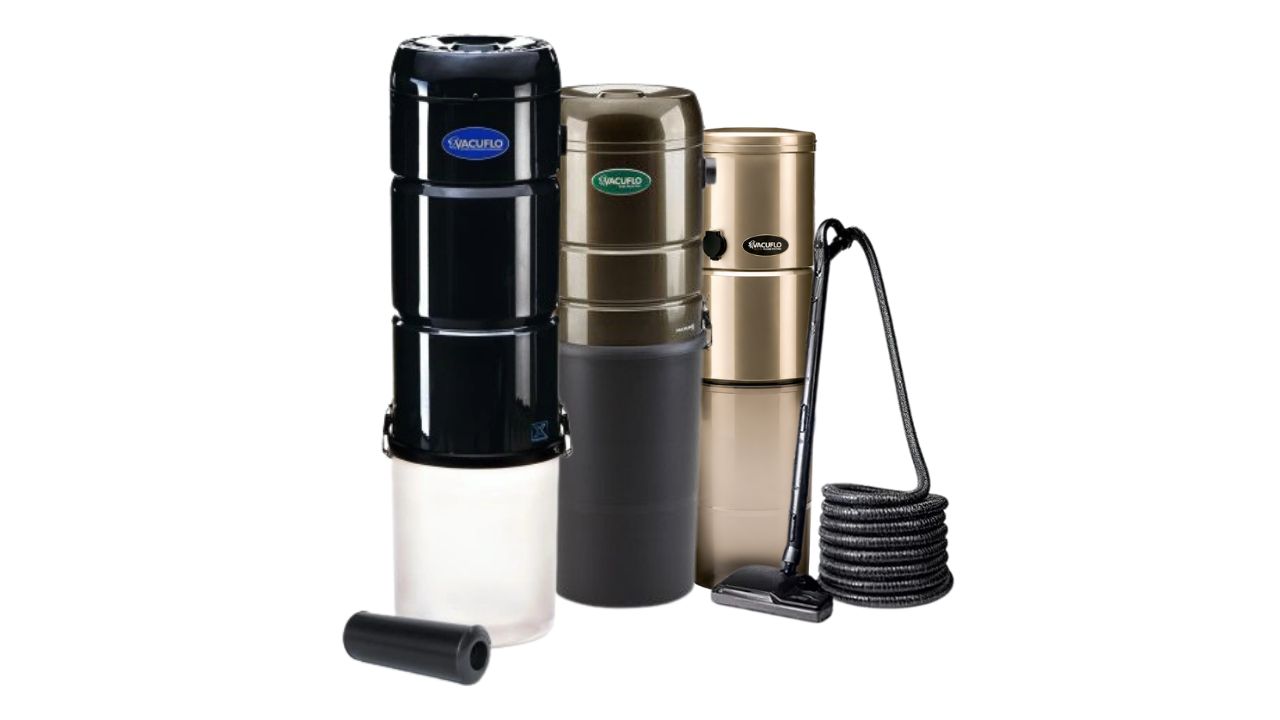
Why are Vacuflo prices so hard to find online?
You search for a number and get a dealer contact form instead. Vacuflo sells through authorized dealers who quote jobs privately rather than printing a sticker price for the public.
Online retailers do list unit prices, but those numbers cover the power unit by itself. They skip the pipe, inlets, and labor that turn a box in a utility room into a working system.
Dealer quote versus online sticker price
The same model can show two prices that don’t match, and neither one is lying. A dealer’s quote bundles labor, fittings, and a few feet of pipe into one number. An online retailer’s price tag covers the bare unit, full stop.
Here’s the trap. Buying that bare unit from a seller who isn’t an authorized Vacuflo dealer can cancel your coverage. Vacuflo’s official Limited Lifetime Warranty terms protect the original owner in the original home and exclude units bought outside the authorized dealer network. Save $150 on a marketplace listing, lose decades of free parts coverage.
What buyers actually ask before they commit
People don’t want a list price. They want the out-the-door number, the one that includes the part nobody quotes up front: install.
And they’re scared of paying premium money for a unit that performs like the cheapest option on the shelf. This guide splits the power unit price from the full installed cost, model by model, so you can budget both halves separately.
What a Vacuflo power unit really costs today
A Vacuflo power unit ranges from $585 for an entry-level single-motor model to roughly $1,825 for the largest dual-motor unit built for big homes. Air watts, the measure of actual suction at the hose end, climb with that price, but not in a straight line.
Power unit prices from condo to mansion
A condo or small ranch doesn’t need the biggest box on the shelf. The FC300, Vacuflo’s entry filtered cyclonic unit, runs about $585, delivers 422 air watts, and covers homes up to roughly 2,500 square feet.
Step up a size and the numbers move fast. The FC550 lands near $749 at 520 air watts. The FC650 runs about $889 at 575 air watts, the strongest single-motor option in the lineup.
For homes that push past one furnace and one floor plan, the dual-motor 760 reaches close to $1,549 and delivers 886 air watts, but it demands its own dedicated 30-amp circuit, not the 20-amp line a single-motor unit uses.
Reading the spec table without getting fooled
| Model | Power Unit Price | Air Watts | Notes |
|---|---|---|---|
| FC300 | $585 | 422 | Up to 2,500 sq ft, single motor |
| FC550 | $749 | 520 | Single motor |
| FC650 | $889 | 575 | Strongest single-motor unit |
| 566Q | $1,119 | 535 | Dedicated 20-amp circuit |
| 760 | ~$1,549 | 886 | Dual motor, dedicated 30-amp circuit |
| Maxum DB3000 | $949 | Entry Maxum tier | Replaceable filter bag |
| Maxum DB9000 | $1,825 | Top Maxum tier | 240V, largest homes |
Read this table by air watts per dollar, not by price alone. The FC650 at $889 outperforms the pricier 566Q at $1,119 on raw air watts, 575 against 535. You’re not buying more suction with the 566Q. You’re buying its heavier-duty 20-amp dedicated circuit and motor build instead.
A dealer quote rarely explains that trade-off.
Why a sale price hides the real value
You’ll see a model listed at one price, crossed out, next to a lower sale price. Inflated list prices make a routine markdown look generous, even when the sale price is just the going rate.
Ignore the strikethrough entirely. Judge a unit on air watts per dollar against the table above, and check whether the seller is an authorized Vacuflo dealer before you click buy. A bigger discount from an unauthorized seller still risks the warranty exclusion covered earlier.
What number actually matters here? Not the percentage off. The air watts you’re paying for, divided by the dollars you’re spending.
The install cost your quote quietly leaves out
The power unit is rarely half your final bill. Pipe, inlets, hose, and labor make up the rest, and that part of the quote is where budgets blow up.
What full Vacuflo installation actually costs now
Most homeowners pay close to $1,582 total for a central vacuum install, according to national central vacuum installation cost data from HomeGuide. Installed systems commonly land between $800 and $3,500 depending on home size, inlet count, and whether you’re building new or retrofitting.
That average sits well above the price of an entry-level FC300 alone. If your dealer quote comes in near the unit price by itself, ask what got left out.
New build versus retrofit changes everything
Open framing changes the entire math. A new-construction rough-in, where pipe runs go in before drywall, costs $400 to $800 in labor on top of the unit price.
A retrofit into finished walls is a different job. Fishing 2-inch pipe through framing, insulation, and fire blocks at each floor joist can push labor to $1,000 to $2,500 on top of the unit, $400 to $1,000 more than building new.
Here’s what a clean retrofit quote should itemize:
- Power unit model, price, and air watt rating
- Number of wall inlets and their planned locations
- Linear feet of 2-inch pipe and number of elbows required
- Labor hours for wall access, patching, and paint touch-up
- Warranty terms, including whether labor is covered and for how long
Skip any of those five lines, and you’re signing a quote you can’t actually evaluate.
The 35 foot rule that controls inlet count
Each wall inlet should cover roughly a 35-foot hose reach into every room it serves. That single number is what actually decides how many inlets your home needs, not square footage alone.
More inlets raise your install cost. But too few inlets force a longer hose run from a single inlet, and every extra 10 feet of hose and every 90-degree elbow you add past the manufacturer’s rated maximum costs you suction at the far end of the line.
Map your inlet count against the 35-foot rule on a floor plan before any dealer counts inlets for you.
Decode the confusing Vacuflo model name jumble
Vacuflo’s naming overlaps across at least three series: FC, the numbered 566Q and 760, and the Maxum DB line. That overlap is the single biggest reason two listings for what looks like the same vacuum show two different prices.
FC, DB, Maxum, and numbered units explained
The Maxum and DB series are the same product family marketed under two names depending on the seller. A unit listed as a “Maxum 5” and a unit listed as a “DB5000” can be the exact same motor and canister wearing different labels.
The same overlap shows up in Vacuflo’s other product lines. Pricing for Vacuflo MaxAir performance details and for the Vacuflo Edge series gets quoted under separate model codes depending on the dealer, even when the underlying motor and filtration match a unit you’ve already priced elsewhere.
Matching names across two sellers before you buy stops you from paying twice for what’s really one unit.
Why proprietary inlet valves can lock you in
Vacuflo wall inlets often use a faceplate or bore that doesn’t match a generic hose. Owners replacing an old system report buying a separate adaptor just to fit a standard hose to an existing inlet.
Standard 2-inch central vacuum fittings work across most North American brands, but older Vacuflo and Sears or Kenmore installs used non-standard bores that need an adaptor for a modern hose. Check your existing inlet bore before you buy a hose or power brush, not after.
The air watt and square footage trap
Vacuflo’s coverage ratings, like the 760’s claimed 12,000 square feet, describe ideal conditions, not your actual floor plan with bends, elbows, and a finished basement in the way.
Why the coverage square footage runs optimistic
Real suction fades with longer pipe runs and tight bends, the opposite of what a coverage number on a spec sheet implies. The 760’s 12,000-square-foot rating assumes minimal elbows and a centrally located power unit, not a sprawling ranch with the utility room in one corner.
Halve the rated coverage and size your unit by your home’s largest single floor instead of its total square footage. That’s a more honest starting point than the number on the box.
Air watts beat motor wattage every time
Air watts measure real cleaning power at the hose end, the suction you actually feel when the brush hits carpet. Motor wattage measures electricity the unit draws, which tells you almost nothing about cleaning performance on its own.
A dealer who leads with motor wattage instead of air watts is selling you a bigger number, not a stronger vacuum. Compare air watts across the table above, every time, and ignore motor wattage as a buying signal entirely.
Is a powerful Vacuflo ever too much?
Skip the dual-motor 760 if your home is under 2,500 square feet with short, straight pipe runs. The extra suction goes nowhere a single-motor FC650 couldn’t already reach.
Slight oversizing protects suction across long two-story runs where pipe length and elbow count eat into air watts before they reach the farthest inlet. Pay for that headroom only when your floor plan genuinely demands it.
Skip Vacuflo altogether if you’re moving within two years. The value sits in decades of daily use against a unit’s price, not in resale, and a portable vacuum recoups its cost faster on a short timeline.
True Cyclonic power and the venting tradeoff
True Cyclonic filtration spins debris out of the airstream by centrifugal force, no bag required, and that single design choice shapes everything from running cost to where the exhaust air ends up.
What True Cyclonic filtration really means for you
True Cyclonic separates dirt from air by spinning it hard enough that debris drops into the canister on its own. No bag means no recurring bag cost across the life of the unit, and suction stays steadier as the canister fills compared with a bag that clogs as it loads.
That steady suction is the trade-off worth paying for in a True Cyclonic model over a Maxum bag unit, if dust and pet hair fill your canister fast.
Does a Vacuflo have to vent outside?
No, filtered units don’t require outside venting, but filterless True Cyclonic designs push fine dust toward the motor exhaust, which runs best vented outside rather than into a utility room. Installers report that moisture and grit reaching the motor over years can shorten its life indoors.
Outside venting adds a short run of duct work and a modest install cost. It’s a smaller line item than most buyers expect once a dealer itemizes it separately.
Filtered or filtered cyclonic if allergies matter
Use a unit with a true HEPA-rated filter, certified to capture 99.97 percent of particles at 0.3 microns under the U.S. Department of Energy standard, if anyone in the home has asthma or dust allergies. Confirm the bag or filter carries that certification printed on the documentation, not just a “HEPA-style” label on the box, since that distinction is the entire point of buying filtered over True Cyclonic in an allergy household.
Match a Vacuflo to your home and budget
The right Vacuflo model comes down to two numbers: your largest single floor’s square footage and the air watts that floor actually needs to clear the farthest inlet.
Pick a unit by floor size and air watts
A small condo or single-floor home under 2,500 square feet pairs well with the FC300 near $585. A typical family home with two floors and a handful of inlets suits the FC650 around $889, the strongest single-motor option before you need a dedicated 30-amp circuit.
Large two-story homes with long pipe runs justify the dual-motor 760 near $1,549. That’s the point where a single motor starts losing too much suction at the farthest bedroom inlet to skip the upgrade.
Budget the whole system, not just the box
Add $800 to $1,500 of install cost onto your unit price, more for a retrofit into finished walls. Set aside room in that budget for hose length, a power brush, and the inlets your floor plan needs.
A realistic total for most homes lands near $2,000 to $2,500 once pipe, inlets, and labor are itemized against the unit price from the table above. That’s the number to compare against a dealer’s full quote, not the power unit price alone.
Questions to ask before you sign a quote
- What’s the exact model, air watt rating, and unit price, separate from labor?
- How many inlets are included, and where do they sit against the 35-foot rule?
- Is the exhaust vented outside, and what does that line item cost?
- What’s covered under the Limited Lifetime Warranty, and for how many years is labor included?
- Does this price match what an authorized dealer would charge for the same model?
Ask all five before you sign, and you’ll know exactly what you’re paying for instead of trusting the bottom-line number alone.
Conclusion
You arrived expecting one sticker price to answer everything about Vacuflo prices. You leave knowing the power unit price and the installed total are two separate numbers, and that buying from the wrong seller can cost you the Limited Lifetime Warranty before the unit ever runs.
Tonight, measure your home’s largest floor, count your planned inlet spots against the 35-foot rule, and request one itemized quote from an authorized dealer to compare against the table above. Unlike the portable you keep dragging up the stairs, a properly sized Vacuflo system pulls dust and dander out of the house entirely, instead of recirculating it back into the air you breathe every day.
Frequently Asked Questions
How much does a Vacuflo central vacuum cost?
A Vacuflo power unit alone runs $585 to $1,825 depending on the model, and the full installed system lands between $800 and $3,500. Budget both numbers separately, since most online prices cover only the unit.
Why can’t I find Vacuflo prices online?
Vacuflo sells through authorized dealers who quote jobs privately instead of publishing a retail price list. Any single number you find online almost always covers the power unit by itself, not the install.
What’s the difference in price between Vacuflo True Cyclonic, Filtered Cyclonic, and Maxum bag units?
True Cyclonic and Filtered Cyclonic units like the FC300 through FC650 run $585 to $889, while Maxum bag units span a wider $949 to $1,825 range depending on size. The Maxum line trades a recurring bag cost for simpler filter replacement.
How much does it cost to install a Vacuflo system in an existing home?
Retrofitting a finished home costs $400 to $1,000 more in labor than the same job during new construction, since pipe has to be fished through existing walls and fire blocks. Total retrofit installs commonly land in the $1,500 to $3,500 range once the unit price is included.
Does buying a Vacuflo online void the warranty?
Yes, if the seller isn’t an authorized Vacuflo dealer. The Limited Lifetime Warranty excludes units purchased outside the authorized dealer network, so a discount price from an unverified online listing can cost you decades of free parts coverage.
Which Vacuflo model do I need for my home size?
Match the model to your largest single floor, not your total square footage: the FC300 suits homes under 2,500 square feet, the FC650 fits most two-story family homes, and the dual-motor 760 fits large homes with long pipe runs.
Is a Vacuflo worth the price compared to a Beam or a cordless vacuum?
Yes, for anyone staying in the home more than a few years. Beam, owned by Electrolux Group since its acquisition of the brand’s global central vacuum assets, competes closely on air watts and price, so the better choice comes down to dealer network and warranty terms in your area rather than the brand name alone.