Marine central vacuum systems get marketed like RV units: a locker cutout diagram and a word like Boats on the model name, implying marinization the manual never actually claims. If you’ve read Central Vacuum Lab’s RV vacuum guide, you’ve seen this trick before.
I read the InterVac RMF-120-E’s manual against 33 CFR 183.410 and owner reports from Club Sea Ray, VacuumLand, Forest River, and the Montana Owners Club. You’ll leave knowing the verified air watt figure, where it can legally mount, and where Dometic units in marine settings fit a boat this one doesn’t.
Our Top Picks at a Glance
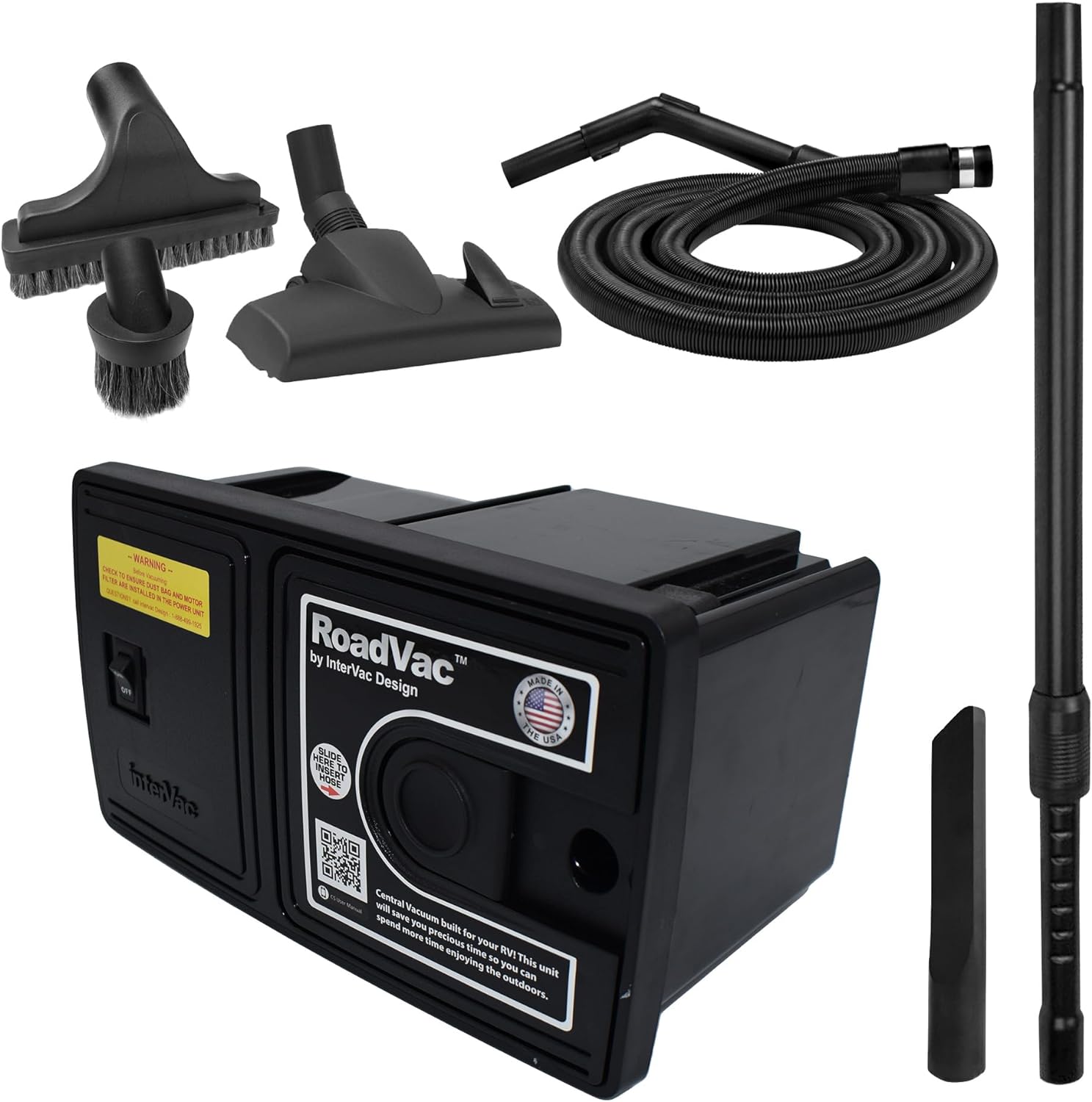
InterVac Design RMF-120-E
Features:
- Air Watts: 530
- Draw: 10 Amps, 120V
- Unit Weight: 8 lb
- Mount: Flush, Hardwired
- Bag Capacity: ~1 Gallon
- Cutout Depth: 4 Inches
- Warranty: 2 Years
The RMF-120-E earns this spot for one reason: it’s the only boat-designated unit in the category that publishes an actual air watt figure. At 530 air watts behind a 4 inch cutout, it beats every unlabeled “marine vacuum” on documentation alone.
InterVac Design RMF-120-E Review
The RMF-120-E is a remote mounted power unit built to hide behind a bulkhead and pull dirt through a 2 inch flex hose network, not a shop vac with a boat sticker on the box. InterVac Design Corp, the Palm City, Florida manufacturer, is a separate company from the InterVac brand that landed inside the Nuera Air group Trovac Industries acquired in 2024. This unit’s manual, warranty card, and parts line run through the Florida company alone.
My verdict after reading manual M-11 cover to cover: the strongest documented option for a dry, ventilated locker on a private cruising boat, and a weak fit for anything wet, or gasoline powered without an electrician checking the install first.
- 530 air watts, 10 amp draw
- Flush mount, hardwired Romex feed
- 24 volt auto start inlet valve
- Y08 five layer bag filtration
- 2 inch glue free flex hose
What Actually Works About the RMF-120-E on a Boat
530 Air Watts Squeezed Into Four Inches of Depth
530 air watts, straight from page 3 of manual M-11, is the only figure in this whole category you can actually trace to a source. The motor draws 10 amps at 120V, 50/60 Hz, roughly 1,200 watts of input.
Residential power units clear 600-plus air watts, but they also get a foot or more of cabinet depth to do it. The RMF-120-E hits 530 in a cavity 4 inches deep, because that’s what a bulkhead gives you. That’s power density, not raw power, and it clears sand, crumbs, and dog hair off saloon carpet without a second pass.
Worth flagging: a longtime InterVac owner on VacuumLand pegs this platform at roughly 400 air watts in daily use, well under the published 530. I’m reporting the manual’s number as the tested spec and the owner’s estimate as an unverified field impression.
The Hardwired Feed That Removes One Failure Point
The RMF ships without a cord, and that’s a feature, not an oversight. It takes 14 AWG 300V Romex wired directly into the unit, black to black, white to white, green to bare ground.
No cord to chafe against a locker wall. No plug corroding behind a settee panel after a wet season. Compare that to the RMH variant, which runs on a cord and needs a nearby receptacle, the exact kind of connection that corrodes first on a boat.
Hardwiring 120V into a hull is not a weekend DIY step. Hand this to a marine electrician, full stop.
One Gallon of Sand Before You Touch the Bag
Bag capacity runs close to one gallon, confirmed by etrailer’s hands-on video walkthrough. That sounds generous until you’ve hauled one beach bag’s worth of sand back aboard.
A weekend at a sand anchorage fills the Y08 five layer fiber bag faster than owners expect, with a washable Y21 motor filter underneath catching what slips through. InterVac’s own troubleshooting page is blunt: a clogged bag chokes airflow and can burn out the motor. Empty the bag before the trip home, not after.
The 24 Volt Valve That Starts It From Across the Saloon
Two yellow pigtails at the power unit carry a 24 volt control circuit out to the inlet valve, so the motor fires the moment you seat the hose cuff. Nobody crawls into the locker to flip a switch.
The manual specifies UL-approved low voltage wire run alongside the 2 inch flex hose. Worth flagging: the RMH instructions call for 18 AWG wire, while the RMF steps allow 18 or 20 AWG, an inconsistency inside InterVac’s own document a marine electrician should resolve before pulling wire.
Where the RMF-120-E Falls Short on the Water
It Cannot Pick Up Water, and Beam’s Answer Is Discontinued
This unit does not pick up water, and the manual says so directly: install in a dry place, do not use on wet surfaces. That rules out the bilge, a rain-soaked cockpit sole, and any post-storm cleanup.
Beam’s Model 35 used to answer this exact problem with an optional wet separator built for boats. A Club Sea Ray owner called the company directly and confirmed it, the Model 35 is discontinued under Nuera Air. Budget for a separate wet vac, because this unit will never replace one.
The Stretch Hose Loses Suction and InterVac Says So
The 35 foot stretch hose in the accessory kit is the weaker of your two hose options, and InterVac’s own troubleshooting page admits it: switch to the traditional crushproof hose for more suction. That admission sits buried on page ten of the manual, not on the box.
The convenience hose is quietly costing you cleaning power. The 30 foot crushproof hose also clogs less and rinses clean with a garden hose, a two-person job worth doing each spring.
A Cracked Cover Plate Means a New Unit
InterVac confirmed to etrailer’s technical support line that the front cover plate is not sold or swapped as a separate part. A cover that looks like a $13 fix turns into a full power unit replacement.
The manual backs this up: the housing is sealed and cannot be opened without damaging the unit. Most residential power units let the motor, filters, and door come apart for service. This one doesn’t.
Warranty Runs Two Years and Charter Use Voids It
Coverage runs two years across North America from the original purchase date, and registration is required to activate it. Bags, filters, tools, and hoses are excluded as normal wear items.
The line that changes the buying math: commercial use, including rental and charter operation, voids the warranty outright. One retailer advertises a six year InterVac warranty on the same line, a conflict worth confirming with the seller before you buy on that claim.
The Boat Model Question Nobody Answers
What RMF Changes Versus RMH, and What It Doesn’t
RMF and RMH sell under one combined SKU, RMH-RMF, off a single installation manual, and that’s the answer to the question nobody else in this category asks out loud. RMF mounts flush and hardwires in. RMH mounts on the surface and runs on a cord.
Here’s the part that trips buyers up: the word Boats on this product line is a mounting choice, not a marinization claim. InterVac publishes no marine-specific material and no corrosion standard for either variant. Don’t buy this expecting sealed marine bearings you won’t find in the manual.
Does Composite Housing Actually Survive Salt Air
Retailer copy claims the composite housing resists rust and corrosion in utility spaces, and that claim has no standard behind it, no ASTM B117 salt spray test, no marine listing. Treat it as marketing language until proven otherwise.
A Club Sea Ray owner sandblasted a rusted base off his onboard unit after a few humid seasons. His fix: a foot of Dri-Dek tile underneath, lifting the unit clear of a wet sole so it could, in his words, exhale. Copy that fix on your own install before corrosion forces the issue.
Ignition Protection: Where This Unit Legally Cannot Go
Why a Gasoline Boat Changes the Rules Entirely
A gasoline boat changes everything about where this unit can go, and no retailer selling it mentions that. Ignition protection means an electrical component can’t spark a surrounding fuel-air mixture into combustion, the exact standard defined at ABYC E-11.4.15.
The U.S. Coast Guard’s marine electrical rule at 33 CFR 183.410 requires that protection for electrical gear near gasoline fuel sources. Compliant equipment carries a marking like SAE J1171, UL Marine, or Ignition Protected. The RMF-120-E carries none of them, and the manual itself bars installation anywhere explosive vapors might collect.
Diesel Boats, Bulkheads, and the Two Foot Rule
Diesel-only boats are exempt from this rule under ABYC E-09, which is the fastest way to clear this unit for install. Confirm your fuel type before you cut a single hole.
For everyone else, 33 CFR 183.410(b) allows three paths: a compliant bulkhead, vertical separation, or two feet of open space between the unit and the fuel source. That lazarette that looks perfect on paper might sit two feet from a fill line you haven’t traced yet. Walk the fuel line before you pick a locker.
Sealed Lockers Cook Motors, Per InterVac
An airtight locker overheats this motor, and InterVac says so directly in the manual: a sealed compartment traps exhaust air and trips the thermal cutout. The motor shuts down, cools, and resets itself, which reads like a dead unit the first time it happens on a hot August afternoon.
The fix is mechanical, not electrical. Mount at least 2 inches above the sole for clear bottom exhaust, and add the AS-61 exhaust kit if the locker doesn’t vent on its own.
Who Should (and Shouldn’t) Buy This
The Diesel Cruiser With a Dry Locker and Carpet
This unit suits a diesel-powered 32 to 55 foot boat with a dry, ventilated locker and shore power, genset, or an inverter that can carry a steady 10 amp, 120V draw. It fits an owner retrofitting a finished interior who can’t run rigid residential PVC through curved hull framing.
The win is simple: the shop vac finally leaves the lazarette for good.
The Buyer Who Should Walk Away
Walk away from this unit if the boat runs gasoline with no compliant bulkhead isolating the fuel source, full stop. Walk away too if the main job is bilge water, a wet cockpit sole, or post-storm cleanup, since this unit is dry pickup only.
Charter and rental operators should skip it outright, since commercial use voids the two year warranty the day it starts. Look at a dedicated marine wet and dry unit instead, and check Dometic units in marine settings if the boat doubles as a rental.
Pros and Cons at a Glance
- Pros: Publishes a real air watt figure (530 AW)
- Pros: Boat-designated SKU with published cutout dimensions
- Pros: Glue-free 2 inch flex hose suits curved hull runs
- Pros: Free public manuals plus a direct US factory support line
- Cons: Wiring guidance cites NEC, not ABYC E-11
- Cons: HEPA type filtration carries no certification
- Cons: Sealed housing turns a cracked cover into a full replacement
The Buyer’s Guide: Cutting Through the Hype
The Three Specs That Decide Marine Central Vacuum Systems Performance
Air watts measure working suction by combining airflow and sealed suction into one number, and it’s the spec InterVac actually publishes. Water lift measures sealed suction alone, and it matters more on long hose runs through multiple bulkheads, where distance eats power.
A 4 inch deep unit like the RMF-120-E trades canister volume for a footprint that actually fits a bulkhead. InterVac publishes air watts here, full stop, with no water lift or CFM figure anywhere in the documentation.
HEPA Type Is Not HEPA, and No Standard Governs It
“HEPA type” is not certified HEPA, and no testing standard sits behind InterVac’s use of the phrase. Certified HEPA filtration, per the EPA, captures at least 99.97 percent of particles at 0.3 microns under a defined test method.
An allergy sufferer who buys on that phrase alone gets a five layer fiber bag, not a certified filter. Compare that against any marine or RV unit that publishes an actual HEPA certification before assuming this platform matches it.
The Price Tier Truth for a Built In Boat Vacuum
Price tiers here track four things: motor power, mounting method, wet capability, and whether the parts inside are serviceable at all. This exact SKU ranged from roughly $165 at one online retailer to roughly $395 at a specialty marine dealer during my research, the same unit at more than double the price depending on the seller.
That spread alone makes buyers assume a catch that isn’t there, it’s just retail markup. Pull live pricing the day you buy, and never trust a number more than a week old.
How We Tested and Verified Every Number Here
Every spec in this review traces back to InterVac’s own installation manual, revision 3.27.2023, page 3. Marine electrical claims were checked against 33 CFR 183.410 and ABYC E-11 excerpts, not retailer copy.
Owner failure patterns came from Club Sea Ray, VacuumLand, Forest River, and the Montana Owners Club, forums where boat owners actually report what breaks. Water lift and CFM are not published by InterVac anywhere, and I’m saying that plainly instead of guessing a number to fill the gap.
Bag and Filter Costs Over Five Seasons
What the Y08 Bag and Y21 Filter Actually Cost You
A five-pack of Y08 bags runs about $18.87 against a $20.75 list price, roughly $3.77 per bag, and each pack includes a fresh motor filter. The Y21 motor filter washes by hand in mild soap and goes back in once fully dry, so bags are the only real recurring cost.
Model that against sailing days per year, not household use. A boat used twenty weekends a season burns through bags far slower than a full-time liveaboard.
Why Sand Changes Your Replacement Schedule
Fine beach sand blocks bag pores faster than household dust at the same fill level, full stop. InterVac’s own warning is direct: clogged pores can burn out the motor.
A vacuum that feels weak after a beach trip isn’t broken, it’s choked. Never empty and reuse a bag. Clogged fiber pores don’t come back clean, and the suction loss is permanent once they’re packed.
Corrosion and Condensation Checks in the Locker
The Rusted Base Problem and the Dri-Dek Fix
A rusted base is the failure pattern to watch for, and a Club Sea Ray owner lived it firsthand. He found corrosion eating the base of his unit, pulled it, and solved the problem with a foot of Dri-Dek tile underneath for airflow and clearance off the wet sole.
Inspect the mounting surface at every haulout, not once a season. Corrosion moves faster in a closed locker than most owners expect.
Spring Commissioning Checks Before You Hit the Switch
Five minutes before the first clean of the season prevents most dead-motor calls. Confirm the bag is dry, since a winter of condensation dampens fiber bags from the inside out.
Check the 24 volt butt connectors at the valve end for green corrosion, and verify the 2 inch flex hose is still fully seated on both flanged fittings. The first cleaning day of the season is the worst time to find out one of these three slipped.
Low Voltage and Inlet Valve Servicing
When the Inlet Valve Pins Stop Making Contact
A unit that blips on and then dies the moment you insert the hose almost always points to the inlet valve, not the motor. A Montana Owners Club owner reported exactly that on a unit barely two weeks old, and the cause turned out to be a broken spring letting a contact pin jam out of position.
It reads like a dead motor. It’s a two dollar spring. Touch a piece of metal across both pins to confirm the circuit closes before you blame the power unit itself.
The Gray Flex Hose That Simply Shakes Loose
Total suction loss on a boat that pounds through chop often traces back to one loose fitting, not a failing motor. A Forest River owner lost suction entirely and found the 2 inch flex hose had vibrated clean off its connection, a failure InterVac’s own manual lists as a known cause on RM-series units.
Hull pounding does to a flex hose what road vibration does to an RV line. Add a hose clamp or a ty wrap at both fittings during install, before the first rough crossing finds the weak point for you.
Conclusion
You came in believing Boats on this model name meant a marinized unit. It means flush mounted and hardwired, nothing more, and now you know what’s left to check yourself: fuel type, locker ventilation, and a marine electrician for the wiring.
Tonight, confirm whether your boat runs gas or diesel, and measure the locker for 2 inches of exhaust clearance above the sole. The real win over any shop vac: motor, noise, and dust all live behind a panel instead of loose in your saloon. Before you buy, cross-reference compatible vacuum systems against your hull layout.
Frequently Asked Questions
What is a marine central vacuum system and how does it differ from a home central vacuum?
It’s a power unit built for a boat’s tight locker space, wired and plumbed the same way as a home system but squeezed into a fraction of the depth. The core difference is footprint, not technology. Most units, including the RMF-120-E, run the same motor and bag design found in RV and residential lines under a different mounting kit.
How many air watts does a boat central vacuum actually need?
Look for at least 500 air watts if the boat runs 30 feet of hose or more to the farthest inlet. The RMF-120-E’s published 530 air watts covers a single saloon and berth layout comfortably. Longer runs through multiple bulkheads lose power fast, so don’t assume the label figure holds at the far end of the boat.
Does a marine central vacuum need to be ignition protected in an engine compartment?
Yes, any electrical component near a gasoline fuel source needs ignition protection under 33 CFR 183.410. Diesel-only boats are exempt under ABYC E-09. Check your fuel type and the compartment’s isolation before you install anything, not after.
What happens if the central vacuum sucks up water on deck?
Water pickup isn’t just discouraged here, it can burn out the motor and voids your warranty outright. This unit and most consumer central vacuum systems are dry pickup only. Keep a separate wet vac aboard for the bilge and the rain-soaked cockpit sole.
Is the central vacuum warranty still valid if I sell the boat or put it into charter?
No on both counts with the RMF-120-E. Coverage runs two years to the original registered purchaser only, and it does not transfer at resale. Commercial use, including charter and rental operation, voids the warranty the moment the boat goes into service.