You inherited a beige can in the basement that says Electrolux, and you assumed that meant heirloom quality. But the badge lies a little. The electrolux central vacuum system model 1590 is not made by the Electrolux selling refrigerators today, and that single mix-up sends owners chasing the wrong parts from the wrong service network. For context on how the naming split happened across eras, see the wider Electrolux central vacuum range.
By the end, you will know exactly who built it, what it can still do, and whether tonight you fix it or finally let it go.
Electrolux Central Vacuum System Model 1590
Your 1590 is an Aerus-built workhorse with a strong Ametek/Lamb motor and a washable foam filter that does not reach HEPA standards. The real decision is never about the name on the canister. It is about how much life remains in the parts that wear out.Why Your Electrolux Badge Is Not What You Think
The name on your power unit is not a lie. It is just outdated by about 25 years, and that gap costs owners real money when they search for parts.
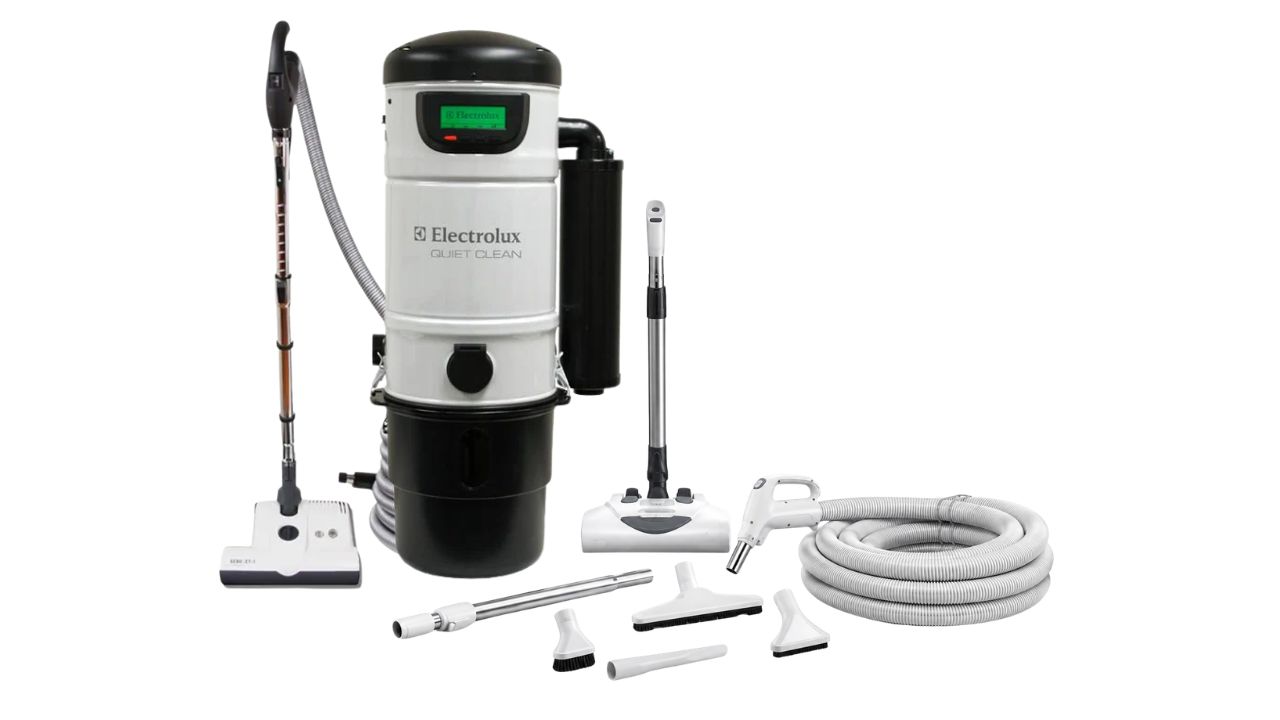
Who Actually Built Your 1590 Power Unit
One owner described calling the Electrolux appliance line for a replacement motor, bouncing through three departments, and landing at a number for Aerus LLC, formerly Electrolux Corporation USA, the Virginia-based company that manufactured the 1590. That routing is the correct path.
The 1590 came from Electrolux Corporation USA, an American company with no ownership connection to AB Electrolux of Sweden. Around 2000, the North American “Electrolux” brand rights were sold back to the Swedish parent, and Electrolux Corporation USA transitioned to Aerus, the company that originally built the Electrolux Model 1590, completing the name change by roughly 2003 to 2004. Aerus LLC still services the 1590 and stocks its most common replacement parts.
The Electrolux on store shelves is the Swedish Electrolux Group’s product line, whose central vacuum division landed with Trovac Industries in 2024 and produces Beam. Beam and the 1590 share a badge era, not a manufacturer.
Why People Buy This for the Name and Regret It
Search the repair forums and you find owners who bought a used 1590 purely because the badge matched a vacuum brand they grew up trusting, then hit parts catalogs listing the unit under a company that no longer uses that name and filtration that does not hold up to modern allergy standards. The machine is not a bad value. But the brand trust that sells it is misplaced by about two decades.
The Eureka Myth That Confuses Every 1590 Owner
A popular forum comment, cited and recycled enough to reach the top of several search results, insists the 1590 was built by Eureka. It was not. Check the full Electrolux Corporation USA to Aerus transition timeline before you order anything. Chasing Eureka motors or Eureka control boards wastes real money and real time on a machine with a completely different parts lineage.
What Is Really Under That Beige Canister
The motor is the good news. The filter is the honest conversation.
The Ametek/Lamb Motor Doing All the Work
Take the lid off a 1590 and you find an Ametek/Lamb tangential-bypass motor with a 5.7-inch fan, rated at 110 to 120 volts. One owner replacing a motor after 18 years of use found his original unit had a flat-bottom motor mount while every affordable replacement showed a tapered-bottom. They look similar at a distance. They are not interchangeable.
The 1590 uses a sealed tangential-bypass design that pulls air around the outside of the motor rather than through it, keeping abrasive fine dust away from the bearings. Replacement sealed-bearing motors outlast factory units for exactly that reason.
Air Watts on Paper vs. What Reaches Your Hose
Replacement motor listings cite around 515 air watts for the 1590. That number is a bench test at peak static pressure, not the suction arriving at the inlet after 40 feet of pipe. Per ASTM F558, air watts equal CFM times water lift divided by 8.5. Every elbow, every fitting, every foot of Schedule 20 PVC between the unit and the farthest inlet introduces friction loss, and your actual inlet sees something meaningfully lower than the lab figure.
Two-Stage or Three-Stage, and Why It Matters
Here is the part that trips up most replacement orders. Some 1590 units shipped with a two-stage motor, the Lamb Ametek 119631, rated at roughly 128 inches of water lift, 114 CFM, 515 air watts, and 14.4 amps. Others shipped with a three-stage motor, the Lamb Ametek 116765, rated at roughly 136 inches of water lift, 95 CFM, 465 air watts, and 13.1 amps. These are bare-motor lab values, not installed inlet performance.
More stages build higher static pressure, which is why the three-stage version produces stronger water lift even while drawing fewer amps, the same way adding a gear lets you climb without spinning out. Forum owners who have run both report the three-stage version cleans harder on carpet. Check your original motor’s part number before ordering, or you will not get what you paid for.
The Filtration Gap Nobody at the Dealer Mentions
The moment allergy owners discover the 1590’s filter spec is usually not during purchase. It is the afternoon they empty the bucket.
Foam Filter, Not HEPA, and What That Means
| Feature | 1590 Foam Filter | True HEPA |
|---|---|---|
| Filter media | Washable foam | Pleated synthetic fiber |
| Capture rate | Not rated | 99.97% at 0.3 microns (U.S. DOE standard) |
| Maintenance | Rinse and dry | Replace on schedule |
| Allergen control | Basic debris | Certified fine particle capture |
The 1590 uses a washable foam filter secured by a wing nut and retaining ring. It catches larger debris reliably. It does not meet U.S. EPA and Department of Energy true HEPA certification, which requires capturing 99.97 percent of particles at 0.3 microns. Use a power unit with certified HEPA-rated filtration, when anyone in the home has dust or dander allergies and replacing the 1590 is on the table.
When Dumping the Dirt Bucket Triggers Allergies
Owners describe it the same way: carry the bucket outside, pull the lid, and a visible dust cloud rises from the bin. Bag the bin before you carry it out. Disposable liner bags inside the dirt bucket keep captured fine dust contained at emptying. Central vacuum’s real allergen advantage is that exhaust vents outside the living space. Emptying without liners cancels that benefit immediately.
Why Your Suction Died After Years of Loyal Service
Start simple. The answer is usually cheaper than you fear.
The Full Dirt Bucket Stealing a Quarter of Your Power
One owner reported a 1590 that struggled to lift a tissue. The bucket looked less than a quarter full from the top. Below the dust cone, it was packed solid, blocking airflow through the unit.
Empty it before it looks full. The visible surface at the top of the bucket is not the right gauge. Check the dust cone clearance below.
Cracked Hoses and the Silent Air Leak Problem
A cracked hose or open wand swivel bypasses the motor entirely. You feel almost nothing at the cleaning head, but the motor sounds fine at the unit. The air leaves through the gap before it creates useful suction.
Check the handle swivel first, since these crack at the pivot point from repetitive bending. A healthy 1590 at a close inlet should feel roughly 80 to 95 inches of water lift. Feeling significantly less before any long pipe run points to a hose leak, not a failing motor.
When a Clog Hides 30 Feet Inside the Wall
Disconnect the inlet pipe at the power unit and test suction directly at the canister opening. Strong suction at the can but weak suction at a wall inlet points to a buried clog in the pipe run between them.
Sticky objects and small socks build slow blockages that feel exactly like a worn motor. Isolate the unit from the pipe first, then test inlets one at a time from nearest to farthest to find the affected run.
The Repair Bills Owners Actually Face
Most 1590 repairs are one of three things: a bad relay on the control board, a worn motor, or a failed pressure switch. Stacked together, they change the math.
That Failing Control Board and Its Sneaky Relay
One owner traced a completely dead 1590 to a single bad relay terminal on the control board and resoldered it with a basic kit. The unit ran four more years. The control board converts low-voltage signal from the wall inlet switch into the full 120V that drives the motor. When the relay contacts corrode or a solder joint cracks from heat cycling, the whole unit goes silent.
A failing board and a dying motor look identical at the wall outlet. Test the board first. It is the cheaper fix, and the one most owners skip.
The Pressure Switch That Shuts You Down Early
One owner’s 1590 quit every five minutes during a cleaning session. A new motor did nothing. A replacement pressure switch fixed it completely. The switch reads airflow resistance and cuts the motor when it senses a drop past its setpoint. A worn switch trips at the wrong threshold, sometimes from nothing more than a filter that needs rinsing.
Diagnose the pressure switch before condemning the motor. It costs a fraction of a motor replacement.
Power Nozzle Brushes You Can Barely Find Anymore
The 6B power nozzle brush strips are getting difficult to source. Some are discontinued entirely. Owners are matching universal brush strips by length and bristle density, cutting them to fit. Confirm compatibility before buying, and do not toss a functioning nozzle just because original strips are off the shelf.
Repair It or Rip It Out
The decision tree is simpler than it looks once you run the numbers.
Is the Electrolux Central Vacuum System Model 1590 Worth Keeping?
A homeowner weighing a motor replacement on a 22-year-old 1590 put it plainly: the motor costs roughly the same share of a new unit as a water heater element costs of a new heater. A sound board and intact PVC runs make repair the smart money. Stacked failures across the motor, board, and power nozzle together tip the math toward replacing the power unit while keeping the inlets and pipe runs you already have.
The 10-to-12-Year Rule Dealers Push on You
“Anything over ten years old, replace it.” You will hear this from dealers who install new units. That advice sells power units. A 1590 motor drawing at nameplate amperage and starting cleanly is not done. Check amperage draw with an inexpensive clamp meter before you decide. Separate genuine wear from a sales pitch with one ten-second test.
What a Modern Unit Buys You That This Cannot
| Feature | Electrolux 1590 | Modern Unit |
|---|---|---|
| Filtration | Washable foam | True HEPA (certified models) |
| Noise level | Higher motor noise | As low as 62 dB on some models |
| Parts availability | Getting scarce | Current stock, active warranty |
| Pipe compatibility | Standard 2-inch PVC | Standard 2-inch PVC |
Your 1590 trades current parts support and certified filtration for a proven motor platform and decades of demonstrated service. A much quieter successor unit in the Aerus CentraLux line connects to standard 2-inch central vacuum PVC, meaning your existing pipe network, inlet valves, and low-voltage wiring carry over.
Keeping a 1590 Alive for Another Decade
Owners still running 1590s in the late 2020s share one habit: they maintain the filter on a schedule, not when suction drops.
The Filter Cleaning Schedule That Saves Your Motor
A starved motor overheats, and the foam filter in the 1590 loads slowly enough that the first visible sign of a clogged filter is often a motor already running hotter than it should. Clean or rinse the foam filter every three months in normal use, monthly in a high-pet home. Add a secondary motor filter behind the foam layer to block the finest particles from reaching the bearings. This single habit extends motor life more than any other maintenance step.
How Far Your Inlets Sit From the Unit
Map which inlets sit farthest from your power unit before blaming the motor for weak suction in a distant room. Suction drops with every 10-foot pipe run extension and every 90-degree elbow added beyond the manufacturer’s maximum. A 1590 running strong at the nearest inlet but feeling weak 60 feet away through four elbows is working exactly as pipe run physics allow.
Parts Still in Stock vs. Parts Gone Forever
Motors, control boards, foam filters, gaskets, and standard 35-foot hoses are still widely available through Aerus dealers and aftermarket suppliers. Original 6B power nozzle brush strips and some decorative inlet trim are getting scarce. A unit with a confirmed working motor and board but a worn nozzle is a reasonable buy. A unit with unknown board history and a cracked hose priced near motor-replacement cost is not.
Conclusion
You walked in thinking the Electrolux name guaranteed support, confused about who to call for parts. You leave knowing this is an Aerus machine with a tough motor, a dated filter, and clear cost math behind every repair decision. Tonight, pop the canister, empty the bin below the dust cone, and check the hose swivel for cracks before you spend a dime. Read verified owner reviews and ratings for broader owner feedback on this unit and its successors. Fix it right and this thing cleans every room from one quiet motor in the basement, something no portable you have dragged upstairs can match.
Frequently Asked Questions
Who actually makes the Electrolux Model 1590 central vacuum, and is it the same as Beam?
No. The 1590 was built by Electrolux Corporation USA, which became Aerus LLC in 2001. Beam belongs to the Swedish Electrolux Group lineage, now under Trovac Industries. They share a badge era, not a manufacturer or parts network.
Is the Electrolux 1590 central vacuum still made, and can I still get parts?
The 1590 is discontinued, but key parts remain available through Aerus dealers and aftermarket suppliers. Motors, control boards, foam filters, and standard hoses are stocked. Original 6B power nozzle brush strips are getting scarce, so confirm nozzle parts before buying a used unit.
Which replacement motor fits an Electrolux 1590, and why are there two different ones?
Two Ametek/Lamb motors appear across parts catalogs: the 119631 (two-stage, roughly 515 air watts, 14.4 amps) and the 116765 (three-stage, roughly 465 air watts, 13.1 amps). Some 1590 units shipped with each. Check your original motor’s part number and confirm the base shape, since flat-bottom and tapered-bottom mounts are not interchangeable.
How do I fix an Electrolux 1590 that runs but has no suction?
Check the dirt bucket first since it may be packed solid below the dust cone even when it looks empty from the top. Then inspect the hose and swivel for cracks. Disconnect the inlet pipe at the unit and test suction at the canister opening. Strong suction there but weak at the wall means a pipe run clog, not a motor problem.
Should I repair my old Electrolux 1590 or replace just the power unit?
Repair it when the problem is a single component and the board and pipe network are sound. Replace the power unit when you face stacked failures or need certified HEPA filtration. Your existing 2-inch PVC and inlet valves are compatible with modern Aerus CentraLux units either way.