The central electrolux vacuum search pulls most owners in three wrong directions before landing on the right one. The badge on your power unit says Electrolux, but the company behind that name sold the business twice in six years and left central vacuums entirely.
By the end of this guide you will know exactly which Electrolux you own, who stands behind it today, and whether repair or replacement is the smarter move.
Central Electrolux Vacuum
“Central electrolux vacuum” is one search term pointing at three separate product lineages with no shared parts, no shared warranty chain, and no shared manufacturer. Identifying your specific unit comes before any parts search, service call, or buying decision.Why One Name Hides Three Different Vacuums
Which Electrolux central vacuum do I actually own?
Your model number is the only reliable answer. A homeowner in Raleigh spent two weeks calling Electrolux appliance service lines for a motor quote. She owned an Aerus CentraLux, a completely separate lineage, and every number she dialed had never heard of it. The badge said Electrolux. The parts chain said something else entirely.
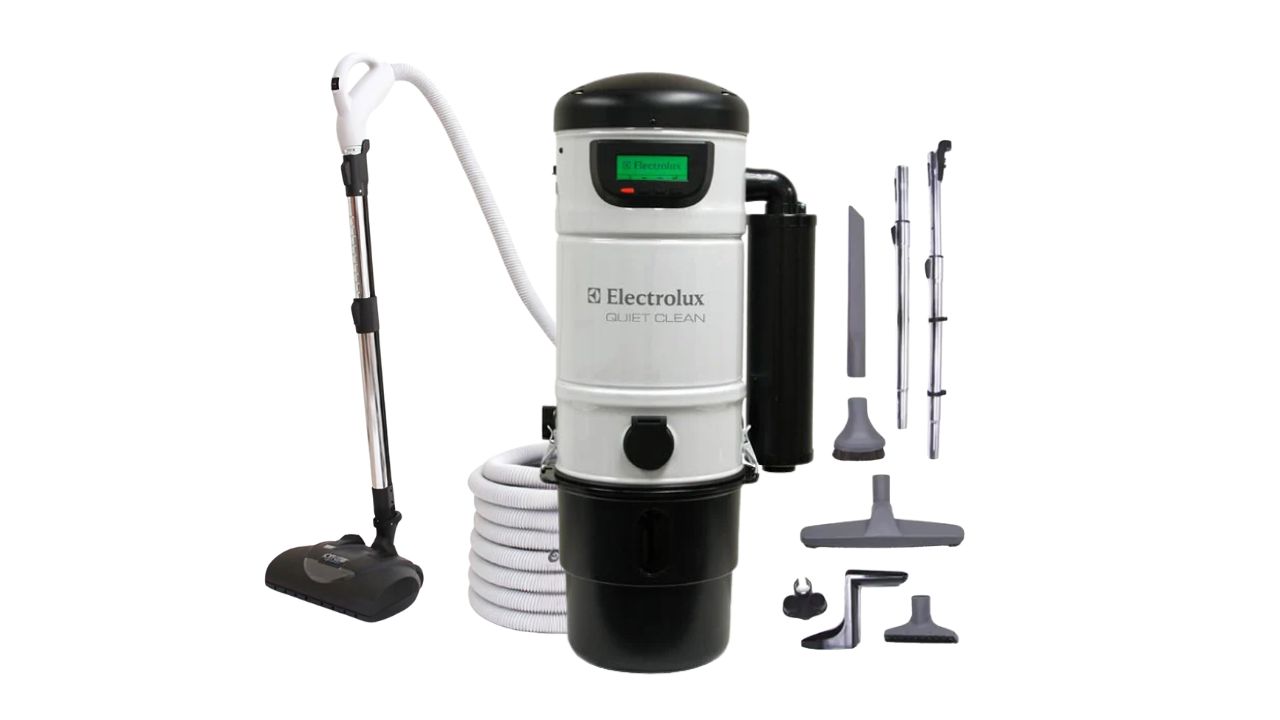
Start with the model number plate on your power unit. Numbers like 1580, E130, or E131 trace to the Beam platform, a lineage you can trace through the Electrolux Model 1590 system. Units marked CentraLux, or sold through an Aerus dealer, belong to a different company with a different parts network. The wall inlets and PVC tubing in your home cross to almost any brand. The motor, control board, and hose fittings are specific to yours.
The door-to-door Lux you grew up with
The American Electrolux that sold door-to-door became Aerus LLC in 2000, fully separating from the Swedish parent. Aerus still operates a dealer network across North America, backs new CentraLux purchases with a 5-year limited warranty, and stocks filters, bags, and hoses locally. The lineage runs continuously. The corporate label does not.
The QuietClean unit sold online right now
The PU3650 and PU3900 are the Electrolux-badged units most online shoppers find first. They were built by Beam, the Iowa-based manufacturer that Electrolux AB of Sweden acquired in 1987 and rebranded as Beam by Electrolux Central Vacuum Systems in 2007. Modern machines with real suction numbers. Also built by a company that no longer makes them, then sold by a second company that stopped production in 2024.
The European built-in nobody mentions
Electrolux AB and its AEG brand sell a separate built-in vacuum range across Europe with different filter formats, hose connection standards, and parts from European suppliers. Zero cross-compatibility with North American Beam-platform units. Spec sheets from generic searches may describe this line without flagging it, and the part numbers look similar enough to cost you a wasted order and three weeks.
The Ownership Trail Dealers Skip
How Beam became Electrolux then left
Electrolux AB bought Beam in 1987. By 2007 it was Beam by Electrolux Central Vacuum Systems, a name most buyers never read past the first word. Manufacturing moved to Juarez, Mexico around 2010. The badge changed. The factory did not. Parts cross-compatibility between a 2006 “Beam” and a 2012 “Beam by Electrolux” is strong precisely because the production line was the same throughout.
The 2018 sale most reviews never mention
Electrolux AB divested its North American central vacuum business to Nuera Air in 2018. Per Electrolux’s 2018 divestiture of its central vacuum business, the divested Beam and Sanitaire lines reported combined revenues of approximately USD 70 million in 2017. Electrolux exited the central vacuum category in North America entirely. The Electrolux name on new units became a licensed label on Beam-built hardware, not a mark of Electrolux manufacturing.
Where your warranty actually lives now
Nuera Air halted production of Beam-platform units in April 2024. Les Industries Trovac Ltd., the Quebec-based manufacturer behind the CycloVac line, acquired the Beam brand and committed to supporting maintenance and repair on existing units. Your “Electrolux” warranty now runs through a company you never bought from. Call Trovac, confirm the transfer applies to your model, and get it in writing.
Reading The Spec Sheet Without Getting Fooled
Why air watts beat the wattage on the box
Air watts are a measure of cleaning power at the hose inlet under load, calculated using the ASTM F558 test standard. Water lift, in inches, is sealed suction at zero airflow. CFM measures airflow at near-zero suction. Both live at opposite ends of the performance curve, not the middle where a vacuum actually runs across carpet.
Air watts are the number that cleans your floor. Input wattage on the box tells you only how much electricity you burn.
The spec math that does not add up
The PU3650 rates at 600 air watts, 125 CFM, and 140 inches of water lift. Run the ASTM F558 formula (CFM multiplied by water lift, divided by 8.5) and the result does not match 600, because peak CFM and peak water lift never occur simultaneously in a real system. Trust the rated air watt figure.
The square footage claim you should cut in half
The same PU3650 appears at 4,000 square feet on one retail page and 8,000 on another. Coverage ratings ignore pipe run length, elbow count, and real inlet distance. Halve the rated square footage as your working rule. A 4,000-square-foot rating becomes a realistic 2,000 for a home with a 60-foot pipe run and three sweep elbows between the unit and the far bedroom.
What The PU3650 And PU3900 Actually Offer
The PU3650 by the numbers
The PU3650 delivers 600 air watts, a 4-gallon receptacle, and a self-cleaning permanent filter that eliminates per-bag costs. The hybrid bagged-or-bagless design lets you run bagless for everyday debris and switch to bagged when someone in the home reacts to dust. QuietClean insulation keeps operating sound near 70 decibels. For performance data across real installations, see the PU3650 QuietClean central vacuum. With Trovac now holding the brand, confirming who processes a warranty claim today is worth a call before you buy.
The PU3900 for larger floor plans
The PU3900 steps up to 640 air watts with a higher-capacity receptacle and a two-stage bypass motor, which routes debris away from the motor chamber. Bypass motors extend motor life under heavy debris loads because fine particles in a thru-flow design wear the brushes directly. Apply the same halving rule to its coverage rating. For homes above 3,500 square feet with pipe runs exceeding 60 feet, compare it against the Oxygen series central vacuum before committing.
The motor question buyers never ask
Older Electrolux-badged units used Ametek Lamb motors, the same units in NuTone (now manufactured under license by Broan-NuTone LLC after Nortek’s consolidation of the brand’s residential vacuum lines) and most North American central vacuum systems. Ametek Lamb carries a deep aftermarket parts trail from multiple suppliers. Newer listings cite Domel, a European manufacturer with a thinner North American network. Ask which motor sits inside before you buy. The answer changes your 10-year parts outlook significantly.
Filtration Claims You Should Question
HEPA versus HEPA-style in plain words
True HEPA meets the US Department of Energy standard: 99.97% capture of airborne particles at 0.3 microns, independently tested and certified. Aerus markets CentraLux filtration as “equal to HEPA standards,” meaning comparable internal performance, not independent certification. The bouncer checks most guests. Not all of them. Allergy and asthma households should ask for the certifying body and test standard by name before accepting any HEPA-adjacent claim on a central vacuum unit.
What self-cleaning filters really mean for you
Self-cleaning permanent filters cut per-bag costs and prevent suction loss from clogged filters. What they do not prevent is the dust release when you empty the canister. A family running a self-cleaning Beam unit through a 2,600-square-foot home with a golden retriever saw a visible cloud every monthly empty, and the youngest child’s allergist connected the timing within one season. Empty outside or into a sealed bag.
What Owners Say After Living With It
Is a central Electrolux vacuum still worth buying today?
A discounted Electrolux-badged unit can still be a sound buy if the price reflects the brand uncertainty. Quiet operation and 600-plus air watts are real advantages over any portable canister. Buying at full retail is harder to justify when CycloVac, also now under Les Industries Trovac Ltd. following the 2024 acquisition, offers an active dealer network and clearer parts support at similar prices. Owner discussions on VacuumLand flag the later Beam Alliance-era hose and powerhead as weak relative to the motor strength. Treat that as directional sentiment, not lab data.
The proprietary hose complaint that traps owners
Some Beam Alliance-series hoses use proprietary fittings that do not accept standard 1.25-inch or 1.375-inch central vacuum cuffs. That locks owners into one powerhead family and raises accessory costs because aftermarket suppliers do not tool up for low-volume proprietary connections. Standard fittings are compatible with Beam, CycloVac, OVO, MD Manufacturing, and most North American systems. Vacuflo uses a proprietary low-voltage connection on older models. Early Sears/Kenmore installations used a non-standard bore requiring an adapter for modern hoses. Check standard versus proprietary cuffs before committing to any accessory purchase.
The reliability flag worth a phone call
One major central vacuum retailer posted a consumer alert about relay control board failures in a specific Electrolux production window. Single-source alerts are not a recall, but the failure mode deserves a direct question: which production window is this unit from, and have board revisions been applied? Hesitation on that question is an answer in itself.
Parts, Service And The Orphan Problem
Why a discontinued brand is not a dead brand
The wall inlets, PVC tubing, and low-voltage wiring in your home hold most of the installed value of a central vacuum system. None of those components are brand-specific. An owner in suburban Chicago ran a 1997 Beam unit for 22 years, replaced the motor with an Ametek Lamb unit from an aftermarket supplier, and added five more years for under $200. The motor and control board get scarce first. The pipe in your walls accepts any modern power unit you connect to it.
Aerus CentraLux owners have a clearer path
Aerus still operates its own dealer network stocking filters, bags, brushes, and replacement hoses. A CentraLux owner in Portland called her local dealer for a filter and had the part in two days. The 5-year limited warranty on new purchases runs through Aerus’s own service network, not a third-party acquirer. That continuity is the strongest reason to correctly identify your unit before you start any parts search.
When repair beats replacement on an old unit
Motor replacement on a Beam-platform or CentraLux unit runs $80 to $200 for the part, plus labor. A replacement power unit from a current manufacturer starts around $400. Replace only when the motor, receptacle body, and control board fail together, or when no supplier stocks parts for your model. Quote the motor first before anyone talks about a new system.
How To Choose Or Replace Without Regret
Match inlet count to square footage per floor
Plan inlets so a 30-to-35-foot hose reaches every corner from the nearest wall inlet. Count placements by square footage per floor, not total home square footage. Every 90-degree elbow compounds suction loss over distance, and that compounding is the concern dealers rarely raise because raising it does not shorten the sales call.
Compare Electrolux against current makers
| System | Air Watts | Warranty | Parts Availability |
|---|---|---|---|
| Electrolux PU3650 | 600 | 10 yr (Trovac) | Uncertain |
| Electrolux PU3900 | 640 | 10 yr (Trovac) | Uncertain |
| CycloVac (Trovac) | 600-750 | 10 yr | Active dealer network |
| MD Manufacturing | 550-775 | 5-10 yr | Strong dealer network |
Active brands with current production carry lower long-term cost uncertainty. A discounted Electrolux-badged unit can win on price if the condition is solid and the discount offsets the parts risk. Decide whether brand certainty is worth the price difference before you commit.
The questions to ask before you pay
Before you call a dealer or click Buy Now:
- Which exact model and motor sits inside this unit?
- Who honors the warranty today, and through which service process?
- Do the hose and powerhead fittings accept standard cuffs or proprietary ends?
- Is the motor an Ametek Lamb or Domel unit, and where do I source replacements?
- Can I get a control board in two years, and from which supplier?
No seller should hesitate on any of these. Hesitation is the answer.
Conclusion
You arrived thinking Electrolux was one central vacuum. You leave knowing it is three lineages: one Aerus-supported with a live dealer network, one transitioning through Trovac’s acquisition of Beam, and one European line with no bearing on your wall inlets. Pull the model number off your power unit tonight. That number tells you whether Aerus, Trovac, or an aftermarket motor supplier is your next call. For in-depth Electrolux central vacuum reviews comparing these lineages across real homes, the next step is already there. A central vacuum that exhausts 100 percent of its dirty air outside the living space will outlast three portables, but only when you are keeping the right one.
Frequently Asked Questions
Are Electrolux central vacuums still made, and who owns the brand now?
No. Electrolux AB sold the Beam-platform business to Nuera Air in 2018 and exited central vacuums entirely. Nuera Air halted production in April 2024, and Les Industries Trovac Ltd. now owns the Beam brand and supports existing units for maintenance and repair.
What is the difference between an Electrolux central vacuum, a Beam, and an Aerus CentraLux?
Three separate products, no shared parts. Electrolux-badged units (PU3650, PU3900) were built by Beam before the brand passed through Nuera Air to Trovac. Aerus CentraLux is the US successor to the old door-to-door American Electrolux, a separate company with its own dealer network and parts supply.
Can I still get replacement parts for my Electrolux central vacuum power unit?
Yes, for most wear items. Wall inlets, PVC fittings, filters, and standard hoses are available through aftermarket suppliers. Control boards and motors on discontinued models will narrow over time. Identify your motor brand first: Ametek Lamb and Domel parts channels differ significantly.
Should I repair my old Electrolux central vacuum or replace it with a new system?
Repair it if only the motor has failed and parts are still available. Replace when the motor, control board, and receptacle body fail together, or when no supplier stocks parts for your model. The pipe and inlets in your walls hold most of the installation value. Quote a motor first.