Every search for electrolux central vacuum systems reviews returns the same stale loop: reversed ownership history, no mention of discontinued status, and zero clarity on which Electrolux you’re actually buying. The units sold as Electrolux were built by Beam, a brand AB Electrolux of Sweden sold to a Canadian company in 2018. Manufacturing stopped entirely in 2024.
By the end of this guide, you’ll know which Electrolux you own, whether parts still exist, and whether to service or replace it. Start with our complete Electrolux central vacuum guide for broader coverage of the full model range.
Electrolux Central Vacuum Systems Reviews
The Electrolux badge on a central vacuum tells you almost nothing about who built the unit, who stands behind it today, or whether you can still get parts. Three separate companies have carried the name in North America, and the one that manufactured most Electrolux central vacuums exited the category in 2024.Which Electrolux Central Vacuum Are You Buying
Most buyers searching “electrolux central vacuum systems reviews” are searching for three different products at once without knowing it. That confusion is not accidental, and understanding it is the first step to making the right call.
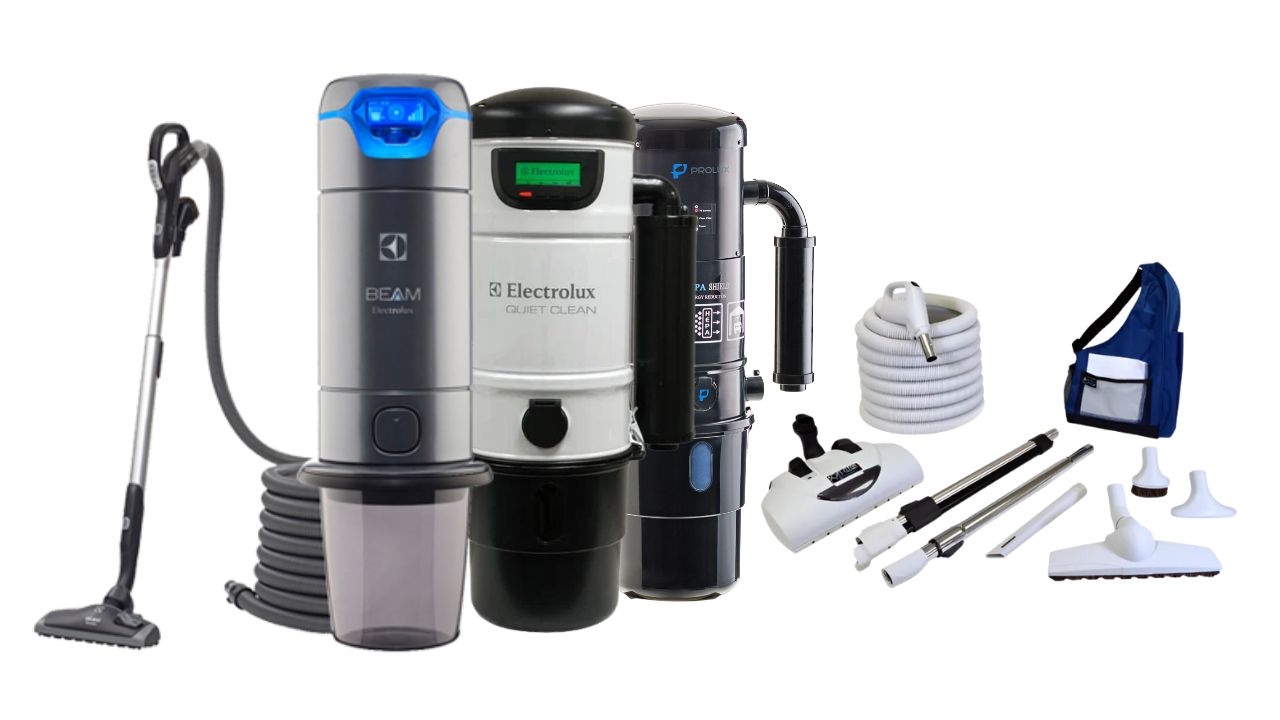
Three Different Companies Carry The Electrolux Name
Three firms have operated under variations of the Electrolux name in North America, and only one still makes central vacuums today. Getting them straight is the difference between a unit you can service for fifteen years and one you can’t.
The first is AB Electrolux, the Swedish multinational parent company, which licensed and later stamped its name on the central vacuum line manufactured by Beam Industries of Iowa. The second is Beam Central Vacuum, which AB Electrolux owned outright from 1987 through 2018 and sold across parts of the North American market under the Electrolux label. The third is Aerus LLC, formerly the Electrolux Corporation USA, a completely separate domestic company that sold portable vacuum cleaners under the Electrolux name until it rebranded around 2004. For the full history of that separation, see the history of Aerus, the former Electrolux Corporation USA.
The confusion persists because dealers rarely separate them. Blurring the three companies keeps buyers moving toward whatever the dealer has in stock.
The Beam Built Units Sold As Electrolux
The central vacuum power units sold as Electrolux were Beam units underneath. The badge differed. The machine did not.
A family running a PU3650 in suburban Ohio spent nearly two years chasing Electrolux-branded replacement bags before a certified installer pointed out that the same components ship from Beam’s parts catalog under a different part number. The brand name on the canister was the only thing slowing them down.
The model number stamped on the canister’s data plate is your anchor. Pull it before you search for anything. Cross-reference it against Beam’s parts catalog or contact a Trovac Industries dealer directly for compatibility. You can also read about the electrolux central vacuum system model 1590 to see how model-specific parts identification plays out on an older unit.
Why This Mix Up Costs Buyers Money
Brand confusion costs real money in lost time and wrong parts orders. Service techs who don’t recognize the Electrolux canister won’t quote a repair without researching it first. Bags sold under the Electrolux label hit dead-end searches once stock depletes. Suction drops, the owner calls the number on the manual, and that number routes to a company that left the business in 2018. That’s the practical cost of buying a name without knowing who stands behind it.
The Brand Story Your Dealer Skips
No dealer volunteers this history because a fully informed buyer asks harder questions.
Beam Made It, Electrolux Just Stamped It
Beam Industries built central vacuums in Iowa long before the Electrolux name appeared on the canister. AB Electrolux, the Swedish multinational, acquired Beam in 1987 and continued manufacturing under both names for the North American market. Think of it like two cars from one factory floor wearing different badges at the dealership. The chassis was identical. The Electrolux sticker on the front panel was the only meaningful difference.
How Electrolux Quietly Left Central Vacuums Behind
In 2018, AB Electrolux sold Electrolux’s official divestiture of its North American central vacuum business to Nuera Air, a Montreal-based company. The Beam and Electrolux central vacuum lines, along with the Sanitaire commercial floor care brand, left the Electrolux portfolio in the same transaction. Sanitaire went to Bissell. The central vacuum operations, carrying roughly USD 70 million in 2017 revenue, went to Nuera Air.
That move matters because AB Electrolux collected the check and walked away. Every Electrolux-badged central vacuum sold after 2018 was a Nuera Air product wearing old branding. Most buyers never learned that detail.
Who Owns The Beam Line Today
Nuera Air halted production of the Beam, Husky, and DuoVac central vacuum lines in April 2024. Trovac Industries, a Quebec-based manufacturer with its own established central vacuum portfolio, then acquired the Beam brand assets and now positions itself as the world’s largest central vacuum manufacturer.
That handoff matters for two reasons. First, any Electrolux central vacuum you buy today is legacy stock from before the production halt, not a current-production unit. Second, warranty and parts support route through Trovac and whatever dealer network they rebuild, not through the company that originally put the Electrolux logo on the box.
Aerus Is Not The Same Electrolux
Aerus LLC, the former Electrolux Corporation USA, is a completely separate company from AB Electrolux and from Beam. Aerus relinquished the Electrolux name around 2004 when AB Electrolux enforced its US trademark, and Aerus has operated under its own brand independently ever since. Aerus still manufactures central vacuums today.
The hardware is not interchangeable. Aerus and Electrolux-Group units use different motor mounts, different inlet wiring configurations, and different canister diameters. Buying Aerus bags for a Beam-built Electrolux unit, or calling an Aerus dealer for a PU3650 repair, sends you in the wrong direction entirely. Treat them as different brands because they are.
What Owners Actually Say After Years
Long-term Electrolux central vacuum owners break into two clear camps, and the line between them almost always runs through the filtration choice made at purchase.
What Do Real Electrolux Central Vacuum Systems Reviews Reveal
Most long-term owners report steady suction across the first seven to ten years of daily use, with noticeably quieter operation than any portable they’d replaced. That tracks with the PU3650’s tangential bypass motor design, which draws cooling air separately from the debris stream and extends motor lifespan well beyond flow-through motor units at the same price point. For the full performance picture on that specific unit, read the PU3650 QuietClean unit in depth.
The complaint pattern in owner reviews centers on two things: warranty coverage that runs shorter than comparable units at the same price, and parts availability anxiety that surfaces once owners realize the brand is no longer in active production. Both are legitimate concerns now.
The Foam Filter Complaint That Keeps Repeating
Bagless Electrolux owners on VacuumLand and retailer review pages describe a recurring chore: washing the foam filter every three to four weeks to keep suction from fading noticeably. One owner running a PU3650 in a 2,200 sq ft home with two dogs reported that skipping the filter wash for more than a month dropped suction at a bedroom inlet 58 feet from the basement power unit to the point of frustration.
That’s not a manufacturing defect. That’s how bagless central vacuum filtration works under real pet-load conditions. But no dealer leads with it. Treat this as owner-reported experience from retailer review aggregators and vacuum enthusiast forums, not a tested lab outcome.
Bagless Regret Versus Bagged Satisfaction
Bagged Electrolux owners almost never mention the filter. They empty the bag twice a year and move on. Bagless owners clean foam filters on a schedule ranging from every two weeks to once a month, depending on pet load and carpet type.
The regret shows up clearly in long-term owner reviews: buyers who chose bagless on price grounds wish they had paid the difference for the bagged configuration. The dust-cloud-at-cleanout problem, where fine particles escape during foam filter removal, appears in enough owner accounts to call it a pattern. The Electrolux Oxygen series took a different design approach to this trade-off worth understanding before you commit to a configuration. See the Electrolux Oxygen central vacuum breakdown for the specifics.
Reading The Specs Without Getting Fooled
The same Electrolux unit carries four different square footage ratings across four retailers. Here’s where those numbers come from and where they break down.
Air Watts Matter More Than Motor Wattage
Air watts measure true suction power at the cleaning head under load, not electricity consumed at the wall outlet. The formula is CFM (cubic feet per minute of airflow) multiplied by water lift (in inches), divided by 8.5 per ASTM F558, the North American central vacuum performance standard. The PU3650 QuietClean unit publishes 600 air watts, 125 CFM, and 140 inches of water lift under peak lab conditions. Real-world numbers at the cleaning head drop as pipe runs extend and elbows accumulate. A source quoting a different divisor than 8.5, or presenting “air watts” without referencing ASTM F558, is running marketing math.
What That 7000 Square Foot Rating Hides
The same PU3650 carries a coverage rating of 4,000 square feet on some sites, 7,000 on others, and as high as 12,000 on others. Every one of those numbers assumes a short pipe run, minimal elbows, and inlet placement close to the power unit. Real installations are rarely any of those things.
A practical rule: halve any dealer-published coverage number once you account for a real pipe layout with sweep elbows, a power unit located in a basement or detached garage, and inlets distributed across multiple floors. A unit rated for 7,000 square feet under lab assumptions performs reliably across 3,000 to 3,500 square feet in a two-story home with a standard pipe run from a basement mechanical room to a second-floor hallway inlet.
Single Fan Versus Two Fan Motor Truth
| Motor Type | How It Cools | Lifespan Signal | Noise Level |
|---|---|---|---|
| Tangential bypass (two-stage) | Separate cooling air path, debris never contacts motor internals | Longer service life, motor brushes are replaceable | Moderate |
| Flow-through (single-stage) | Cooling air passes through the debris stream | Shorter service life, particle load accelerates wear | Lower |
The PU3650 runs a two-stage tangential bypass motor, the correct choice for residential central vacuum installations. A tangential bypass motor draws cooling air around the housing separately from the air carrying debris, so the motor internals never see the particle load. Flow-through motors pull cooling air through the debris stream and wear faster as particle load accumulates on windings and brushes.
How Suction Fades Over Long Pipe Runs
Water lift is the spec that predicts whether your unit will pull embedded pet hair up a 60-foot pipe run to a second-floor inlet. The PU3650’s 140 inches of water lift is high enough for a two-story home with a standard layout, but suction drops with every 10-foot pipe extension and every 90-degree elbow added beyond the manufacturer’s specified maximum.
A sweep elbow, the long-radius bend used in place of a sharp 90-degree fitting, loses far less suction than a standard elbow. Two sharp elbows on a 60-foot run can cost more performance than 20 feet of additional straight pipe. An installer who substitutes standard elbows for sweep elbows to save 20 minutes costs you cleaning power at every distant inlet for the life of the system.
Filtration Claims Versus Real Certified Standards
The filtration language on Electrolux central vacuum listings contains specific gaps worth reading carefully before buying, especially for households with allergy or asthma concerns.
HEPA Style Bags Are Not True HEPA
True HEPA filtration, as defined by the US Department of Energy standard, captures 99.97% of airborne particles at 0.3 microns. That threshold is what “HEPA” means when the certification is independently verified. “HEPA style” bags use denser filter media than standard paper bags but do not meet the 99.97% capture threshold and carry no independent certification to confirm it.
Ask for the certified capture rate and the tested particle size before accepting “HEPA style” as equivalent to HEPA. An allergy household deserves the exact answer from a lab-certified data sheet, not the marketing close-enough.
What The Gore Tex Filter Really Does
Some Electrolux central vacuum listings note a Gore-Tex motor protection filter as a feature of the power unit’s internal filtration path. A Gore-Tex motor filter uses expanded polytetrafluoroethylene membrane technology to block fine dust particles that pass through the primary separation stage from reaching the motor’s interior. Owners of high-mileage Electrolux units credit this filter with protecting motor windings from accelerated dust contamination across long service periods.
This benefit appears consistently enough in owner accounts from long-running units to treat it as a meaningful design feature rather than marketing copy. Independent third-party capture-rate data at specific particle sizes is not published in the open literature, so note it as owner-reported until a second source confirms it.
Does This System Help Allergy Sufferers
A central vacuum vented to the exterior removes 100% of exhaust air from the living space. That is the defining allergy benefit of built-in systems over any portable canister or upright, which recirculate fine particles back through the room during operation. Choose a certified filtration unit with true-HEPA bags or a sealed cyclonic canister, where anyone in the home has asthma or dust mite sensitivity. The venting path matters more than the filter grade alone. A parent managing a child’s dust sensitivity does not need more airborne particle exposure from weekly vacuuming.
The Service Problem Nobody Warns You About
The biggest risk with an Electrolux central vacuum right now is not the motor. It’s the support chain behind it.
Buying An Orphaned Brand Is Risky
An orphaned brand is one that still has units in the field but no active manufacturer standing behind new production. Electrolux central vacuums are now in that category. Production stopped in April 2024. Trovac Industries holds the Beam brand assets, but Trovac’s current investment focus is on its existing CycloVac and DuoVac lines, and dealer coverage for Beam-specific parts and service is still rebuilding after the transition.
That means owners of Electrolux-badged units depend on existing distributor parts inventory, cross-compatible Beam components, and dealers willing to work on a brand mid-transition. It’s manageable with the right installer, but it’s a narrower safety net than buying an actively manufactured unit with a full parts program behind it.
The Relay Module Alert Worth Knowing
Retailers have flagged a relay control module fault on certain Electrolux central vacuum units. Owners experiencing repeated start failures, or units that run briefly then cycle off unexpectedly, should ask their service technician about this specific component before assuming motor failure. Motor replacement runs significantly more expensive than a relay module swap, and misdiagnosis costs both time and money.
This is a dealer-level service notice, not a formal consumer safety recall. Verify applicability to your specific model number with a Beam-certified installer or a Trovac-authorized service center before ordering parts.
Where You Get Parts And Repairs Now
Find your model number before calling anyone. Photograph the data plate on the canister. Beam-built Electrolux units route to Trovac Industries dealers for parts support. Aerus units route to Aerus’s entirely separate service network.
Call a local Beam or Trovac dealer and confirm they carry replacement bags, motor brushes, and inlet valves for your specific model. Ask whether the motor is still available if yours is more than ten years old. That call takes ten minutes and saves you from committing to a unit you cannot service two years from now.
Should You Buy, Keep, Or Replace It
The right answer depends on your system’s age, your pipe condition, and your tolerance for sourcing parts from a brand in mid-transition.
When Keeping Your Electrolux Still Makes Sense
A working Electrolux central vacuum running on sound PVC pipe is worth keeping. The pipe does not wear out under normal use. Inlets last 15 to 20 years in most installations. Swapping only the power unit costs a fraction of a full system replacement and takes under an hour for an experienced installer.
One installer in the Denver metro described swapping a failed PU3650 with a compatible Beam motor on the same wall bracket in the mechanical room. Same pipe, same inlets, new motor. The homeowners, a retired couple with 2,600 sq ft of hardwood and area rugs, had suction back before lunch. The pipe from eighteen years earlier was never in question, and the total cost was roughly one-third of a full replacement.
When A Different Brand Beats It
| Brand | Motor Type | Motor Warranty | Approx. Unit Price |
|---|---|---|---|
| Electrolux PU3650 (legacy stock) | Two-stage bypass | Typically 5 years | $500 to $700 |
| CycloVac GS750 (Trovac) | Two-stage bypass | Up to 10 years | $650 to $900 |
| Canavac LX750 | Two-stage bypass | 10 years motor | $600 to $850 |
| MD Manufacturing CV950 | Two-stage bypass | Lifetime motor (commercial) | $750 to $1,100 |
New-money buyers are better served by an actively supported brand. CycloVac, manufactured by Trovac Industries, offers commercial-grade motors and longer warranty terms at comparable prices. MD Manufacturing, a Canadian producer with a dense North American dealer network, offers a lifetime motor warranty on select commercial-grade residential units.
Buying remaining Electrolux stock at a meaningful discount is defensible only after confirming local parts availability. Without that call, the orphaned-brand risk does not justify the savings.
Your First Move Before Spending A Dollar
Tonight, find the model number plate on your power unit canister. Photograph it. Count the inlets on each floor of your home.
Match that inlet count to your square footage per floor, not your total home size. A 4,500 sq ft home with two floors and six inlets needs different air watt and water lift specs than the same square footage in a single-level open layout with four inlets and a 75-foot pipe run to the farthest cleaning point. Then call one local Beam or Trovac dealer with the model number in hand before deciding anything.
Conclusion
You came in trusting a familiar name and leave knowing the badge was Electrolux, the machine was Beam, and the parent company exited the business in 2018. Two ownership transfers later, manufacturing stopped entirely in 2024 and parts support depends on finding the right Trovac-network dealer.
Tonight, photograph the model number on your canister and make one call to a Trovac or Beam dealer to confirm parts still exist for your specific unit. A central vacuum you can actually service will outlast any portable you’ve ever owned. But that advantage disappears the moment you can’t source a replacement motor.
Frequently Asked Questions
Who makes Electrolux central vacuum systems now?
Trovac Industries holds the Beam brand assets after Nuera Air ceased production in April 2024. No company currently manufactures new Electrolux-branded central vacuum units. Units still listed for sale are remaining stock from before the production halt.
What is the difference between an Electrolux and an Aerus central vacuum?
They are completely separate brands that share only a name history. Aerus LLC is the former Electrolux Corporation USA, which rebranded around 2004. Electrolux-branded central vacuums came from the Beam manufacturing line owned by AB Electrolux of Sweden. The two companies do not share hardware, parts, bags, or service networks.
Is the Electrolux PU3650 a good central vacuum?
Yes, for homes under approximately 3,500 sq ft with a standard pipe layout. The PU3650 runs a two-stage tangential bypass motor rated at 600 air watts and 140 inches of water lift under peak lab conditions per ASTM F558. The limitation is orphaned-brand status: parts availability narrows each year as distributor stock depletes and no new production restores it.
Can I still buy parts and bags for an Electrolux central vacuum?
Parts and bags are still available through Trovac-network and Beam-certified dealers, but inventory is finite and not being replenished by active manufacturing. Call a local dealer before buying a used unit or committing to a repair, and confirm that motor brushes, filter bags, and inlet valves are in stock for your exact model number.
Should I replace my old Electrolux central vacuum or repair it?
Repair it, as long as the pipe is sound and parts are confirmed available. The PVC tubing and inlet valves represent the bulk of a central vacuum system’s installation value. Swapping the power unit onto an existing bracket costs a fraction of a full system replacement. Confirm parts availability for your model first, then replace only the power unit, and leave the pipe in place.